Gardners Multiple Intelligence Theory Diana Zepeda Sandra Groth

- Slides: 12
Gardner’s Multiple Intelligence Theory Diana Zepeda, Sandra Groth, Qianqian Lu, Santiago Pazmino April 22, 2017
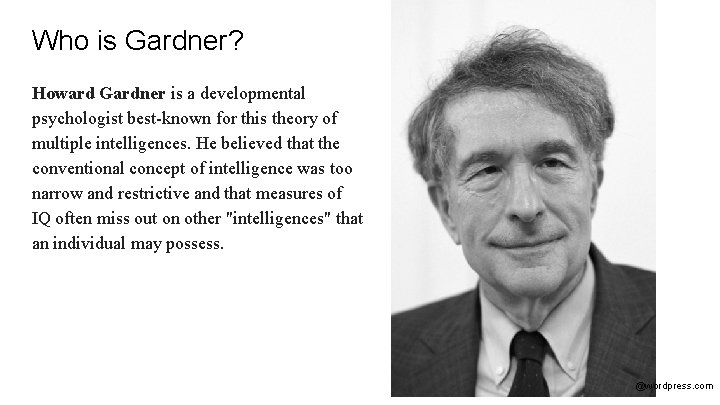
Who is Gardner? Howard Gardner is a developmental psychologist best-known for this theory of multiple intelligences. He believed that the conventional concept of intelligence was too narrow and restrictive and that measures of IQ often miss out on other "intelligences" that an individual may possess. @wordpress. com
Howard Gardner first published his MI theory in 1983, suggesting that intelligence is not a single, static IQ number, but rather a dynamic collection of skills and talents that are manifested differently in different people (Gardner, 1983).
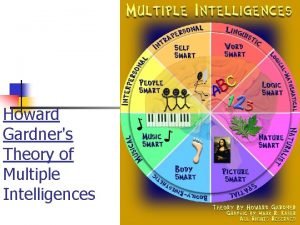
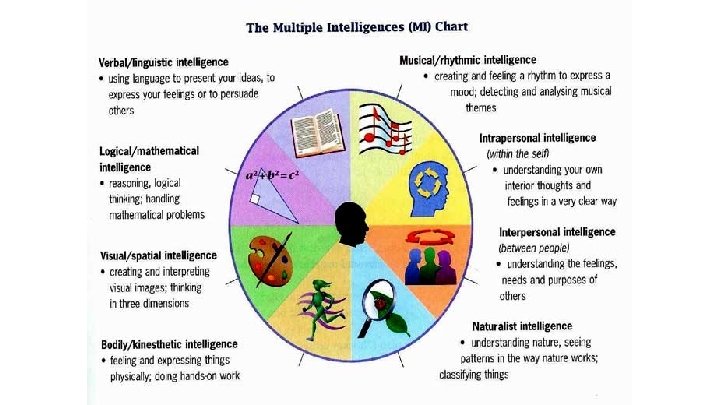
Howard Gardner initially formulated a list of seven intelligences. His listing was provisional. The first two have been typically valued in schools; the next three are usually associated with the arts; and the final two are what Howard Gardner called ‘personal intelligences’ (Gardner 1999: 41 -43).
https: //youtu. be/s 2 Edujr. M 0 v. A
What MI am I? http: //multipleintelligencesoasis. org/what-mi-am-i/
How is theory important to education? The appeal of multiple intelligences to educators- differentiation Howard Gardner’s theory of multiple intelligences has not been readily accepted within academic psychology. However, it has met with a strongly positive response from many educators. It has been embraced by a range of educational theorists and, significantly, applied by teachers and policymakers to the problems of schooling. A number of schools in North America have looked to structure curricula according to the intelligences, and to design classrooms and even whole schools to reflect the understandings that Howard Gardner develops. The theory can also be found in use within pre-school, higher, vocational and adult education initiatives.
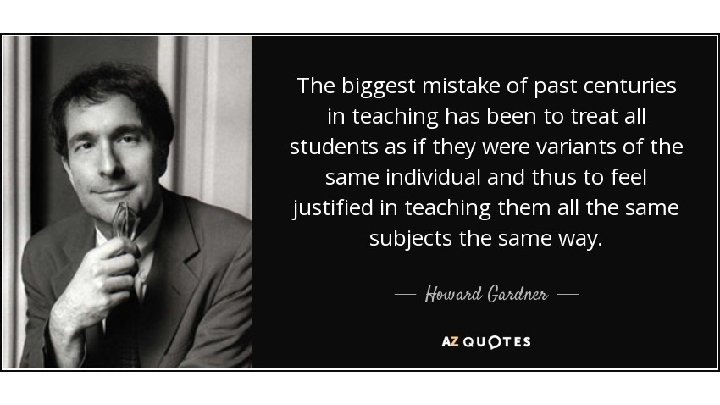
There also two chief educational implications of the Theory of Multiple Intelligences: 1) Individuation (also termed personalization) – Since each human being has her own unique configuration of intelligences, we should take that into account when teaching, mentoring or nurturing. As much as possible, we should teach individuals in ways that they can learn. And we should assess them in a way that allows them to show what they have understood and to apply their knowledge and skills in unfamiliar contexts. 2) Pluralization – Ideas, concepts, theories, skills should be taught in several different ways. Whether one is teaching the arts, sciences, history, or math, the seminal ideas should be presented in multiple ways. If you can present the art works of Michelangelo, or the laws of supply and demand, or the Pythagorean Theorem in several ways, you achieve two important goals. First of all, you reach more students, because some students learn best from reading, some from building something, some from acting out a story, etc. Second, you show what it is like to be an expert—to understand something fully, you should be able to think of it in several ways.
Multiple Intelligences in Action http: //multipleintelligencesoasis. org/good-practices-2/
Sources: www. ttacnews. vcu. edu www. multipleintelligencesoasis. org www. infed. org www. makey. com