Fundaments of Game Design Ch 1 Richard Gesick


- Slides: 11
Fundaments of Game Design Ch 1 Richard Gesick
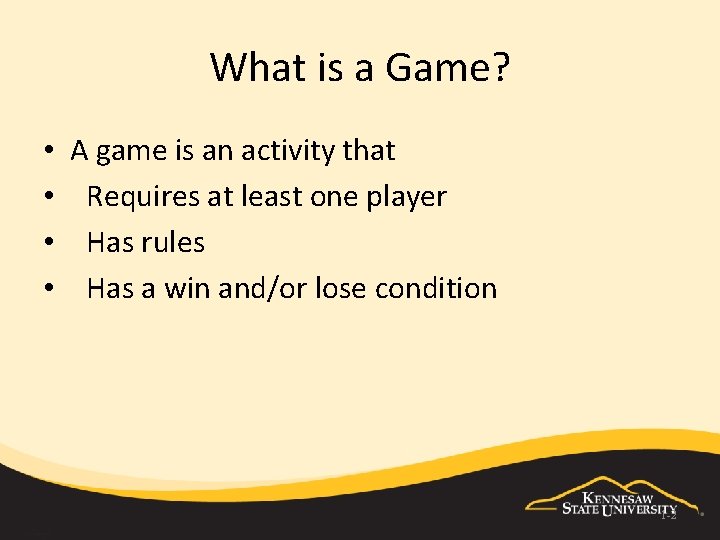
What is a Game? • • A game is an activity that Requires at least one player Has rules Has a win and/or lose condition 1 -2
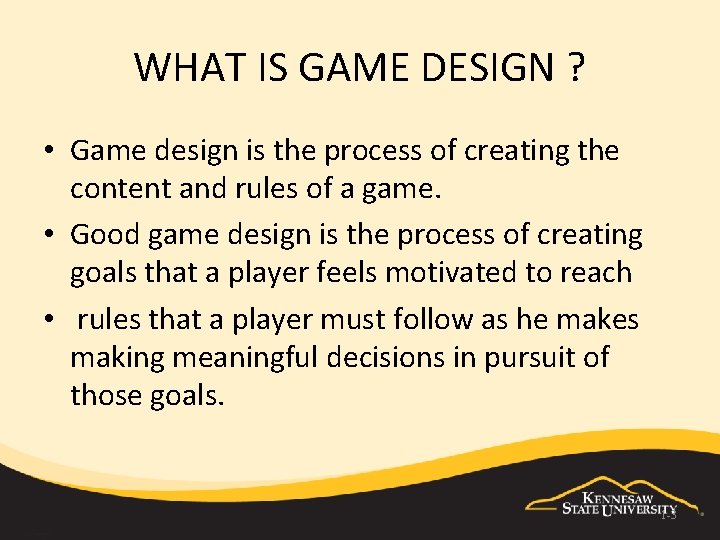
WHAT IS GAME DESIGN ? • Game design is the process of creating the content and rules of a game. • Good game design is the process of creating goals that a player feels motivated to reach • rules that a player must follow as he makes making meaningful decisions in pursuit of those goals. 1 -3
What makes a game “good” • Good game design is player-centric • Player’s desires are truly considered • game design is about creating opportunities for players to make meaningful decisions that affect the outcome of the game. 1 -4
The “core” or “core dynamic” of a game • the single thing gameplay is about • A core is usually tied to a specific “core mechanic” 1 -5
Some core dynamics • • • Territorial Acquisition Spatial Reasoning Destruction Collection Chasing or Evading Prediction Survival Building Trading Race to the End 1 -6
learning game design • Learning by doing • order to design, you must practice design, and you must play what you practice. 1 -7
Approaches to design Blue sky Slow boil Mechanic MDA (mechanics-dynamics-aesthetics) aesthetics doesn’t refer to looks but emotional responses • IP (of others) • Story • Research • • 1 -8
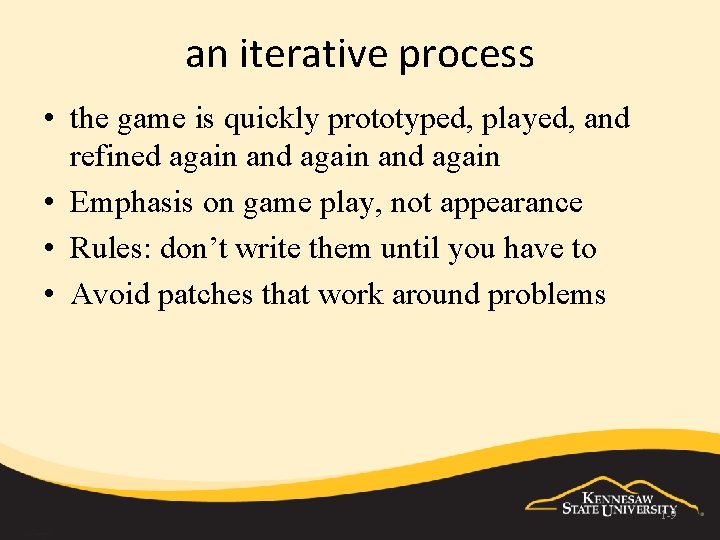
an iterative process • the game is quickly prototyped, played, and refined again and again • Emphasis on game play, not appearance • Rules: don’t write them until you have to • Avoid patches that work around problems 1 -9
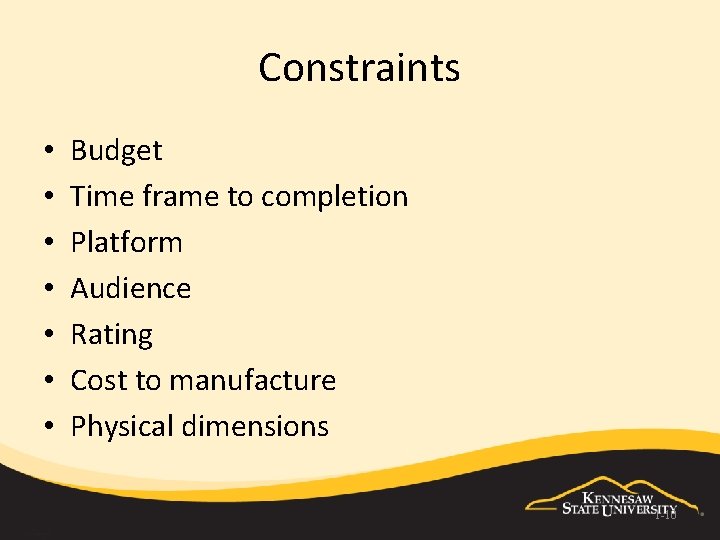
Constraints • • Budget Time frame to completion Platform Audience Rating Cost to manufacture Physical dimensions 1 -10
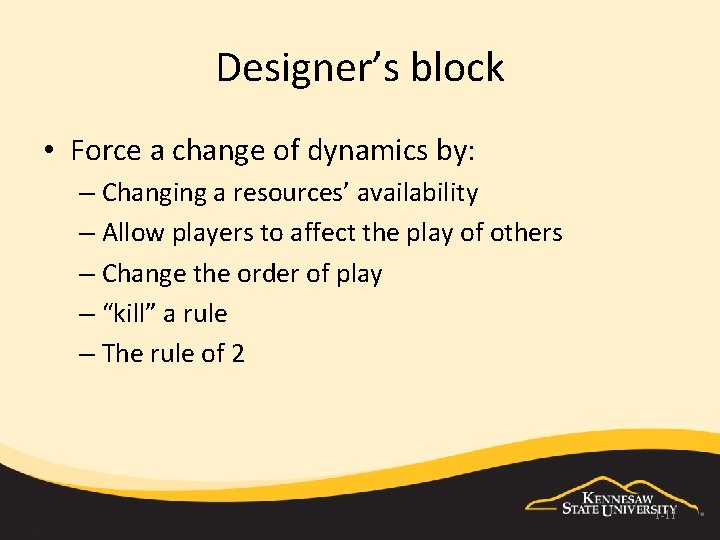
Designer’s block • Force a change of dynamics by: – Changing a resources’ availability – Allow players to affect the play of others – Change the order of play – “kill” a rule – The rule of 2 1 -11