Francesco Di Renzo Playing around with different vacua
- Slides: 17
Francesco Di Renzo Playing around with different vacua a heretical (perturbative) way to FT Lattice QCD F. Di Renzo Università di Parma and INFN, Parma, Italy x. QCD 07 Frascati - August 6, 2007
Francesco Di Renzo Playing around with different vacua A disclaimer … Despite the fact that I have been working (also) in Finite Temperature for some time, I still regard myself as an ousider in the field. Much of what I know comes from collaborations with experts in the field (M. Laine. Y. Schroeder, M. P. Lombardo, M. D’Elia) … … in what follows errors and naiveness are of my own … My own expertise has been for quite a long time in a (non diagrammatic) way of doing Lattice Perturbation Theory. While LPT has never been regarded as such a useful tool in FT Lattice QCD (even harder than at T=0!), I will try to elaborate on a proposal aiming at gaining some information from it. No results will be given. This is really the discussion of a proposal. x. QCD 07 Frascati - August 6, 2007
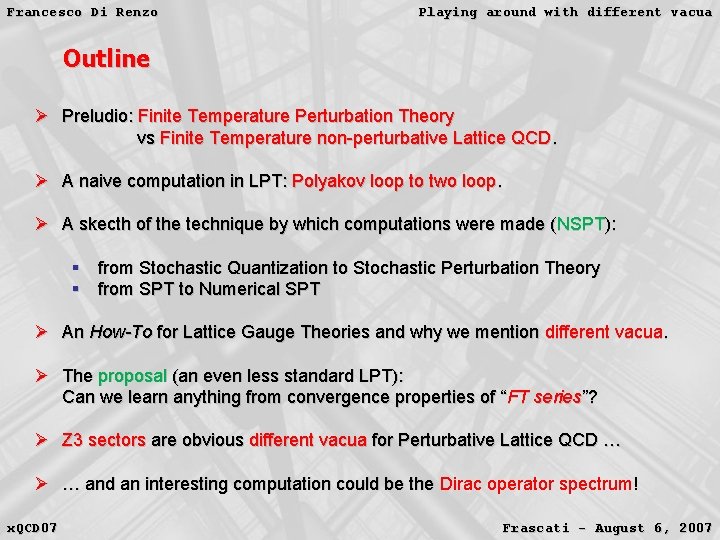
Francesco Di Renzo Playing around with different vacua Outline Ø Preludio: Finite Temperature Perturbation Theory vs Finite Temperature non-perturbative Lattice QCD. Ø A naive computation in LPT: Polyakov loop to two loop. Ø A skecth of the technique by which computations were made (NSPT): § from Stochastic Quantization to Stochastic Perturbation Theory § from SPT to Numerical SPT Ø An How-To for Lattice Gauge Theories and why we mention different vacua. Ø The proposal (an even less standard LPT): Can we learn anything from convergence properties of “FT series”? Ø Z 3 sectors are obvious different vacua for Perturbative Lattice QCD … Ø … and an interesting computation could be the Dirac operator spectrum! x. QCD 07 Frascati - August 6, 2007
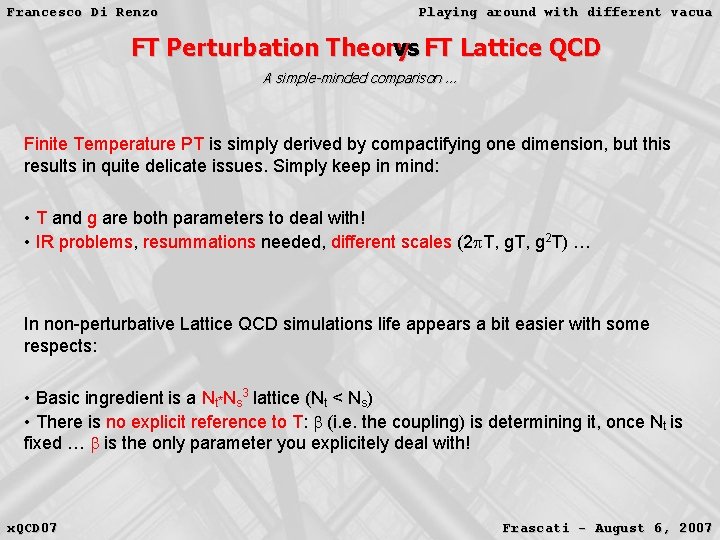
Francesco Di Renzo Playing around with different vacua FT Perturbation Theory vs FT Lattice QCD A simple-minded comparison … Finite Temperature PT is simply derived by compactifying one dimension, but this results in quite delicate issues. Simply keep in mind: • T and g are both parameters to deal with! • IR problems, resummations needed, different scales (2 p. T, g 2 T) … In non-perturbative Lattice QCD simulations life appears a bit easier with some respects: • Basic ingredient is a Nt*Ns 3 lattice (Nt < Ns) • There is no explicit reference to T: b (i. e. the coupling) is determining it, once Nt is fixed … b is the only parameter you explicitely deal with! x. QCD 07 Frascati - August 6, 2007
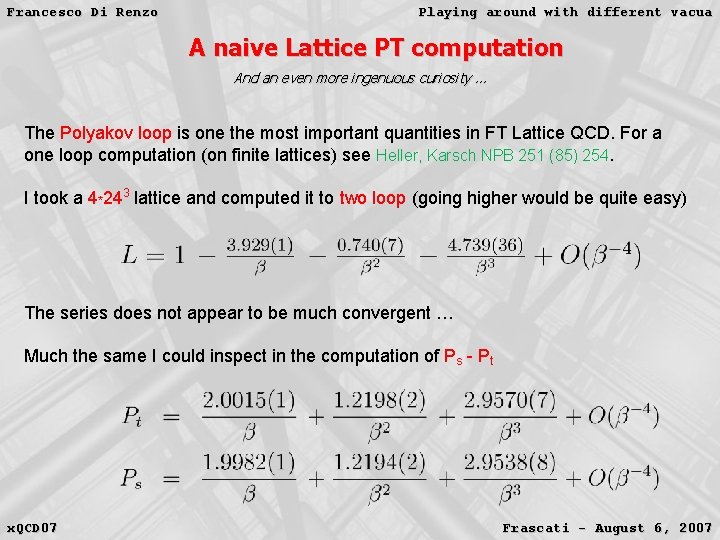
Francesco Di Renzo Playing around with different vacua A naive Lattice PT computation And an even more ingenuous curiosity … The Polyakov loop is one the most important quantities in FT Lattice QCD. For a one loop computation (on finite lattices) see Heller, Karsch NPB 251 (85) 254. I took a 4*243 lattice and computed it to two loop (going higher would be quite easy) The series does not appear to be much convergent … Much the same I could inspect in the computation of Ps - Pt x. QCD 07 Frascati - August 6, 2007
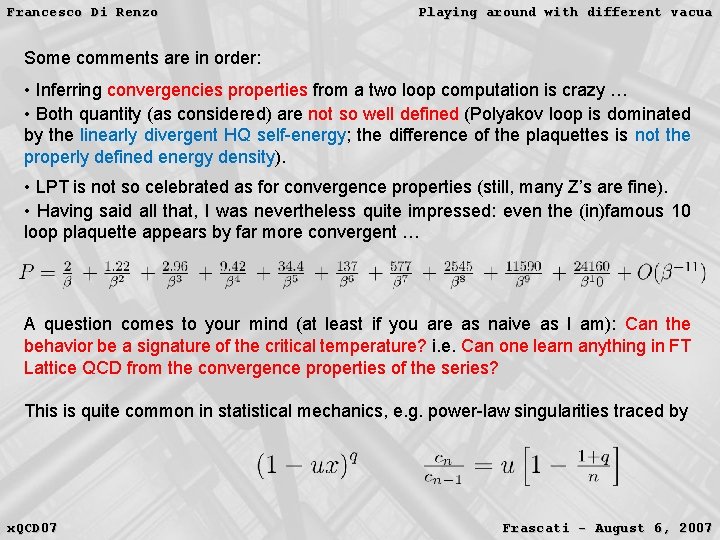
Francesco Di Renzo Playing around with different vacua Some comments are in order: • Inferring convergencies properties from a two loop computation is crazy … • Both quantity (as considered) are not so well defined (Polyakov loop is dominated by the linearly divergent HQ self-energy; the difference of the plaquettes is not the properly defined energy density). • LPT is not so celebrated as for convergence properties (still, many Z’s are fine). • Having said all that, I was nevertheless quite impressed: even the (in)famous 10 loop plaquette appears by far more convergent … A question comes to your mind (at least if you are as naive as I am): Can the behavior be a signature of the critical temperature? i. e. Can one learn anything in FT Lattice QCD from the convergence properties of the series? This is quite common in statistical mechanics, e. g. power-law singularities traced by x. QCD 07 Frascati - August 6, 2007
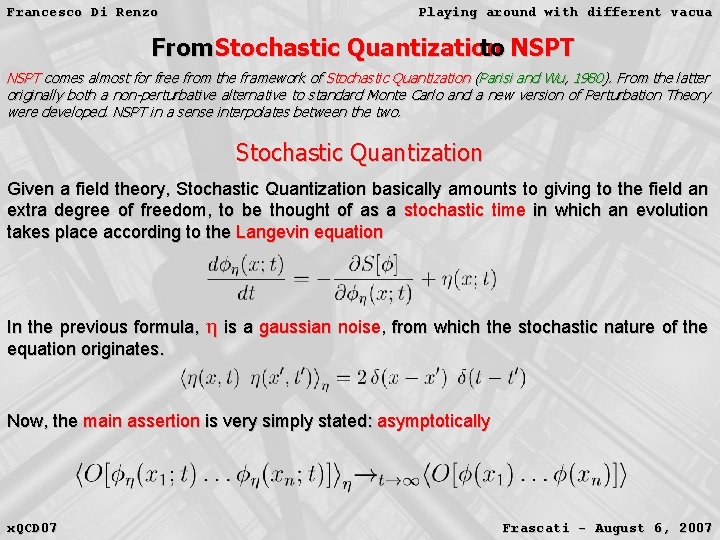
Francesco Di Renzo Playing around with different vacua From Stochastic Quantization to NSPT comes almost for free from the framework of Stochastic Quantization (Parisi and Wu, 1980). From the latter originally both a non-perturbative alternative to standard Monte Carlo and a new version of Perturbation Theory were developed. NSPT in a sense interpolates between the two. Stochastic Quantization Given a field theory, Stochastic Quantization basically amounts to giving to the field an extra degree of freedom, to be thought of as a stochastic time in which an evolution takes place according to the Langevin equation In the previous formula, h is a gaussian noise, from which the stochastic nature of the equation originates. Now, the main assertion is very simply stated: asymptotically x. QCD 07 Frascati - August 6, 2007
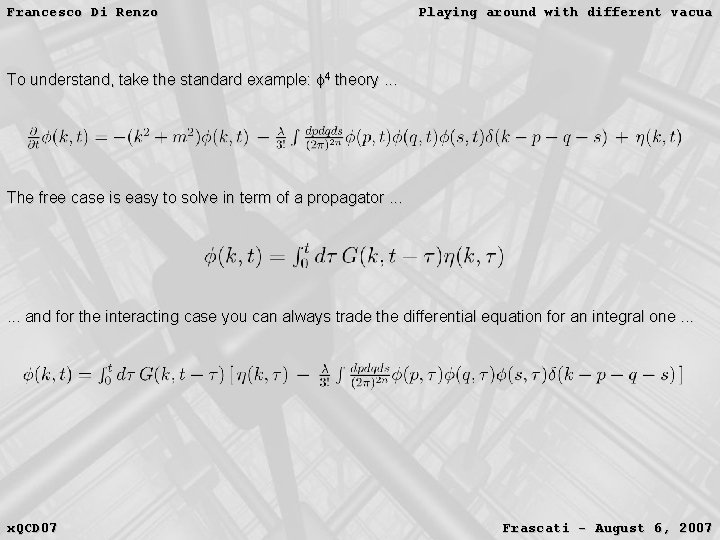
Francesco Di Renzo Playing around with different vacua To understand, take the standard example: f 4 theory. . . The free case is easy to solve in term of a propagator. . . and for the interacting case you can always trade the differential equation for an integral one. . . x. QCD 07 Frascati - August 6, 2007
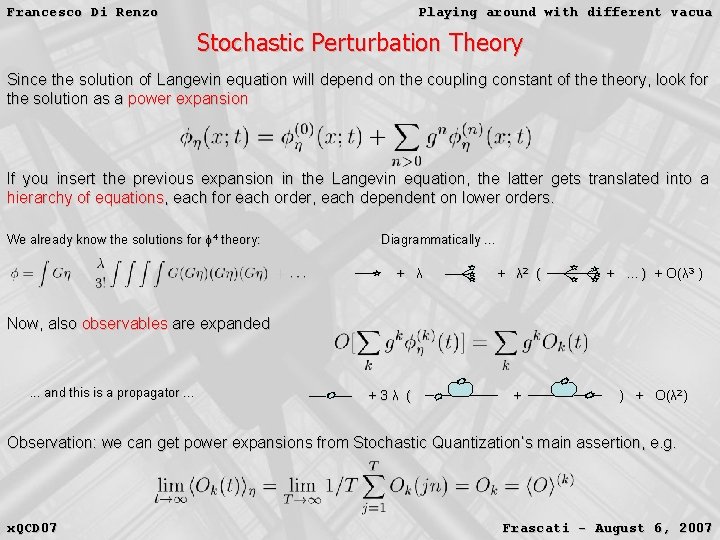
Francesco Di Renzo Playing around with different vacua Stochastic Perturbation Theory Since the solution of Langevin equation will depend on the coupling constant of theory, look for the solution as a power expansion If you insert the previous expansion in the Langevin equation, the latter gets translated into a hierarchy of equations, each for each order, each dependent on lower orders. We already know the solutions for f 4 theory: Diagrammatically. . . + λ 2 ( +. . . ) + O(λ 3 ) + O(λ 2) Now, also observables are expanded . . . and this is a propagator. . . +3λ ( Observation: we can get power expansions from Stochastic Quantization’s main assertion, e. g. x. QCD 07 Frascati - August 6, 2007
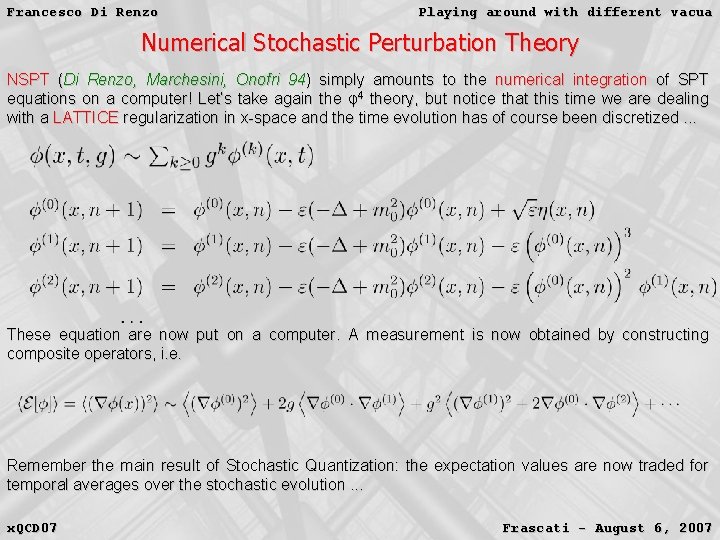
Francesco Di Renzo Playing around with different vacua Numerical Stochastic Perturbation Theory NSPT (Di Renzo, Marchesini, Onofri 94) simply amounts to the numerical integration of SPT equations on a computer! Let’s take again the φ4 theory, but notice that this time we are dealing with a LATTICE regularization in x-space and the time evolution has of course been discretized. . . These equation are now put on a computer. A measurement is now obtained by constructing composite operators, i. e. Remember the main result of Stochastic Quantization: the expectation values are now traded for temporal averages over the stochastic evolution. . . x. QCD 07 Frascati - August 6, 2007
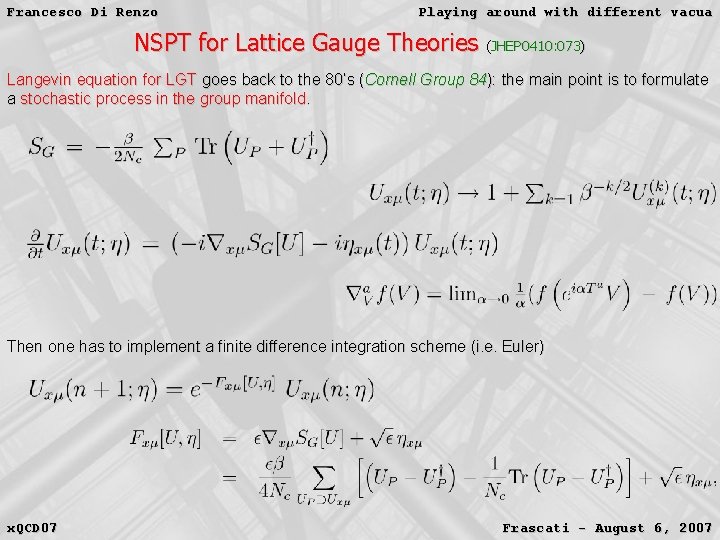
Francesco Di Renzo Playing around with different vacua NSPT for Lattice Gauge Theories (JHEP 0410: 073) Langevin equation for LGT goes back to the 80’s (Cornell Group 84): the main point is to formulate a stochastic process in the group manifold. Then one has to implement a finite difference integration scheme (i. e. Euler) x. QCD 07 Frascati - August 6, 2007
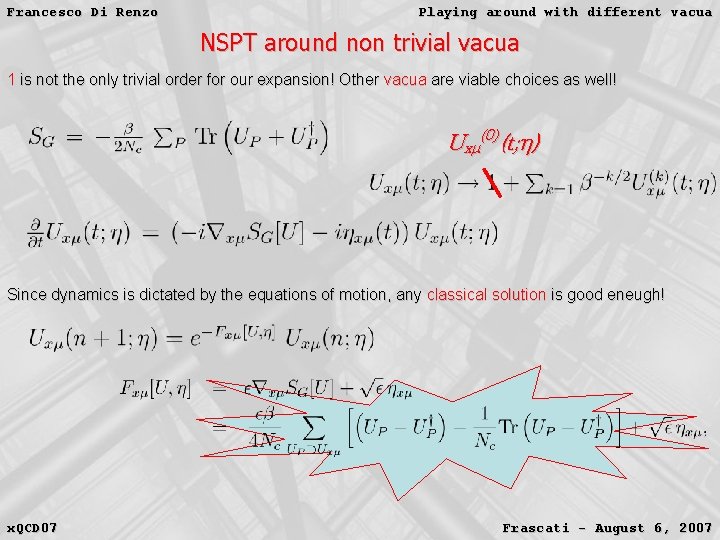
Francesco Di Renzo Playing around with different vacua NSPT around non trivial vacua 1 is not the only trivial order for our expansion! Other vacua are viable choices as well! Uxm(0)(t; h) Since dynamics is dictated by the equations of motion, any classical solution is good eneugh! x. QCD 07 Frascati - August 6, 2007
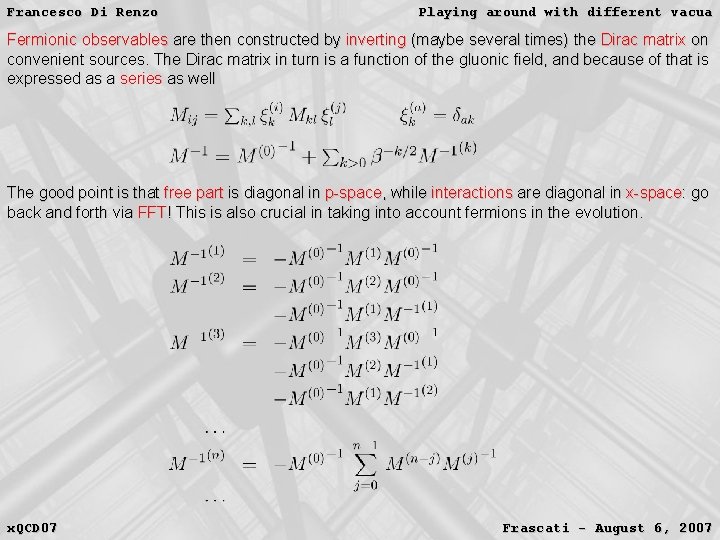
Francesco Di Renzo Playing around with different vacua Fermionic observables are then constructed by inverting (maybe several times) the Dirac matrix on convenient sources. The Dirac matrix in turn is a function of the gluonic field, and because of that is expressed as a series as well The good point is that free part is diagonal in p-space, while interactions are diagonal in x-space: go back and forth via FFT! This is also crucial in taking into account fermions in the evolution. x. QCD 07 Frascati - August 6, 2007
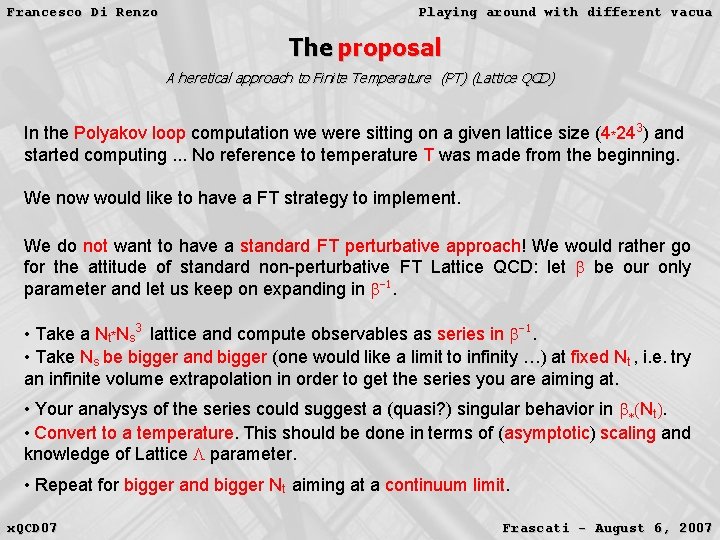
Francesco Di Renzo Playing around with different vacua The proposal A heretical approach to Finite Temperature (PT) (Lattice QCD) In the Polyakov loop computation we were sitting on a given lattice size (4*243) and started computing. . . No reference to temperature T was made from the beginning. We now would like to have a FT strategy to implement. We do not want to have a standard FT perturbative approach! We would rather go for the attitude of standard non-perturbative FT Lattice QCD: let b be our only parameter and let us keep on expanding in b-1. • Take a Nt*Ns 3 lattice and compute observables as series in b-1. • Take Ns be bigger and bigger (one would like a limit to infinity …) at fixed Nt , i. e. try an infinite volume extrapolation in order to get the series you are aiming at. • Your analysys of the series could suggest a (quasi? ) singular behavior in b*(Nt). • Convert to a temperature. This should be done in terms of (asymptotic) scaling and knowledge of Lattice L parameter. • Repeat for bigger and bigger Nt aiming at a continuum limit. x. QCD 07 Frascati - August 6, 2007
Francesco Di Renzo Playing around with different vacua Once again, some comments are in order. One could ask: ”So, what? This really looks like what one does in the non-perturbative framework …” Well … ü Convergencies properties can be quite precise in describing singular points. ü One does not need to scan a region in b and could save resources to pin down a better continuum limit. ü It could be that subtleties of standard FT Perturbation Theory are avoided: only the coupling in place (this required to commit to a finite number of points. . . ) ü One needs to revert to (asymptotic) scaling to translate to a physical temperature (but remember that the L parameter is by now quite well known). ü Fermions are easily treated in NSPT. … ü The idea of different vacua is quite intriguing in this framework: Different Z 3 sectors are natural candidate to investigate. x. QCD 07 Frascati - August 6, 2007
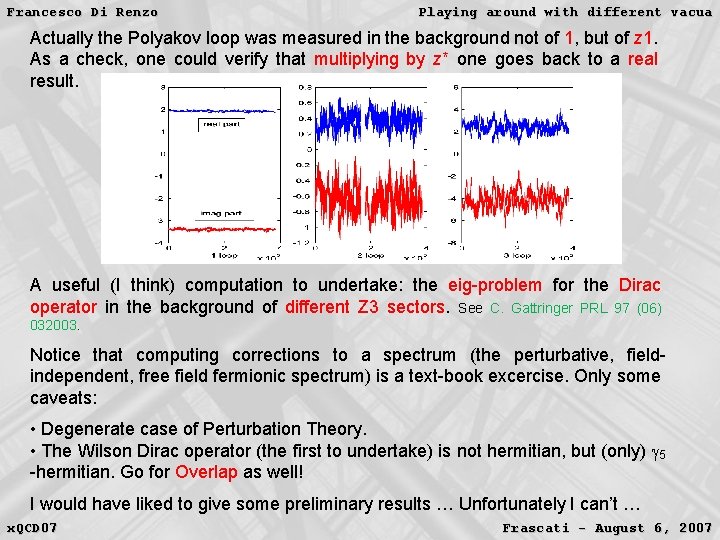
Francesco Di Renzo Playing around with different vacua Actually the Polyakov loop was measured in the background not of 1, but of z 1. As a check, one could verify that multiplying by z* one goes back to a real result. A useful (I think) computation to undertake: the eig-problem for the Dirac operator in the background of different Z 3 sectors. See C. Gattringer PRL 97 (06) 032003. Notice that computing corrections to a spectrum (the perturbative, fieldindependent, free field fermionic spectrum) is a text-book excercise. Only some caveats: • Degenerate case of Perturbation Theory. • The Wilson Dirac operator (the first to undertake) is not hermitian, but (only) g 5 -hermitian. Go for Overlap as well! I would have liked to give some preliminary results … Unfortunately I can’t … x. QCD 07 Frascati - August 6, 2007
Francesco Di Renzo Playing around with different vacua Conclusions • I only discussed some idea that are at the moment a proposal. • The NSPT Dirac operator spectrum computation will be undertaken for sure. • These were only ideas, so that I suspect a possible comment could be: “Where’s the beef? ” Ok, you can’t eat, but maybe I was able to let you smell it! x. QCD 07 Frascati - August 6, 2007