FOREX MANAGEMENT What is foreign exchange An expression
- Slides: 36
FOREX MANAGEMENT
What is foreign exchange? - An expression to denote foreign currency - Also covers the method by which a currency of one country is exchanged for that of another.
Characteristics of foreign exchange market
1. ‘An Over The Counter market’ - No physical presence in the same sense as a stock exchange or commodity market - The participants deal among themselves and settle their transactions directly - There is no exchange or clearing house
2. Only market open 24 hours - FX Market is a 24 hour market - It starts when a calendar business day opens in Sydney, Tokyo, Hong Kong, Singapore and then moves to Middle East to Europe to New York to the West Coast of United States where the calendar business comes to a close - FX Market operates seven days a week (Middle East Markets function on Saturdays and Sundays) - Effectively it is a 24 hour a day / seven days a week / 365 days a year Market!
3. No single location – no barriers - FX market is not located in a single building - No specific market place exists - FX market has few restrictions in this modern world - FX market is global in nature / character - While the market does not exist at each and every center in the world, it is accessible from any part of the world
4. Exchange rates fluctuate every four second
5. Settlement of transactions normally does not take place simultaneously
6. Highly liquid market
7. Money / capital / debt markets also impact FX market
Foreign exchange rates Exchange rate is the rate at which one currency is exchanged for another currency. That is, the number of units of one currency which exchange for given number of units of another currency is the rate of exchange Therefore an exchange rate is a simple arithmetical statement which gives value of one currency in terms of another currency
Types of exchange rates
1. Fixed and Floating exchange rates Fixed exchange rate is the official rate set by the monetary authorities for one or more currencies. Under floating exchange rate, the value of the currency is decided by supply and demand factors
2. Direct and indirect exchange rates Direct method - Under this, a given number of units of local currency per unit of foreign currency is quoted. They are designated as direct/certain rates because the rupee cost of single foreign currency unit can be obtained directly. Direct quotation is also called home currency quotation. Indirect method – Under this, a given number of units of foreign currency per unit of local currency is quoted. Indirect quotation is also called foreign currency quotation
3. Buying and selling Exchange rates are quoted as two way quotes – for purchase and sale transactions
4. Spot and forward The delivery under a foreign exchange transaction can be settled in one of the following ways Ready or cash – To be settled on the same day Tom – To be settled on the day next to the date of transaction Spot – To be settled on the second working day from the date of contract Forward – To be settled at a date farther than the spot date
5. Working of forward rates Spot prices of the currencies involved Interest rate differential for the currencies Future period for which the price is worked
Factors influencing exchange rates Short term factors - commercial - financial Long term factors - currency and economic conditions - political and industrial conditions
Risks in foreign exchange market A risk is an unplanned event with financial consequences resulting in loss or reduced earnings. When we analyse risks in foreign exchange market, we should start with international trade as with out international trade no foreign exchange can be generated.
International trade characteristics Buyer and seller in different countries Goods and value of goods move in opposite direction Currencies of buyer and the seller have their own values which undergo change
International trade risks
Buyer risk - Non-acceptance risk - Non-payment risk - Quality claim risk - Credit risk
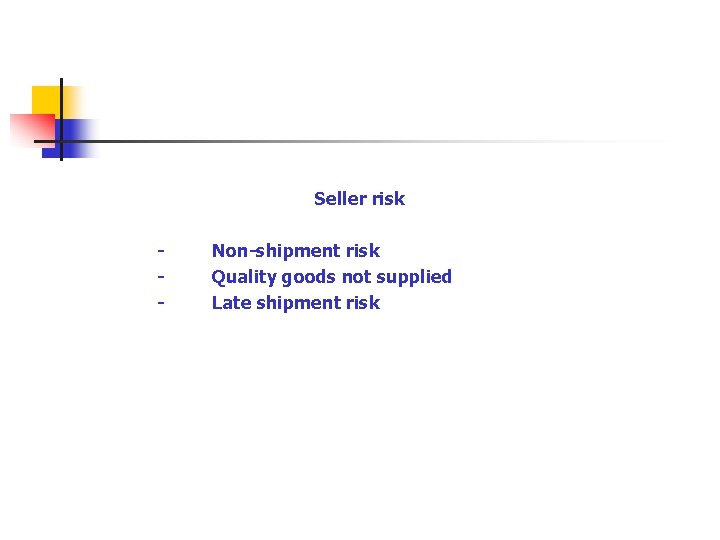
Seller risk - Non-shipment risk - Quality goods not supplied - Late shipment risk
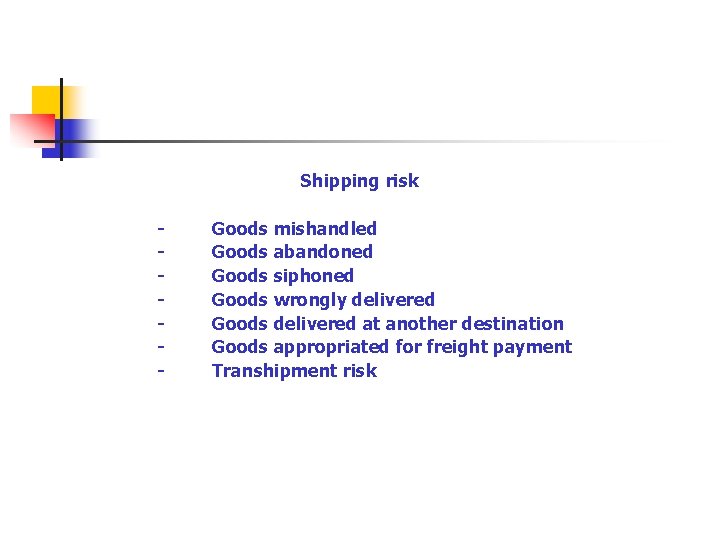
Shipping risk - Goods mishandled - Goods abandoned - Goods siphoned - Goods wrongly delivered - Goods delivered at another destination - Goods appropriated for freight payment - Transhipment risk
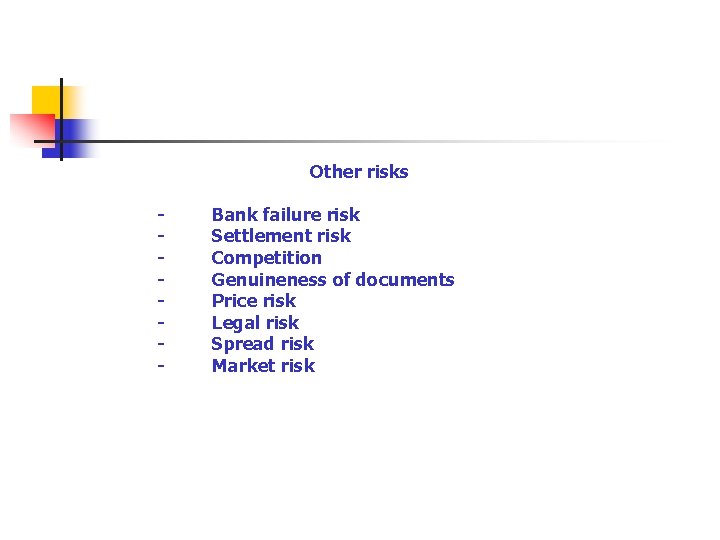
Other risks - Bank failure risk - Settlement risk - Competition - Genuineness of documents - Price risk - Legal risk - Spread risk - Market risk
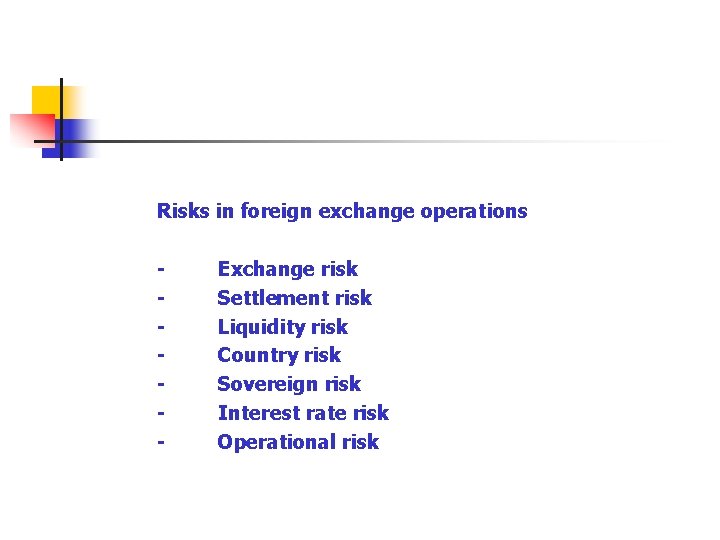
Risks in foreign exchange operations - Exchange risk - Settlement risk - Liquidity risk - Country risk - Sovereign risk - Interest rate risk - Operational risk
Management of exchange risk - Identify all areas of risk - Evaluate these risks - Set various exposure limits - Issue clear policy guidelines / directives
Derivative products Derivative instruments are derived from the values of the underlying exposures such as commodities, currencies or shares and bonds which when added to the exposures will neutralize or alter to acceptable levels, the uncertainty profile of the exposures. They are also expressed as hedging instruments
Forward contracts Simplest of all the derivative products. Forward contract is a mechanism through which the rate is fixed in advance for purchase or sale of foreign currency at a future date. In such an arrangement, the risk of loss, which might accrue on account of adverse movement in the rate of exchange, is sought to be removed
Options One essential feature of a forward contract is that once one has locked into a rate in a forward contract, he cannot benefit from the movement of the market in his favour. Options are unique financial instruments in that they enable the option holder (or buyer of option) to maximize his profits at the same time limiting his losses. This is possible as options confer upon the holder the right (to buy or sell) without the obligation (to buy or sell)
Swaps A swap means an exchange of specific streams of payments over an agreed period of time between two parties, referred to as counter parties. The essence of a swap contract is the binding of two counter parties to exchange two different payment streams over time, the payment being tied at least in part to subsequent and uncertain market price developments. In most cases the prices concerned have been exchange rates and / or interest rates
Futures are specialized contracts to buy or sell a standard quantity of an item at a specified future date and at a fixed price that is agreed when the contract is made. Futures are traded on futures exchange. The above definition applies to any futures contract – commodity futures or financial futures. The main difference is that for many financial futures contracts instead of physical delivery there is only a cash settlement on the delivery date
Foreign exchange management in India It is a three tier set up in India the participants being – the individuals / corporates (who have or need foreign exchange), the authorized dealer banks and the FEDAI / RBI at the apex level.
Guidelines relating to foreign exchange management All foreign exchange transactions are to be routed through Authorised Dealers for whom guidelines are issued by RBI under the provisions of Foreign Exchange Management Act
Websites / literature / books Websites – http: //www. rbi. org. in Literature – Daily news papers particularly financial papers carrying the foreign exchange market movements and updates Books – Any standard book in the market (One can also refer to Introduction to Foreign Trade, Foreign Exchange and Risk Management published by Indian Institute of Bankers and co-authored by this presenter)
Thank You