Fiscal Federalism Resource Control and Poverty Alleviation in
- Slides: 15
Fiscal Federalism, Resource Control and Poverty Alleviation in Nigeria By Dr. Sylvester Ohiomu Department of Accounting & Economics Edo University, Iyamho, Edo State Email: ohmsylve@yahoo. com 1
Introduction o This study analyzes fiscal federalism, resource control and poverty alleviation in Nigeria to synthesize the extent to which revenue allocation formula in conjunction with agitations for resource control has affected the path of economic growth and sustainable national development in relation to poverty alleviation. o In recent years, the issues of fiscal federalism, resource control, and poverty alleviation have dominated discussions at various levels of Nigeria’s political debate. o Federalism refers the existence in one country of more than one level of government, each with different expenditure responsibilities and taxing powers. 2
Introduction Cont’d o The Federal Government, 36 State-Governments and the 774 Local Governments have a percentage of the revenue allocated from the federation account which is distributed in the following proportions: 48. 50 percent to the Federal Government, 26. 72 percent to States, 20. 60 percent to the Local Government councils, and 4. 18 percent to centrally control special funds on the basis of the following indices and percentage weights: equal shares to each state or locality at 40 percent; population at 30 percent; social development needs at 10 percent; land mass and terrain at 10 percent and internal revenue generation at 10 percent (Suberu, 1994) o Normally each tier of Government should be given adequate resources to be able to discharge its constitutional responsibilities, which is very important for the preservation of the autonomy of the constituent units. 3
Introduction Cont’d o The concept of fiscal federalism is relevant for all kinds of government: unitary, federal and nonfederal. The existence of imbalance between functions and resource base makes it expedient for the higher level of government to transfer revenue to the lower level. o Resource control is the agitation for ownership and management of endowed resources. It largely deals with the need to regain ownership, control, use and management of resources primarily for the benefit of the communities and the people on whose land the resources originate and secondarily for the good governance and development of the entire country. o Poverty reduction, or poverty alleviation, is a set of measures, both economic and humanitarian, that are intended to permanently lift people out of poverty. 4
Conceptual Review o Principles of Fiscal Federalism The concept of fiscal federalism was first introduced in Nigeria in 1946 following the formation of a federation of three regions (Northern, Eastern and western regions) following the adoption of the Richards Constitution o The Nigerian federal system metamorphosed thereafter from a twotiered federal arrangement initially comprising three unequal political and administrative regions to the current three tiered federal system of 36 states, one Federal Capital Territory and 774 Local Governments (Ijaiya, 1999). o Nigeria is a federal system of government which achieves her macroeconomic objectives by performing the functions of resource allocation, income distribution/redistribution, and economic stabilization within the central government and its units (states and local governments). This is a system characterized by Fiscal Federalism. 5
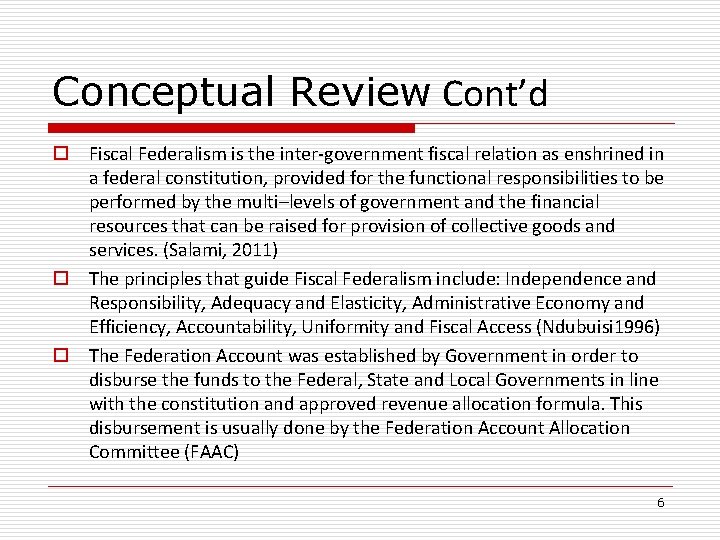
Conceptual Review Cont’d o Fiscal Federalism is the inter-government fiscal relation as enshrined in a federal constitution, provided for the functional responsibilities to be performed by the multi–levels of government and the financial resources that can be raised for provision of collective goods and services. (Salami, 2011) o The principles that guide Fiscal Federalism include: Independence and Responsibility, Adequacy and Elasticity, Administrative Economy and Efficiency, Accountability, Uniformity and Fiscal Access (Ndubuisi 1996) o The Federation Account was established by Government in order to disburse the funds to the Federal, State and Local Governments in line with the constitution and approved revenue allocation formula. This disbursement is usually done by the Federation Account Allocation Committee (FAAC) 6
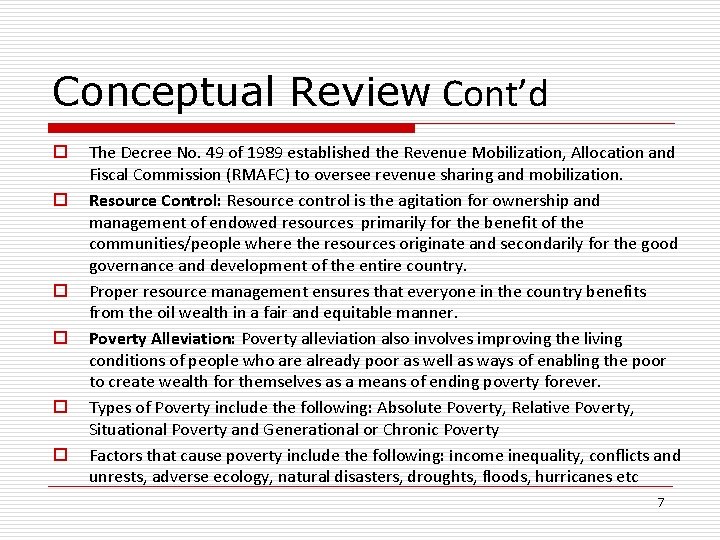
Conceptual Review Cont’d o o o The Decree No. 49 of 1989 established the Revenue Mobilization, Allocation and Fiscal Commission (RMAFC) to oversee revenue sharing and mobilization. Resource Control: Resource control is the agitation for ownership and management of endowed resources primarily for the benefit of the communities/people where the resources originate and secondarily for the good governance and development of the entire country. Proper resource management ensures that everyone in the country benefits from the oil wealth in a fair and equitable manner. Poverty Alleviation: Poverty alleviation also involves improving the living conditions of people who are already poor as well as ways of enabling the poor to create wealth for themselves as a means of ending poverty forever. Types of Poverty include the following: Absolute Poverty, Relative Poverty, Situational Poverty and Generational or Chronic Poverty Factors that cause poverty include the following: income inequality, conflicts and unrests, adverse ecology, natural disasters, droughts, floods, hurricanes etc 7
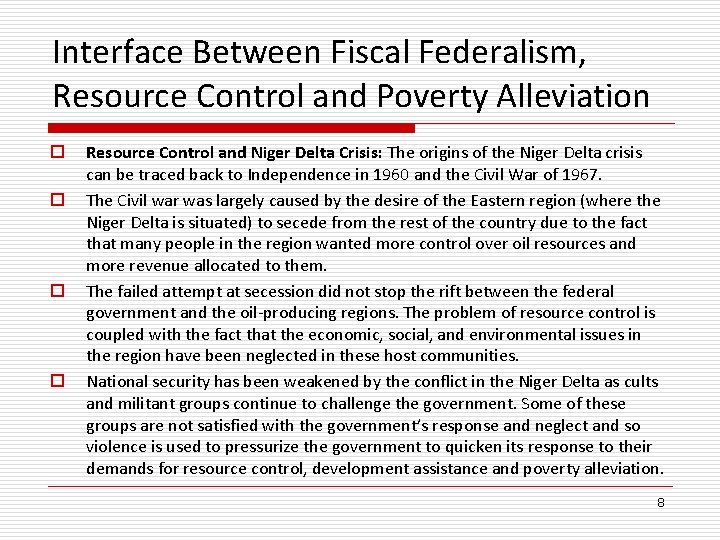
Interface Between Fiscal Federalism, Resource Control and Poverty Alleviation o o Resource Control and Niger Delta Crisis: The origins of the Niger Delta crisis can be traced back to Independence in 1960 and the Civil War of 1967. The Civil war was largely caused by the desire of the Eastern region (where the Niger Delta is situated) to secede from the rest of the country due to the fact that many people in the region wanted more control over oil resources and more revenue allocated to them. The failed attempt at secession did not stop the rift between the federal government and the oil-producing regions. The problem of resource control is coupled with the fact that the economic, social, and environmental issues in the region have been neglected in these host communities. National security has been weakened by the conflict in the Niger Delta as cults and militant groups continue to challenge the government. Some of these groups are not satisfied with the government’s response and neglect and so violence is used to pressurize the government to quicken its response to their demands for resource control, development assistance and poverty alleviation. 8
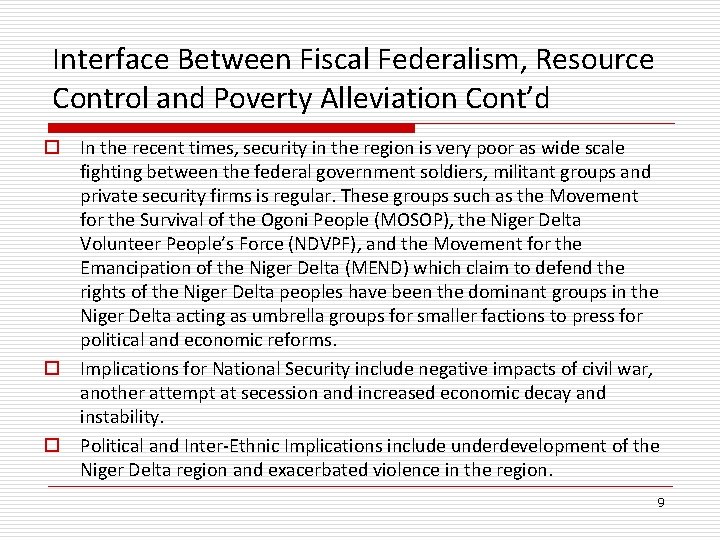
Interface Between Fiscal Federalism, Resource Control and Poverty Alleviation Cont’d o In the recent times, security in the region is very poor as wide scale fighting between the federal government soldiers, militant groups and private security firms is regular. These groups such as the Movement for the Survival of the Ogoni People (MOSOP), the Niger Delta Volunteer People’s Force (NDVPF), and the Movement for the Emancipation of the Niger Delta (MEND) which claim to defend the rights of the Niger Delta peoples have been the dominant groups in the Niger Delta acting as umbrella groups for smaller factions to press for political and economic reforms. o Implications for National Security include negative impacts of civil war, another attempt at secession and increased economic decay and instability. o Political and Inter-Ethnic Implications include underdevelopment of the Niger Delta region and exacerbated violence in the region. 9
Interface Between Fiscal Federalism, Resource Control and Poverty Alleviation Cont’d o Economic Implications include heightened poverty and gross underdevelopment with the absence of electricity, roads, schools and potable water. o Poverty Alleviation Assessment: Dialogue must focus on discovering what the needs of the region are and the best ways to meet these needs. Without unity and cohesion it will be difficult for any progress or development to be made in the region. o Impact of poverty include Hunger, Health challenges and Deaths, Social, economic and Political degradation. People in absolute poverty simply cannot afford food, water and shelter. They are not healthy enough to undertake any economic activity. 10
Strategies for Solution to the Problem of Fiscal Federalism, Resource Control and Poverty Alleviation o Strategies for Fiscal Federalism: The current revenue allocation formula should be reviewed and each tier of government should be allocated revenue according to functions they perform o Transparency, accountability and efficiency on the part of all the levels of government should be enshrined to ensure that revenue allocated to specific projects are utilized appropriately. o Strategies for Resource Control: The Niger Delta Development Commission (NDDC) should be strengthened with the capacity and the finances to function effectively to deal with these developmental demands. o Measures to successfully disarm and reintegrate youth into society is very important and this involves finding alternatives to their livelihood and survival. 11
Summary and Conclusion o Methods used for reducing poverty involves the strategic use of tools such as education, economic development, health and income redistribution to improve the livelihoods of the world’s poorest by governments and internationally approved organizations. o Fiscal Federalism and Revenue allocation in Nigeria both in the pre-independence era and the post-independence era were fraught with controversies. The federal, state and local governments want a sizeable share of the federation account. 12
Recommendations o o The government should focus on optimal revenue allocation targeted at economic growth. These would aid to achieve the goals of poverty alleviation, desired economic expansion and sustained development in the forthcoming years ahead. The Niger Delta Development Commission (NDDC) should be strengthened with the capacity and the finances to function effectively to deal with these developmental demands. Their role which was meant to reverse the developmental crisis and create an environment and capital for sustainable development in the region must be enhanced. The Governments, oil corporations should provide adequate funding as many of these civil society groups do not have enough resources to fund their staff, rent office space and to take care of other needs that might arise. Continuous dialogue with non-governmental organizations should take precedence at the state and federal government levels for Conflict prevention and conflict resolution. 13
Recommendation for Further Research o In view of the fact the agitations for resource control manifests in the form of violence, thereby threatening government revenues and fiscal federalism, it is herby recommended that empirical research be carried out on this subject matter with the scope of finding out how federalism and resource control affect economic growth poverty alleviation in Nigeria. 14
Thank you 15