
FINDING SOLUTIONS TO HUNGER POVERTY AND INEQUALITY MADE
- Slides: 4
FINDING SOLUTIONS TO HUNGER, POVERTY AND INEQUALITY! MADE BY : IMRA RAHIM.
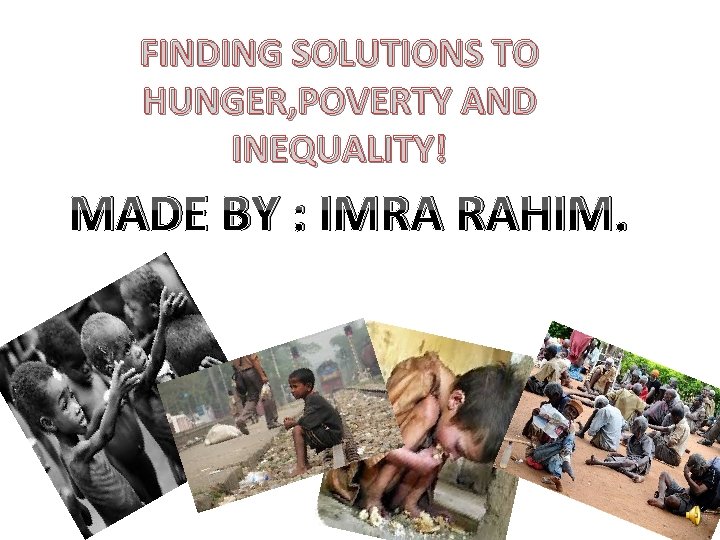
Causes & Solution of Hunger. . The World Food Programme (WFP) reports: “There are 1. 02 billion undernourished people in the world today. That means one in nearly six people do not get enough food to be healthy and lead an active life. Hunger and malnutrition are in fact the number one risk to the health worldwide — greater than AIDS, malaria and tuberculosis combined. Among the key causes of hunger are natural disasters, conflict, poverty, poor agricultural infrastructure and over-exploitation of the environment. Recently, financial and economic crises have pushed more people into hunger. As well as the obvious sort of hunger resulting from an empty stomach, there is also the hidden hunger of micronutrient deficiencies which make people susceptible to infectious diseases, impair physical and mental development, reduce their labour productivity and increase the risk of premature death. Hunger does not only weigh on the individual. It also imposes a crushing economic burden on the developing world. Economists estimate that every child whose physical and mental development is stunted by hunger and malnutrition stands to lose 5 -10 percent in lifetime earnings. Among the Millennium Development Goals which the United Nations has set for the 21 st century, halving the proportion of hunger people in the world is top of the list. Whereas good progress was made in reducing chronic hunger in the 1980 s and the first half of the 1990 s, hunger has been slowly but steadily rising for the past decade. Indeed, despite the noble efforts of the WFP and tens of thousands of individuals, World hunger remains a grave problem. The compelling truth is this: never before in human history has such a large percentage of our species—nearly 20 percent—been malnourished. Each year, between 40 million and 60 million people around the world die from hunger and related diseases. Sadly, the toll is heaviest on the world’s children.
Causes & Solution of Poverty. . Most of our developing country are live in poverty line, Not having access to resources, transportation, education, employment, and child care can make it difficult for them to fully participate in their communities. Before we can address changes for those living in poverty, first, we need to look clearly at what is causing poverty. There are many factors that cause people to live in poverty: lack of income, lack of resources that ensure sustainable lives, limited or lack of access to education and services, a lack of participation in decision-making, and loss of livelihood as a result of economic recession or disaster. There should be a combination of resources, support, empowerment, education, and employment opportunities for individuals living in poverty to enhance their well-being and improve their lives. People living in poverty and vulnerable groups must be empowered through participation in all aspects of their lives. It is essential to expand opportunities to enable those living in poverty in order to enhance their overall capacities and improve their economic and social conditions. We need to change social conditions in order to ensure access for all individuals to resources, opportunities, and public services. People living in poverty should also be empowered by strengthening education at all levels, which would ensure access to education. Providing an education for those living in poverty can aid in their opportunity to develop skills and knowledge that they need to better their conditions and improve their lives. An area that can aid and improve the lives of people living in poverty is ensuring that there is equal access to social services, especially education. For example, equal access to social services programs that enable vulnerable people and those living in poverty will improve their overall quality of life through their full participation in their lives.
Causes & Solution of Inequality. . As international negotiations on a new set of Millennium Development Goals (MDGs) continue, it is worth reflecting on some of the limitations and failures of the MDG framework. Significantly, the program represents the only internationally agreed framework for trying to address some of the most pressing issues facing humanity, and it should be commended and supported on that basis. Despite the many improvements that the eight existing goals have already made to peoples’ lives, however, they are also extremely unambitious and often. Of additional concern is the selective an fail to assist the marginalized groups the target-driven approach they embody which conveniently avoids addressing the root causes of poverty and inequality. The inadequacy of the goals is often illustrated using MDG-1 as an example. From the very start of the MDG negotiation process it was clear that the goal for halving poverty was grossly insufficient given the significant resources and expertise available to governments. The goal also marked a dangerous shift away from the concept of halving the number of people living in poverty as previously agreed by the 186 governments participating at the 1996 World Food Summit. Instead, MDG-1 seeks to halve the proportion of people living in poverty by 2015, which is far less ambitious in light of a world population that is still expanding rapidly, especially in some of the poorest regions. Although reports suggest that the goalhas already been met well ahead of schedule, the actual number of people living in extreme poverty in 2015 will remain unacceptably high at around a billion. Reducing hunger also remains a major challenge, with around 850 million people currently unable to access sufficient quantities of food to meet basic nutritional requirements according to the United Nations (although unofficial estimates are often far greater).