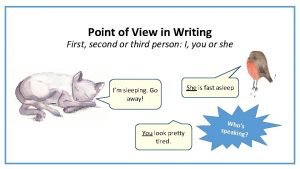
First Person Point of View The point of
- Slides: 22
First Person Point of View: The point of view of writing in which the narrator is part of the story; reader sees and knows only what the character telling the story knows (I, me, my, etc. )
Third-person omniscient P. O. V. : The narrator knows what all characters are thinking, feeling, and doing. The narrator is aware of their intentions. This is the most common form of P. O. V. (he, she, they, etc. )
Third-person limited P. O. V. : The narrator focuses only on one character’s thoughts, feelings, etc. The narrator can only find out about the other characters through talking with them or observing them. (he, she, they, etc. )
Setting: The time and place of action in a story; setting often helps reveal mood.
Characterization: The means by which an author establishes character. An author may directly describe the appearance and personality of character (Direct Characterization) or show it through action or dialogue (Indirect Characterization).
Plot: The action and events in the story.
Conflict: The elements that create a plot. Traditionally, every plot is built from the most basic elements of a conflict and an eventual resolution. The conflict can be Internal (within one character) or External (between characters, with society, and/or nature).
Symbol: The use of one thing to represent another. For example, sunlight as a symbol for hope.
Theme: A universal idea or central message revealed by a work of literature. For example: “Love is blind. ”
Mood: The emotions created in the audience through the reading of a story. (Mood = Me) For example, the mood could be gloomy or cheerful.
Tone: The author’s attitude toward his or her subject. For example, a tone could be pessimistic, optimistic, serious or funny.
Diction: The author’s word choice. Specific words are used to help reveal mood and tone. Example: "Goddamn money. It always ends up making you blue as hell. "
Flashback: An interruption in the story to relate an event from an earlier time.
Foreshadowing: A technique in which an author gives clues about something that will happen later in the story.
Irony: Usually signals a difference between the appearance of things and reality. Ironic statements (verbal irony) often express a meaning exactly opposite from their intended meaning. In ironic situations (situational irony), actions often have an effect exactly opposite from what is intended.
Sarcasm: Language that purposely conveys a certain idea by saying just the opposite, such as if it’s raining outside and you say, “My what a beautiful day. ”
Imagery: The use of description that helps the reader imagine how something looks, sounds, feels, smells, or taste. Most of the time, it refers to appearance. For example, “The young bird’s white, feathered wings fluttered as he made his way across the nighttime sky. ”
Simile: Makes a comparison between two otherwise unlike objects or ideas by connecting them with the words "like" or "as. " For example, “I’m as hungry as a wolf, ” or “My love is like a rose. ”
Metaphor: A comparison connecting two unlike objects or ideas that doesn’t use “like” or “as”—such as “He’s a rock” or “I am an island. ”
Hyperbole: A huge exaggeration. For example, “Dan’s the funniest guy on the planet!” or “My bookbag weighs a ton!”
Personification: Giving inanimate object human characteristics. For example, “The flames reached for the child hovering in the corner. ”
Allusion: A reference to something or someone often literary. For instance, if you were trying to give confidence to a friend and said, “Use the force, ” that would be an allusion to Stars Wars. The verb form of allusion is to allude.