First Assignment a programming assignment for feature extraction
- Slides: 11
First Assignment: a programming assignment for feature extraction
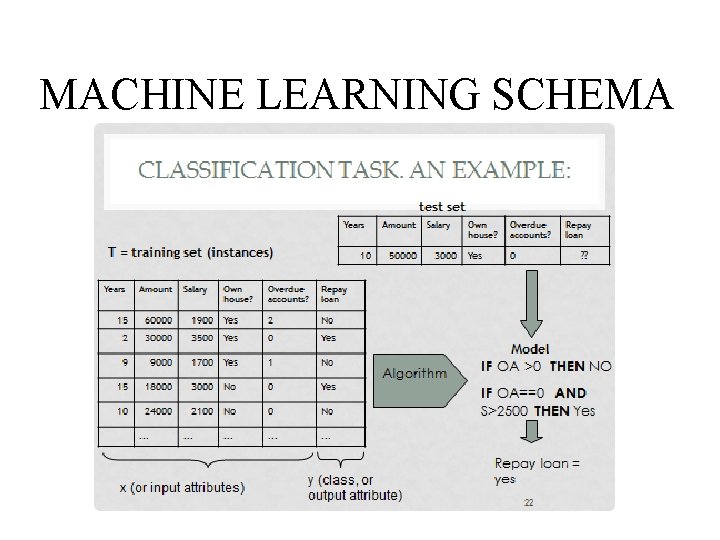
MACHINE LEARNING SCHEMA
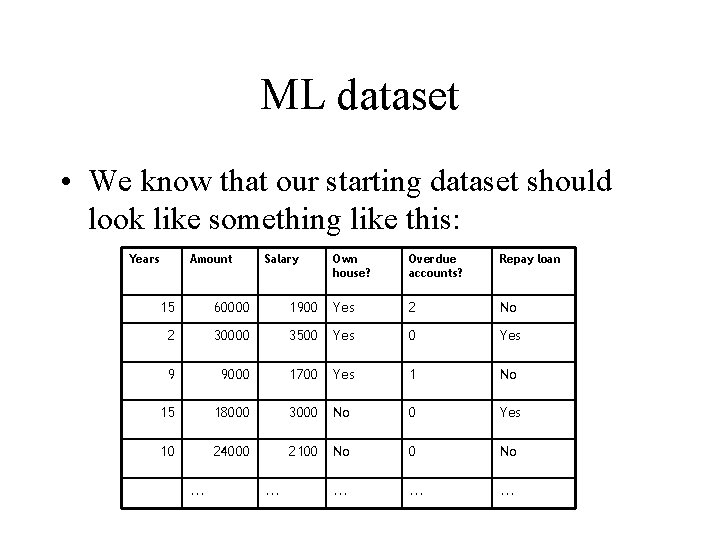
ML dataset • We know that our starting dataset should look like something like this: Years Amount Salary Own house? Overdue accounts? Repay loan 15 60000 1900 Yes 2 No 2 30000 3500 Yes 9 9000 1700 Yes 1 No 15 18000 3000 No 0 Yes 10 24000 2100 No . . . .
Feature extraction • But in many cases, we are not given data in that format and we have to carry out a process in order to convert it to this table format. This is called feature (or attribute) extraction • For instance: text data mining
Text data mining • Let’s suppose we are given different messages (posts) from forums, like twitter, facebook, or similar. And we want to be able to classify them into different categories • In the old times, such forums were called newsgroups, and there were thousands of them
Text categorization • Let’s suppose we are given many messages from the newsgroup “alt. atheism” and the newsgroup “comp. graphics” (computer graphics) – Note: all messages from 20 newsgroups can be found here: http: //qwone. com/~jason/20 Newsgroups/ • And a news agency is interested in building a model that is able to classify messages (news) into two categories: atheism and computer graphics
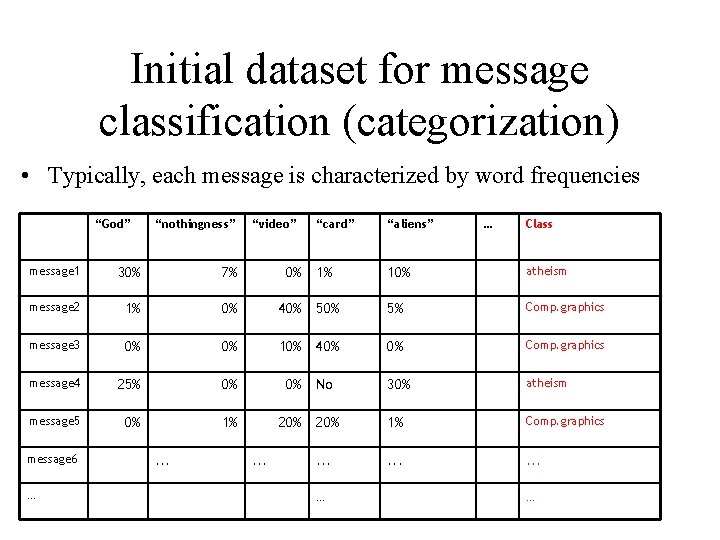
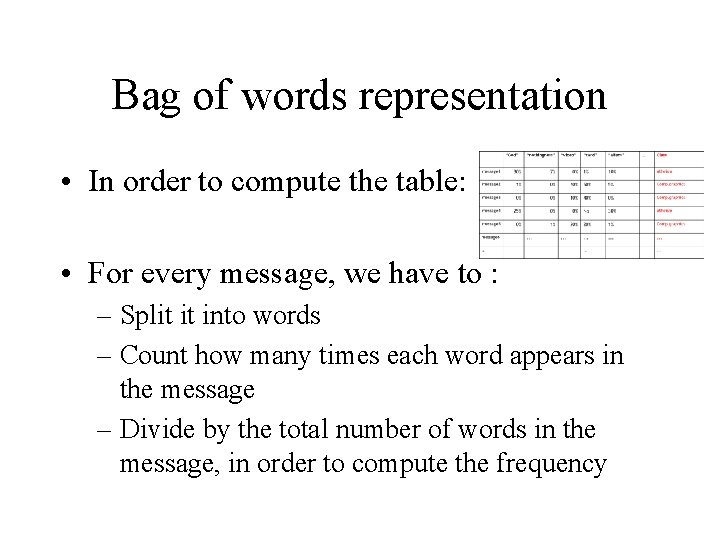
Initial dataset for message classification (categorization) • Typically, each message is characterized by word frequencies “God” “nothingness” “video” “card” “aliens” … Class message 1 30% 7% 0% 1% 10% atheism message 2 1% 0% 40% 5% Comp. graphics message 3 0% 0% 10% 40% 0% Comp. graphics message 4 25% 0% 0% No 30% atheism message 5 0% 1% 20% 1% Comp. graphics . . message 6 … . . . … …
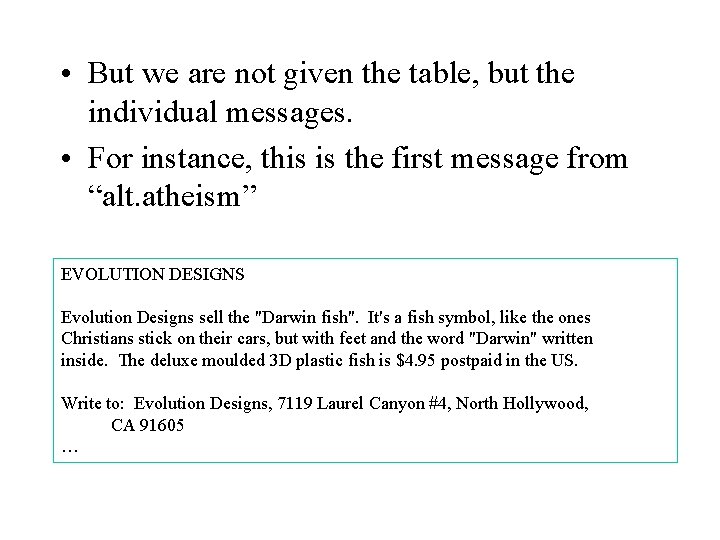
• But we are not given the table, but the individual messages. • For instance, this is the first message from “alt. atheism” EVOLUTION DESIGNS Evolution Designs sell the "Darwin fish". It's a fish symbol, like the ones Christians stick on their cars, but with feet and the word "Darwin" written inside. The deluxe moulded 3 D plastic fish is $4. 95 postpaid in the US. Write to: Evolution Designs, 7119 Laurel Canyon #4, North Hollywood, CA 91605 …
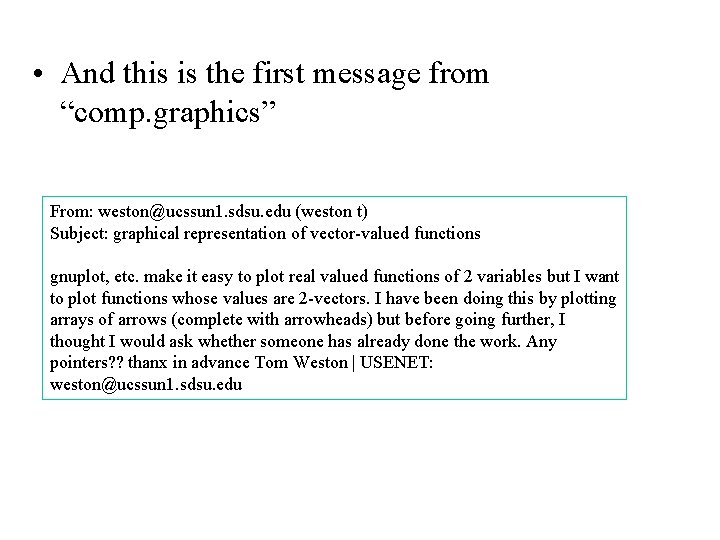
• And this is the first message from “comp. graphics” From: weston@ucssun 1. sdsu. edu (weston t) Subject: graphical representation of vector-valued functions gnuplot, etc. make it easy to plot real valued functions of 2 variables but I want to plot functions whose values are 2 -vectors. I have been doing this by plotting arrays of arrows (complete with arrowheads) but before going further, I thought I would ask whether someone has already done the work. Any pointers? ? thanx in advance Tom Weston | USENET: weston@ucssun 1. sdsu. edu
Bag of words representation • In order to compute the table: • For every message, we have to : – Split it into words – Count how many times each word appears in the message – Divide by the total number of words in the message, in order to compute the frequency
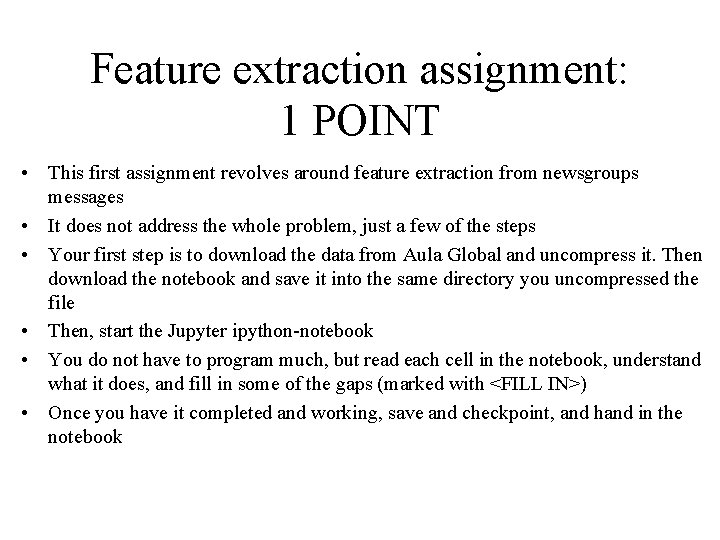
Feature extraction assignment: 1 POINT • This first assignment revolves around feature extraction from newsgroups messages • It does not address the whole problem, just a few of the steps • Your first step is to download the data from Aula Global and uncompress it. Then download the notebook and save it into the same directory you uncompressed the file • Then, start the Jupyter ipython-notebook • You do not have to program much, but read each cell in the notebook, understand what it does, and fill in some of the gaps (marked with <FILL IN>) • Once you have it completed and working, save and checkpoint, and hand in the notebook