External Examiner Induction 201314 External Examiner Induction University


- Slides: 22
External Examiner Induction 2013/14
External Examiner Induction • University Overview • UG & PG Academic Framework • Structure and Purpose of Boards • Role of the External Examiner • Undergraduate & Postgraduate Regulations • IT Access: Wolf, Pebble. Pad and e: Vision • Finance: Claims • Useful Contacts
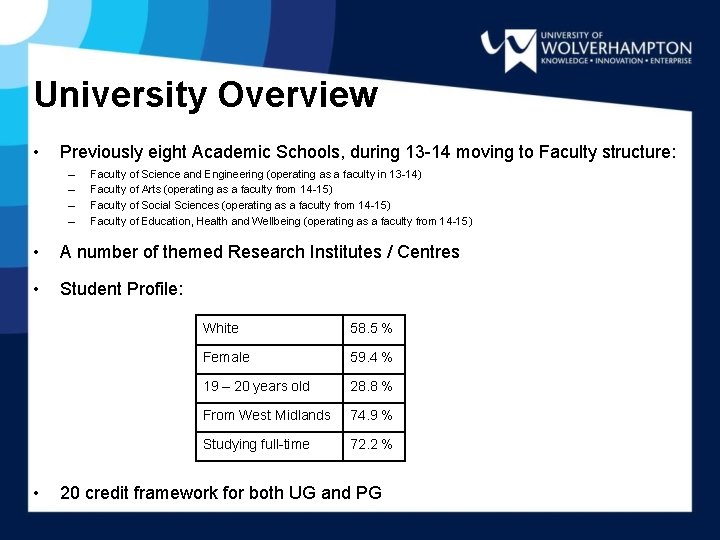
University Overview • Previously eight Academic Schools, during 13 -14 moving to Faculty structure: – – Faculty of Science and Engineering (operating as a faculty in 13 -14) Faculty of Arts (operating as a faculty from 14 -15) Faculty of Social Sciences (operating as a faculty from 14 -15) Faculty of Education, Health and Wellbeing (operating as a faculty from 14 -15) • A number of themed Research Institutes / Centres • Student Profile: • White 58. 5 % Female 59. 4 % 19 – 20 years old 28. 8 % From West Midlands 74. 9 % Studying full-time 72. 2 % 20 credit framework for both UG and PG
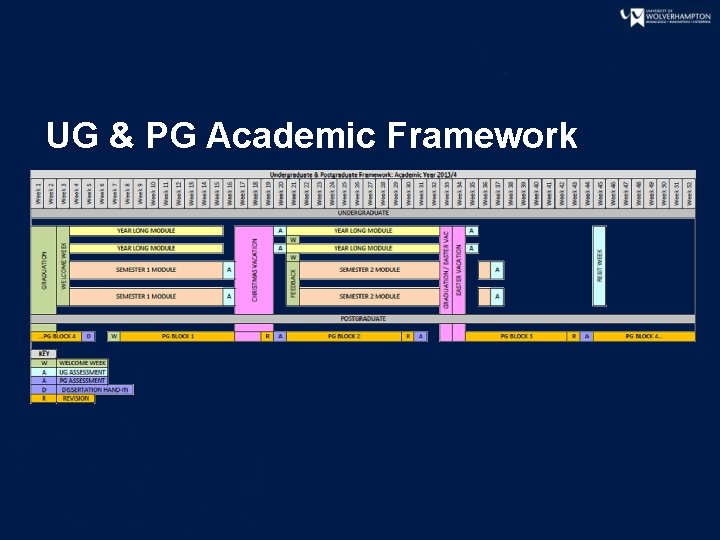
UG & PG Academic Framework
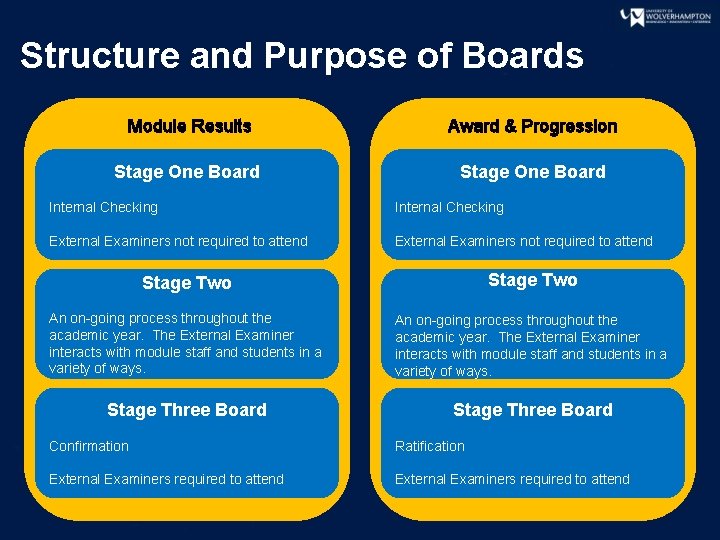
Structure and Purpose of Boards Module Results Award & Progression Stage One Board Internal Checking External Examiners not required to attend Stage Two An on-going process throughout the academic year. The External Examiner interacts with module staff and students in a variety of ways. Stage Three Board Confirmation Ratification External Examiners required to attend
Board Stage Profiles… Attendance Activities Paperwork
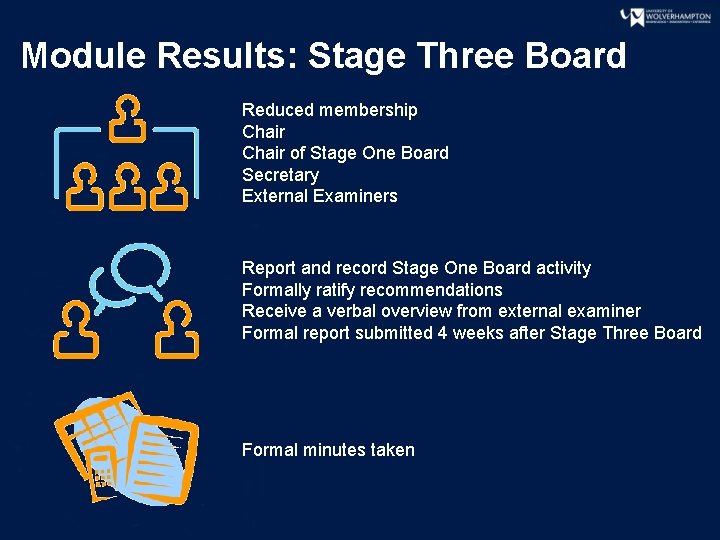
Module Results: Stage Three Board Reduced membership Chair of Stage One Board Secretary External Examiners Report and record Stage One Board activity Formally ratify recommendations Receive a verbal overview from external examiner Formal report submitted 4 weeks after Stage Three Board Formal minutes taken
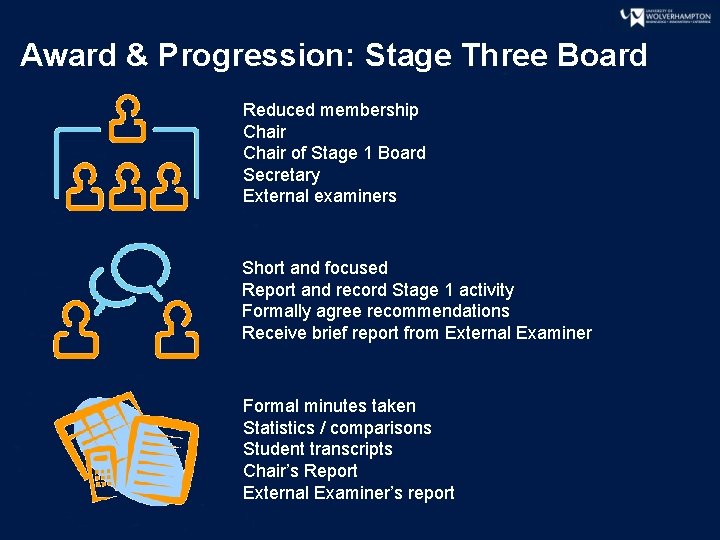
Award & Progression: Stage Three Board Reduced membership Chair of Stage 1 Board Secretary External examiners Short and focused Report and record Stage 1 activity Formally agree recommendations Receive brief report from External Examiner Formal minutes taken Statistics / comparisons Student transcripts Chair’s Report External Examiner’s report
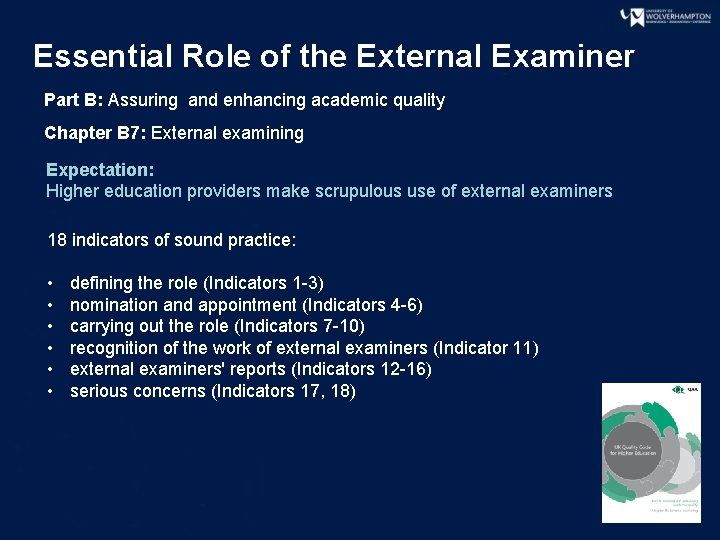
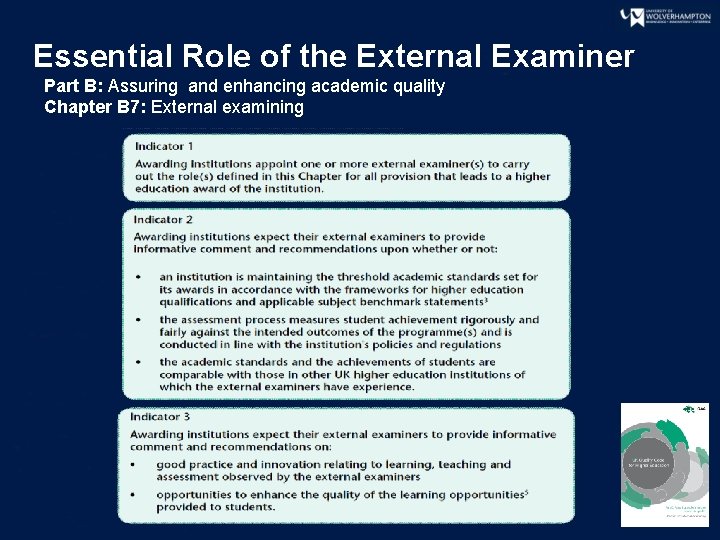
Essential Role of the External Examiner Part B: Assuring and enhancing academic quality Chapter B 7: External examining Expectation: Higher education providers make scrupulous use of external examiners 18 indicators of sound practice: • • • defining the role (Indicators 1 -3) nomination and appointment (Indicators 4 -6) carrying out the role (Indicators 7 -10) recognition of the work of external examiners (Indicator 11) external examiners' reports (Indicators 12 -16) serious concerns (Indicators 17, 18)
Essential Role of the External Examiner Part B: Assuring and enhancing academic quality Chapter B 7: External examining
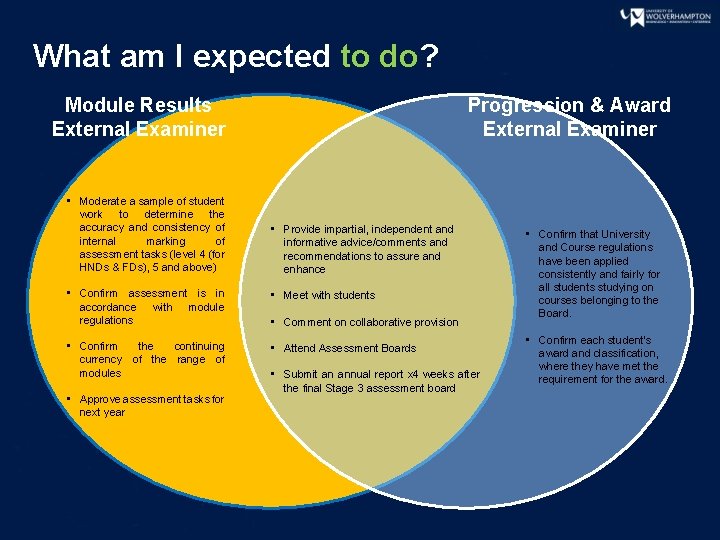
What am I expected to do? Module Results External Examiner • Moderate a sample of student work to determine the accuracy and consistency of internal marking of assessment tasks (level 4 (for HNDs & FDs), 5 and above) Progression & Award External Examiner • Provide impartial, independent and informative advice/comments and recommendations to assure and enhance • Confirm assessment is in accordance with module regulations • Meet with students • Confirm the continuing currency of the range of modules • Attend Assessment Boards • Approve assessment tasks for next year • Comment on collaborative provision • Submit an annual report x 4 weeks after the final Stage 3 assessment board • Confirm that University and Course regulations have been applied consistently and fairly for all students studying on courses belonging to the Board. • Confirm each student’s award and classification, where they have met the requirement for the award.
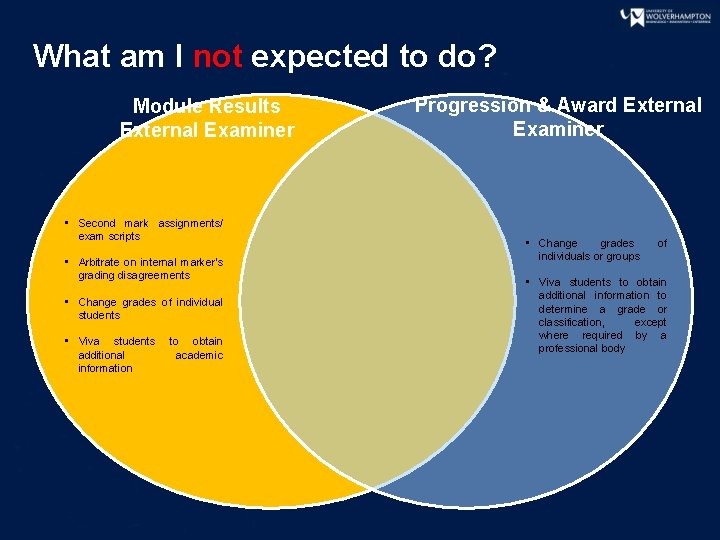
What am I not expected to do? Module Results External Examiner • Second mark assignments/ exam scripts • Arbitrate on internal marker’s grading disagreements • Change grades of individual students • Viva students to obtain additional academic information Progression & Award External Examiner • Change grades individuals or groups of • Viva students to obtain additional information to determine a grade or classification, except where required by a professional body
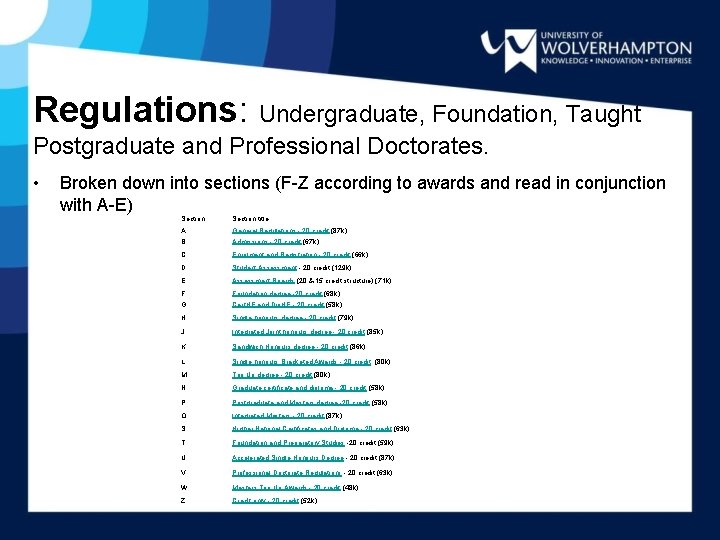
Regulations: Undergraduate, Foundation, Taught Postgraduate and Professional Doctorates. • Broken down into sections (F-Z according to awards and read in conjunction with A-E) Section title A General Regulations - 20 credit (87 k) B Admissions - 20 credit (67 k) C Enrolment and Registration - 20 credit (66 k) D Student Assessment - 20 credit (129 k) E Assessment Boards (20 & 15 credit structure) (71 k) F Foundation degree -20 credit (68 k) G Cert. HE and Dip. HE - 20 credit (58 k) H Single honours degree - 20 credit (79 k) J Integrated Joint honours degree - 20 credit (85 k) K Sandwich Honours degree - 20 credit (86 k) L Single honours Bracketed Awards - 20 credit (80 k) M Top Up degree - 20 credit (80 k) N Graduate certificate and diploma - 20 credit (58 k) P Postgraduate and Masters degree -20 credit (58 k) Q Integrated Masters - 20 credit (87 k) S Higher National Certificates and Diploma - 20 credit (63 k) T Foundation and Preparatory Studies -20 credit (59 k) U Accelerated Single Honours Degree - 20 credit (87 k) V Professional Doctorate Regulations - 20 credit (63 k) W Masters Top Up Awards - 20 credit (48 k) Z Credit only - 20 credit (52 k)
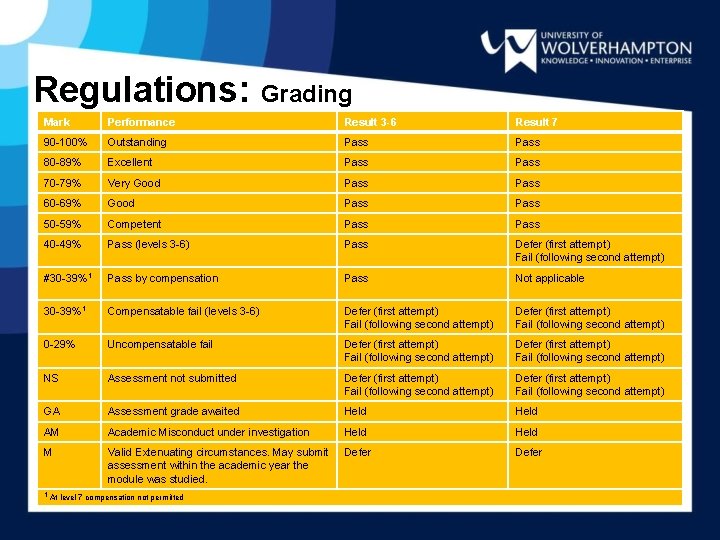
Regulations: Grading Mark Performance Result 3 -6 Result 7 90 -100% Outstanding Pass 80 -89% Excellent Pass 70 -79% Very Good Pass 60 -69% Good Pass 50 -59% Competent Pass 40 -49% Pass (levels 3 -6) Pass Defer (first attempt) Fail (following second attempt) #30 -39%1 Pass by compensation Pass Not applicable 30 -39%1 Compensatable fail (levels 3 -6) Defer (first attempt) Fail (following second attempt) 0 -29% Uncompensatable fail Defer (first attempt) Fail (following second attempt) NS Assessment not submitted Defer (first attempt) Fail (following second attempt) GA Assessment grade awaited Held AM Academic Misconduct under investigation Held M Valid Extenuating circumstances. May submit assessment within the academic year the module was studied. Defer 1 At level 7 compensation not permitted
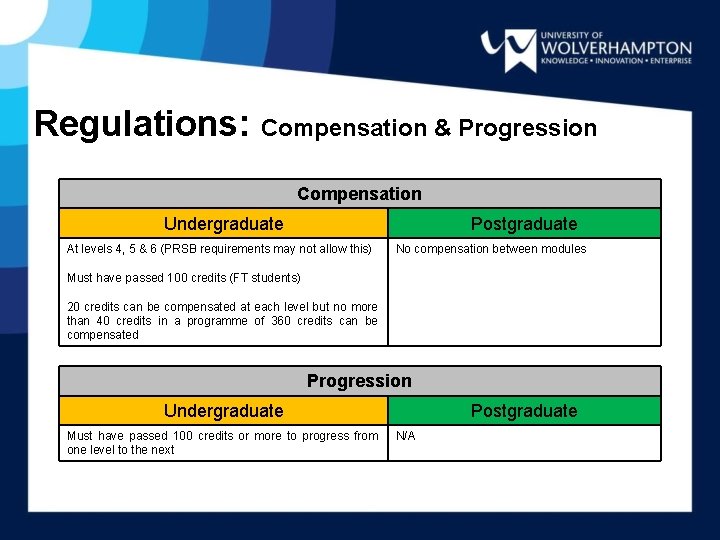
Regulations: Compensation & Progression Compensation Undergraduate Postgraduate At levels 4, 5 & 6 (PRSB requirements may not allow this) No compensation between modules Must have passed 100 credits (FT students) 20 credits can be compensated at each level but no more than 40 credits in a programme of 360 credits can be compensated Progression Undergraduate Must have passed 100 credits or more to progress from one level to the next Postgraduate N/A
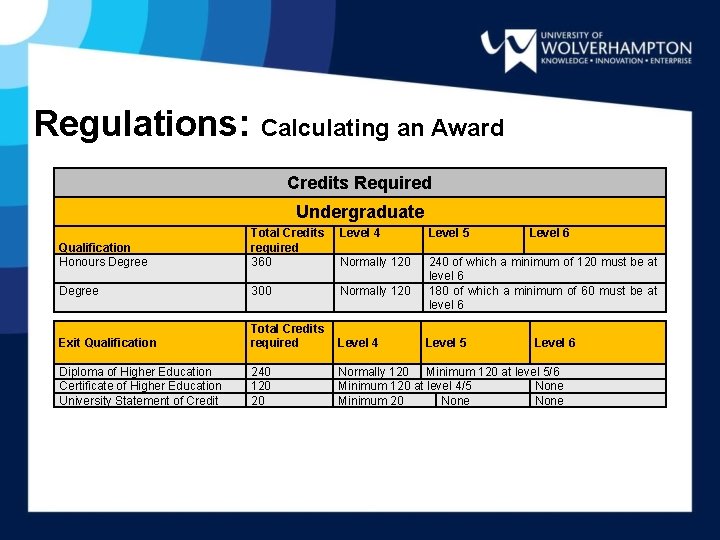
Regulations: Calculating an Award Credits Required Undergraduate Qualification Honours Degree Total Credits Level 4 required 360 Normally 120 300 Normally 120 Exit Qualification Total Credits required 240 120 20 Level 4 Diploma of Higher Education Certificate of Higher Education University Statement of Credit Level 5 Level 6 240 of which a minimum of 120 must be at level 6 180 of which a minimum of 60 must be at level 6 Level 5 Level 6 Normally 120 Minimum 120 at level 5/6 Minimum 120 at level 4/5 None Minimum 20 None
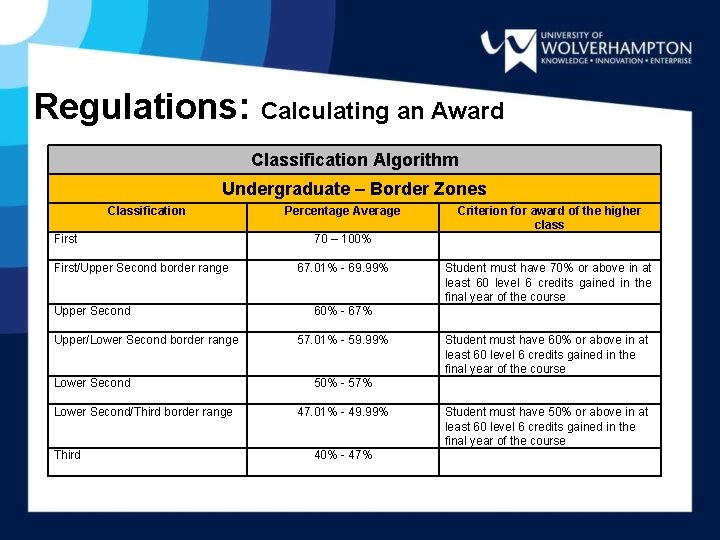
Regulations: Calculating an Award Classification Algorithm Undergraduate – Border Zones Classification First/Upper Second border range Upper Second Upper/Lower Second border range Lower Second/Third border range Third Percentage Average 70 – 100% 67. 01% - 69. 99% 60% - 67% 57. 01% - 59. 99% 50% - 57% 47. 01% - 49. 99% 40% - 47% Criterion for award of the higher class Student must have 70% or above in at least 60 level 6 credits gained in the final year of the course Student must have 60% or above in at least 60 level 6 credits gained in the final year of the course Student must have 50% or above in at least 60 level 6 credits gained in the final year of the course
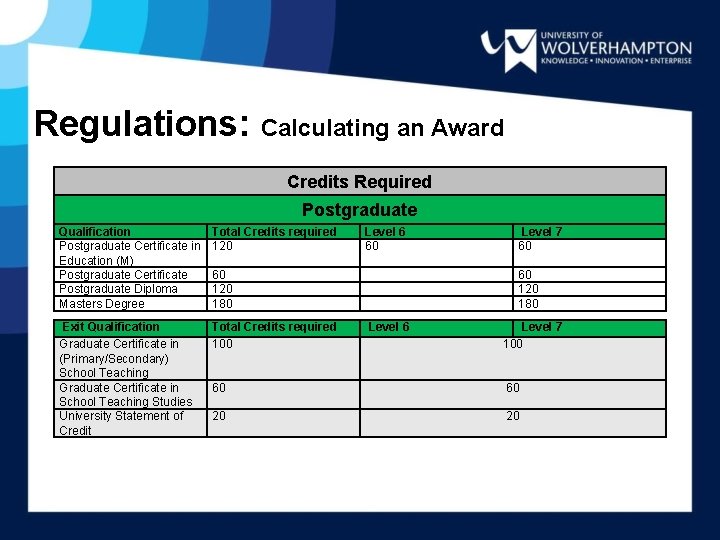
Regulations: Calculating an Award Credits Required Postgraduate Qualification Postgraduate Certificate in Education (M) Postgraduate Certificate Postgraduate Diploma Masters Degree Total Credits required 120 Level 6 60 Level 7 60 60 120 180 Exit Qualification Graduate Certificate in (Primary/Secondary) School Teaching Graduate Certificate in School Teaching Studies University Statement of Credit Total Credits required 100 Level 6 Level 7 100 60 60 20 20
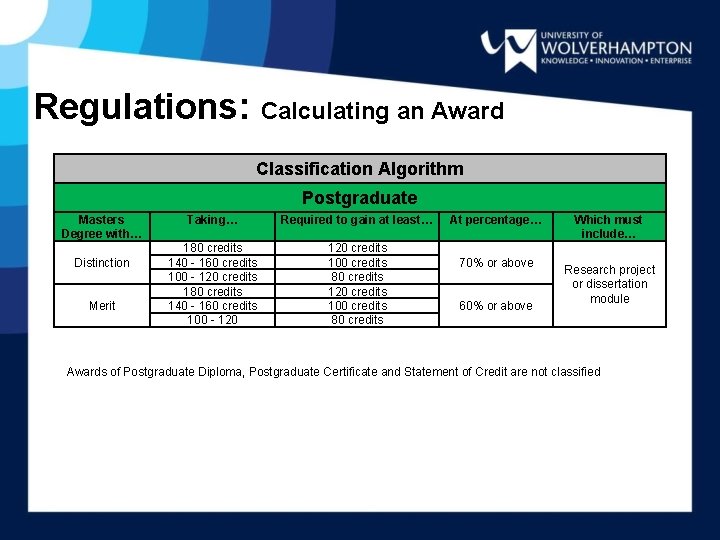
Regulations: Calculating an Award Classification Algorithm Postgraduate Masters Degree with… Distinction Merit Taking… Required to gain at least… 180 credits 140 - 160 credits 100 - 120 credits 100 credits 80 credits 120 credits 100 credits 80 credits At percentage… 70% or above 60% or above Which must include… Research project or dissertation module Awards of Postgraduate Diploma, Postgraduate Certificate and Statement of Credit are not classified
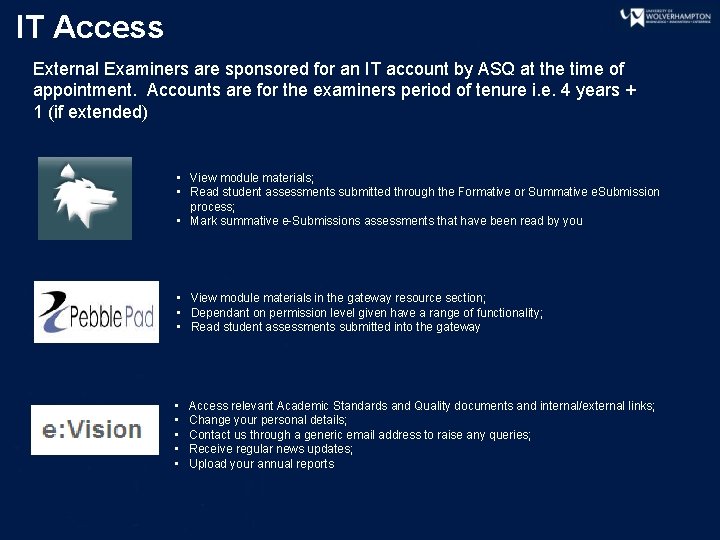
IT Access External Examiners are sponsored for an IT account by ASQ at the time of appointment. Accounts are for the examiners period of tenure i. e. 4 years + 1 (if extended) • View module materials; • Read student assessments submitted through the Formative or Summative e. Submission process; • Mark summative e-Submissions assessments that have been read by you • View module materials in the gateway resource section; • Dependant on permission level given have a range of functionality; • Read student assessments submitted into the gateway • • • Access relevant Academic Standards and Quality documents and internal/external links; Change your personal details; Contact us through a generic email address to raise any queries; Receive regular news updates; Upload your annual reports
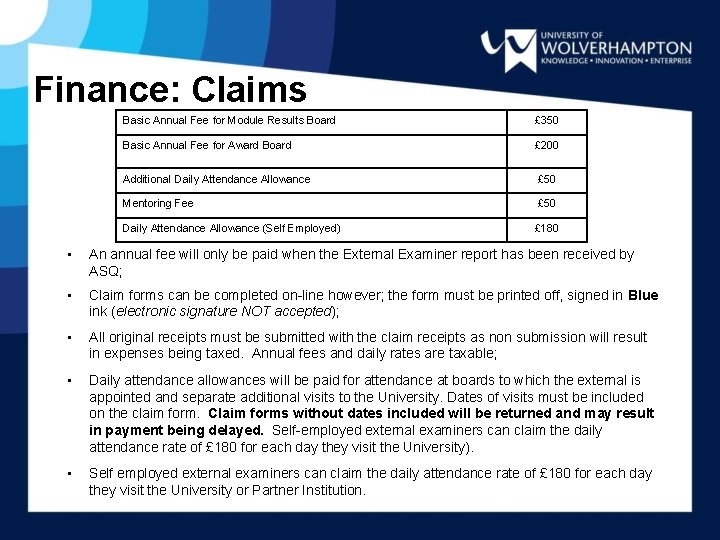
Finance: Claims Basic Annual Fee for Module Results Board £ 350 Basic Annual Fee for Award Board £ 200 Additional Daily Attendance Allowance £ 50 Mentoring Fee £ 50 Daily Attendance Allowance (Self Employed) £ 180 • An annual fee will only be paid when the External Examiner report has been received by ASQ; • Claim forms can be completed on-line however; the form must be printed off, signed in Blue ink (electronic signature NOT accepted); • All original receipts must be submitted with the claim receipts as non submission will result in expenses being taxed. Annual fees and daily rates are taxable; • Daily attendance allowances will be paid for attendance at boards to which the external is appointed and separate additional visits to the University. Dates of visits must be included on the claim form. Claim forms without dates included will be returned and may result in payment being delayed. Self-employed external examiners can claim the daily attendance rate of £ 180 for each day they visit the University). • Self employed external examiners can claim the daily attendance rate of £ 180 for each day they visit the University or Partner Institution.
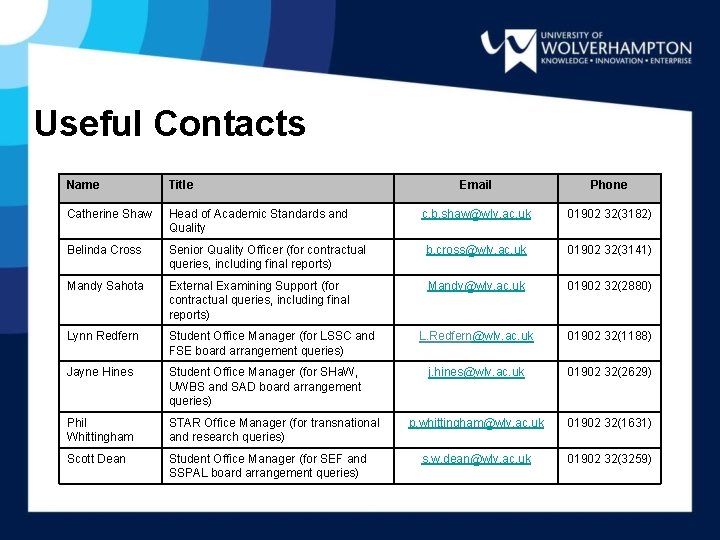
Useful Contacts Name Title Email Phone Catherine Shaw Head of Academic Standards and Quality c. b. shaw@wlv. ac. uk 01902 32(3182) Belinda Cross Senior Quality Officer (for contractual queries, including final reports) b. cross@wlv. ac. uk 01902 32(3141) Mandy Sahota External Examining Support (for contractual queries, including final reports) Mandy@wlv. ac. uk 01902 32(2880) Lynn Redfern Student Office Manager (for LSSC and FSE board arrangement queries) L. Redfern@wlv. ac. uk 01902 32(1188) Jayne Hines Student Office Manager (for SHa. W, UWBS and SAD board arrangement queries) j. hines@wlv. ac. uk 01902 32(2629) Phil Whittingham STAR Office Manager (for transnational and research queries) p. whittingham@wlv. ac. uk 01902 32(1631) Scott Dean Student Office Manager (for SEF and SSPAL board arrangement queries) s. w. dean@wlv. ac. uk 01902 32(3259)