Exploring Victim Precipitation in Internet Crimes Against Children


- Slides: 22
Exploring Victim Precipitation in Internet Crimes Against Children Lynchburg College School of Humanities & Social Sciences Bryce L. Coulter B. A.
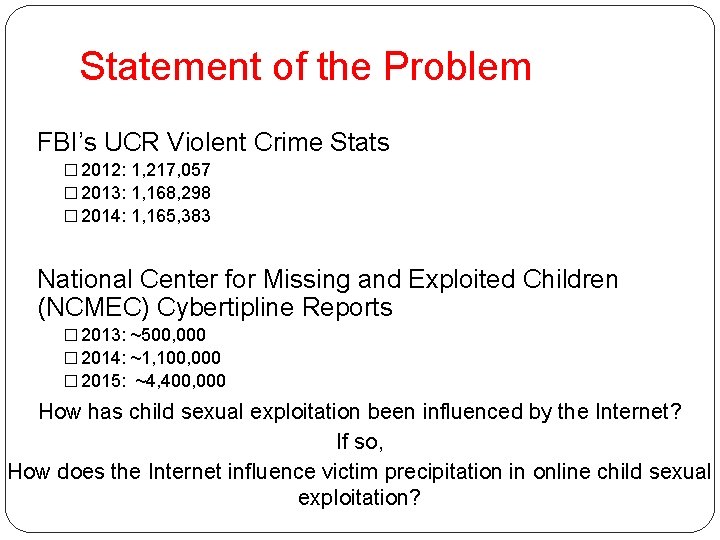
Statement of the Problem FBI’s UCR Violent Crime Stats � 2012: 1, 217, 057 � 2013: 1, 168, 298 � 2014: 1, 165, 383 National Center for Missing and Exploited Children (NCMEC) Cybertipline Reports � 2013: ~500, 000 � 2014: ~1, 100, 000 � 2015: ~4, 400, 000 How has child sexual exploitation been influenced by the Internet? If so, How does the Internet influence victim precipitation in online child sexual exploitation?
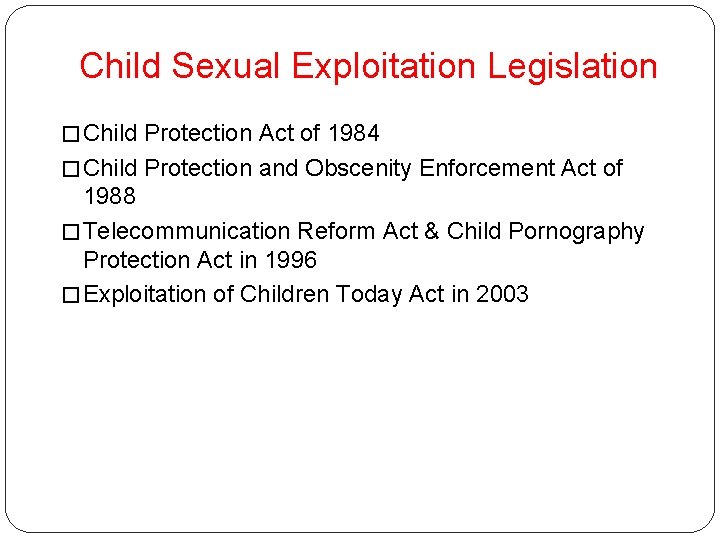
Child Sexual Exploitation Legislation � Child Protection Act of 1984 � Child Protection and Obscenity Enforcement Act of 1988 � Telecommunication Reform Act & Child Pornography Protection Act in 1996 � Exploitation of Children Today Act in 2003
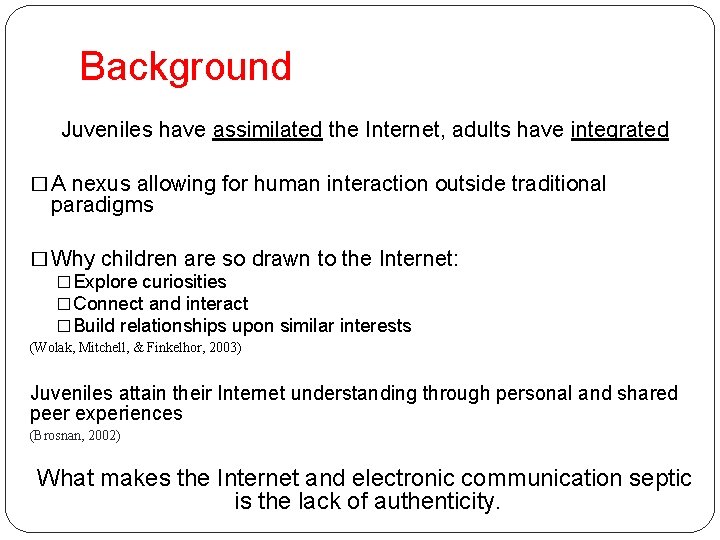
Background Juveniles have assimilated the Internet, adults have integrated � A nexus allowing for human interaction outside traditional paradigms � Why children are so drawn to the Internet: � Explore curiosities � Connect and interact � Build relationships upon similar interests (Wolak, Mitchell, & Finkelhor, 2003) Juveniles attain their Internet understanding through personal and shared peer experiences (Brosnan, 2002) What makes the Internet and electronic communication septic is the lack of authenticity.
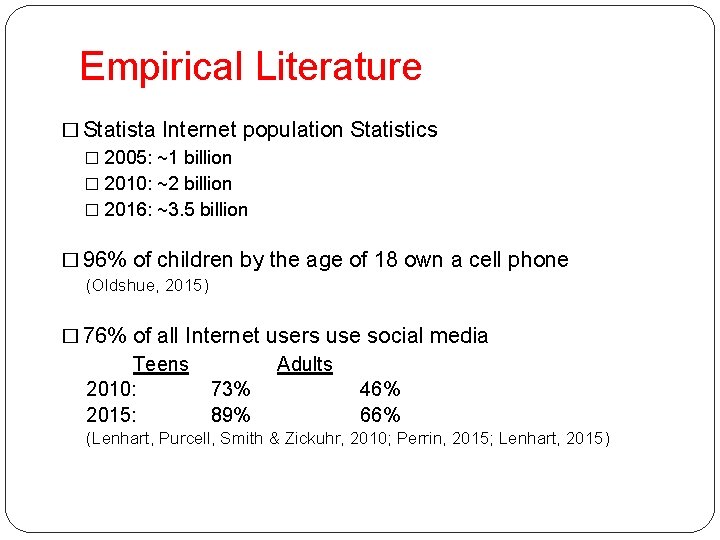
Empirical Literature � Statista Internet population Statistics � 2005: ~1 billion � 2010: ~2 billion � 2016: ~3. 5 billion � 96% of children by the age of 18 own a cell phone (Oldshue, 2015) � 76% of all Internet users use social media Teens Adults 2010: 73% 46% 2015: 89% 66% (Lenhart, Purcell, Smith & Zickuhr, 2010; Perrin, 2015; Lenhart, 2015)
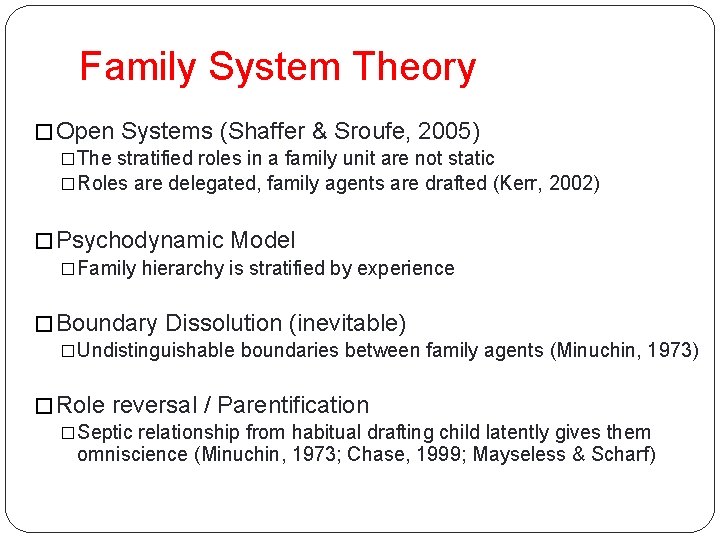
Family System Theory � Open Systems (Shaffer & Sroufe, 2005) �The stratified roles in a family unit are not static �Roles are delegated, family agents are drafted (Kerr, 2002) � Psychodynamic Model �Family hierarchy is stratified by experience � Boundary Dissolution (inevitable) �Undistinguishable boundaries between family agents (Minuchin, 1973) � Role reversal / Parentification �Septic relationship from habitual drafting child latently gives them omniscience (Minuchin, 1973; Chase, 1999; Mayseless & Scharf)
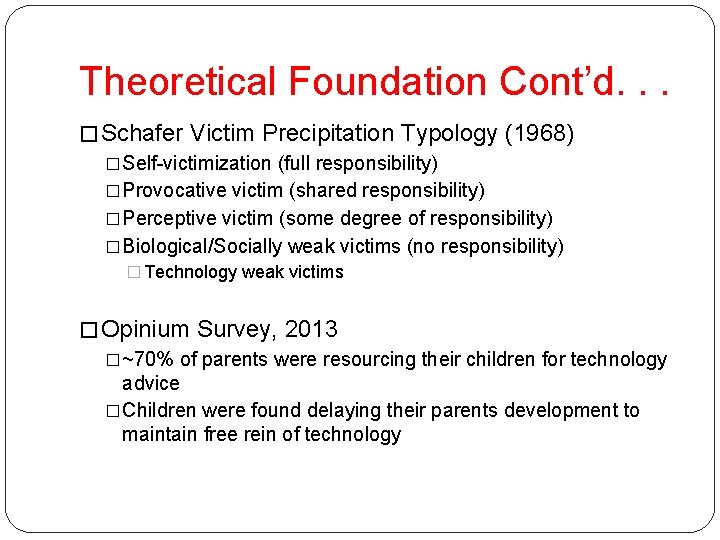
Theoretical Foundation Cont’d. . . � Schafer Victim Precipitation Typology (1968) �Self-victimization (full responsibility) �Provocative victim (shared responsibility) �Perceptive victim (some degree of responsibility) �Biological/Socially weak victims (no responsibility) � Technology weak victims � Opinium Survey, 2013 �~70% of parents were resourcing their children for technology advice �Children were found delaying their parents development to maintain free rein of technology
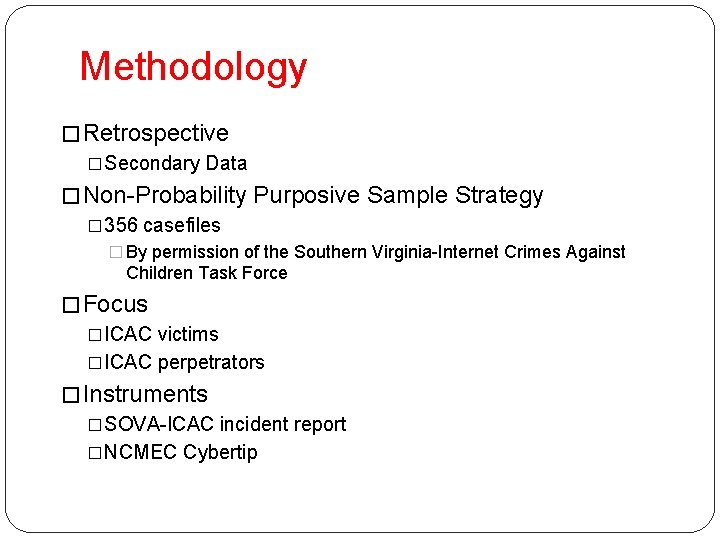
Methodology � Retrospective �Secondary Data � Non-Probability Purposive Sample Strategy � 356 casefiles � By permission of the Southern Virginia-Internet Crimes Against Children Task Force � Focus �ICAC victims �ICAC perpetrators � Instruments �SOVA-ICAC incident report �NCMEC Cybertip
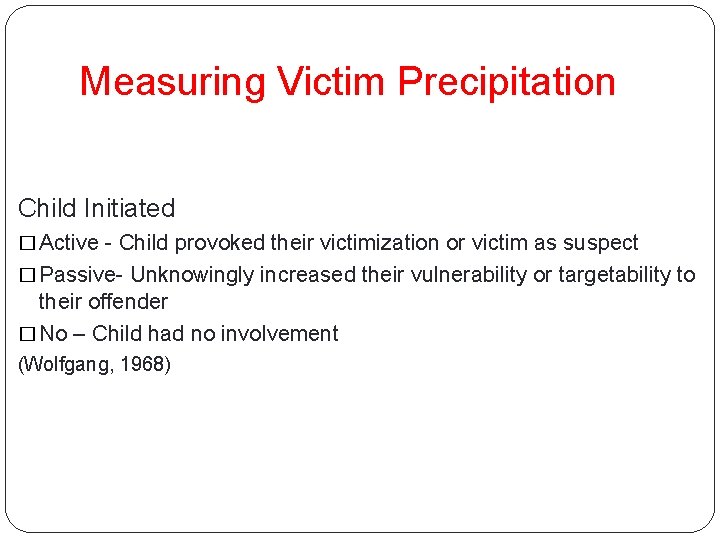
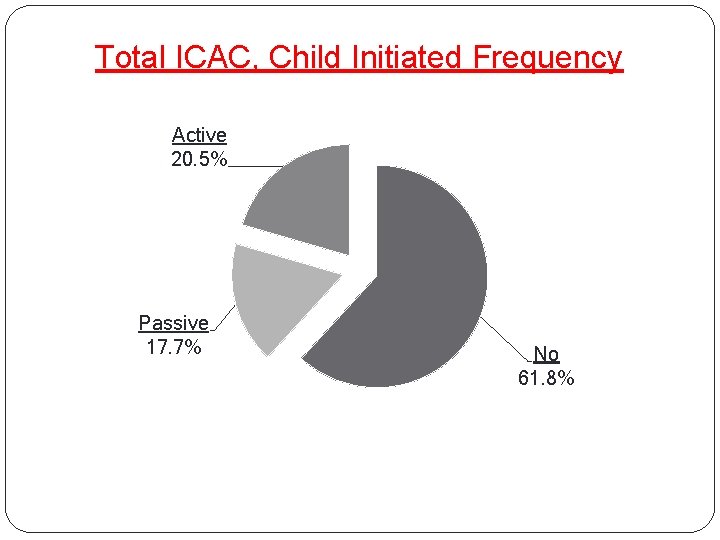
Measuring Victim Precipitation Child Initiated � Active - Child provoked their victimization or victim as suspect � Passive- Unknowingly increased their vulnerability or targetability to their offender � No – Child had no involvement (Wolfgang, 1968)
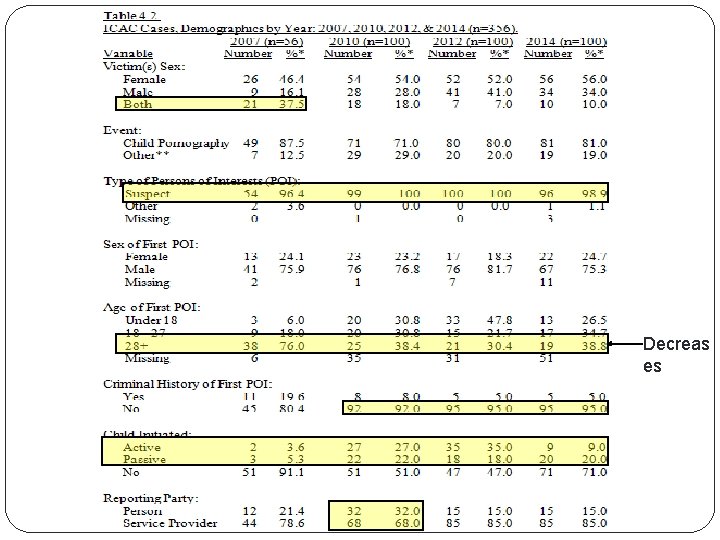
Decreas es
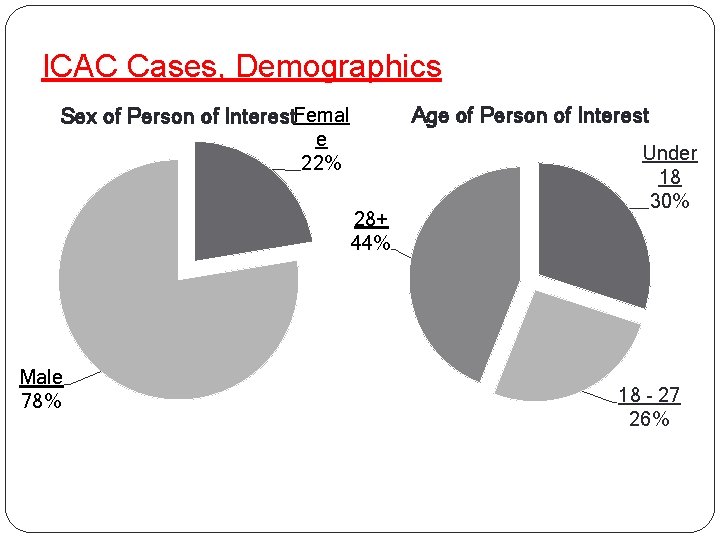
ICAC Cases, Demographics Age of Person of Interest Sex of Person of Interest. Femal e 22% 28+ 44% Male 78% Under 18 30% 18 - 27 26%
Total ICAC, Child Initiated Frequency Active 20. 5% Passive 17. 7% No 61. 8%
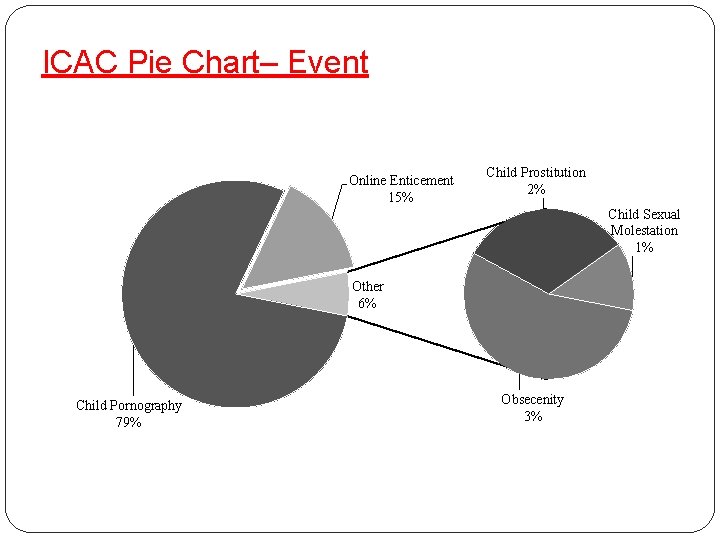
ICAC Pie Chart– Event Online Enticement 15% Child Prostitution 2% Child Sexual Molestation 1% Other 6% Child Pornography 79% Obsecenity 3%
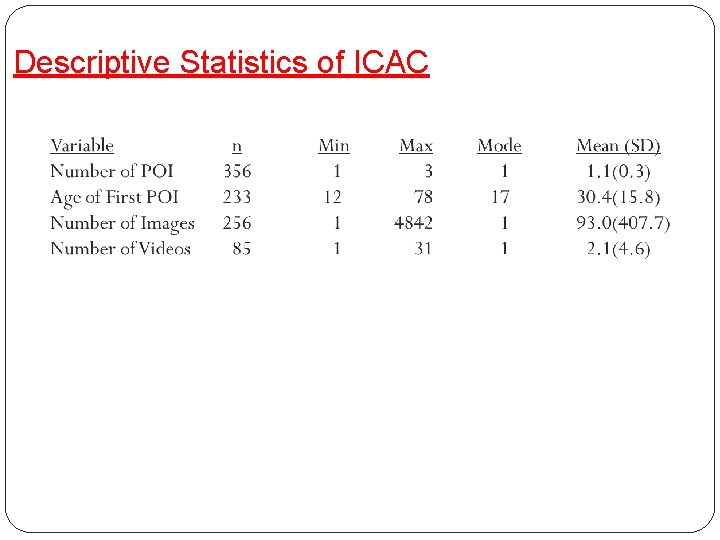
Descriptive Statistics of ICAC
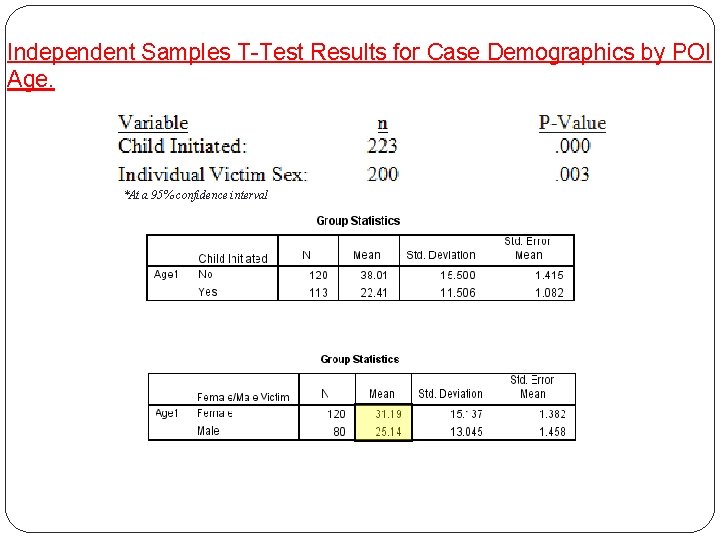
Independent Samples T-Test Results for Case Demographics by POI Age. *At a 95% confidence interval
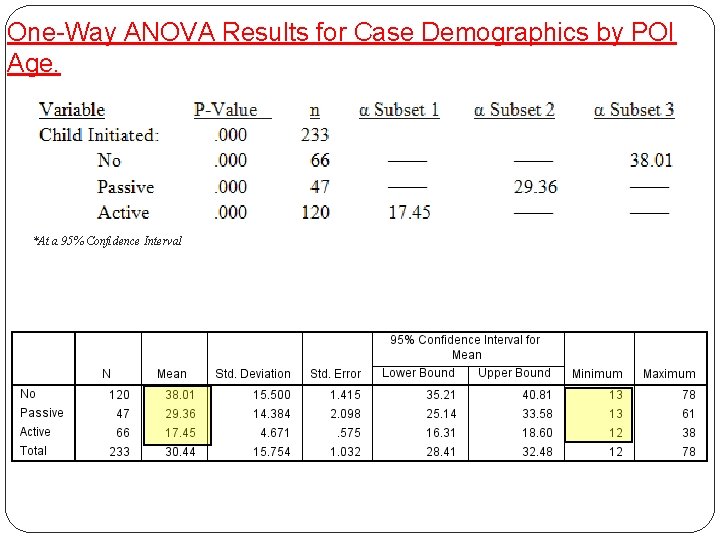
One-Way ANOVA Results for Case Demographics by POI Age. *At a 95% Confidence Interval
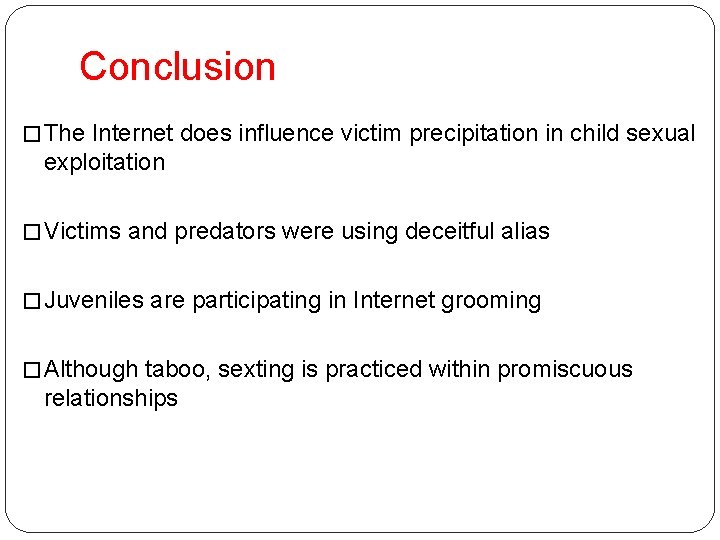
Conclusion � The Internet does influence victim precipitation in child sexual exploitation � Victims and predators were using deceitful alias � Juveniles are participating in Internet grooming � Although taboo, sexting is practiced within promiscuous relationships
REFERENCES Anders, S. (2016). Internet Crimes Against Children. Lecture at SHWL 207, Schewel Hall Barber, B. K. , & Buehler, C. (1996). Family cohesion and enmeshment: Different constructs, different effects. Journal of Marriage and the Family, 433 -441. Bornstein, L. , & Bornstein, M. H. (2007). Parenting styles and child social development. Encyclopedia on Early Childhood Development, 14. Brosnan, M. J. (2002). Technophobia: The psychological Impact of Information Technology. Routledge. Brown, J. , Keller, S. , & Stern, S. , (2009). Sex, sexuality, sexting, and sex education: Adolescents and the media. Prevention Research, 16, 12 -16. Cahoon, B. (1998). Teaching and learning Internet skills. New Directions for Adult and Continuing Education, 1998(78), 5 -13. Chase, N. D. (1999). Burdened Children: Theory, Research, and Treatment of Parentification. Thousand Oaks, CA: Sage. Cloitre, M. & Rosenberg, A. (2006). Sexual revictimization. Cognitive-Behavioral Therapies for Trauma, 321 -361. Craven, S. , Brown, S. , & Gilchrist, E. (2007). Current responses to sexual grooming: Implication for prevention. The Howard Journal of Criminal Justice, 46(1), 60 -71. Cross, C. (2013). “Nobody’s holding a gun to your head…” examining current discourses surrounding victims of online fraud. Crime, Justice and Social Democracy: Proceedings of the 2 nd International Conference , 25 -32, Crime and Justice Research Centre, Queensland University of Technology. Deursen, A. J. , & Dijk, J. A. (2010). Internet skills and the digital divide. New Media & Society, 13(6) 893– 911. Epstein, Z. (2014). How to find the Invisible Internet. Boy Genius Report. Retrieved from http: //bgr. com/2014/01/20/how-to-access-tor-silkroad-deep-web/ Federal Bureau of Investigation. (2014). Crime in the United States, 2014. Retrieved from https: //ucr. fbi. gov/crime-in-the-u. s/2014/crime-inthe-u. s. -2014/offenses-known-to-law-enforcement/violent-crime Feldman, B. (2008). What Experts Say About Where to Put Your Family Computer. Surfnetkids Feldman Publishing. Finkelhor, D. (2009). The prevention of childhood sexual abuse. The future of children, 19(2), 169 -194. Hagan, F. (2014). Research Methods in Criminal Justice and Criminology (9 th ed. ). Upper Saddle River, NJ: Pearson Education Inc. Kerr, M. E. (2002). One family's story: A primer on Bowen theory. Bowen Center for the Study of the Family, Georgetown Family Center.
REFERENCES Lenhart, A. (2009). Teens and Sexting. How and why minor teens are sending sexually suggestive nude or nearly nude images via text messaging. Retrieved from http: //www. pewinternet. org/reports/2009/Teens-and-sexting. aspx Lenhart, A. , Purcell, K. , Smith, A. , & Zickuhr, K. (2010). Social and Young Adults. Millennials. Pew Internet & American Life Project. Retrieved from http: //www. pewinternet. org/2010/02/03/social-media-and-young-adults/ Marsden, R. (2013). Are children naturally better with computers than their parents? Or are they just not scared to get stuck in? Either way, don't expect the gap to close, says Rhodri Marsden. Independent: Gadgets and tech. Retrieved from www. independent. co. uk/life-style/gadgetsand-tech/features/are-children-naturally-better-with-computers-than-their-parents-8628034. html Mayseless, O. , & Scharf, M. (2009). Too close for comfort: inadequate boundaries with parents and individuation in late adolescent girls. American Journal of Orthopsychiatry, 79(2), 191. Mc. Cabe, K. A. , & Johnston, O. C. (2014). Perceptions on the legality of sexting: A report. Social Science Computer Review, 32(6), 765 -768. Minuchin, S. (1973) Families kind Family Therapy. Cambridge, Mass. Harvard University Press. Moriarty, L. J. (2008). Controversies in victimology. Routledge. National Center for Missing and Exploited Children. (2014). 2014 Annual Report. Retrieved from www. missingkids. com/en_US/publications/NCMEC_2014. pdf Nolan, J. J. (2004). Establishing the statistical relationship between population size and UCR crime rate: Its impact and implications. Journal of Criminal Justice, 32(6), 547 -555 Office of Juvenile Justice and Delinquency Prevention. (2015). Program summary. Retrieved from www. ojjdp. gov/programs/Prog. Summary. asp? pi=3 Opinium. (2013). Parents seek tech advice from teenagers. The Malta Independent ICT. 121, 1 -3. Pew Research Center (2014) World Wide Web Timeline. www. pewinternet. org/2014/03/11/world-wide-web-timeline/ Schafer, S. (1968). The Victims and His Criminal: A Study in Functional Responsibility. New York: Random House. Shaffer, A. , & Sroufe, L. A. (2005). The developmental and adaptational implications of generational boundary dissolution: Findings from a prospective, longitudinal study. Journal of Emotional Abuse, 5(2 -3), 67 -84.
REFERENCES Smith, A. (2011). How Americans use text messaging. Pew Research Center Internet, Science & Tech. Retrieved from www. pewinternet. org/2011/09/09/how-americans-use-text-messaging/ Smith, R. E. , Keating, J. P. , Hester, R. K. , & Mitchell, H. E. (1976). Role and justice considerations in the attribution of responsibility to a rape victim. Journal of Research in Personality, 10(3), 346 -357. Statista. (2016). Number of internet Users worldwide from 2005 to 2015 (in millions). Retrieved from www. statista. com/statistics/273018/number-of-internet-users-worldwide/ Vartanian, T. P. (2011). Secondary Data Analysis. New York, NY: Oxford. Wolak, J. , Finkelhor, D. , Mitchell, K. J. , & Ybarra, M. L. (2008). Online "predators" and their victims: Myths, realities, and implications for prevention and treatment. American Psychologist, 63(2), 111. Wolak, J. , Mitchell, K. J. , & Finkelhor, D. (2003). Escaping or connecting? Characteristics of youth who form close online relationships. Journal of Adolescence, 26(1), 105 -119. Wolfgang, M. (1958). Patterns of criminal homicide. Philadelphian, PA: University of Pennsylvania press. Worth, B. (2016). Record-Shattering Number of Child Sexual Exploitation Reports Filed to Cyber. Tipline. Retrieved from: blog. missingkids. com/search/Record-Shattering+Number+of+Child+Sexual+Exploitation+Reports+Filed+to+Cyber. Tipline
Questions?