Experiment 28 Japanese auction price clock ticks up
- Slides: 4
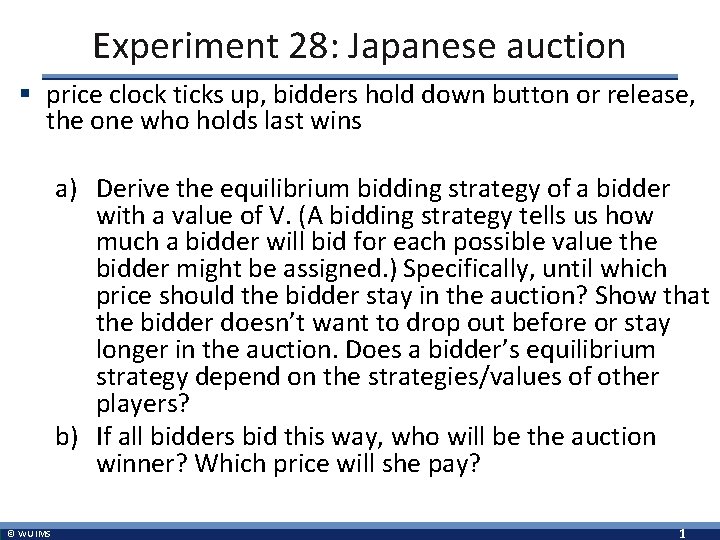
Experiment 28: Japanese auction § price clock ticks up, bidders hold down button or release, the one who holds last wins a) Derive the equilibrium bidding strategy of a bidder with a value of V. (A bidding strategy tells us how much a bidder will bid for each possible value the bidder might be assigned. ) Specifically, until which price should the bidder stay in the auction? Show that the bidder doesn’t want to drop out before or stay longer in the auction. Does a bidder’s equilibrium strategy depend on the strategies/values of other players? b) If all bidders bid this way, who will be the auction winner? Which price will she pay? © WU IMS 1
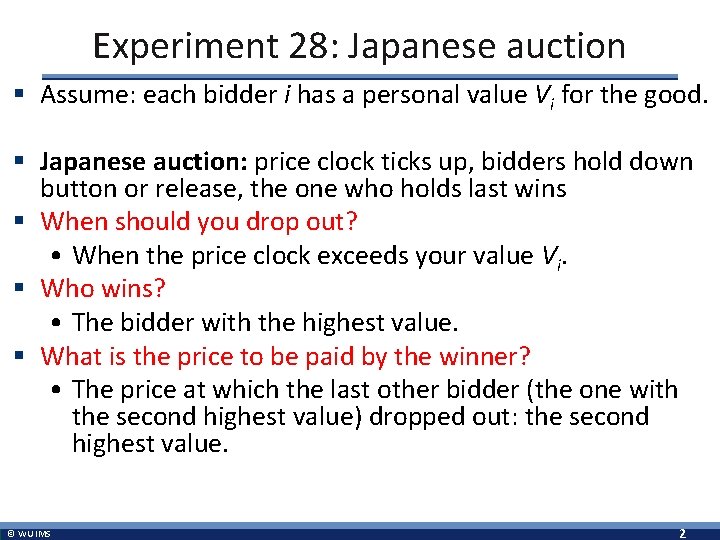
Experiment 28: Japanese auction § Assume: each bidder i has a personal value Vi for the good. § Japanese auction: price clock ticks up, bidders hold down button or release, the one who holds last wins § When should you drop out? • When the price clock exceeds your value Vi. § Who wins? • The bidder with the highest value. § What is the price to be paid by the winner? • The price at which the last other bidder (the one with the second highest value) dropped out: the second highest value. © WU IMS 2
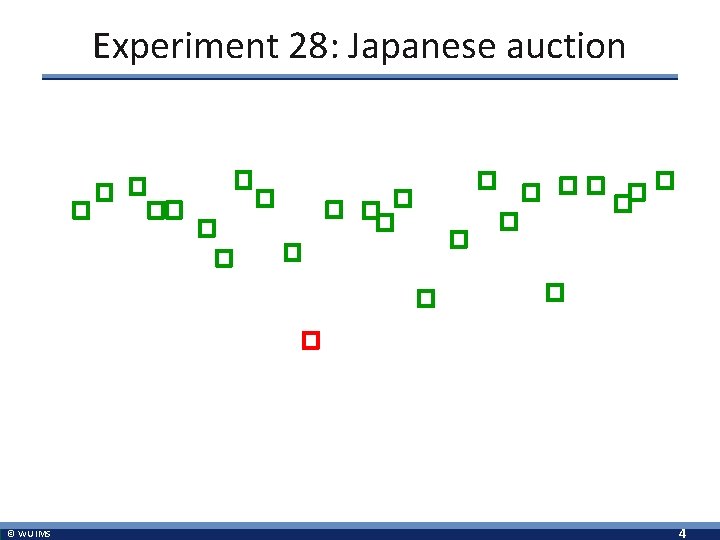
Experiment 28: Japanese auction § Experiment data c) Analyze the data set of the experiment. How do participants bid? © WU IMS 3
Experiment 28: Japanese auction © WU IMS 4