Exp 21 video time 17 54 minutes Exp

- Slides: 10
Exp. 21 – video (time: 17: 54 minutes) Exp. 21: Acid – Base Equilibria: Ionization Constant of an Acid, Ka Acids and bases are classified as “strong” or “weak”. strong - essentially complete (100%) ionization of an acid or base in water (leveling effect) weak - less than complete ionization in water 1 M 1 M (typically < 10%) HCl + H 2 O H 3 O+ + Cl- 1 M 1 M HBr + H 2 O H 3 O+ + Br-
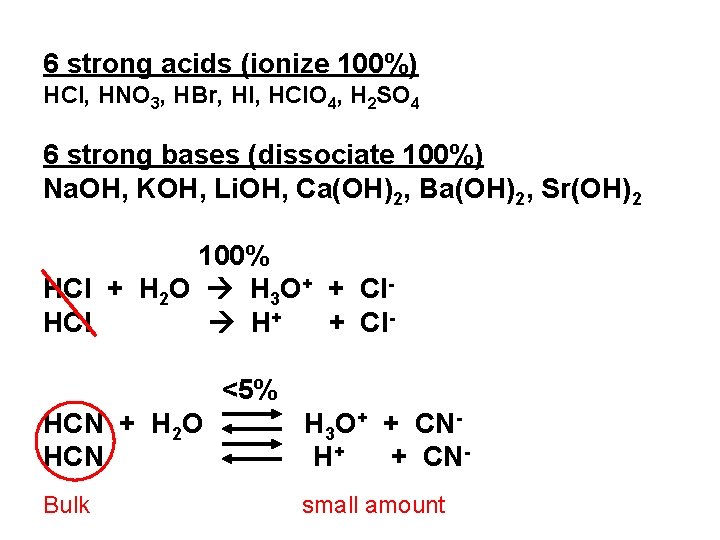
6 strong acids (ionize 100%) HCl, HNO 3, HBr, HI, HCl. O 4, H 2 SO 4 6 strong bases (dissociate 100%) Na. OH, KOH, Li. OH, Ca(OH)2, Ba(OH)2, Sr(OH)2 100% HCl + H 2 O H 3 O+ + Cl. HCl H+ + Cl<5% HCN + H 2 O HCN H 3 O+ + CNH+ + CN- Bulk small amount
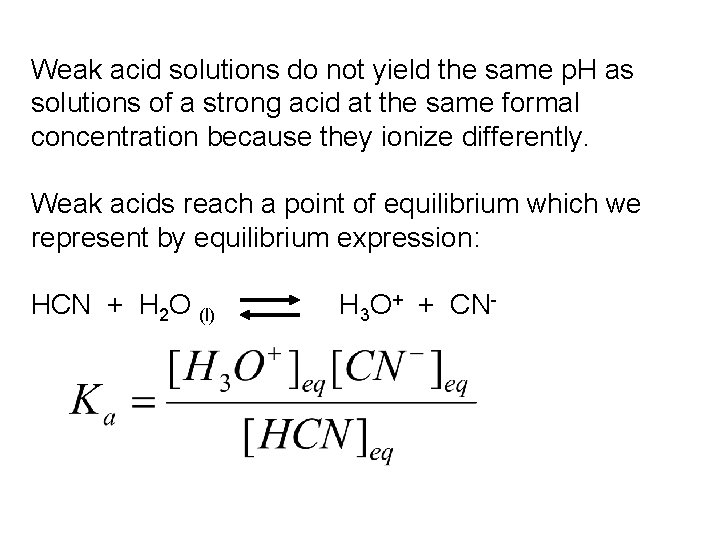
Weak acid solutions do not yield the same p. H as solutions of a strong acid at the same formal concentration because they ionize differently. Weak acids reach a point of equilibrium which we represent by equilibrium expression: HCN + H 2 O (l) H 3 O+ + CN-
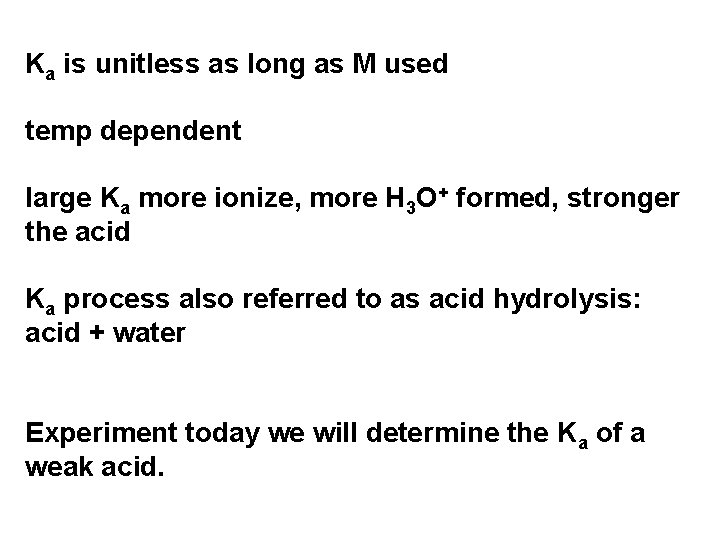
Ka is unitless as long as M used temp dependent large Ka more ionize, more H 3 O+ formed, stronger the acid Ka process also referred to as acid hydrolysis: acid + water Experiment today we will determine the Ka of a weak acid.
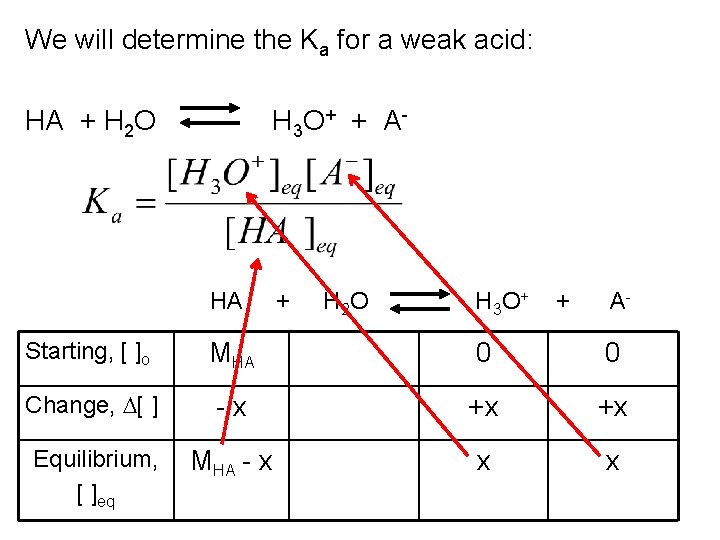
We will determine the Ka for a weak acid: HA + H 2 O H 3 O + + A - HA + H 2 O H 3 O + + A- Starting, [ ]o MHA 0 0 Change, D[ ] -x +x +x Equilibrium, [ ]eq MHA - x x x
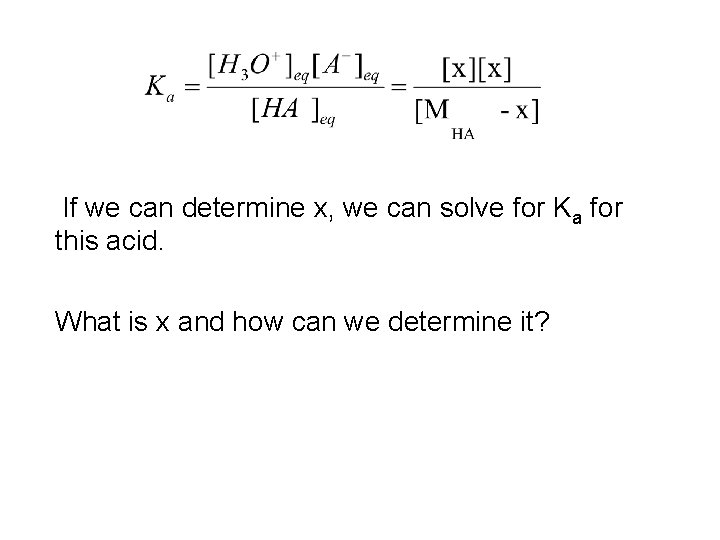
If we can determine x, we can solve for Ka for this acid. What is x and how can we determine it?
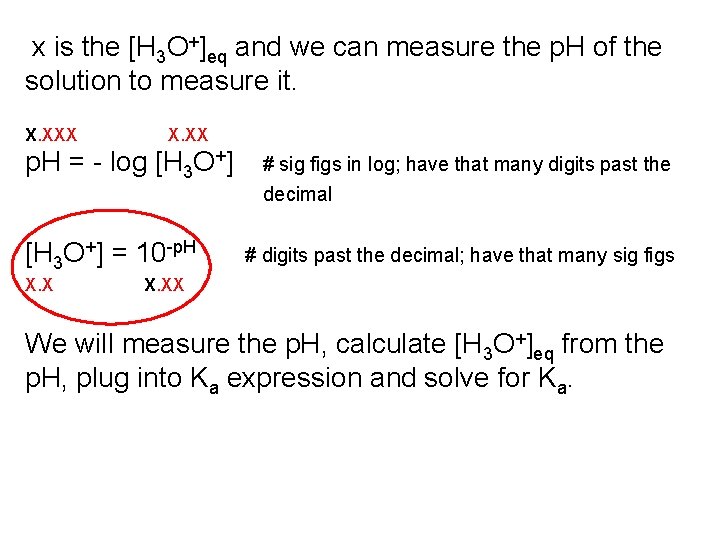
x is the [H 3 O+]eq and we can measure the p. H of the solution to measure it. X. XXX X. XX p. H = - log [H 3 O+] # sig figs in log; have that many digits past the decimal [H 3 O+] = 10 -p. H X. X # digits past the decimal; have that many sig figs X. XX We will measure the p. H, calculate [H 3 O+]eq from the p. H, plug into Ka expression and solve for Ka.
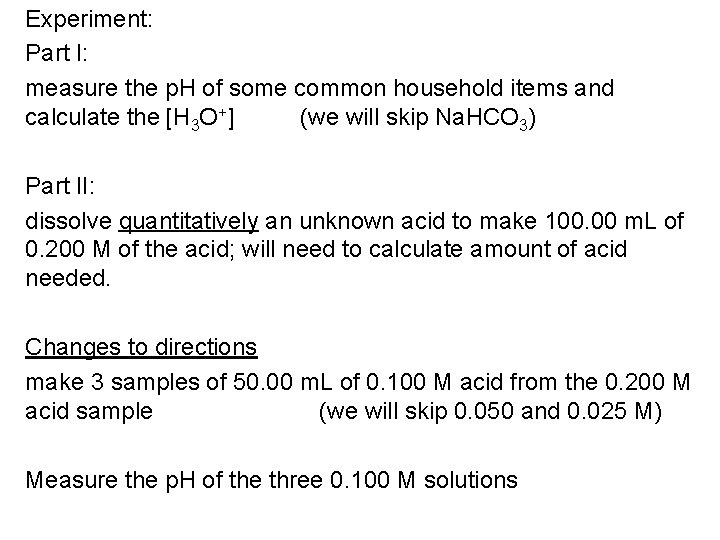
Experiment: Part I: measure the p. H of some common household items and calculate the [H 3 O+] (we will skip Na. HCO 3) Part II: dissolve quantitatively an unknown acid to make 100. 00 m. L of 0. 200 M of the acid; will need to calculate amount of acid needed. Changes to directions make 3 samples of 50. 00 m. L of 0. 100 M acid from the 0. 200 M acid sample (we will skip 0. 050 and 0. 025 M) Measure the p. H of the three 0. 100 M solutions
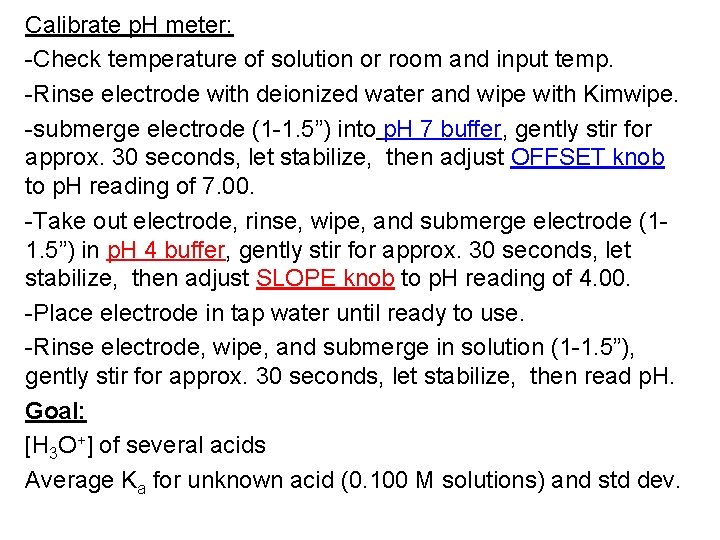
Calibrate p. H meter: -Check temperature of solution or room and input temp. -Rinse electrode with deionized water and wipe with Kimwipe. -submerge electrode (1 -1. 5”) into p. H 7 buffer, gently stir for approx. 30 seconds, let stabilize, then adjust OFFSET knob to p. H reading of 7. 00. -Take out electrode, rinse, wipe, and submerge electrode (11. 5”) in p. H 4 buffer, gently stir for approx. 30 seconds, let stabilize, then adjust SLOPE knob to p. H reading of 4. 00. -Place electrode in tap water until ready to use. -Rinse electrode, wipe, and submerge in solution (1 -1. 5”), gently stir for approx. 30 seconds, let stabilize, then read p. H. Goal: [H 3 O+] of several acids Average Ka for unknown acid (0. 100 M solutions) and std dev.
Additional question: During this semester we have used several instruments to conduct the experiments. After your conclusion in exp 21’s lab report, demonstrate how science and technology are interdependent by discussing cell phones. List three features of the modern cell phone that is possibly due to topics discussed in chemistry. For two of your responses, briefly connect the chemistry topic that allows these features to function.