Evaluating Your Physical Education Curriculum Chapter 13 Evaluation
- Slides: 16
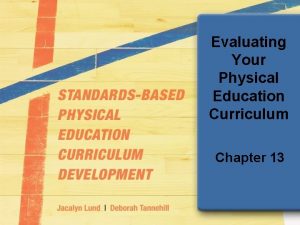
Evaluating Your Physical Education Curriculum Chapter 13
Evaluation • Systematic investigation of merit or worth using information gathered to make that decision (Guskey, 2000) • Needed in physical education to – Keep program current and dynamic – Inform curricular change decisions
Assessment and Evaluation • Assessment – Process of gathering information and data • Evaluation – Judgment – Based on criteria
Good Evaluation – Systematic – Direct and indirect data – Unbiased and fair – Involves stakeholders – Thorough
Defensible Data • Considers – Reliability • Findings are replicable – Validity • Appropriateness of measures
Contextual Statement • • • Climate/weather Cultural/religion Economic wealth Community facilities Regional resources
Purpose of Evaluation • Guides the data sources • Helps to determine – Degree to which goals are being met – Satisfaction of students – Program improvement – If you are doing what you intended
Preformative Evaluation • • • Prior to activity, program, or project Identifies goals Estimates impact Analysis of program implementation Helps to avoid costly mistakes
Formative Evaluation • Occurs during activity • Helps to redirect – Time, money, personnel, and resources • Proactive • Occurs multiple times
Summative Evaluation • • Occurs at conclusion of project Determines what was accomplished Used for accountability Frequently uses quantitative data
Curriculum Evaluation • • • Examine curricular goals Student performance assessments Views of stakeholders Teacher evaluations Facilities assessments
Indirect Measures • • • Afterschool program participation Non-school program participation Student readiness Enrollment in elective classes Attendance, dress, and participation
Student Fitness Levels • Many schools choose to focus on – How to get fit or devising personal plans • Caution about – Expecting all students to achieve a certain level – Setting criterion for particular tests (e. g. , a 6 -minute mile) – Curriculum aligning with fitness goals
NASPE STARS • Time • Teacher – Qualifications – Professional development – Professional involvement – Student ratio • Student health and safety • Facilities and equipment • • Program mission Curriculum Instructional practices Student assessment Inclusion Communication Program evaluation
PECAT • Physical Education Curriculum Analysis Tool • Based on NASPE standards • Developed by CDC in partnership with experts • http: //www. cdc. gov/Healthy. Youth
Evaluation Summary • Good evaluation – Informs programmatic change – Occurs on a regular basis – Is planned – Is based on multiple data sources • Data should inform decision, not make it