
Chapter 31 Health Assessment and Physical Examination Copyright

- Slides: 114
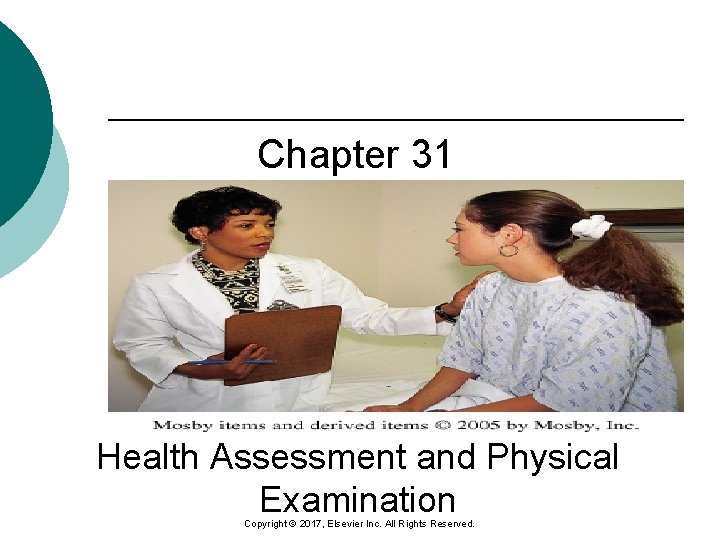
Chapter 31 Health Assessment and Physical Examination Copyright © 2017, Elsevier Inc. All Rights Reserved.
Objectives Perform physical head to toe assessment in an organized manner on an adult client ¡ Distinguish normal and abnormal findings ¡ Recognize normal signs of the aging process ¡ Determine normal findings in various ethnic groups ¡ Copyright © 2017, Elsevier Inc. All Rights Reserved. 2
Purposes of the Physical Examination Triage for emergency care ¡ Routine screening to promote health and wellness ¡ To determine eligibility for: ¡ l l l ¡ Health insurance Military service A new job To admit a patient to a hospital or long-term care facility Copyright © 2017, Elsevier Inc. All Rights Reserved. 3
Purposes of Physical Examination (Cont. ) ¡ Use physical examination to: l l l Gather baseline data about the patient’s health status. Supplement, confirm, or refute subjective data obtained in the nursing history. Identify and confirm nursing diagnoses. Make clinical decisions about a patient’s changing health status and management. Evaluate the outcomes of care. Copyright © 2017, Elsevier Inc. All Rights Reserved. 4
Quick Quiz! 1. When meeting a patient for the first time, it is important to establish a baseline assessment that will enable a nurse to refer back to: A. physiological outcomes of care. B. the normal range of physical findings. C. a pattern of findings identified when the patient is first assessed. D. clinical judgments made about a patient’s changing health status. Copyright © 2017, Elsevier Inc. All Rights Reserved. 5
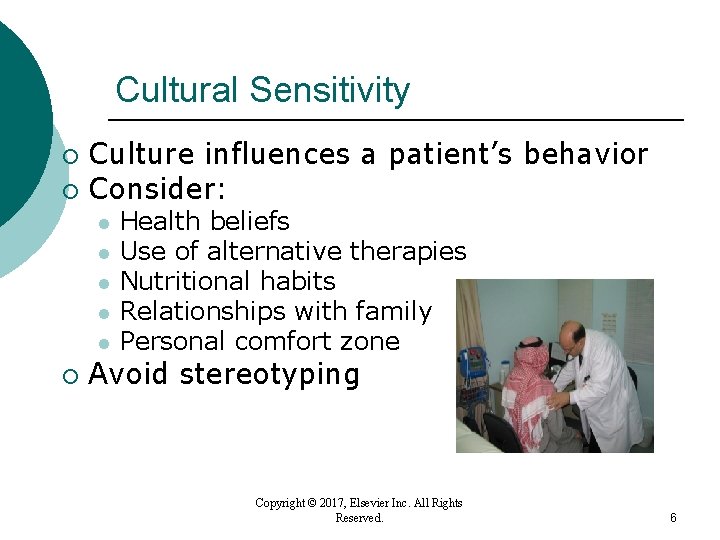
Cultural Sensitivity Culture influences a patient’s behavior ¡ Consider: ¡ l l l ¡ Health beliefs Use of alternative therapies Nutritional habits Relationships with family Personal comfort zone Avoid stereotyping Copyright © 2017, Elsevier Inc. All Rights Reserved. 6
Case Study (Cont. ) ¡ ¡ Mr. Neal is being admitted to the surgery floor for bowel surgery. He is 76 years old and has a history of rectal bleeding and bowel changes. He smokes 2 packs of cigarettes a day and says he has no family history of colon cancer. His wife is with him. Jane is a nursing student assigned to care for Mr. Neal. She begins her assessment with a review of Mr. Neal’s chart and the health care provider’s orders. Copyright © 2017, Elsevier Inc. All Rights Reserved. 7
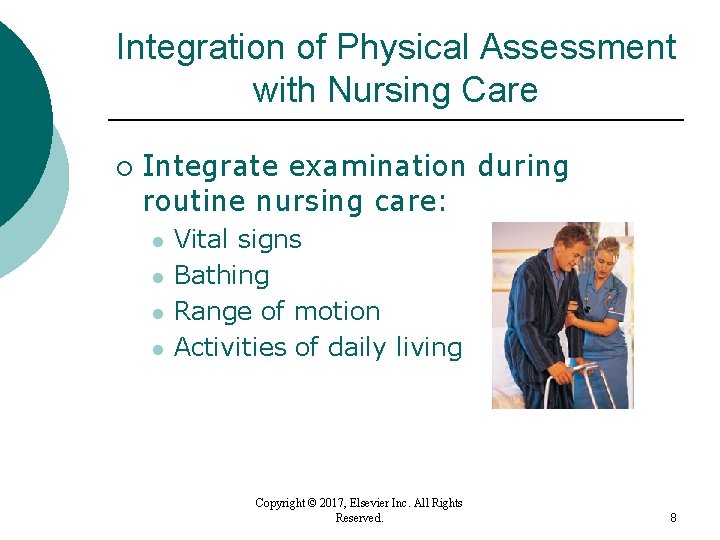
Integration of Physical Assessment with Nursing Care ¡ Integrate examination during routine nursing care: l l Vital signs Bathing Range of motion Activities of daily living Copyright © 2017, Elsevier Inc. All Rights Reserved. 8
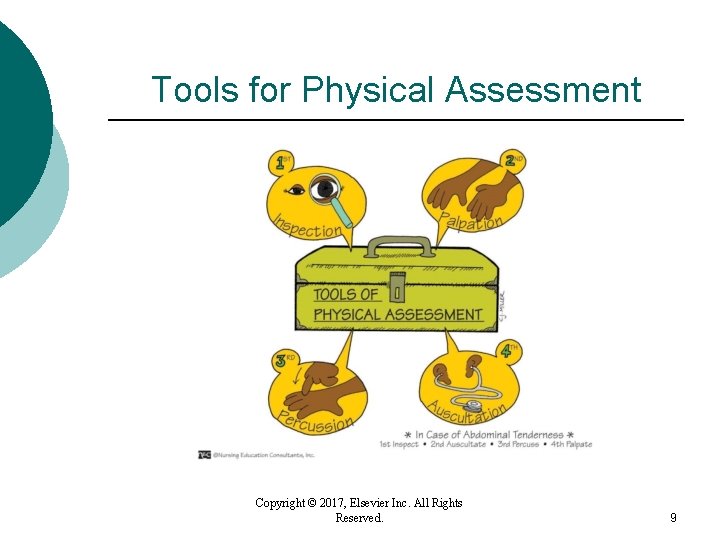
Tools for Physical Assessment Copyright © 2017, Elsevier Inc. All Rights Reserved. 9
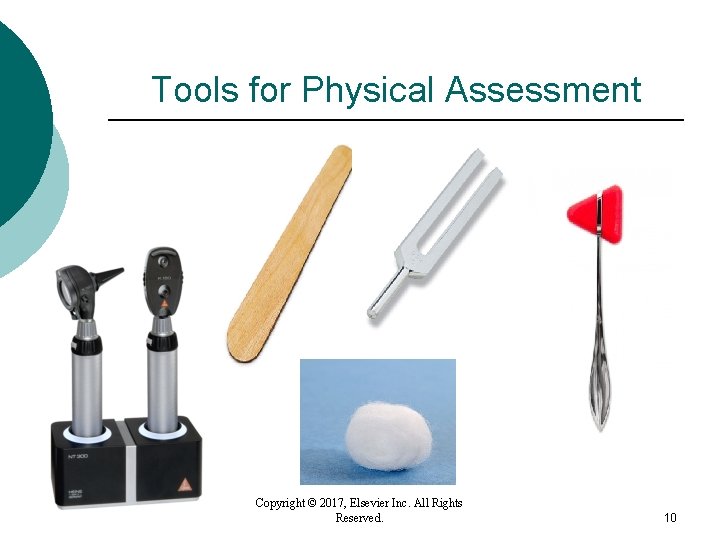
Tools for Physical Assessment Copyright © 2017, Elsevier Inc. All Rights Reserved. 10
Preparation for Examination Infection control ¡ Environment ¡ Equipment ¡ Physical preparation of patient ¡ l Positioning Psychological preparation of patient ¡ Assessment of age groups ¡ Copyright © 2017, Elsevier Inc. All Rights Reserved. 11
Organization of the Examination ¡ ¡ ¡ Assessment of each body system Systematic and organized Head-to-toe approach l Compare sides for symmetry l Assess body systems most at risk for being abnormal l Offer rest periods as needed l Perform painful procedures at the end l Be specific when recording assessments l Record quick notes during the examination; complete larger notes at the end of the examination Copyright © 2017, Elsevier Inc. All Rights Reserved. 12
Techniques of Physical Assessment Inspection ¡ Palpation ¡ Percussion ¡ Auscultation ¡ Copyright © 2017, Elsevier Inc. All Rights Reserved. 13
Inspection ¡ ¡ ¡ Use adequate lighting. Use direct lighting to inspect body cavities. Inspect each area for size, shape, color, symmetry, position, and abnormality. Position and expose body parts as needed so all surfaces can be viewed but privacy can be maintained. When possible, check for side-to-side symmetry. Validate findings with the patient. Copyright © 2017, Elsevier Inc. All Rights Reserved. 14
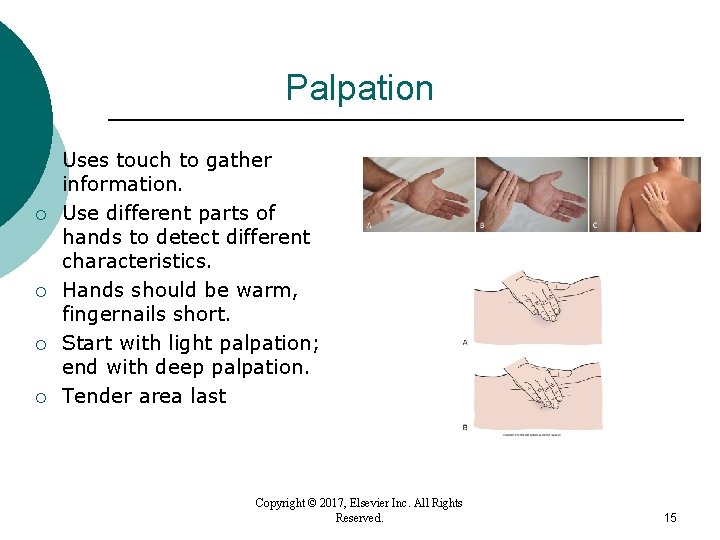
Palpation ¡ ¡ ¡ Uses touch to gather information. Use different parts of hands to detect different characteristics. Hands should be warm, fingernails short. Start with light palpation; end with deep palpation. Tender area last Copyright © 2017, Elsevier Inc. All Rights Reserved. 15
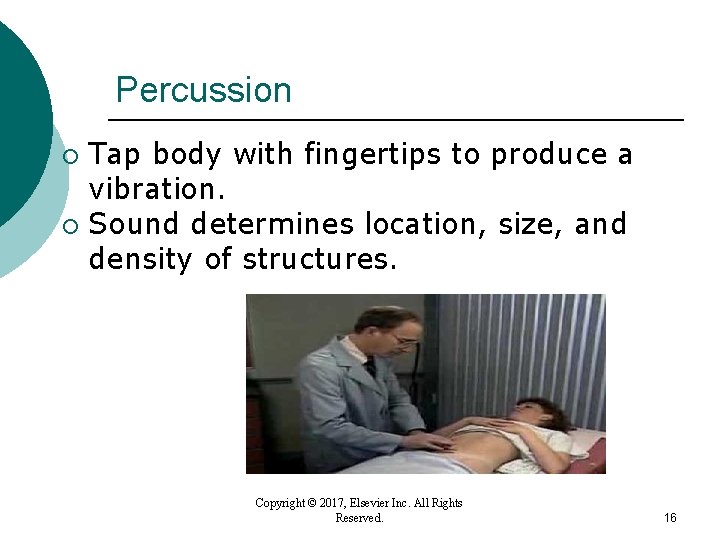
Percussion Tap body with fingertips to produce a vibration. ¡ Sound determines location, size, and density of structures. ¡ Copyright © 2017, Elsevier Inc. All Rights Reserved. 16
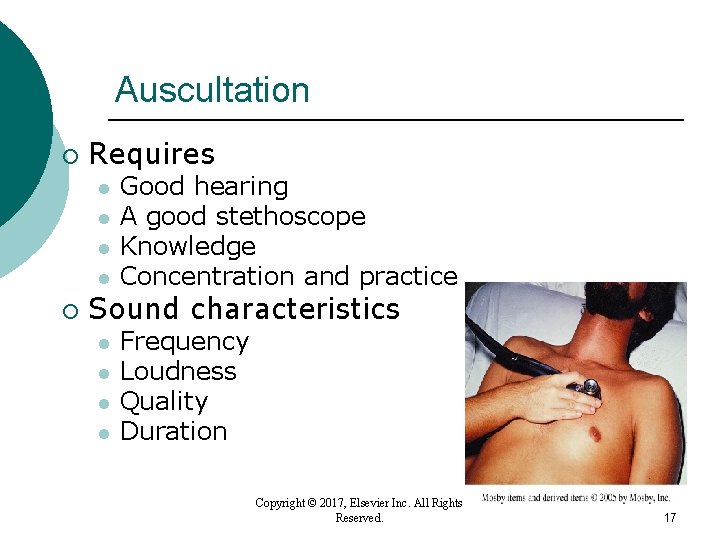
Auscultation ¡ Requires l l ¡ Good hearing A good stethoscope Knowledge Concentration and practice Sound characteristics l l Frequency Loudness Quality Duration Copyright © 2017, Elsevier Inc. All Rights Reserved. 17
General Survey General appearance and behavior l l l l Gender and race Age Signs of distress Body type Posture Gait Body movement l l l l Hygiene and grooming Dress Body odor Affect and mood Speech Signs of patient abuse Substance abuse Copyright © 2017, Elsevier Inc. All Rights Reserved. 18
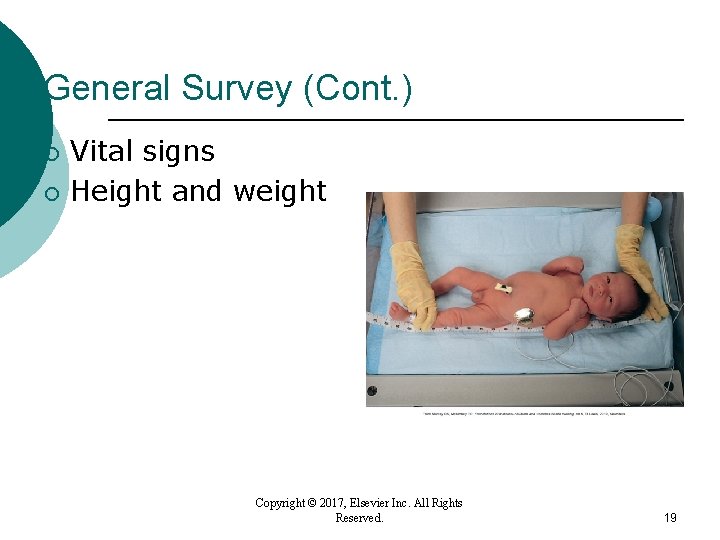
General Survey (Cont. ) ¡ ¡ Vital signs Height and weight Copyright © 2017, Elsevier Inc. All Rights Reserved. 19
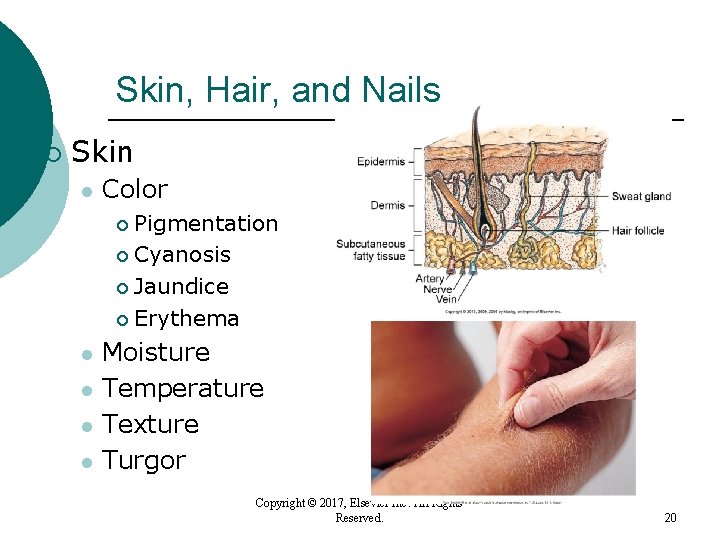
Skin, Hair, and Nails ¡ Skin l Color Pigmentation ¡ Cyanosis ¡ Jaundice ¡ Erythema ¡ l l Moisture Temperature Texture Turgor Copyright © 2017, Elsevier Inc. All Rights Reserved. 20
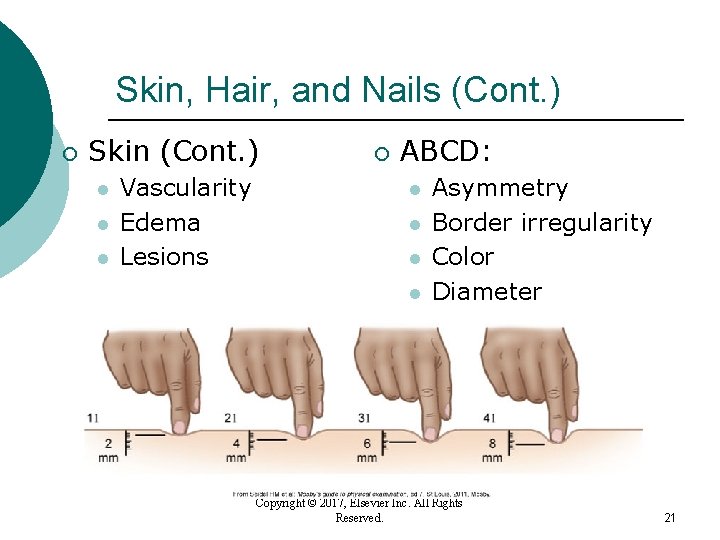
Skin, Hair, and Nails (Cont. ) ¡ Skin (Cont. ) l l l Vascularity Edema Lesions ¡ ABCD: l l Asymmetry Border irregularity Color Diameter Copyright © 2017, Elsevier Inc. All Rights Reserved. 21
Quick Quiz! 2. A patient complains of thirst and headache. The patient appears emaciated. Upon initial examination, you find that the skin does not return to normal shape. Which assessment is consistent with this finding? A. Pallor. B. Edema. C. Erythema. D. Poor skin turgor. Copyright © 2017, Elsevier Inc. All Rights Reserved. 22
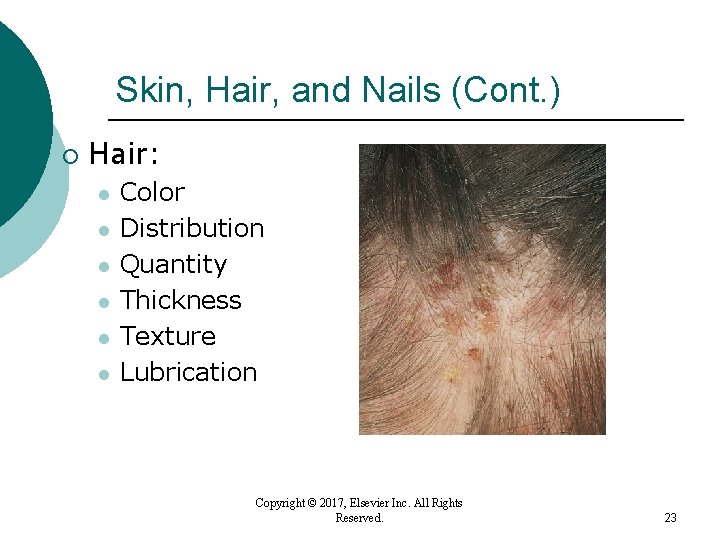
Skin, Hair, and Nails (Cont. ) ¡ Hair: l l l Color Distribution Quantity Thickness Texture Lubrication Copyright © 2017, Elsevier Inc. All Rights Reserved. 23
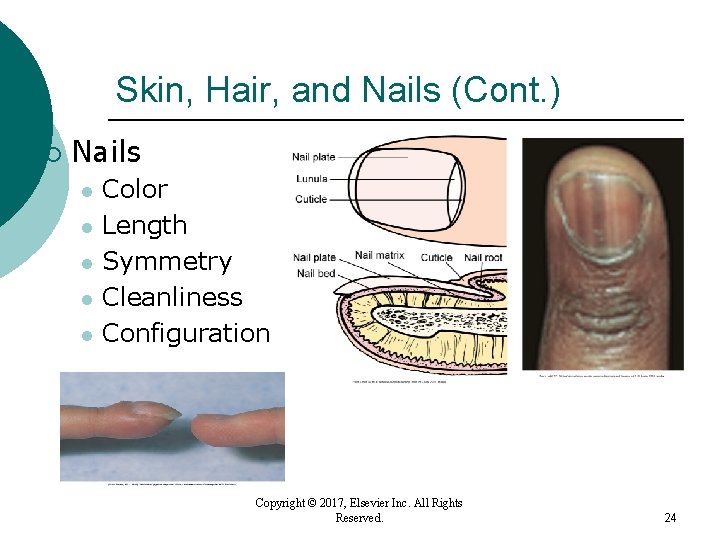
Skin, Hair, and Nails (Cont. ) ¡ Nails l l l Color Length Symmetry Cleanliness Configuration Copyright © 2017, Elsevier Inc. All Rights Reserved. 24
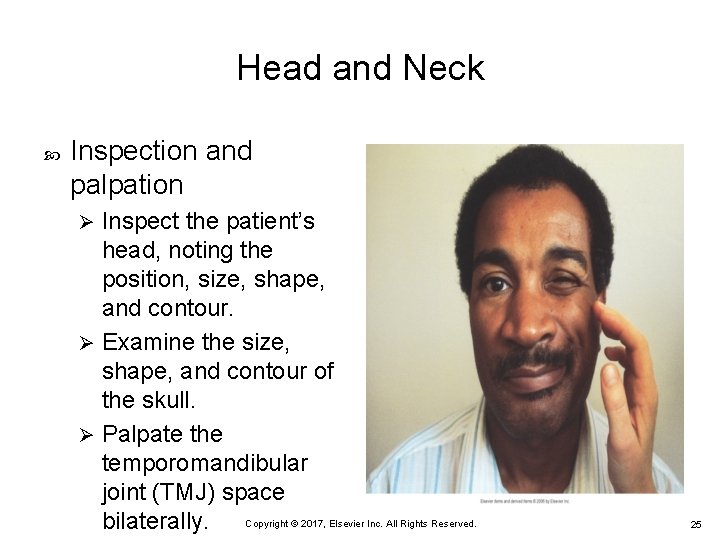
Head and Neck Inspection and palpation Inspect the patient’s head, noting the position, size, shape, and contour. Ø Examine the size, shape, and contour of the skull. Ø Palpate the temporomandibular joint (TMJ) space bilaterally. Copyright © 2017, Elsevier Inc. All Rights Reserved. Ø 25
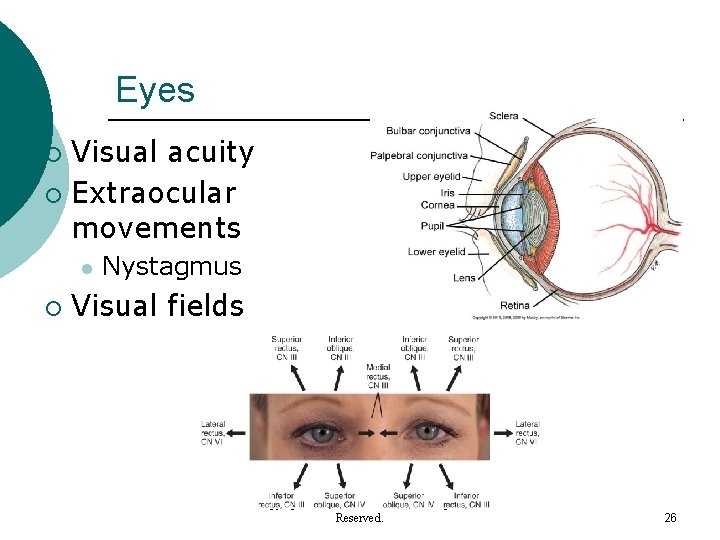
Eyes Visual acuity ¡ Extraocular movements ¡ l ¡ Nystagmus Visual fields Copyright © 2017, Elsevier Inc. All Rights Reserved. 26
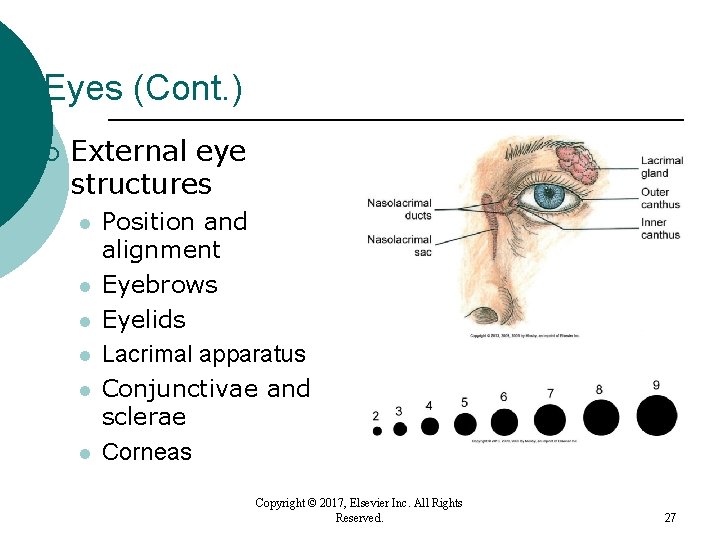
Eyes (Cont. ) ¡ External eye structures l l l Position and alignment Eyebrows Eyelids Lacrimal apparatus Conjunctivae and sclerae Corneas Copyright © 2017, Elsevier Inc. All Rights Reserved. 27
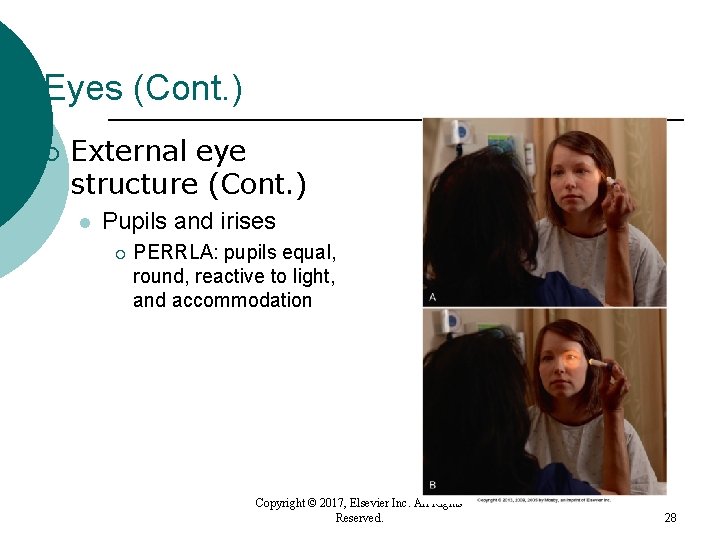
Eyes (Cont. ) ¡ External eye structure (Cont. ) l Pupils and irises ¡ PERRLA: pupils equal, round, reactive to light, and accommodation Copyright © 2017, Elsevier Inc. All Rights Reserved. 28
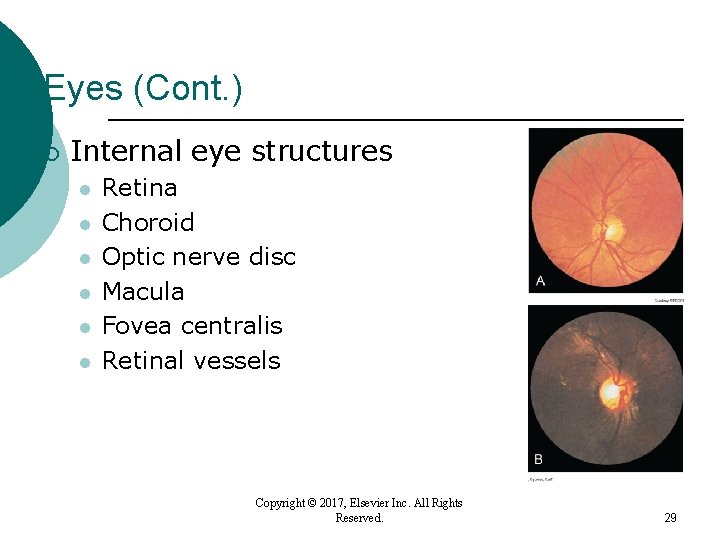
Eyes (Cont. ) ¡ Internal eye structures l l l Retina Choroid Optic nerve disc Macula Fovea centralis Retinal vessels Copyright © 2017, Elsevier Inc. All Rights Reserved. 29
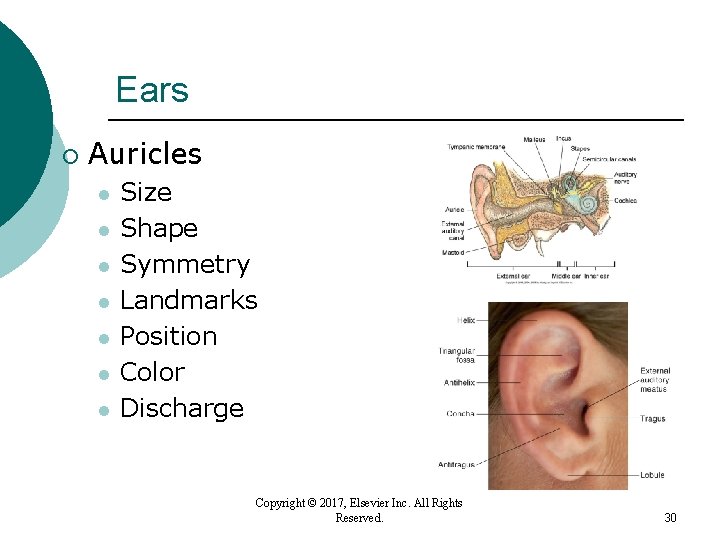
Ears ¡ Auricles l l l l Size Shape Symmetry Landmarks Position Color Discharge Copyright © 2017, Elsevier Inc. All Rights Reserved. 30
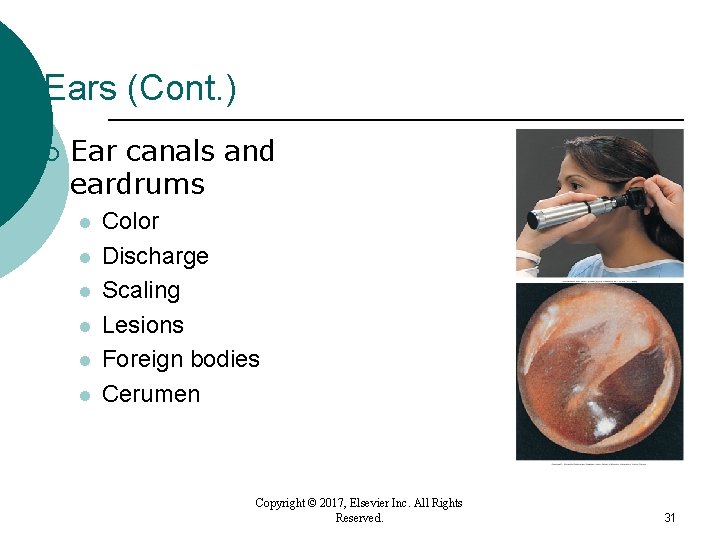
Ears (Cont. ) ¡ Ear canals and eardrums l l l Color Discharge Scaling Lesions Foreign bodies Cerumen Copyright © 2017, Elsevier Inc. All Rights Reserved. 31
Ears (Cont. ) ¡ Hearing acuity l l l Three types of hearing loss (conduction, sensorineural, and mixed) Ototoxicity If a hearing loss is present, test the hearing using a tuning fork. Copyright © 2017, Elsevier Inc. All Rights Reserved. 32
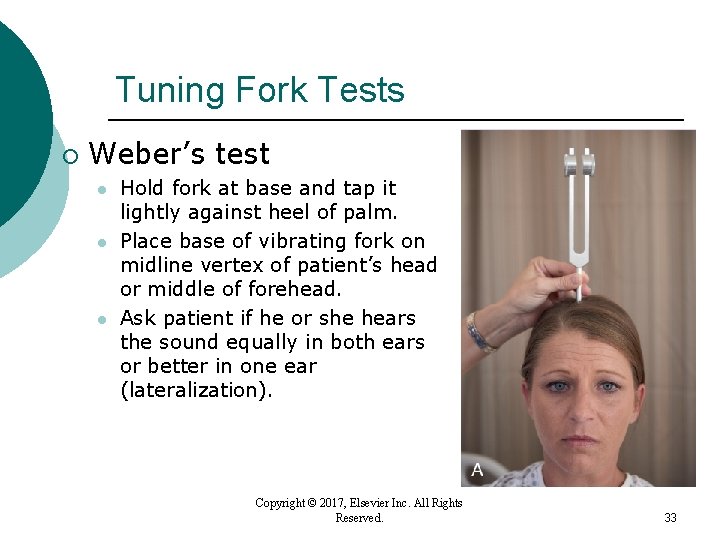
Tuning Fork Tests ¡ Weber’s test l l l Hold fork at base and tap it lightly against heel of palm. Place base of vibrating fork on midline vertex of patient’s head or middle of forehead. Ask patient if he or she hears the sound equally in both ears or better in one ear (lateralization). Copyright © 2017, Elsevier Inc. All Rights Reserved. 33
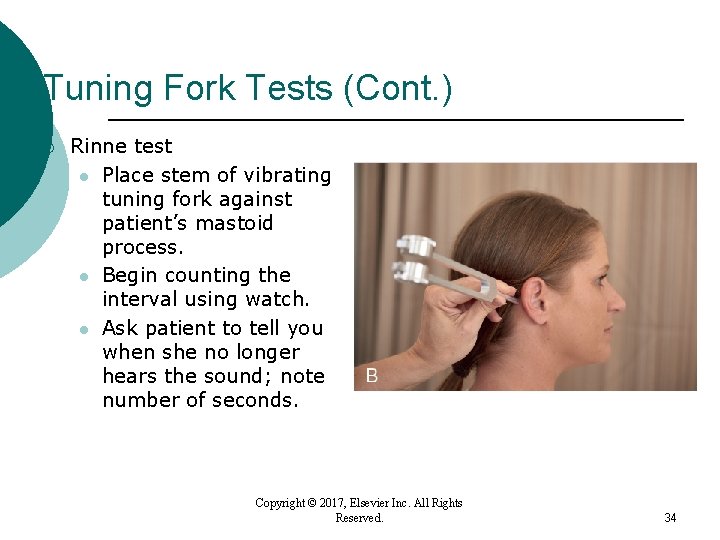
Tuning Fork Tests (Cont. ) ¡ Rinne test l Place stem of vibrating tuning fork against patient’s mastoid process. l Begin counting the interval using watch. l Ask patient to tell you when she no longer hears the sound; note number of seconds. Copyright © 2017, Elsevier Inc. All Rights Reserved. 34
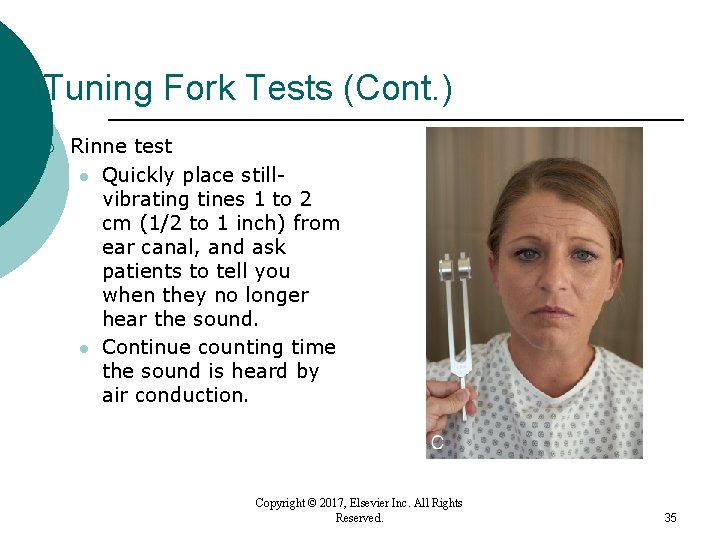
Tuning Fork Tests (Cont. ) ¡ Rinne test l Quickly place stillvibrating tines 1 to 2 cm (1/2 to 1 inch) from ear canal, and ask patients to tell you when they no longer hear the sound. l Continue counting time the sound is heard by air conduction. Copyright © 2017, Elsevier Inc. All Rights Reserved. 35
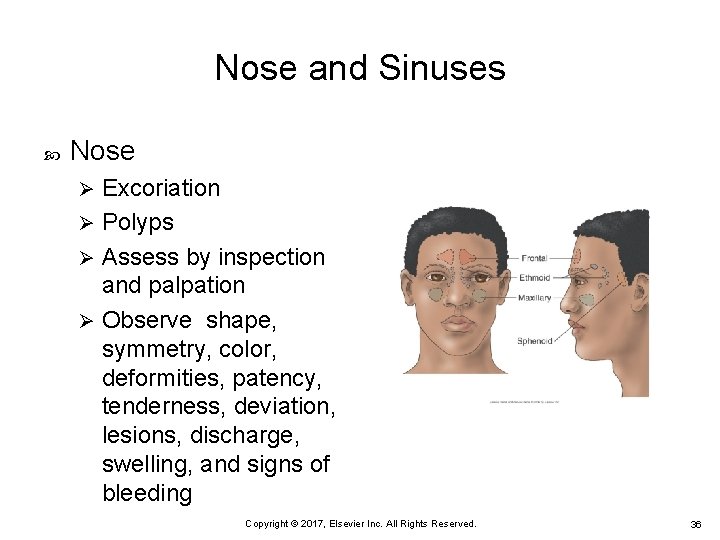
Nose and Sinuses Nose Excoriation Ø Polyps Ø Assess by inspection and palpation Ø Observe shape, symmetry, color, deformities, patency, tenderness, deviation, lesions, discharge, swelling, and signs of bleeding Ø Copyright © 2017, Elsevier Inc. All Rights Reserved. 36
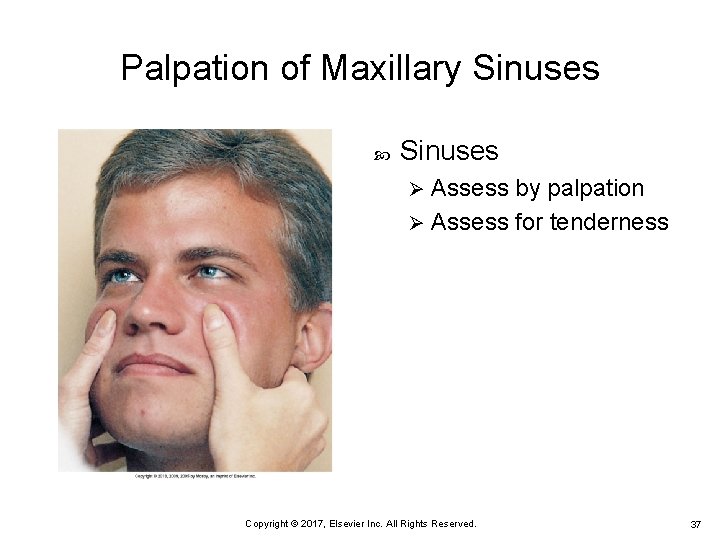
Palpation of Maxillary Sinuses Assess by palpation Ø Assess for tenderness Ø Copyright © 2017, Elsevier Inc. All Rights Reserved. 37
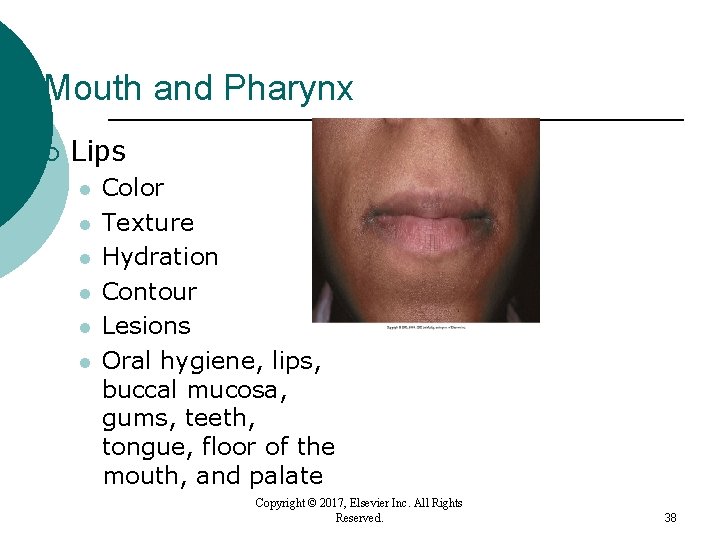
Mouth and Pharynx ¡ Lips l l l Color Texture Hydration Contour Lesions Oral hygiene, lips, buccal mucosa, gums, teeth, tongue, floor of the mouth, and palate Copyright © 2017, Elsevier Inc. All Rights Reserved. 38
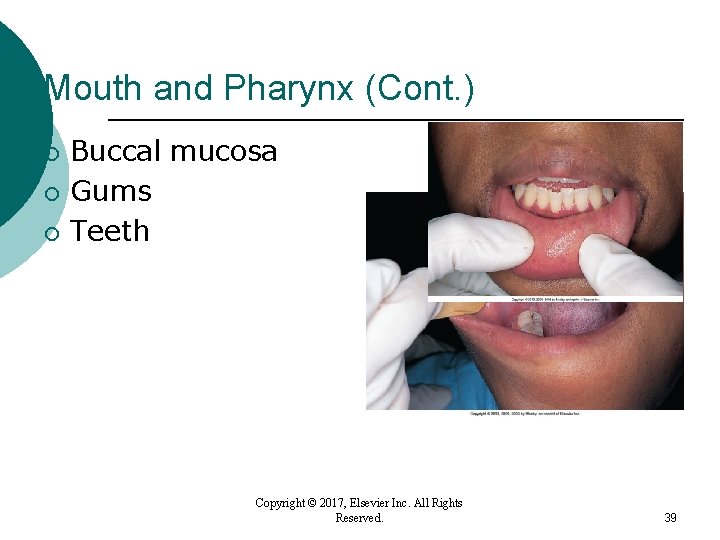
Mouth and Pharynx (Cont. ) ¡ ¡ ¡ Buccal mucosa Gums Teeth Copyright © 2017, Elsevier Inc. All Rights Reserved. 39
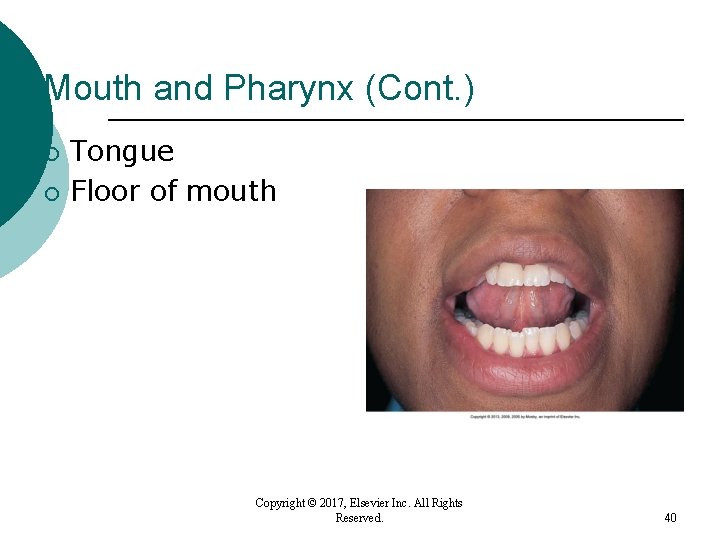
Mouth and Pharynx (Cont. ) ¡ ¡ Tongue Floor of mouth Copyright © 2017, Elsevier Inc. All Rights Reserved. 40
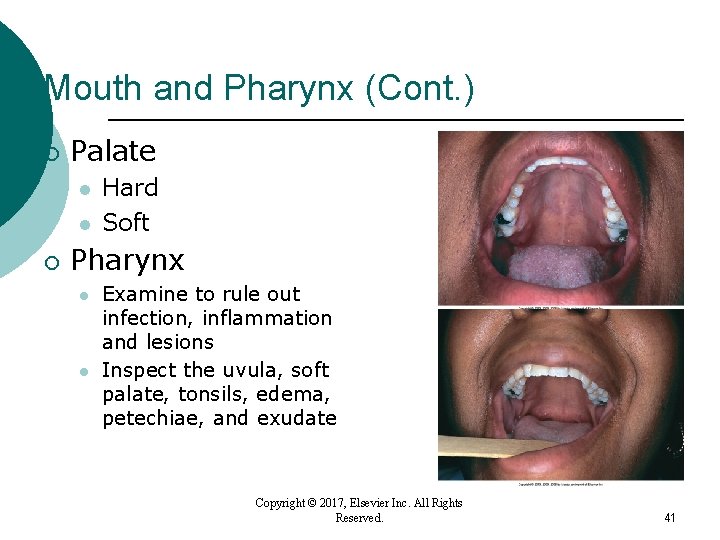
Mouth and Pharynx (Cont. ) ¡ Palate l l ¡ Hard Soft Pharynx l l Examine to rule out infection, inflammation and lesions Inspect the uvula, soft palate, tonsils, edema, petechiae, and exudate Copyright © 2017, Elsevier Inc. All Rights Reserved. 41
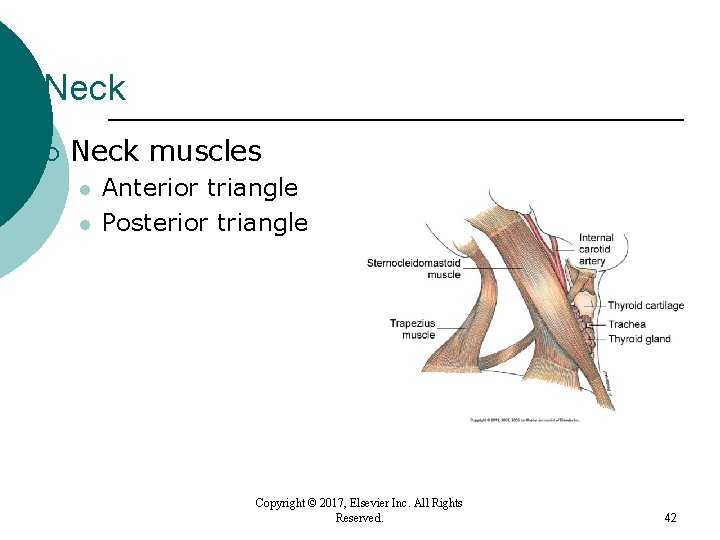
Neck ¡ Neck muscles l l Anterior triangle Posterior triangle Copyright © 2017, Elsevier Inc. All Rights Reserved. 42
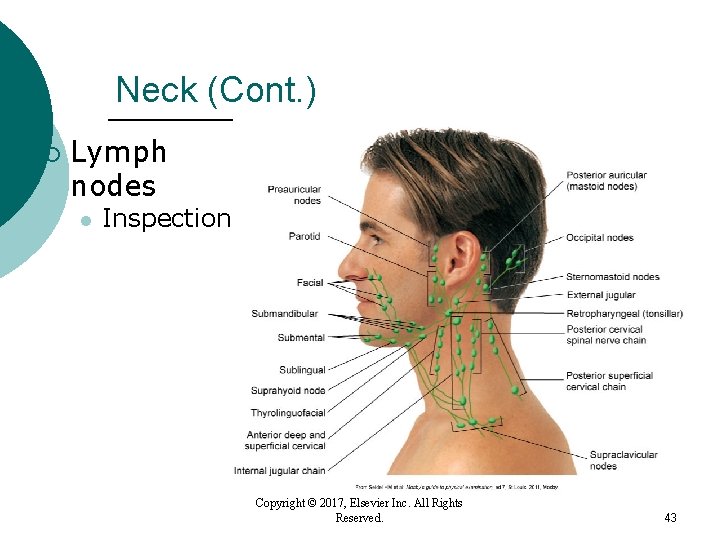
Neck (Cont. ) ¡ Lymph nodes l Inspection Copyright © 2017, Elsevier Inc. All Rights Reserved. 43
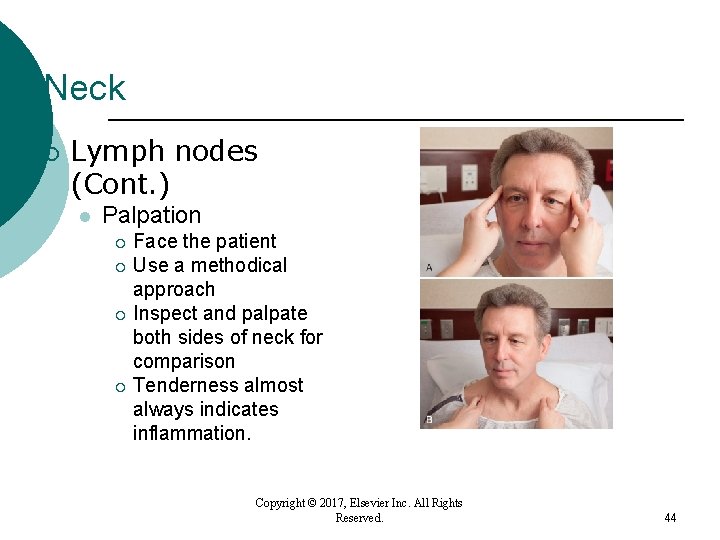
Neck ¡ Lymph nodes (Cont. ) l Palpation Face the patient ¡ Use a methodical approach ¡ Inspect and palpate both sides of neck for comparison ¡ Tenderness almost always indicates inflammation. ¡ Copyright © 2017, Elsevier Inc. All Rights Reserved. 44
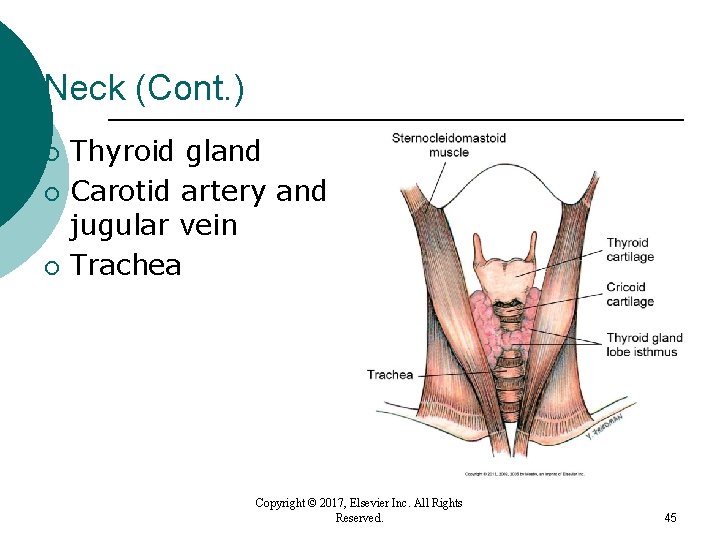
Neck (Cont. ) ¡ ¡ ¡ Thyroid gland Carotid artery and jugular vein Trachea Copyright © 2017, Elsevier Inc. All Rights Reserved. 45
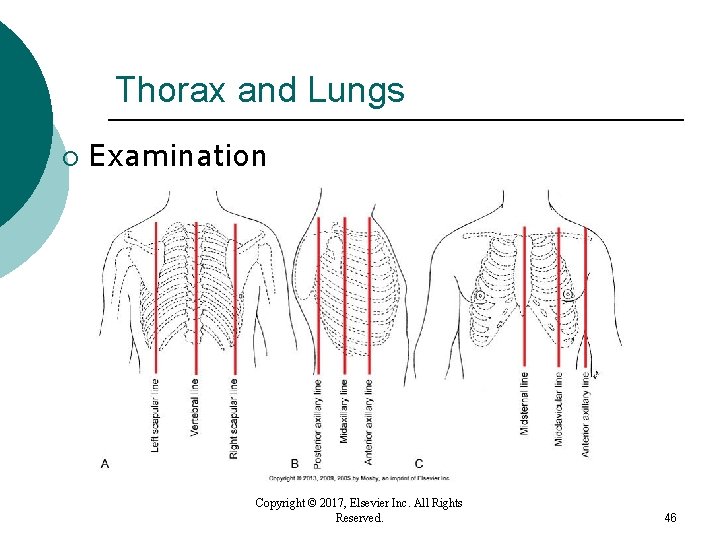
Thorax and Lungs ¡ Examination Copyright © 2017, Elsevier Inc. All Rights Reserved. 46
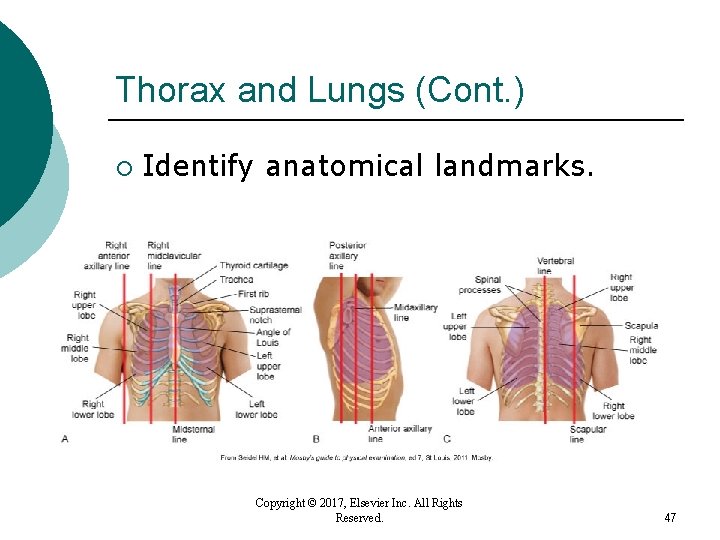
Thorax and Lungs (Cont. ) ¡ Identify anatomical landmarks. Copyright © 2017, Elsevier Inc. All Rights Reserved. 47
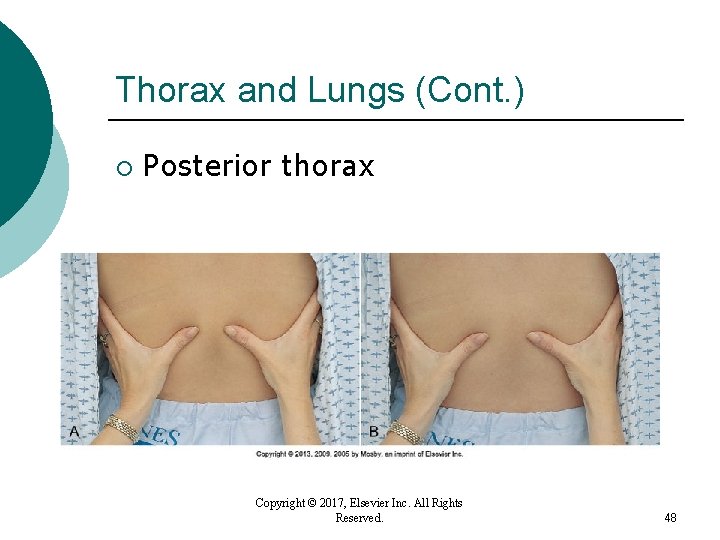
Thorax and Lungs (Cont. ) ¡ Posterior thorax Copyright © 2017, Elsevier Inc. All Rights Reserved. 48
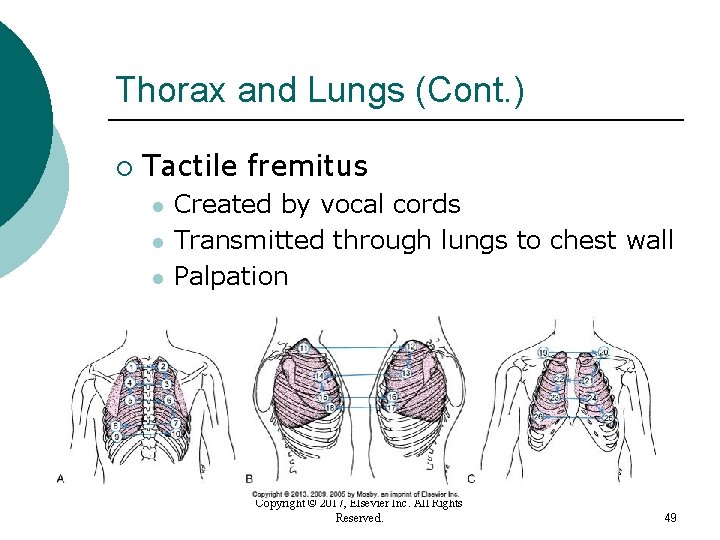
Thorax and Lungs (Cont. ) ¡ Tactile fremitus l l l Created by vocal cords Transmitted through lungs to chest wall Palpation Copyright © 2017, Elsevier Inc. All Rights Reserved. 49
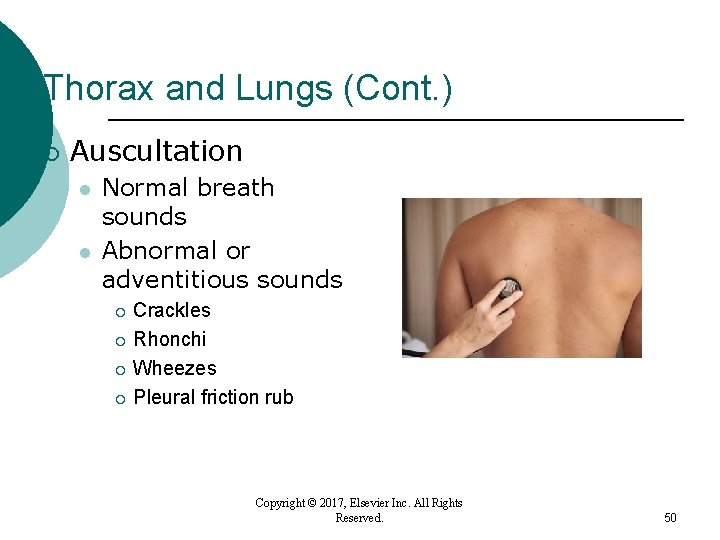
Thorax and Lungs (Cont. ) ¡ Auscultation l l Normal breath sounds Abnormal or adventitious sounds Crackles ¡ Rhonchi ¡ Wheezes ¡ Pleural friction rub ¡ Copyright © 2017, Elsevier Inc. All Rights Reserved. 50
Quick Quiz! 3. A patient is admitted with pneumonia. When auscultating the patient’s chest, you hear low-pitched, continuous sounds over the bronchi. These sounds are labeled as: A. crackles. B. rhonchi. C. wheezes. D. pleural rub. Copyright © 2017, Elsevier Inc. All Rights Reserved. 51
Thorax and Lungs (Cont. ) ¡ Lateral thorax l ¡ Vesicular sounds Anterior thorax l l l Observe accessory muscles. Palpate muscles and skeleton. Assess tactile fremitus. Compare right and left sides. Auscultate for bronchial sounds. Copyright © 2017, Elsevier Inc. All Rights Reserved. 52
Case Study (Cont. ) ¡ During her lung assessment, Jane recognizes that there is a patientteaching opportunity with Mr. Neal. l What issue does Jane need to address? Copyright © 2017, Elsevier Inc. All Rights Reserved. 53
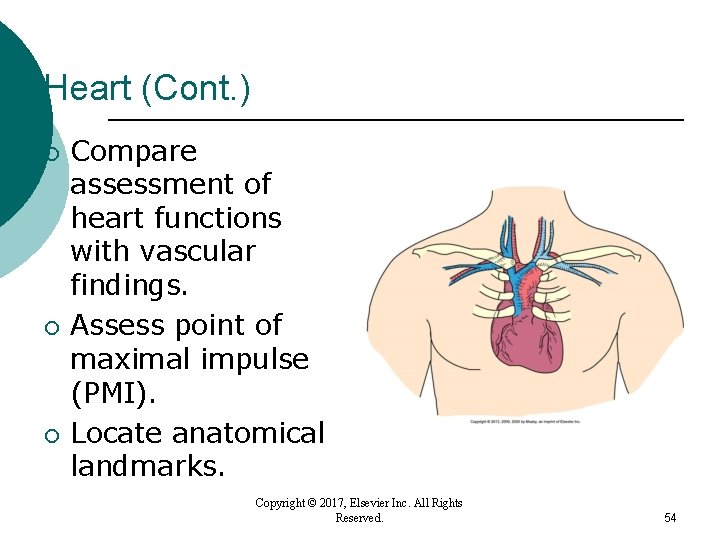
Heart (Cont. ) ¡ ¡ ¡ Compare assessment of heart functions with vascular findings. Assess point of maximal impulse (PMI). Locate anatomical landmarks. Copyright © 2017, Elsevier Inc. All Rights Reserved. 54
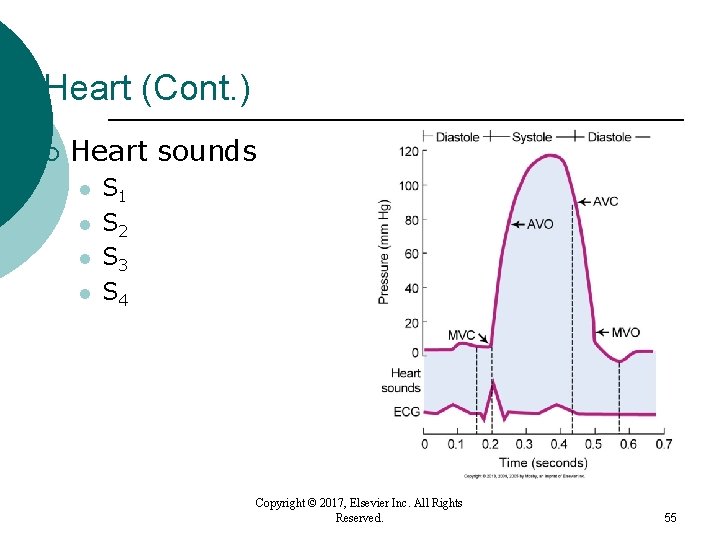
Heart (Cont. ) ¡ Heart sounds l l S 1 S 2 S 3 S 4 Copyright © 2017, Elsevier Inc. All Rights Reserved. 55
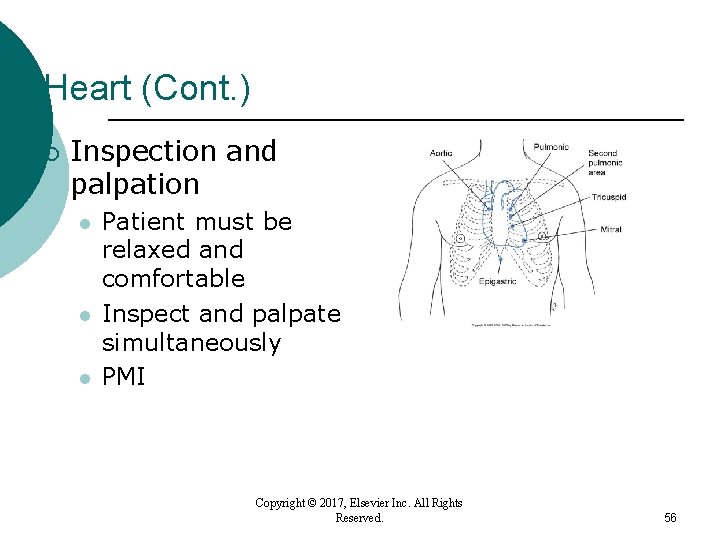
Heart (Cont. ) ¡ Inspection and palpation l l l Patient must be relaxed and comfortable Inspect and palpate simultaneously PMI Copyright © 2017, Elsevier Inc. All Rights Reserved. 56
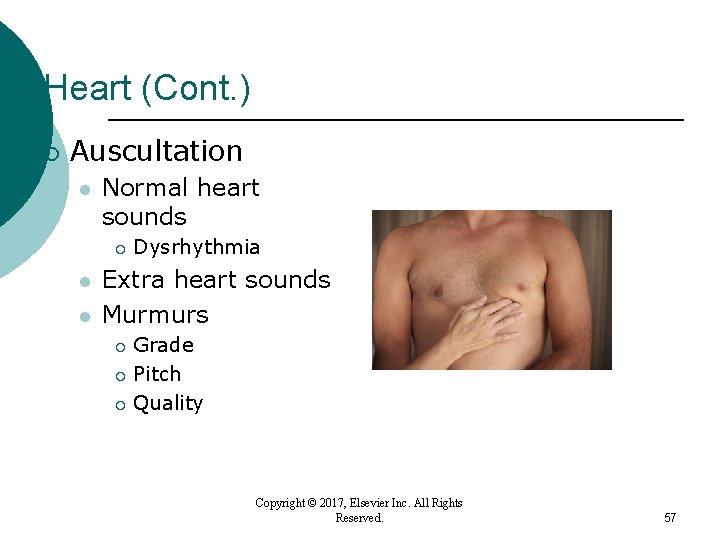
Heart (Cont. ) ¡ Auscultation l Normal heart sounds ¡ l l Dysrhythmia Extra heart sounds Murmurs Grade ¡ Pitch ¡ Quality ¡ Copyright © 2017, Elsevier Inc. All Rights Reserved. 57
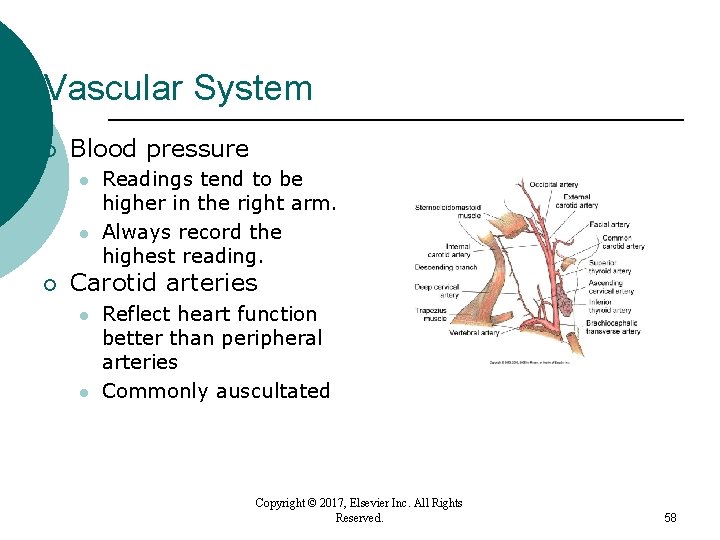
Vascular System ¡ Blood pressure l l ¡ Readings tend to be higher in the right arm. Always record the highest reading. Carotid arteries l l Reflect heart function better than peripheral arteries Commonly auscultated Copyright © 2017, Elsevier Inc. All Rights Reserved. 58
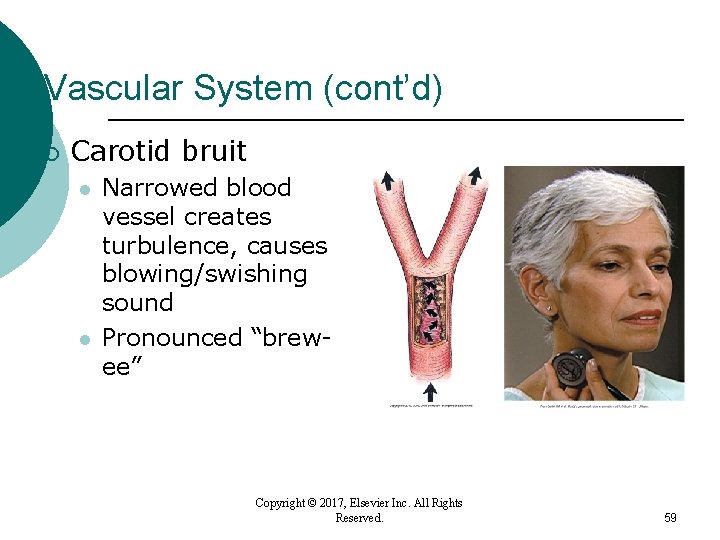
Vascular System (cont’d) ¡ Carotid bruit l l Narrowed blood vessel creates turbulence, causes blowing/swishing sound Pronounced “brewee” Copyright © 2017, Elsevier Inc. All Rights Reserved. 59
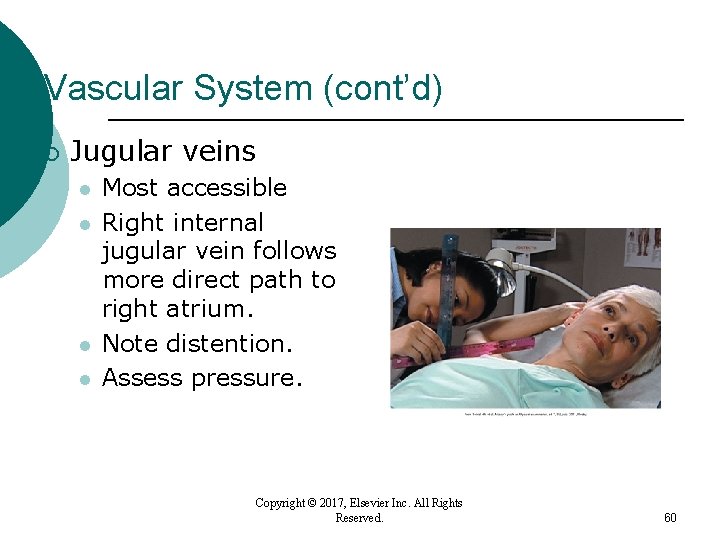
Vascular System (cont’d) ¡ Jugular veins l l Most accessible Right internal jugular vein follows more direct path to right atrium. Note distention. Assess pressure. Copyright © 2017, Elsevier Inc. All Rights Reserved. 60
Vascular System (Cont. ) ¡ Peripheral arteries and veins l l l Assess the adequacy of blood flow to the extremities by measuring arterial pulses and inspecting the condition of the skin and nails. Assess the integrity of the venous system. Assess the arterial pulses in the extremities to determine sufficiency of the entire arterial circulation. Copyright © 2017, Elsevier Inc. All Rights Reserved. 61
Vascular System (Cont. ) ¡ Peripheral arteries l l Assess each peripheral artery for elasticity of the vessel wall, strength, and equality. Pulses 0: ¡ 1: ¡ 2: ¡ 3: ¡ 4: ¡ absent, not palpable pulse diminished, barely palpable expected/normal full pulse, increased bounding pulse Copyright © 2017, Elsevier Inc. All Rights Reserved. 62
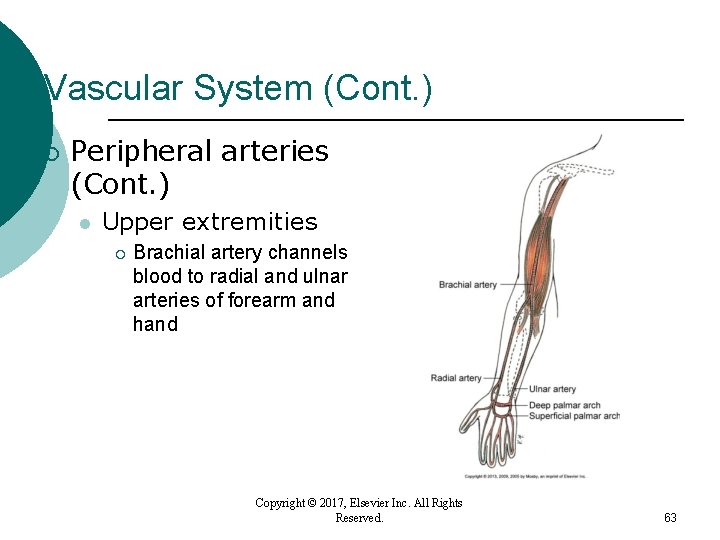
Vascular System (Cont. ) ¡ Peripheral arteries (Cont. ) l Upper extremities ¡ Brachial artery channels blood to radial and ulnar arteries of forearm and hand Copyright © 2017, Elsevier Inc. All Rights Reserved. 63
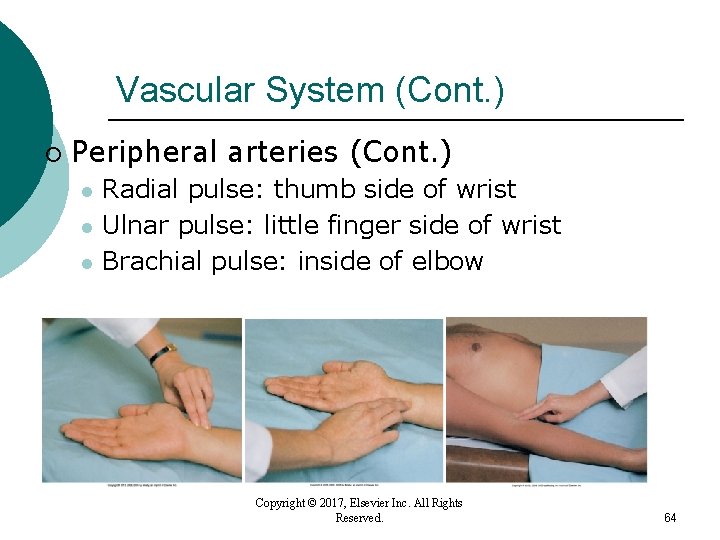
Vascular System (Cont. ) ¡ Peripheral arteries (Cont. ) l l l Radial pulse: thumb side of wrist Ulnar pulse: little finger side of wrist Brachial pulse: inside of elbow Copyright © 2017, Elsevier Inc. All Rights Reserved. 64
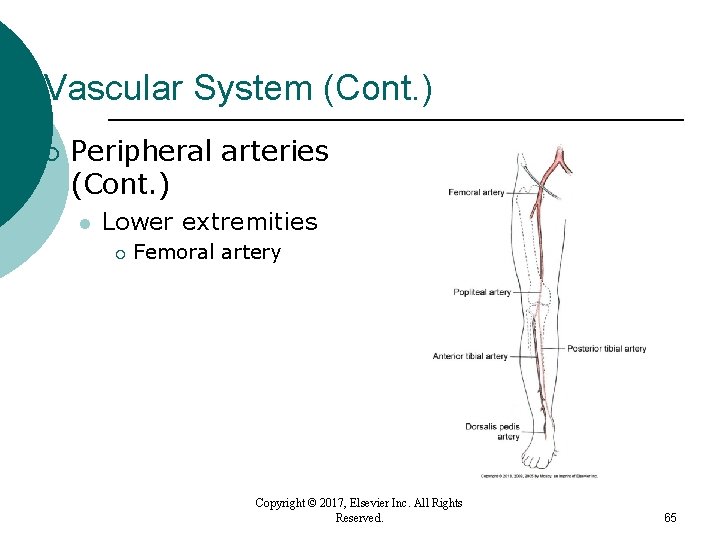
Vascular System (Cont. ) ¡ Peripheral arteries (Cont. ) l Lower extremities ¡ Femoral artery Copyright © 2017, Elsevier Inc. All Rights Reserved. 65
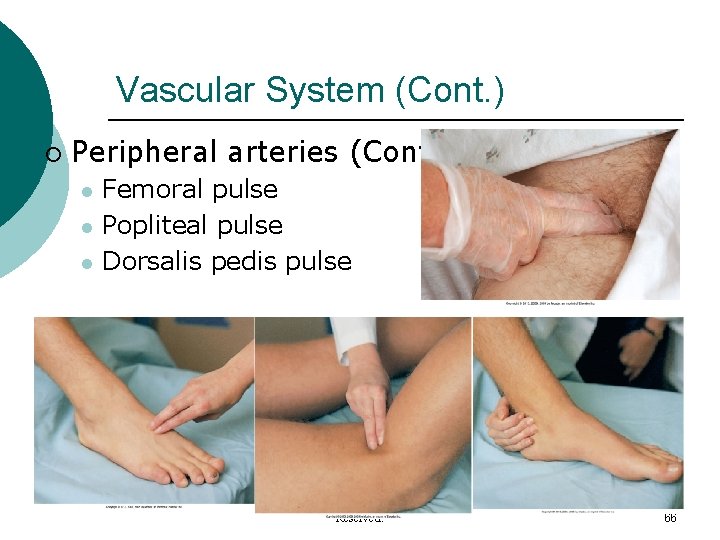
Vascular System (Cont. ) ¡ Peripheral arteries (Cont. ) l l l Femoral pulse Popliteal pulse Dorsalis pedis pulse Copyright © 2017, Elsevier Inc. All Rights Reserved. 66
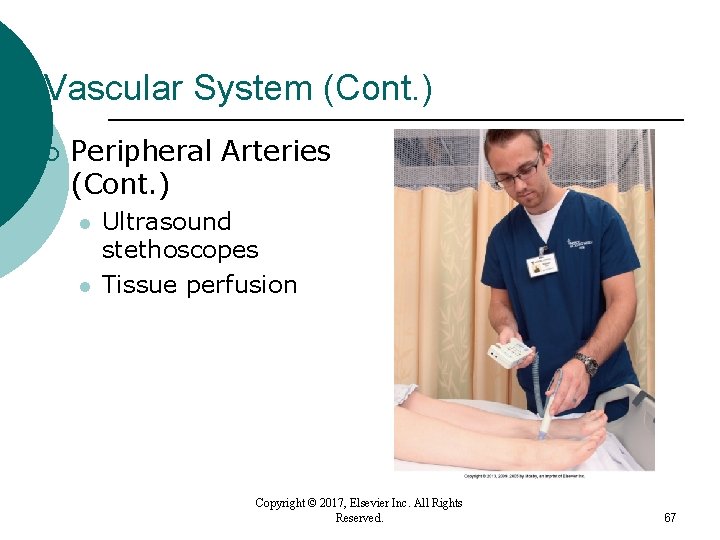
Vascular System (Cont. ) ¡ Peripheral Arteries (Cont. ) l l Ultrasound stethoscopes Tissue perfusion Copyright © 2017, Elsevier Inc. All Rights Reserved. 67
Vascular System (Cont. ) ¡ Peripheral Veins l l Varicosities Peripheral edema ¡ l Pitting edema Phlebitis Copyright © 2017, Elsevier Inc. All Rights Reserved. 68
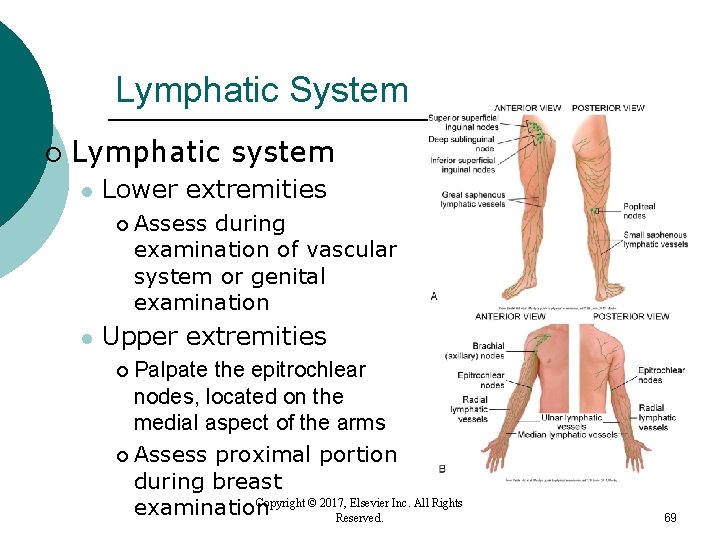
Lymphatic System ¡ Lymphatic system l Lower extremities ¡ l Assess during examination of vascular system or genital examination Upper extremities Palpate the epitrochlear nodes, located on the medial aspect of the arms ¡ Assess proximal portion during breast Copyright © 2017, Elsevier Inc. All Rights examination Reserved. ¡ 69
Breasts ¡ Assess in both male and female patients. l l ¡ ¡ Male breast: small amount breast of glandular tissue Female breast: majority of breast is glandular tissue Breast cancer is second to lung cancer as the leading cause of death in women with cancer. Teach patients health behaviors such as breast self-examination (BSE). Copyright © 2017, Elsevier Inc. All Rights Reserved. 70
Female Breasts ¡ Early breast cancer detection recommendations: l l l Monthly BSE is an option for women in their 20 s and 30 s. 20 years of age and older: need to report any breast changes to a health care provider immediately 20 to 40: clinical breast examination by a health care provider every 3 years; older than 40: annually. Family history of breast cancer: annual examination by a health care provider. Asymptomatic women: screening mammogram by age 40; women age 40 and older: annually. Women at increased risk: consider additional testing (MRI). Copyright © 2017, Elsevier Inc. All Rights Reserved. 71
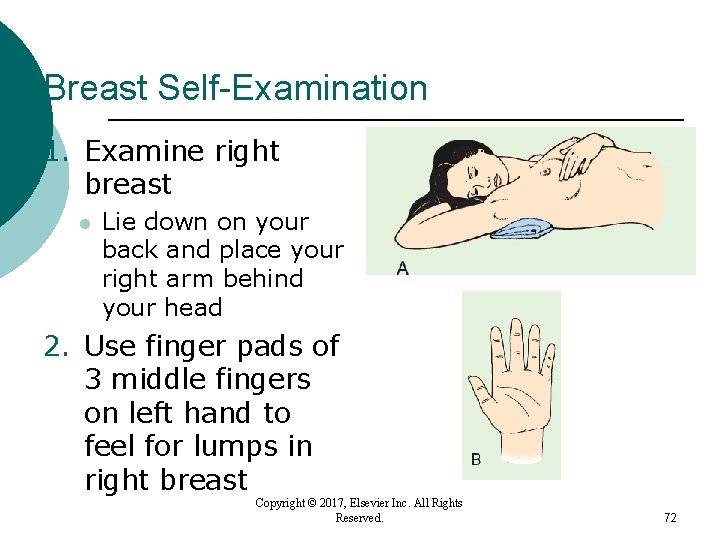
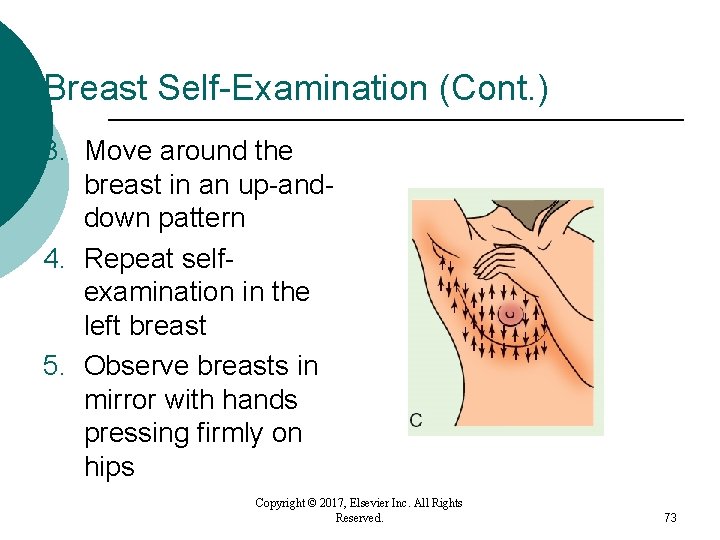
Breast Self-Examination 1. Examine right breast l Lie down on your back and place your right arm behind your head 2. Use finger pads of 3 middle fingers on left hand to feel for lumps in right breast Copyright © 2017, Elsevier Inc. All Rights Reserved. 72
Breast Self-Examination (Cont. ) 3. Move around the breast in an up-anddown pattern 4. Repeat selfexamination in the left breast 5. Observe breasts in mirror with hands pressing firmly on hips Copyright © 2017, Elsevier Inc. All Rights Reserved. 73
Breast Self-Examination (Cont. ) 6. Examine each underarm while sitting or standing and with your arm only slightly raised 7. If implants are present, help the patient determine the edges of each implant and how to evaluate each breast 8. Instruct patient to call the health care provider if she finds a lump or other abnormality. 9. Use Teach Back Copyright © 2017, Elsevier Inc. All Rights Reserved. 74
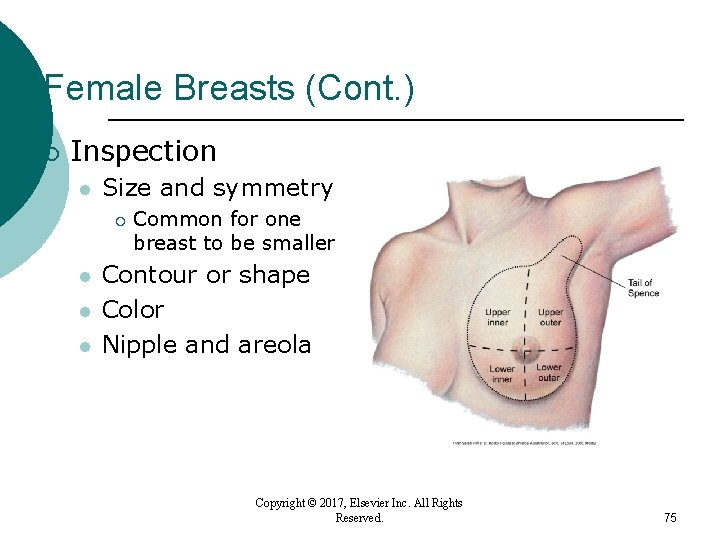
Female Breasts (Cont. ) ¡ Inspection l Size and symmetry ¡ l l l Common for one breast to be smaller Contour or shape Color Nipple and areola Copyright © 2017, Elsevier Inc. All Rights Reserved. 75
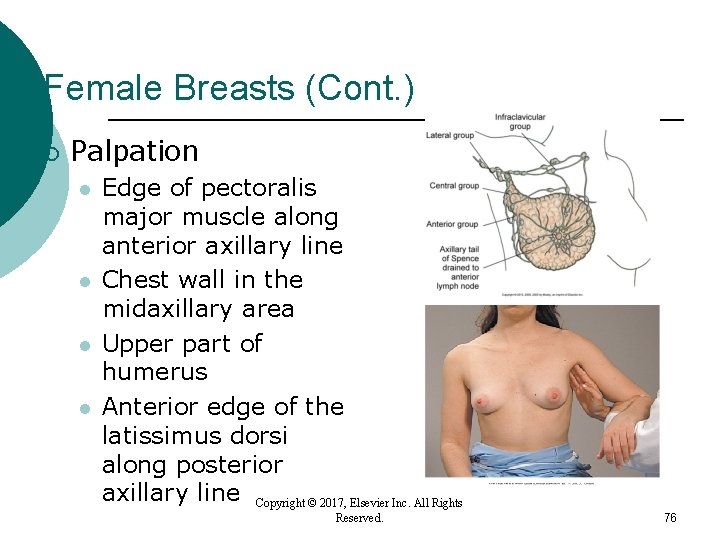
Female Breasts (Cont. ) ¡ Palpation l l Edge of pectoralis major muscle along anterior axillary line Chest wall in the midaxillary area Upper part of humerus Anterior edge of the latissimus dorsi along posterior axillary line Copyright © 2017, Elsevier Inc. All Rights Reserved. 76
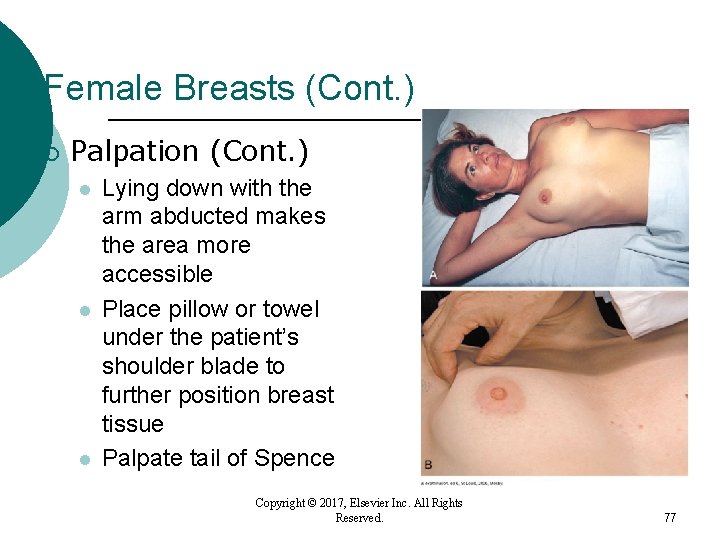
Female Breasts (Cont. ) ¡ Palpation (Cont. ) l l l Lying down with the arm abducted makes the area more accessible Place pillow or towel under the patient’s shoulder blade to further position breast tissue Palpate tail of Spence Copyright © 2017, Elsevier Inc. All Rights Reserved. 77
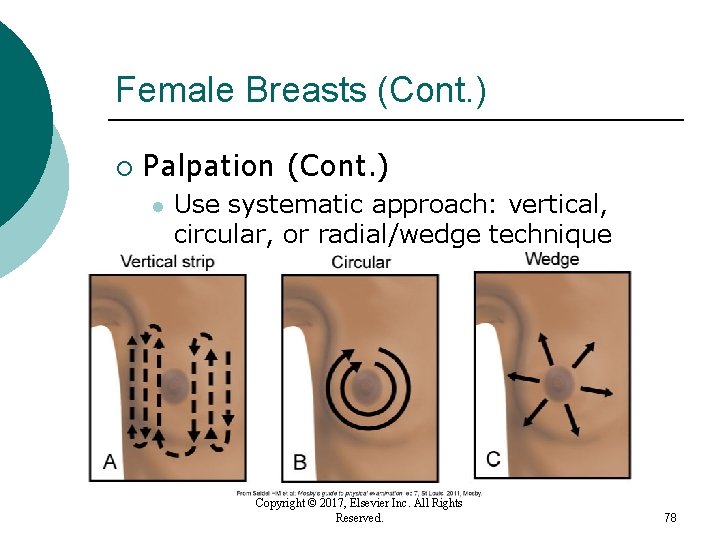
Female Breasts (Cont. ) ¡ Palpation (Cont. ) l Use systematic approach: vertical, circular, or radial/wedge technique Copyright © 2017, Elsevier Inc. All Rights Reserved. 78
Male Breasts Inspect the nipple and areola for nodules, edema, and ulceration ¡ Breast enlargement ¡ l l ¡ An enlarged male breast results from obesity or glandular enlargement Breast enlargement in young males results from steroid use Men at high risk may be scheduled by their health care provider for routine mammograms Copyright © 2017, Elsevier Inc. All Rights Reserved. 79
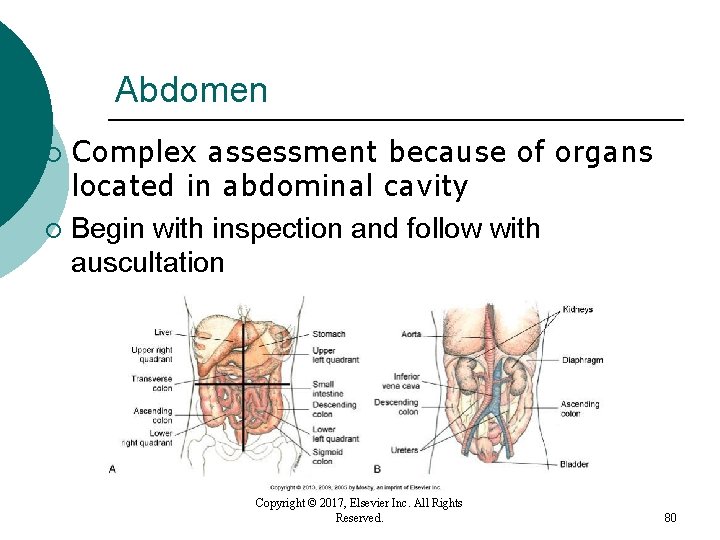
Abdomen Complex assessment because of organs located in abdominal cavity ¡ Begin with inspection and follow with auscultation ¡ Copyright © 2017, Elsevier Inc. All Rights Reserved. 80
Abdomen (Cont. ) ¡ Inspection l l l Skin Umbilicus Contour and symmetry Enlarged organs or masses Movements or pulsations Copyright © 2017, Elsevier Inc. All Rights Reserved. 81
Abdomen (Cont. ) ¡ Auscultation l Bowel motility Peristalsis ¡ Borborygmi ¡ l Vascular sounds ¡ l Bruits Kidney tenderness Copyright © 2017, Elsevier Inc. All Rights Reserved. 82
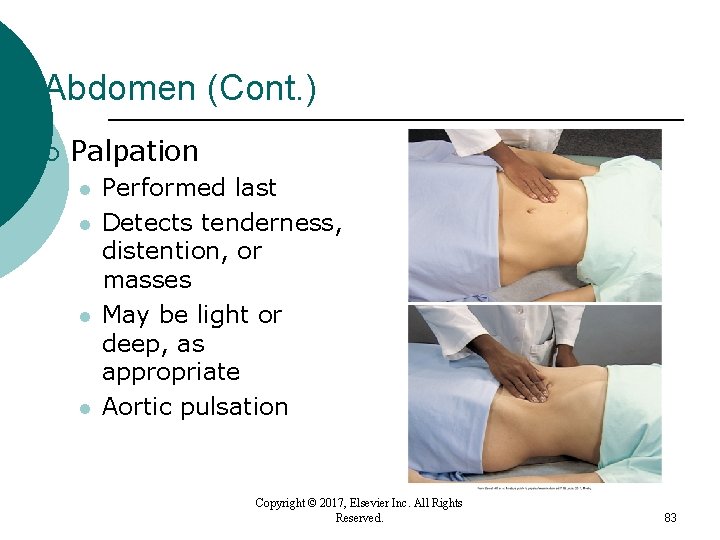
Abdomen (Cont. ) ¡ Palpation l l Performed last Detects tenderness, distention, or masses May be light or deep, as appropriate Aortic pulsation Copyright © 2017, Elsevier Inc. All Rights Reserved. 83
Quick Quiz! 4. Which technique should the nurse use first when conducting an abdominal assessment? A. Auscultation. B. Inspection. C. Palpation. D. Percussion. Copyright © 2017, Elsevier Inc. All Rights Reserved. 84
Female Genitalia and Reproductive Tract Assessment includes both internal and external organs. ¡ Understand cultural sensitivity. ¡ Identify changes across the life span. ¡ Use inspection and palpation. ¡ Copyright © 2017, Elsevier Inc. All Rights Reserved. 85
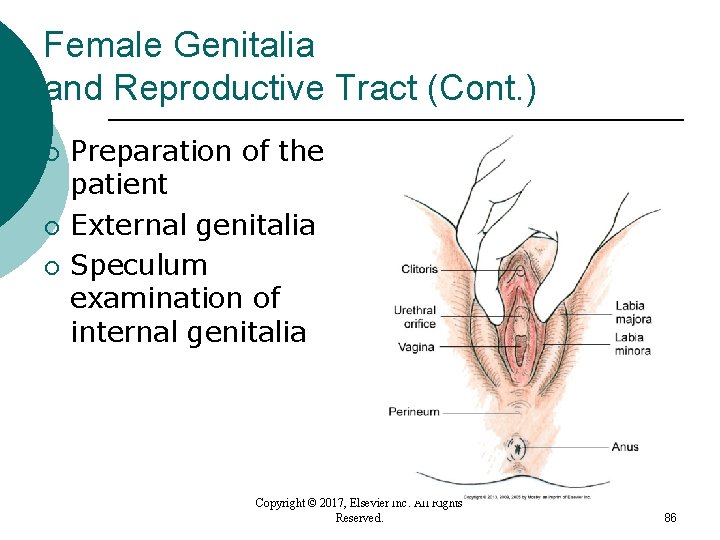
Female Genitalia and Reproductive Tract (Cont. ) ¡ ¡ ¡ Preparation of the patient External genitalia Speculum examination of internal genitalia Copyright © 2017, Elsevier Inc. All Rights Reserved. 86
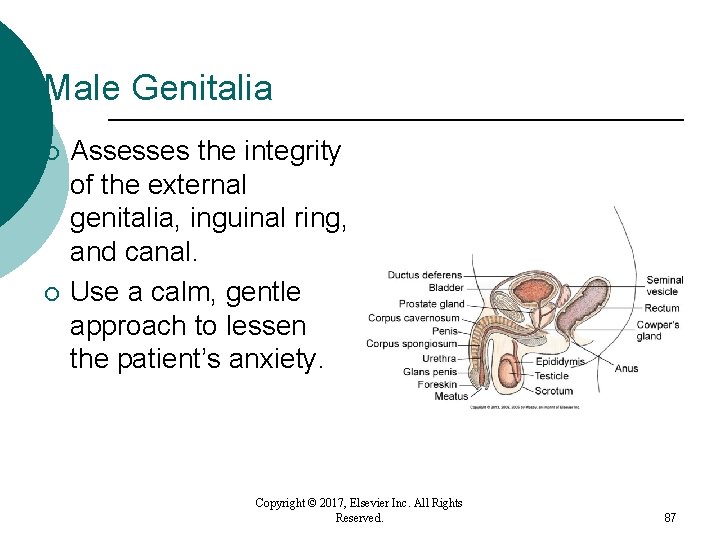
Male Genitalia ¡ ¡ Assesses the integrity of the external genitalia, inguinal ring, and canal. Use a calm, gentle approach to lessen the patient’s anxiety. Copyright © 2017, Elsevier Inc. All Rights Reserved. 87
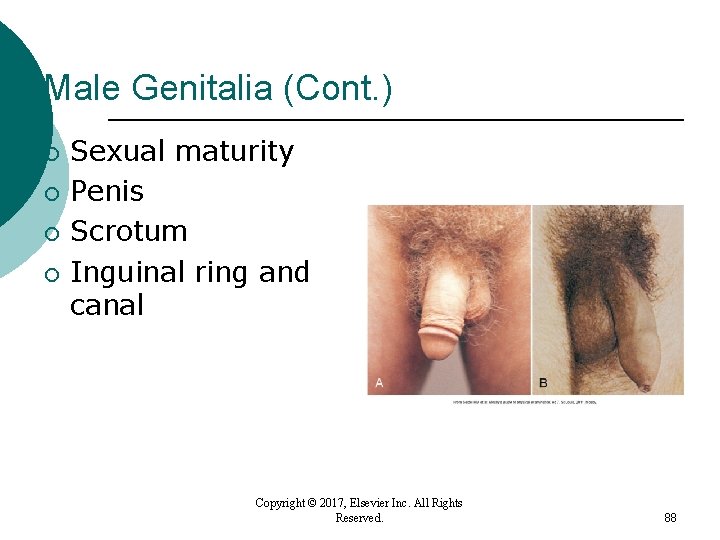
Male Genitalia (Cont. ) ¡ ¡ Sexual maturity Penis Scrotum Inguinal ring and canal Copyright © 2017, Elsevier Inc. All Rights Reserved. 88
Male Genital Self-Examination ¡ ¡ Perform the examination after a warm bath or shower, when the scrotal skin is less thick. Stand naked in front of a mirror, hold the penis in your hand, and examine the head. Pull back foreskin if uncircumcised to expose glans. Inspect and palpate head of penis in a clockwise motion, looking carefully for bumps, sores, or blisters. Look for any genital warts. Copyright © 2017, Elsevier Inc. All Rights Reserved. 89
Male Genital Self-Examination (Cont. ) ¡ ¡ ¡ Look at opening at end of penis for discharge. Look along entire shaft of penis for same signs. Separate pubic hair at base of penis, and carefully examine skin underneath. Copyright © 2017, Elsevier Inc. All Rights Reserved. 90
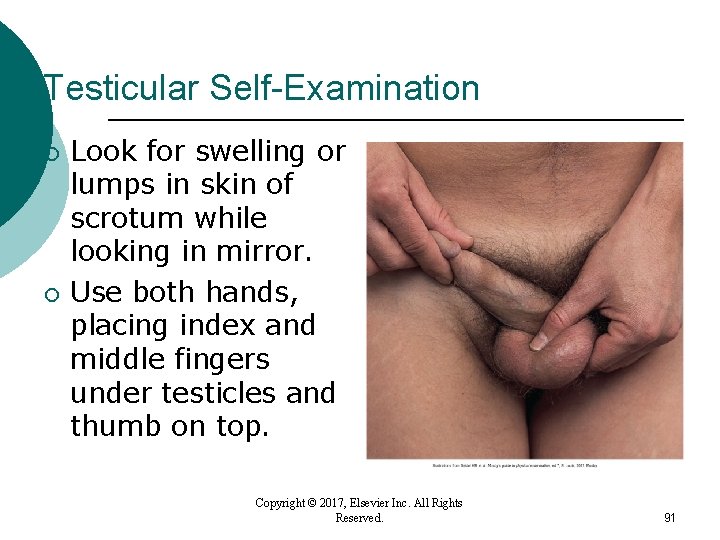
Testicular Self-Examination ¡ ¡ Look for swelling or lumps in skin of scrotum while looking in mirror. Use both hands, placing index and middle fingers under testicles and thumb on top. Copyright © 2017, Elsevier Inc. All Rights Reserved. 91
Testicular Self-Examination (Cont. ) ¡ ¡ Gently roll testicle, feeling for lumps, swelling, soreness, or harder consistency. Find the epididymis (cordlike structure on top and back of testicle; it is not a lump). Feel for small, pea-sized lumps on front and side of testicle. Abnormal lumps are usually painless. Call your health care provider for abnormal findings. Copyright © 2017, Elsevier Inc. All Rights Reserved. 92
Rectum and Anus Perform after genital examination. ¡ Explain all steps to the patient. ¡ Provide privacy. ¡ Use inspection and digital palpation. ¡ Copyright © 2017, Elsevier Inc. All Rights Reserved. 93
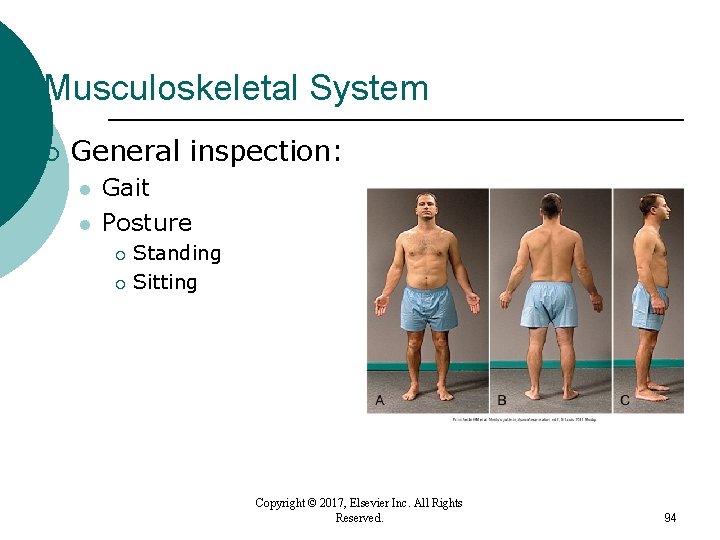
Musculoskeletal System ¡ General inspection: l l Gait Posture Standing ¡ Sitting ¡ Copyright © 2017, Elsevier Inc. All Rights Reserved. 94
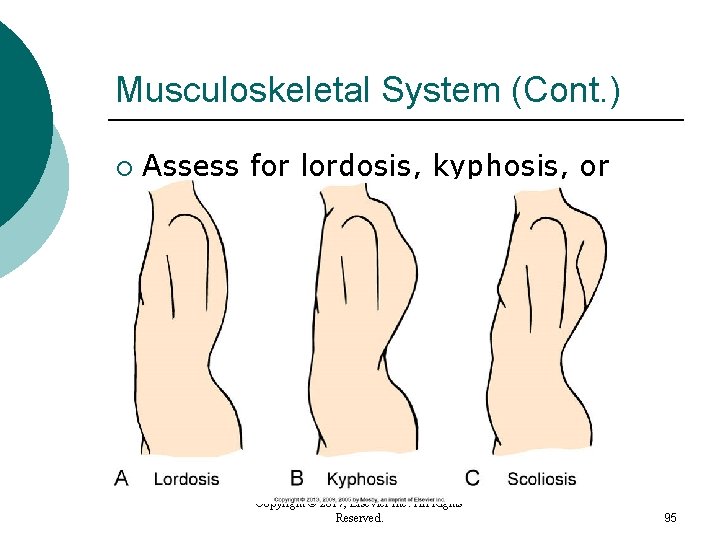
Musculoskeletal System (Cont. ) ¡ Assess for lordosis, kyphosis, or scoliosis. Copyright © 2017, Elsevier Inc. All Rights Reserved. 95
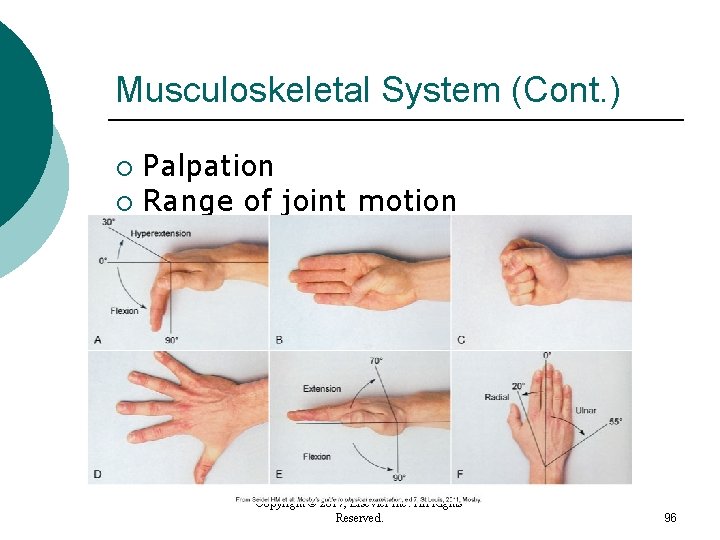
Musculoskeletal System (Cont. ) Palpation ¡ Range of joint motion ¡ Copyright © 2017, Elsevier Inc. All Rights Reserved. 96
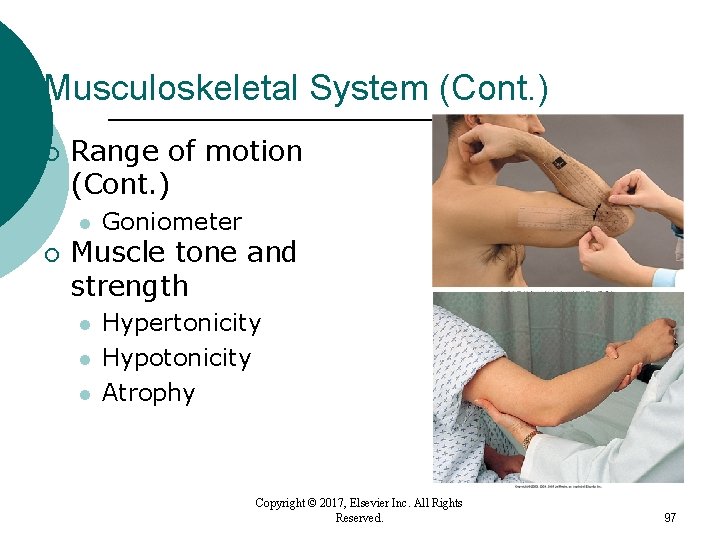
Musculoskeletal System (Cont. ) ¡ Range of motion (Cont. ) l ¡ Goniometer Muscle tone and strength l l l Hypertonicity Hypotonicity Atrophy Copyright © 2017, Elsevier Inc. All Rights Reserved. 97
Case Study (Cont. ) ¡ Jane continues to care for Mr. Neal. He had a colon resection for cancer 2 days ago. The morning shift has just started, and the night nurse reported that he had an “uneventful” night. Mr. Neal is allowed nothing by mouth (NPO) and has an IV line for parenteral fluids, a nasogastric (NG) tube connected to low intermittent suction, an abdominal dressing, and a urethral (Foley) catheter with gravity drainage. Copyright © 2017, Elsevier Inc. All Rights Reserved. 98
Neurological System Responsible for many functions ¡ Full assessment requires time and attention to detail. ¡ Many variables must be considered during evaluation: level of consciousness (LOC), physical status, chief complaint. ¡ Collect all equipment before beginning. ¡ Copyright © 2017, Elsevier Inc. All Rights Reserved. 99
Neurological System (Cont. ) ¡ Mental and emotional status l l l Mini-Mental State Examination (MMSE) Cultural considerations Delirium Copyright © 2017, Elsevier Inc. All Rights Reserved. 100
MMSE Sample Questions ¡ Orientation to time l ¡ Registration l ¡ “Listen carefully. I am going to say three words. Say them back after I stop. Ready? Here they are. . . HOUSE (pause), CAR (pause), LAKE (pause). Now repeat these words back to me. ” (Repeat up to 5 times but score only the first trial. ) Naming l ¡ “What is the date? ” “What is this? ” (Point to a pencil or pen. ) Reading l “Please read this and do what it says. ” (Show examinee the words on the stimulus form: CLOSE YOUR EYES. ) Copyright © 2017, Elsevier Inc. All Rights Reserved. 101
Neurological System (Cont. ) ¡ Level of consciousness l ¡ Behavior and appearance l ¡ Glasgow Coma Scale Nonverbal and verbal Language l Aphasia Sensory (receptive) ¡ Motor (expressive) ¡ Copyright © 2017, Elsevier Inc. All Rights Reserved. 102
Neurological System (Cont. ) ¡ Intellectual function l l l ¡ Memory Knowledge Abstract thinking Association Judgment Cranial nerve function Copyright © 2017, Elsevier Inc. All Rights Reserved. 103
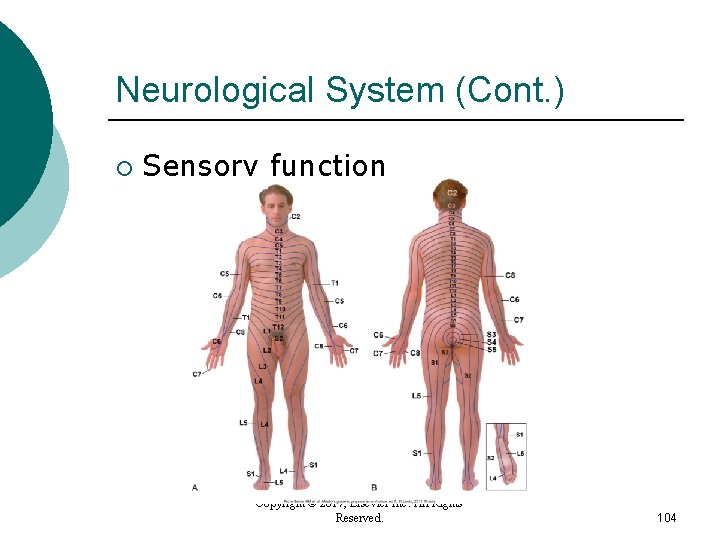
Neurological System (Cont. ) ¡ Sensory function Copyright © 2017, Elsevier Inc. All Rights Reserved. 104
Neurological System (Cont. ) ¡ Motor function l l Coordination Balance Have the patient perform a Romberg’s test by standing with feet together, arms at the sides, both with eyes open and eyes closed. ¡ Have the patient close the eyes, with arms held straight at the sides, and stand on one foot and then the other. ¡ Another test involves asking the patient to walk a straight line by placing the heel of one foot directly in front of the toes Copyright © 2017, Elsevier Inc. All Rightsof the other foot. ¡ Reserved. 105
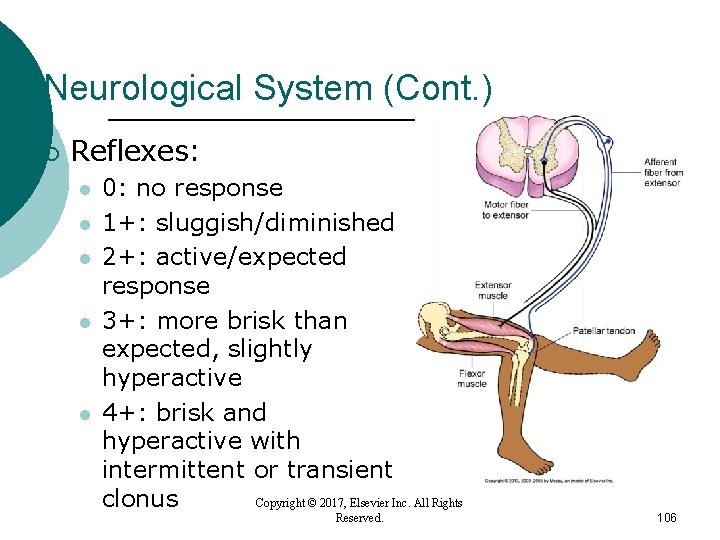
Neurological System (Cont. ) ¡ Reflexes: l l l 0: no response 1+: sluggish/diminished 2+: active/expected response 3+: more brisk than expected, slightly hyperactive 4+: brisk and hyperactive with intermittent or transient clonus Copyright © 2017, Elsevier Inc. All Rights Reserved. 106
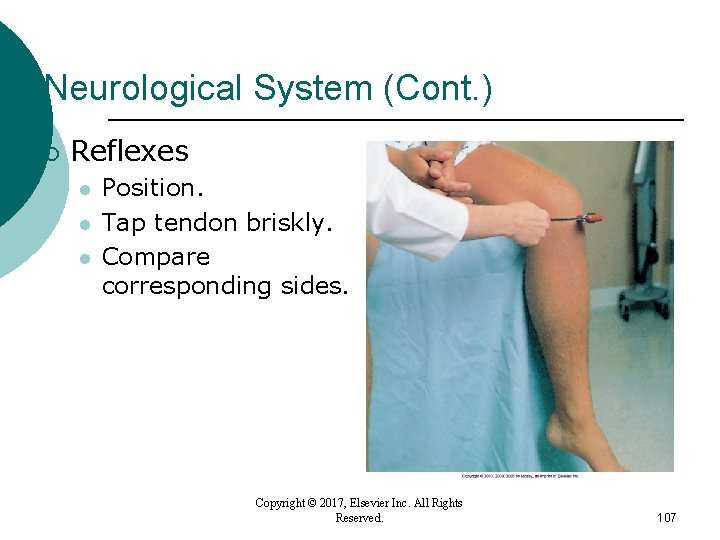
Neurological System (Cont. ) ¡ Reflexes l l l Position. Tap tendon briskly. Compare corresponding sides. Copyright © 2017, Elsevier Inc. All Rights Reserved. 107
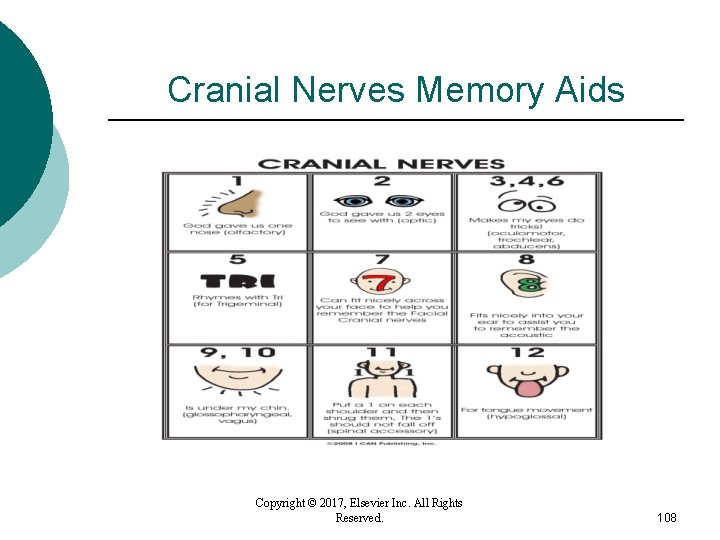
Cranial Nerves Memory Aids Copyright © 2017, Elsevier Inc. All Rights Reserved. 108
After the Examination ¡ ¡ ¡ Record findings. Give the patient time to dress; assist if needed. If findings are serious, consult health care provider before informing the patient. Delegate cleaning of equipment and examination area. Record complete assessment; review for accuracy and thoroughness. Communicate significant findings. Copyright © 2017, Elsevier Inc. All Rights Reserved. 109
Summary Remember to gather equipment ¡ Only expose client when necessary ¡ Perform in an organized manner ¡ Prevent changing client’s position frequently ¡ Recognize changes due to aging process ¡ Be respectful to client ¡ Copyright © 2017, Elsevier Inc. All Rights Reserved. 110
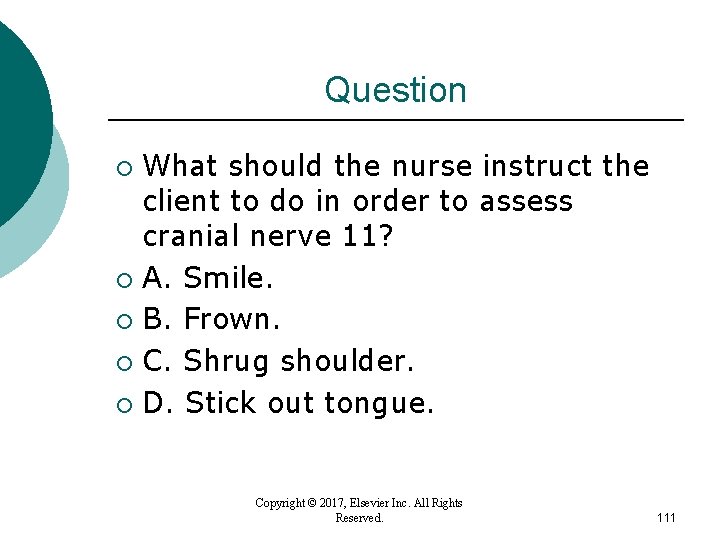
Question What should the nurse instruct the client to do in order to assess cranial nerve 11? ¡ A. Smile. ¡ B. Frown. ¡ C. Shrug shoulder. ¡ D. Stick out tongue. ¡ Copyright © 2017, Elsevier Inc. All Rights Reserved. 111
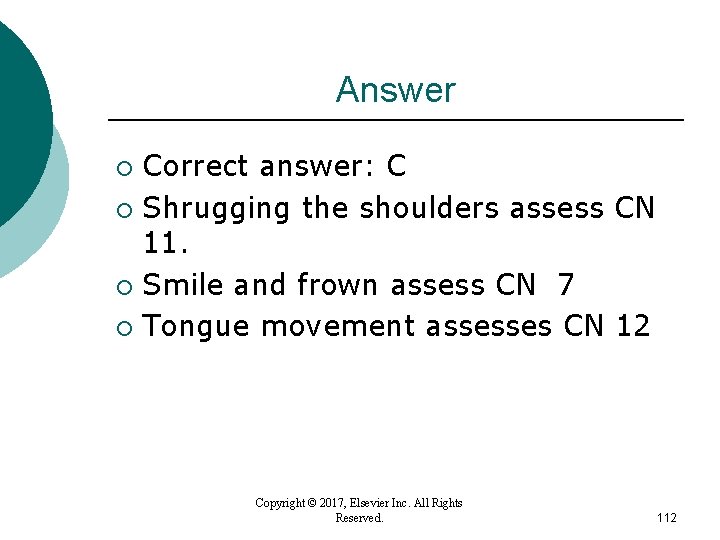
Answer Correct answer: C ¡ Shrugging the shoulders assess CN 11. ¡ Smile and frown assess CN 7 ¡ Tongue movement assesses CN 12 ¡ Copyright © 2017, Elsevier Inc. All Rights Reserved. 112
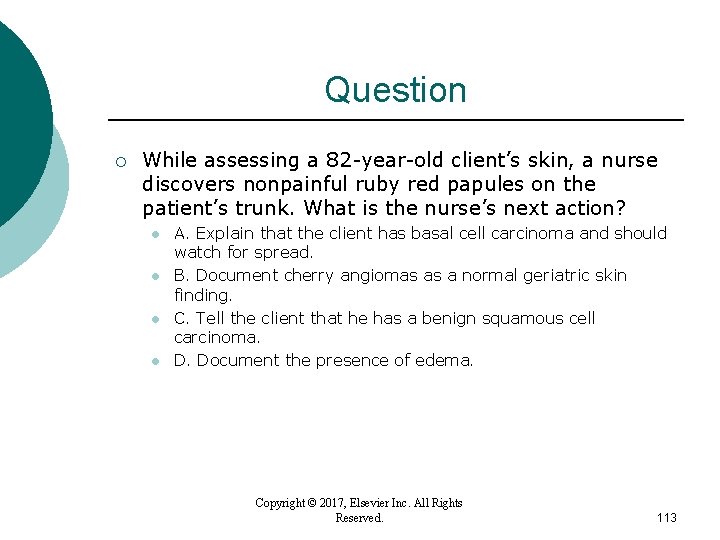
Question ¡ While assessing a 82 -year-old client’s skin, a nurse discovers nonpainful ruby red papules on the patient’s trunk. What is the nurse’s next action? l l A. Explain that the client has basal cell carcinoma and should watch for spread. B. Document cherry angiomas as a normal geriatric skin finding. C. Tell the client that he has a benign squamous cell carcinoma. D. Document the presence of edema. Copyright © 2017, Elsevier Inc. All Rights Reserved. 113
Answer ¡ ¡ Correct Answer: B The skin is normally free of lesions, except for common freckles or age-related changes such as skin tags, senile keratosis (thickening of skin), cherry angiomas (ruby red papules), and atrophic warts. Basal cell carcinoma is most common in sun-exposed areas and frequently occurs in a background of sun-damaged skin; it almost never spreads to other parts of the body. Squamous cell carcinoma is more serious than basal cell and develops on the outer layers of sun-exposed skin; these cells may travel to lymph nodes and throughout the body. Report abnormal lesions to the health care provider for further examination. Edema is an area of skin that becomes swollen or edematous from a buildup of fluid in the tissues. This has nothing to do with cherry angiomas. Copyright © 2017, Elsevier Inc. All Rights Reserved. 114