
Chapter 2 The Heritage of Physical Education Sport


- Slides: 42
Chapter 2: The Heritage of Physical Education, Sport, and Fitness in the United States. HPHE 1500 Dr. Ayers © 2009 Mc. Graw-Hill Higher Education. All rights reserved.
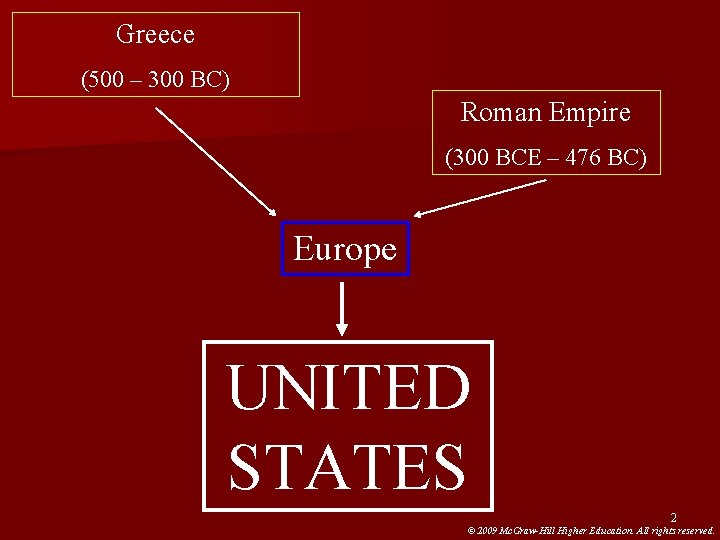
Greece (500 – 300 BC) Roman Empire (300 BCE – 476 BC) Europe UNITED STATES 2 © 2009 Mc. Graw-Hill Higher Education. All rights reserved.
The Greek influence (500 -300 BC) þ Male dominated society; only men had access to education. þ Physical prowess was much sought after; games key part of life. þ Physical training and sport also prepared military for defense against outside intruders. þ Greeks were creators of philosophy, music, etc. þ Sparta (a military dominated city-state) typified the use of stringent selection of children for lifelong physical training. 3 © 2009 Mc. Graw-Hill Higher Education. All rights reserved.
The Roman influence (300 -476 BC) þ Military training critical to conquering other civilizations. þ Obedience, discipline, & physical prowess were key goals of military training. þ Its sporting events mirrored what we see today: Entertainment, large venues, betting. þ Women were less marginalized. þ Romans were adopters of cultural practices. þ The empire’s demise also lessened the perceived importance of sport and fitness. 4 © 2009 Mc. Graw-Hill Higher Education. All rights reserved.
Discussion Question 1. How was the Roman influence different from the Greeks? 5 © 2009 Mc. Graw-Hill Higher Education. All rights reserved.
The Birth of a Profession - 1885 þ William G. Anderson noted the lack of support (i. e. , preparation programs, literature) for “gymnastics teachers” (aka, physical educators) þ Organized the first ever professional meeting, that spawned the Association for the Advancement of Physical Education (n=60). 6 © 2009 Mc. Graw-Hill Higher Education. All rights reserved.
The pre-1885 Sport & fitness scene Some sample marquee developments: (see also Box 2. 1) þ 1825 -1 st Physical Education teacher: Charles Beck þ 1827 -First competitive football game þ 1837 -Catherine Beecher founded Western Female Inst þ 1839 -First teacher training program founded þ 1848 -“Turnverein” club (German) formed þ 1851 -First YMCA in America (character edu & PA) þ 1859 -First intercollegiate baseball game 7 © 2009 Mc. Graw-Hill Higher Education. All rights reserved.
The pre-1885 Sport & fitness Context þ A young, conservative nation þ Strong Puritan values prohibiting play & exercise þ 1879 - Dudley Sargent, Ast. Prof. @ Harvard þ Mid 1800 s: Exercise & fitness become valued & commonly accepted. . . Yet Sport emerges later! þ Sport played mostly in colleges – student driven 8 © 2009 Mc. Graw-Hill Higher Education. All rights reserved.
Context for an emerging Profession þ Declining opposition to sport & exercise. þ Large-scale immigration to the new world. þ Industrialization (produced wealth). þ Urbanization (necessitated the dev’t of other acts). þ Transportation (rail) & communication (radio & TV). þ Education – Free universal education for ALL. þ Intellectual climate (e. g. , Darwin, Freud, Marx). 9 © 2009 Mc. Graw-Hill Higher Education. All rights reserved.
Battle of the “Systems” þ Multiple approaches to formal Gymnastics hailed from Europe (e. g. , Germany & Sweden). þ Formal, prescribed exercises done in unison as group þ European climate=Nationalism & military preparation þ Faculty Psychology=Perceived cognitive benefits of exercise þ 1889 Boston Conference þ Focus: Purposes of Physical Education and how to achieve these 10 © 2009 Mc. Graw-Hill Higher Education. All rights reserved.
Emergence of Organized Sport (late 1800’s) þ Post-Civil War period: Sport games gradually become standardized (i. e. , institutionalized). . . They “come of age” (see list on pg. 33) þ Two-way influence between Europe & USA in the emergence of different sports. þ Women played key role in Sport’s emergence in the USA (e. g. , Basketball and Volleyball). þ 1896: First Modern Olympic Games: P. de Coubertin proposes Olympism philosophy (edu program of peace & cultural understanding to unite modern world) 11 © 2009 Mc. Graw-Hill Higher Education. All rights reserved.
Sport on College Campuses þ Rapid rise in men’s college sport (fr. 1850 to 1900) þ Initially, mostly student driven (despite frequent opposition from faculty and administration) þ As sport became more central, abuses increased which made faculty support and oversight necessary þ Women’s intercollegiate sports were controlled by faculty from the start, ergo slower growth & fewer abuses. 12 © 2009 Mc. Graw-Hill Higher Education. All rights reserved.
Roots of abuse in College Sport þ “Win at all cost” mentality (lack of gentleman class) þ Absence of any sense of honor, fair play, and respect for rules (as taught to young British men in schools) þ Abuse occurred relative to eligibility and athlete treatment by universities (pg. 36 example) þ Examples: Playing for multiple colleges, getting paid to play. NEEDED. . . FACULTY OVERSIGHT 13 © 2009 Mc. Graw-Hill Higher Education. All rights reserved.
Faculty oversight of College Sport þ Emergence of Athletic Conferences (e. g. , Western Conference). þ Increased institutional control over college sport. þ Rules were made for eligibility, transfer of students, hiring and retaining coaches, etc. þ Women’s college sport was overseen from the start, thus experienced fewer abuses (e. g. , Blanche Trilling forms Athl. Conf. of American College Women in 1917) 14 © 2009 Mc. Graw-Hill Higher Education. All rights reserved.
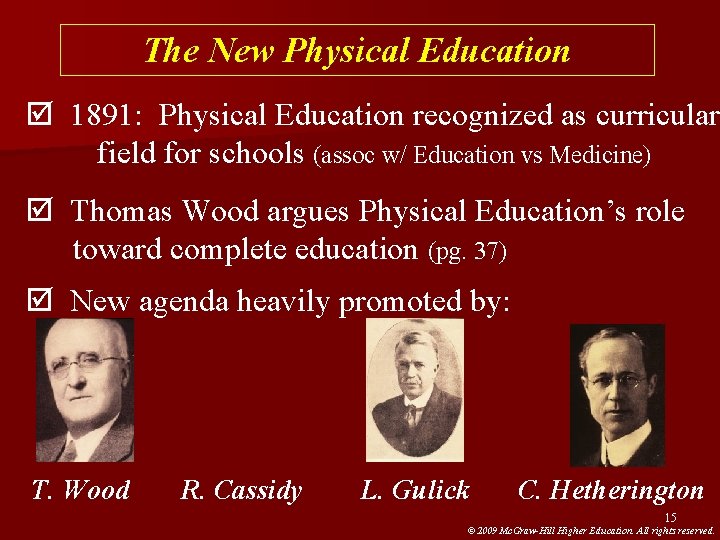
The New Physical Education þ 1891: Physical Education recognized as curricular field for schools (assoc w/ Education vs Medicine) þ Thomas Wood argues Physical Education’s role toward complete education (pg. 37) þ New agenda heavily promoted by: T. Wood R. Cassidy L. Gulick C. Hetherington 15 © 2009 Mc. Graw-Hill Higher Education. All rights reserved.
Physical Education. . . The Profession (1900 – 1920) þ Embrace of other movements: Dance, Playgrounds, Camping, College Intramurals, & Recreation þ See Box 2. 3 (pg. 39) for evolution of our organization þ Emergence of a Sport culture. þ 1904: American Academy of Physical Education. 16 © 2009 Mc. Graw-Hill Higher Education. All rights reserved.
Physical Education: The Golden Age (Post-World War I) þ USA comes out of WWI as an international power with a strong economy & an emerging middle class þ Interest in sport grows rapidly (radio and cars aid this) þ Continued discrimination against African. Americans results in formation of separate leagues 17 © 2009 Mc. Graw-Hill Higher Education. All rights reserved.
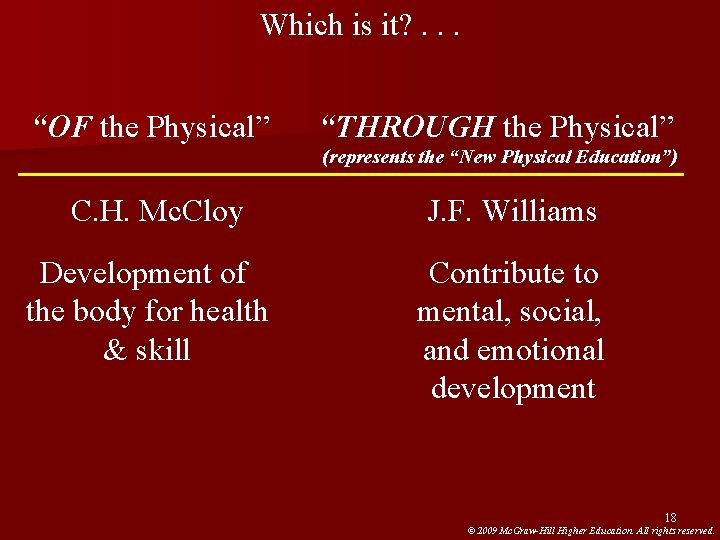
Which is it? . . . “OF the Physical” “THROUGH the Physical” (represents the “New Physical Education”) C. H. Mc. Cloy Development of the body for health & skill J. F. Williams Contribute to mental, social, and emotional development 18 © 2009 Mc. Graw-Hill Higher Education. All rights reserved.
Second-generation leaders (“through the Physical”) Jesse Feiring Williams (Teachers College) Jay B. Nash (NYU) VS. Charles H. Mc. Cloy The “OF” vs. “THROUGH” continues even today 19 © 2009 Mc. Graw-Hill Higher Education. All rights reserved.
Discussion Question What is education OF the physical versus THROUGH the physical? 20 © 2009 Mc. Graw-Hill Higher Education. All rights reserved.
The Science of Physical Education… Beginnings (1920’s) Hitchcock & Sargent’s emphasis on measurement & prescriptive exercises based on test data establ. American gymnastic systems on science 1924: The first doctoral programs established 1930: Research Quarterly’s first issue published Increased focus on Research was essential to ensuring legitimacy in Universities & Colleges 21 © 2009 Mc. Graw-Hill Higher Education. All rights reserved.
Access and Equity. . . Not such a Golden Age REMEMBER: Women not yet allowed to vote. . . Pioneer women in Physical Education: C C C Delphine Hanna Ethel Perrin Jessie Bancroft Amy Morris Homans Elizabeth Burchenal Blanche Trilling 22 © 2009 Mc. Graw-Hill Higher Education. All rights reserved.
Access and Equity. . . Not such a Golden Age REMEMBER: African-Americans still lacked full constitutional rights… Colleges that accepted black students: C C C Springfield College Oberlin College Sargent School for Women 23 © 2009 Mc. Graw-Hill Higher Education. All rights reserved.
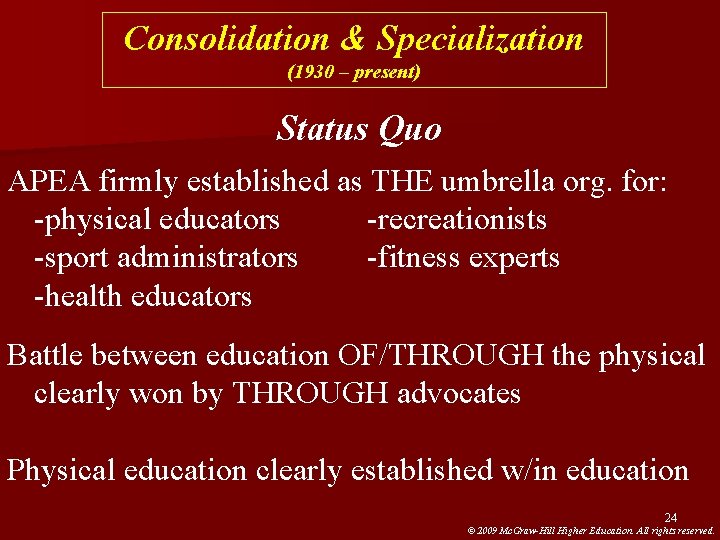
Consolidation & Specialization (1930 – present) Status Quo APEA firmly established as THE umbrella org. for: -physical educators -recreationists -sport administrators -fitness experts -health educators Battle between education OF/THROUGH the physical clearly won by THROUGH advocates Physical education clearly established w/in education 24 © 2009 Mc. Graw-Hill Higher Education. All rights reserved.
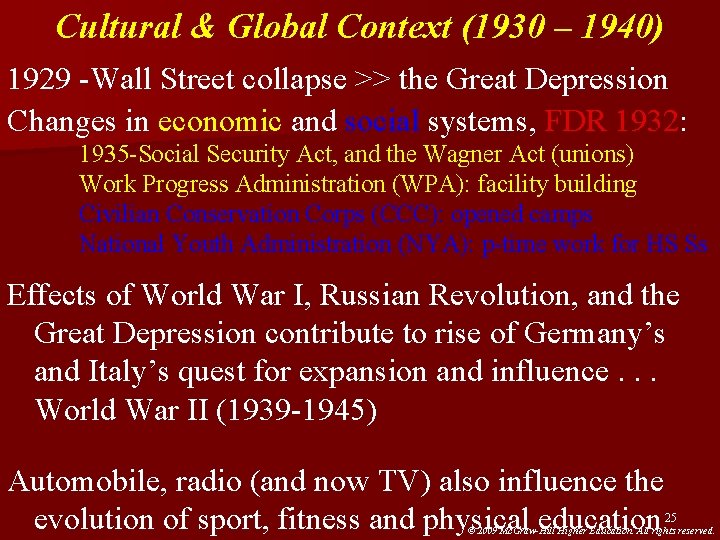
Cultural & Global Context (1930 – 1940) 1929 -Wall Street collapse >> the Great Depression Changes in economic and social systems, FDR 1932: 1935 -Social Security Act, and the Wagner Act (unions) Work Progress Administration (WPA): facility building Civilian Conservation Corps (CCC): opened camps National Youth Administration (NYA): p-time work for HS Ss Effects of World War I, Russian Revolution, and the Great Depression contribute to rise of Germany’s and Italy’s quest for expansion and influence. . . World War II (1939 -1945) Automobile, radio (and now TV) also influence the evolution of sport, fitness and physical education 25 © 2009 Mc. Graw-Hill Higher Education. All rights reserved.
Sport, Fitness, and Physical Education The Depression Years þ Significant cutbacks in funding for sport þ Spectatorship drops, while participation increases (Softball) þ Participation more democratized (across SES levels) þ Federal & private programs boost participation (i. e. , building of facilities and programs targeting youth – Little League Baseball) 26 © 2009 Mc. Graw-Hill Higher Education. All rights reserved.
þ APEA>>AAHPE’s membership actually increases throughout Depression þ NEA institutes Physical Education Teacher Education program evaluation þ AAHPE becomes department in NEA þ 1938: The Physical Education Curriculum (3 -6 week block plan format) 27 © 2009 Mc. Graw-Hill Higher Education. All rights reserved.
Sport, Fitness, and Physical Education World War II Years þ WWII shifts focus back to physical fitness, including in-school Physical Education programs þ War Training camps included extensive sport, fitness and recreation facilities and programs þ War Years precipitated the research specialization in Physical Education that would explode in the 1960 s as the Kinesiology discipline movement þ Emergence of Adapted Physical Education 28 © 2009 Mc. Graw-Hill Higher Education. All rights reserved.
Sport, Fitness, and Physical Education Post-World War II Years þ Cultural & societal shifts: > Birth of “suburbs” (housing demands) > Higher education enrollment soars (G. I. Bill) > The Baby Boom þ Expansion of Sport through the growth of spectator sports: > Growth in the number of teams in professional sport > Golf becomes a sport for the general public > Olympics return in 1948 in London > Growth in collegiate sports, w/ increased media coverage 29 © 2009 Mc. Graw-Hill Higher Education. All rights reserved.
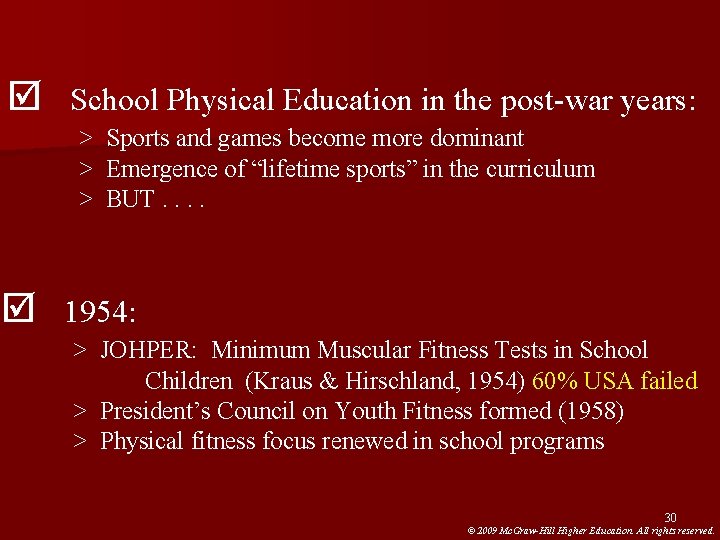
þ School Physical Education in the post-war years: > Sports and games become more dominant > Emergence of “lifetime sports” in the curriculum > BUT. . þ 1954: > JOHPER: Minimum Muscular Fitness Tests in School Children (Kraus & Hirschland, 1954) 60% USA failed > President’s Council on Youth Fitness formed (1958) > Physical fitness focus renewed in school programs 30 © 2009 Mc. Graw-Hill Higher Education. All rights reserved.
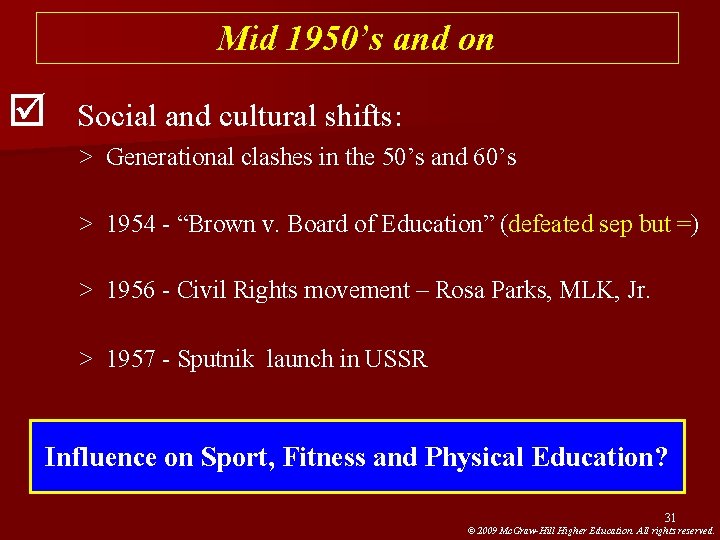
Mid 1950’s and on þ Social and cultural shifts: > Generational clashes in the 50’s and 60’s > 1954 - “Brown v. Board of Education” (defeated sep but =) > 1956 - Civil Rights movement – Rosa Parks, MLK, Jr. > 1957 - Sputnik launch in USSR Influence on Sport, Fitness and Physical Education? 31 © 2009 Mc. Graw-Hill Higher Education. All rights reserved.
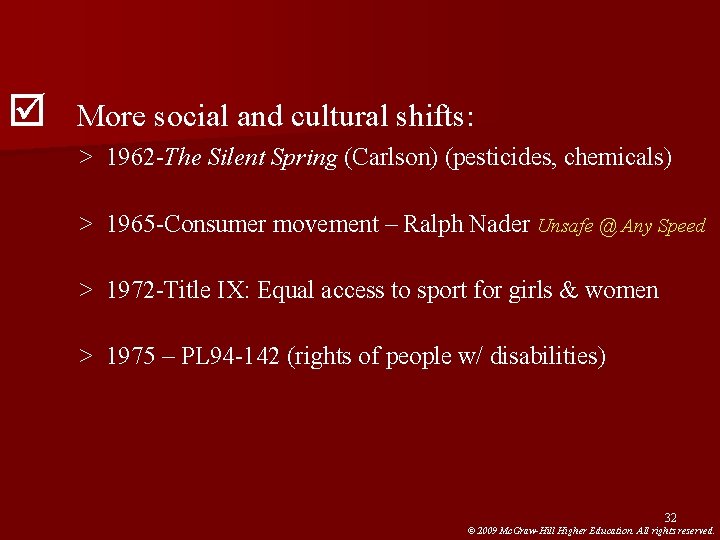
þ More social and cultural shifts: > 1962 -The Silent Spring (Carlson) (pesticides, chemicals) > 1965 -Consumer movement – Ralph Nader Unsafe @ Any Speed > 1972 -Title IX: Equal access to sport for girls & women > 1975 – PL 94 -142 (rights of people w/ disabilities) 32 © 2009 Mc. Graw-Hill Higher Education. All rights reserved.
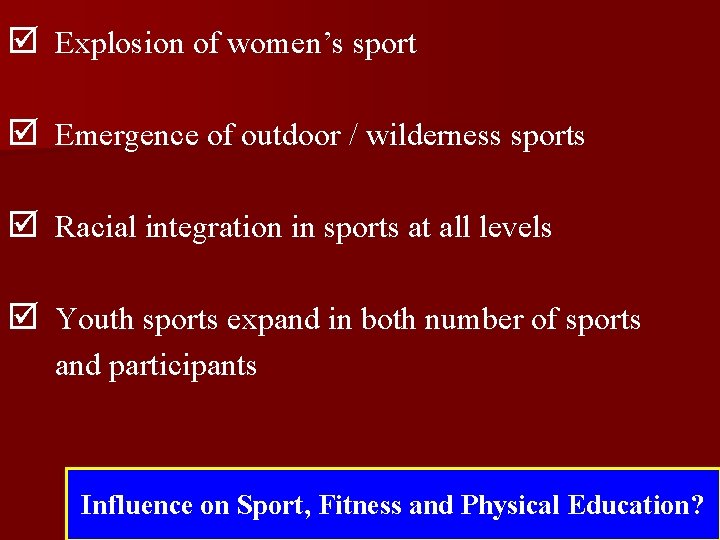
þ Explosion of women’s sport þ Emergence of outdoor / wilderness sports þ Racial integration in sports at all levels þ Youth sports expand in both number of sports and participants Influence on Sport, Fitness and Physical Education? 33 © 2009 Mc. Graw-Hill Higher Education. All rights reserved.
Fitness Renaissance and the Aerobics Era þ Fitness becomes “fashionable” in the 60’s and 70’s. . . the thing to do þ Private sector grabs on to it (driven by economics) þ Kenneth Cooper publishes Aerobics and established the Cooper Aerobics Institute (www. cooperinst. org) þ Increasing scientific support for adopt & value a physically active lifestyle across entire population (AAHPERD major goal) 34 © 2009 Mc. Graw-Hill Higher Education. All rights reserved.
Physical Education since the 1950’s þ Lifetime sports gain place in school programs þ Cooperative games emerged as a counter- movement against the strong push for competition (Sputnik) þ “Discipline of Physical Education” > Knowing as well as doing 35 © 2009 Mc. Graw-Hill Higher Education. All rights reserved.
þ New philosophies and approaches emerge: > > > Adventure Education Movement Education (fr. England) Social & Personal Responsibility Model (Hellison, 1984) Sport Education (Siedentop, Hastie & van der Mars, 1994, 2004) Teaching Games for Understanding (Almond, Bunker & Thorpe, 1983) þ Title IX. . . Opportunities and challenges: > More equal access for both boys and girls > Having to share budgets and facilities 36 © 2009 Mc. Graw-Hill Higher Education. All rights reserved.
Academic Discipline Movement “ I suggest that there is an increasing need for the organization and study of the academic discipline herein called physical education. ” (Franklin Henry, 1964, p. 32) þ Subdisciplines: Biomechanics Kinesiology Motor Control Motor Learning Sport Psychology Sport Sociology Sport History Sport Philosophy þ AAHPERD is the primary professional & academic organization (see Box 2. 5, pg. 54) 37 © 2009 Mc. Graw-Hill Higher Education. All rights reserved.
þ Strong influence on the Physical Education curriculum in Colleges and Universities: > Specialized Graduate programs emerge > Knowledge gained via research becomes prominent in undergrad teacher preparation courses (i. e. , courses in Ex. Phys, Motor Learning, Sport Psych, Biomechanics, etc. ) þ A backlash from Physical Education Teacher Education (PETE) leaders: > Study of human movement vs. human movement itself and the development of teaching skills > Recognized the need to engage in research on teachinglearning processes in school physical education 38 © 2009 Mc. Graw-Hill Higher Education. All rights reserved.
þ NAMES TO KNOW: þ William Anderson (organized 1 st professional meeting of AAPE, became 1 st Secretary of what is now AAHPERD) þ Edward Hitchcock (1 st President of AAPE, also Dir. , Dept of Hygiene & Physical Culture @ Amherst College) þ Dudley Sargent (founded 1 st college dept of PE) þ Springfield College, Oberlin College, Sargent Normal School of Physical Training (roots of PE) þ Amy Morris Homans (Boston Conference) 39 © 2009 Mc. Graw-Hill Higher Education. All rights reserved.
þ NAMES TO KNOW 2: þ Rosalind Cassidy (published The New Physical Education) þJay B. Nash (advocated “through” the physical) þ Jesse Feiring Williams (advocated “through” the physical þ Thomas Wood (advocated “through” the physical) þ Clark Hetherington (advocated “through” the physical) þ C. H. Mc. Cloy (advocated “OF” the physical) 40 © 2009 Mc. Graw-Hill Higher Education. All rights reserved.
þ NAMES TO KNOW 3: þ Delphine Hanna (developed 1 st PETE program) þ Luther Halsey Gulick (early foundational leader in PE) þ Mabel Lee (1 st female Pres. of APEA) 41 © 2009 Mc. Graw-Hill Higher Education. All rights reserved.
Find a Friend… What are three key things that you learned today? What is something you had never heard of that matters to your future as a Physical Educator? 42 © 2009 Mc. Graw-Hill Higher Education. All rights reserved.