Estimation taking account of sample selection with Stata


- Slides: 19
Estimation taking account of sample selection with Stata Cheti Nicoletti ISER, University of Essex 2009
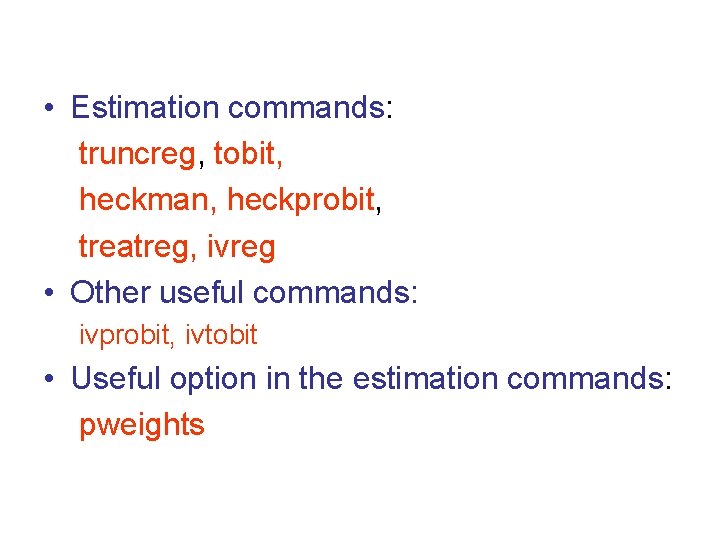
• Estimation commands: truncreg, tobit, heckman, heckprobit, treatreg, ivreg • Other useful commands: ivprobit, ivtobit • Useful option in the estimation commands: pweights
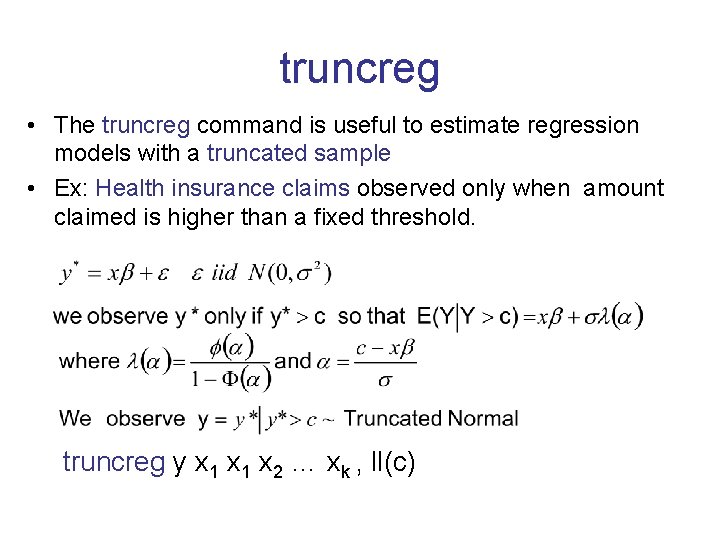
truncreg • The truncreg command is useful to estimate regression models with a truncated sample • Ex: Health insurance claims observed only when amount claimed is higher than a fixed threshold. truncreg y x 1 x 2 … xk , ll(c)
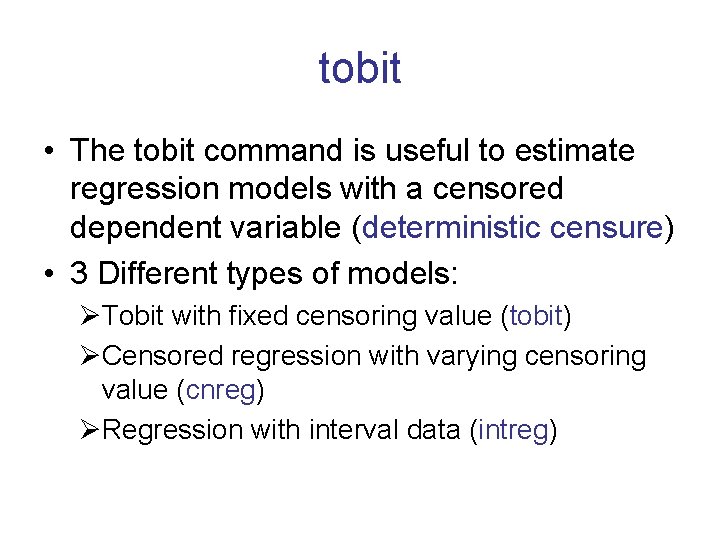
tobit • The tobit command is useful to estimate regression models with a censored dependent variable (deterministic censure) • 3 Different types of models: ØTobit with fixed censoring value (tobit) ØCensored regression with varying censoring value (cnreg) ØRegression with interval data (intreg)
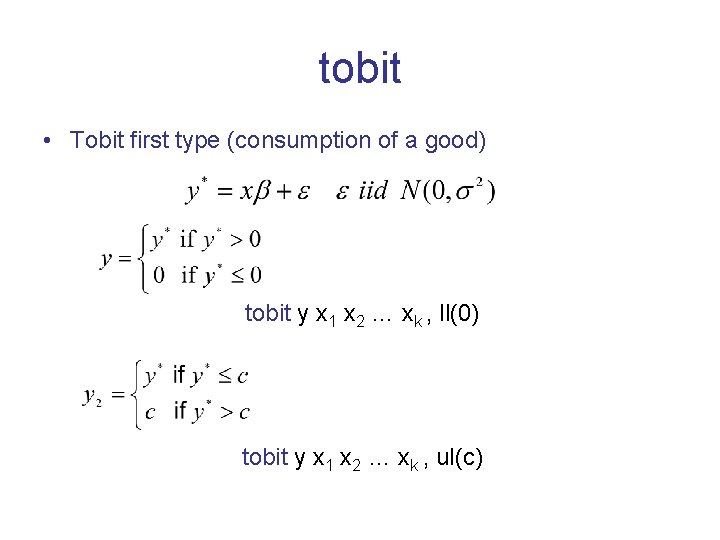
tobit • Tobit first type (consumption of a good) tobit y x 1 x 2 … xk , ll(0) tobit y x 1 x 2 … xk , ul(c)
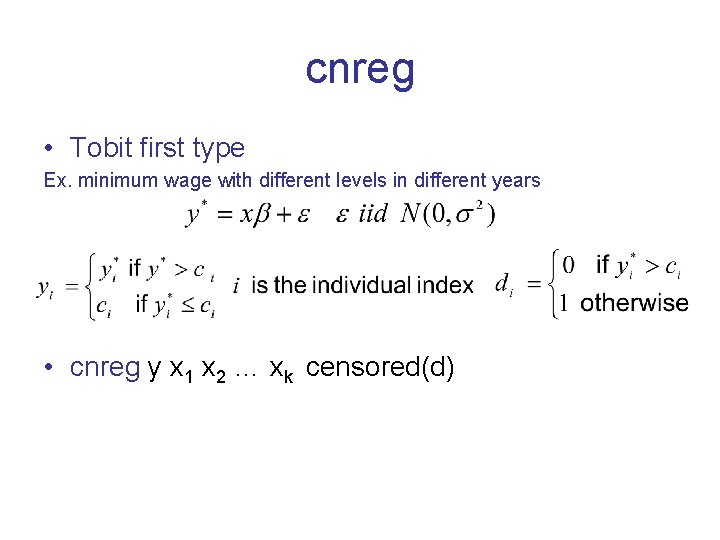
cnreg • Tobit first type Ex. minimum wage with different levels in different years • cnreg y x 1 x 2 … xk censored(d)
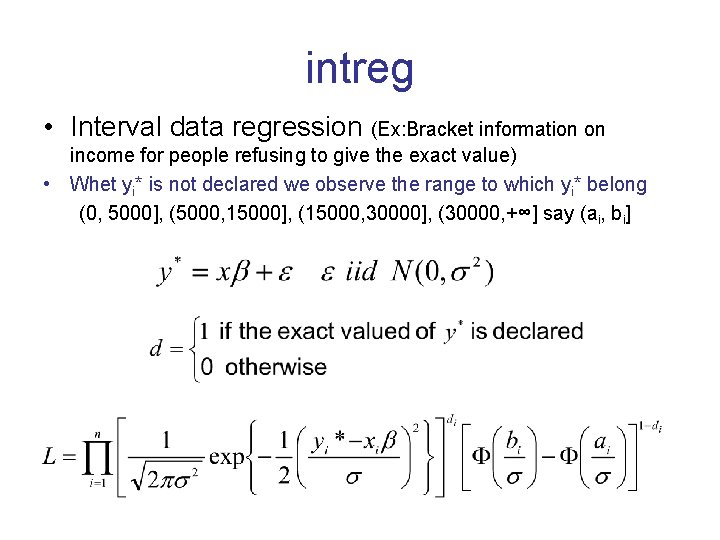
intreg • Interval data regression (Ex: Bracket information on income for people refusing to give the exact value) • Whet yi* is not declared we observe the range to which yi* belong (0, 5000], (5000, 15000], (15000, 30000], (30000, +∞] say (ai, bi]
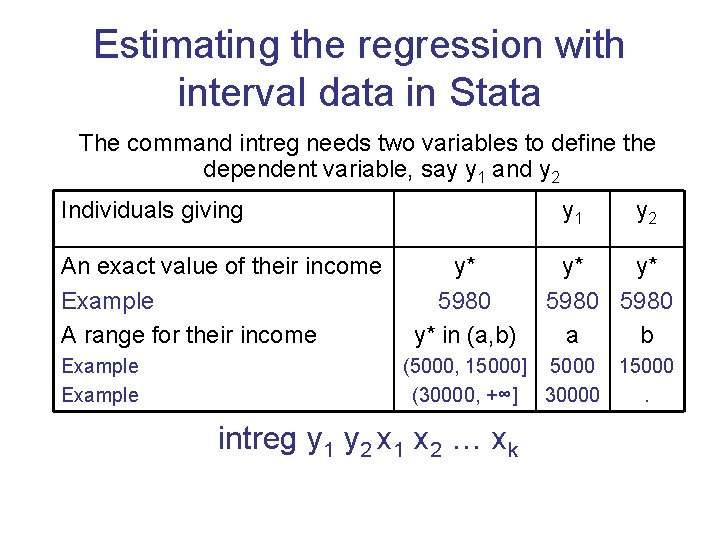
Estimating the regression with interval data in Stata The command intreg needs two variables to define the dependent variable, say y 1 and y 2 Individuals giving An exact value of their income Example A range for their income Example y 1 y* 5980 y* in (a, b) y 2 y* y* 5980 a b (5000, 15000] 5000 15000 (30000, +∞] 30000. intreg y 1 y 2 x 1 x 2 … xk
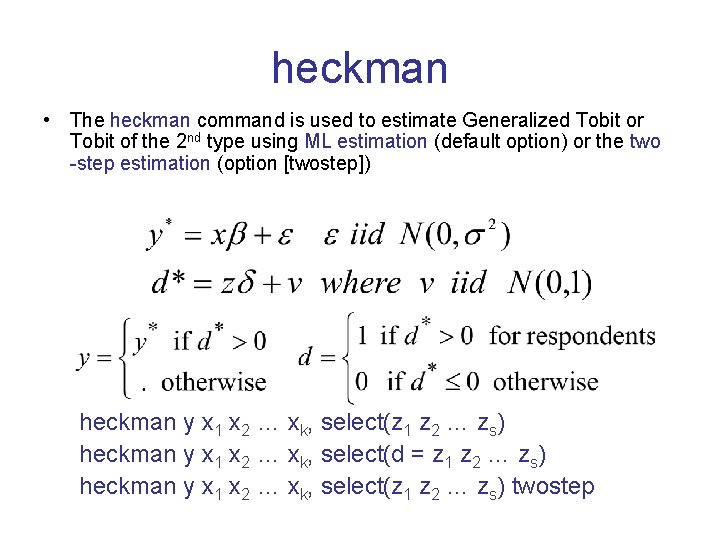
heckman • The heckman command is used to estimate Generalized Tobit or Tobit of the 2 nd type using ML estimation (default option) or the two -step estimation (option [twostep]) heckman y x 1 x 2 … xk, select(z 1 z 2 … zs) heckman y x 1 x 2 … xk, select(d = z 1 z 2 … zs) heckman y x 1 x 2 … xk, select(z 1 z 2 … zs) twostep
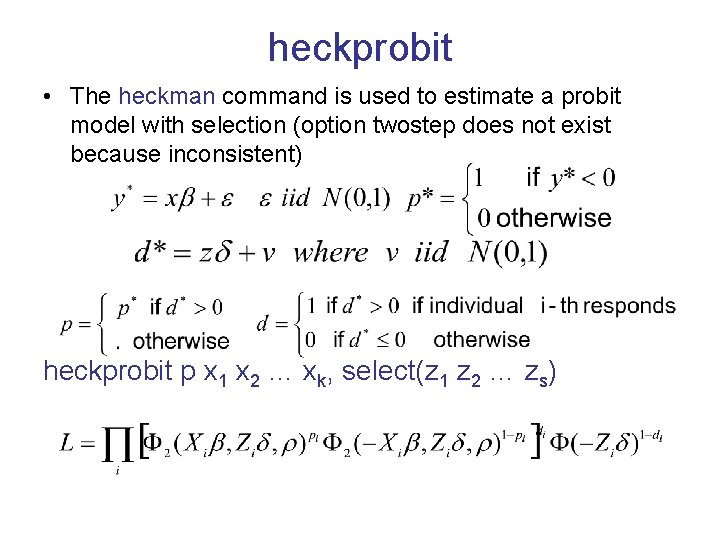
heckprobit • The heckman command is used to estimate a probit model with selection (option twostep does not exist because inconsistent) heckprobit p x 1 x 2 … xk, select(z 1 z 2 … zs)
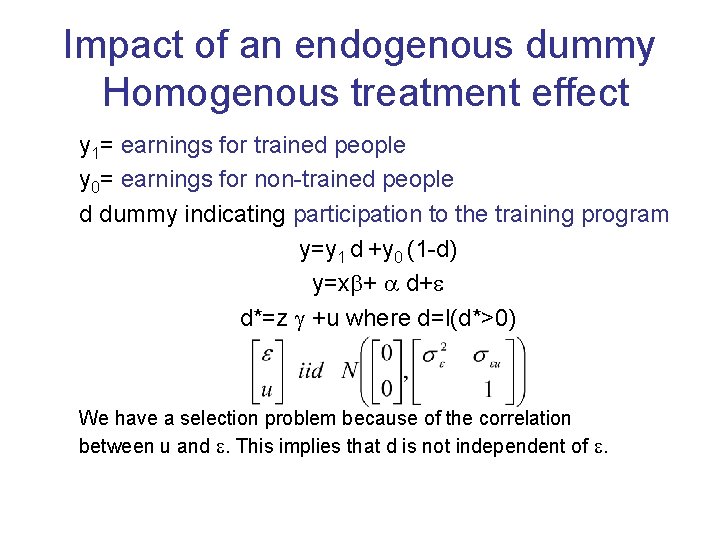
Impact of an endogenous dummy Homogenous treatment effect y 1= earnings for trained people y 0= earnings for non-trained people d dummy indicating participation to the training program y=y 1 d +y 0 (1 -d) y=x + d+ d*=z +u where d=l(d*>0) We have a selection problem because of the correlation between u and . This implies that d is not independent of .
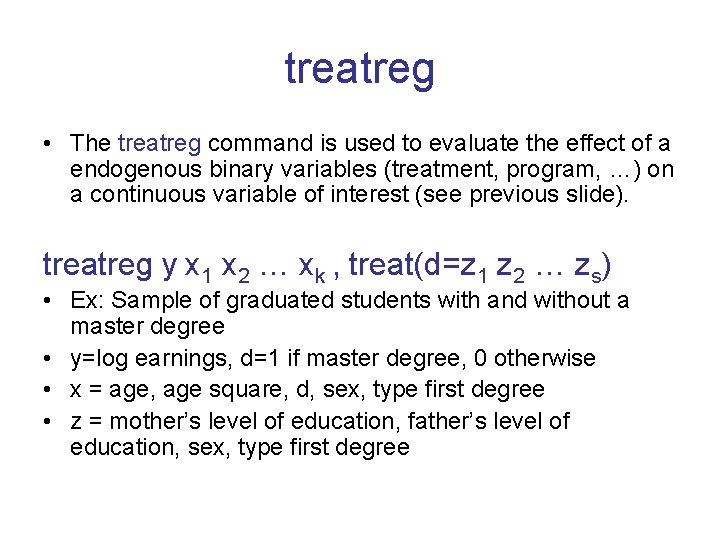
treatreg • The treatreg command is used to evaluate the effect of a endogenous binary variables (treatment, program, …) on a continuous variable of interest (see previous slide). treatreg y x 1 x 2 … xk , treat(d=z 1 z 2 … zs) • Ex: Sample of graduated students with and without a master degree • y=log earnings, d=1 if master degree, 0 otherwise • x = age, age square, d, sex, type first degree • z = mother’s level of education, father’s level of education, sex, type first degree
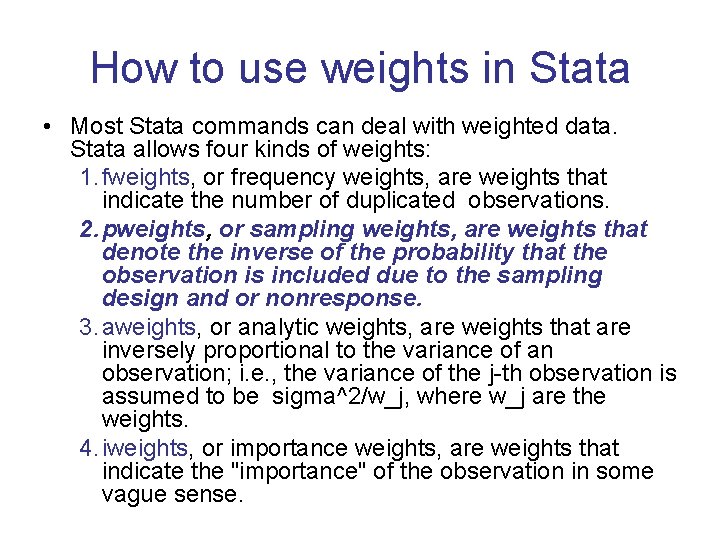
How to use weights in Stata • Most Stata commands can deal with weighted data. Stata allows four kinds of weights: 1. fweights, or frequency weights, are weights that indicate the number of duplicated observations. 2. pweights, or sampling weights, are weights that denote the inverse of the probability that the observation is included due to the sampling design and or nonresponse. 3. aweights, or analytic weights, are weights that are inversely proportional to the variance of an observation; i. e. , the variance of the j-th observation is assumed to be sigma^2/w_j, where w_j are the weights. 4. iweights, or importance weights, are weights that indicate the "importance" of the observation in some vague sense.
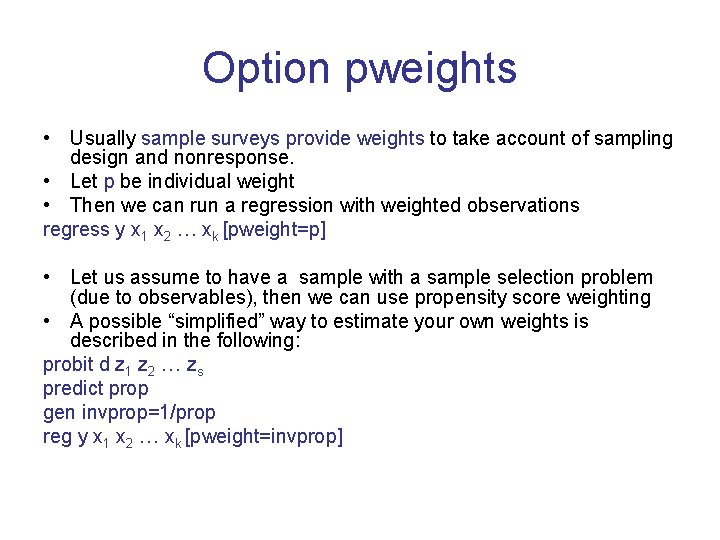
Option pweights • Usually sample surveys provide weights to take account of sampling design and nonresponse. • Let p be individual weight • Then we can run a regression with weighted observations regress y x 1 x 2 … xk [pweight=p] • Let us assume to have a sample with a sample selection problem (due to observables), then we can use propensity score weighting • A possible “simplified” way to estimate your own weights is described in the following: probit d z 1 z 2 … zs predict prop gen invprop=1/prop reg y x 1 x 2 … xk [pweight=invprop]
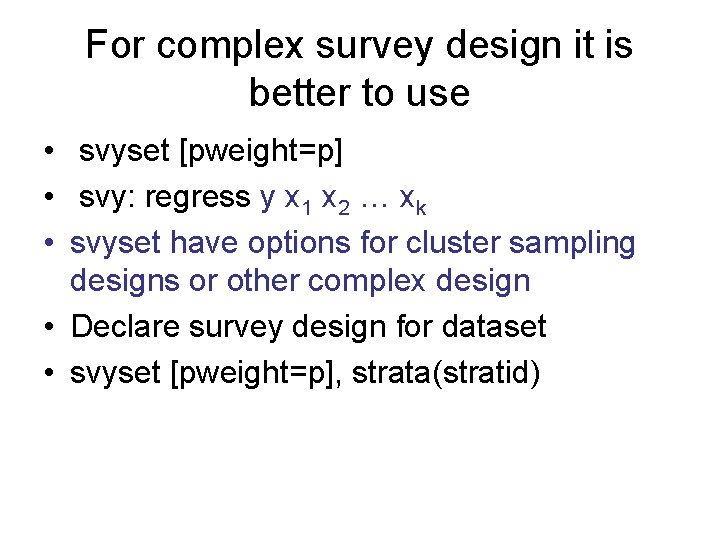
For complex survey design it is better to use • svyset [pweight=p] • svy: regress y x 1 x 2 … xk • svyset have options for cluster sampling designs or other complex design • Declare survey design for dataset • svyset [pweight=p], strata(stratid)
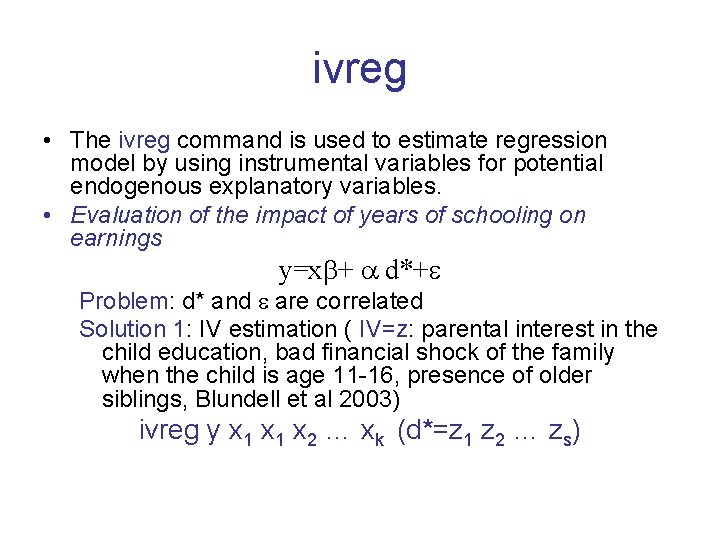
ivreg • The ivreg command is used to estimate regression model by using instrumental variables for potential endogenous explanatory variables. • Evaluation of the impact of years of schooling on earnings y=x + d*+ Problem: d* and are correlated Solution 1: IV estimation ( IV=z: parental interest in the child education, bad financial shock of the family when the child is age 11 -16, presence of older siblings, Blundell et al 2003) ivreg y x 1 x 2 … xk (d*=z 1 z 2 … zs)
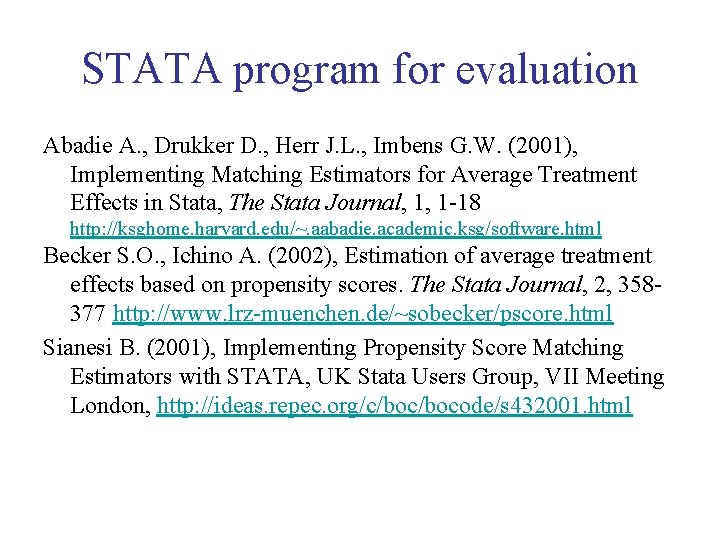
STATA program for evaluation Abadie A. , Drukker D. , Herr J. L. , Imbens G. W. (2001), Implementing Matching Estimators for Average Treatment Effects in Stata, The Stata Journal, 1, 1 -18 http: //ksghome. harvard. edu/~. aabadie. academic. ksg/software. html Becker S. O. , Ichino A. (2002), Estimation of average treatment effects based on propensity scores. The Stata Journal, 2, 358377 http: //www. lrz-muenchen. de/~sobecker/pscore. html Sianesi B. (2001), Implementing Propensity Score Matching Estimators with STATA, UK Stata Users Group, VII Meeting London, http: //ideas. repec. org/c/bocode/s 432001. html
Text Book References: • Amemiya T. (1985), Advanced Econometrics, Basil Blackwell, Oxford. • Gourieroux C. (2000), Econometrics of Qualitative Dependent Variables, Cambridge University Press, Cambridge. • Greene W. H. (2000), Econometric Analysis, Third edition, Prenticehall, London. • Maddala G. S. (1983), Limited-Dependent and Qualitative Variables in Econometrics, Cambridge University Press, Cambridge. • Wooldridge J. M. (2002), Econometric Analysis of Cross-Section and Panel Data, MIT press • Lee M. (2005) Micro-Econometrics for policy, program and treatment effects. Advanced Text in Econometrics. Oxford University Press, Oxford
Survey Articles: • • Angrist J. (2001), Estimation of Limited-Dependent Variable Models with Binary Endogenous Regressors: Simple Strategies for Empirical Practice, ” Journal of Business and Economic Statistics, 19, 2 -28. Angrist J. D. , Krueger A. B. (1999), Empirical strategies in labor economics, published as working paper Princeton University, 401, and in O. Ashenfelter and D. Card, eds. , Handbook of Labor Economics, Volume 3 A, Amsterda, , 1277 -1366. Blundell R. , Costa-Dias M. (2002), Alternative approaches to evaluation in empirical microeconomics', published as IFS, Cemmap working paper, 10, and in Portuguese Economic Journal, Vol. 1, 91 -115, 2002. Blundell R. , Powell J. L. (2001), Endogeneity in nonparametric and semiparametric regression models, IFS, Cemmap working paper, CWP 09/01, Chapter 8 in Advances in Economics and Econometrics , M. Dewatripont, Hansen, L. and S. J. Turnsovsky (eds. ), Cambridge University Press, ESM 36, pp 312 -357, 2003. Heckman J. J. , Ichimura H. , Smith J. A. , Todd P. (1998), Characterization of Selection Bias Using Experimental Data, Econometrica, 66, 1017 -1098. Heckman J. J. , La. Londe R. J. , Smith J. A. (2000), The economics and econometrics of active labor market programs, in O. Ashenfelter and D. Card, (eds. ), Handbook of Labor Economics, vol. 3, North Holland, Amsterdam. Moffitt R. (2004), An introduction to the symposium of matching econometrics, Review of Economics and Statistics, vol. 1, a collection of articles on matching by various authors. Vella F. (1998), Estimating models with sample selection bias: a survey', The Journal of Human Resources, vol. 3, 127 -169.