Esters C I 13 5 What are they
- Slides: 12
Esters C. I. 13. 5
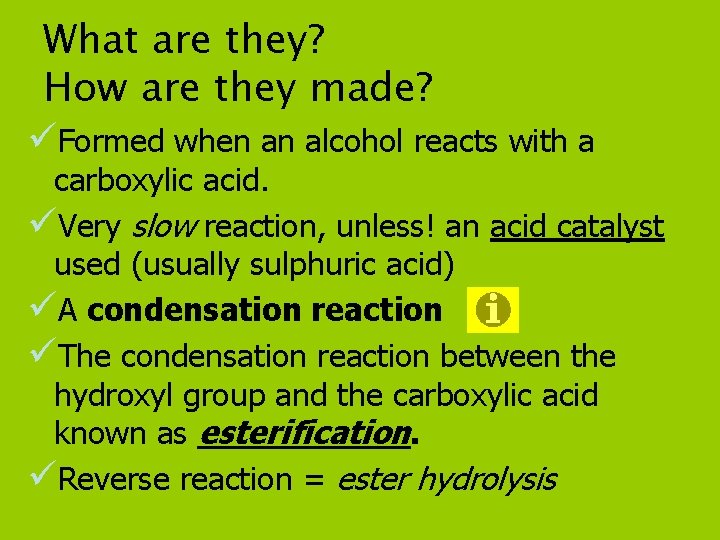
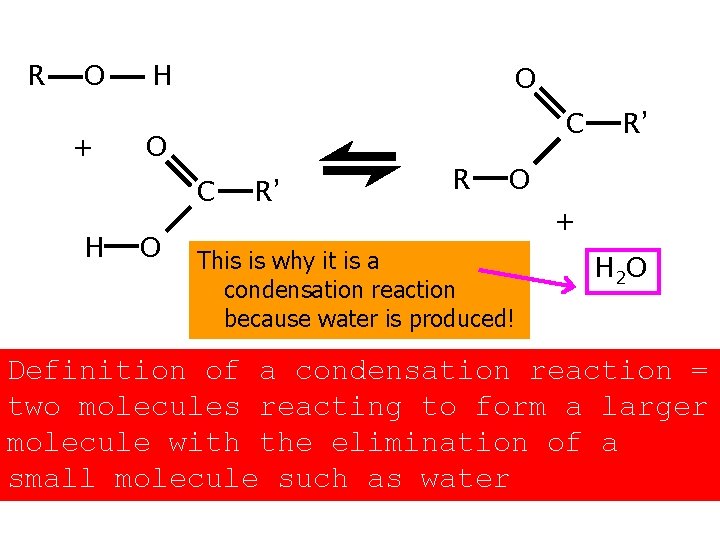
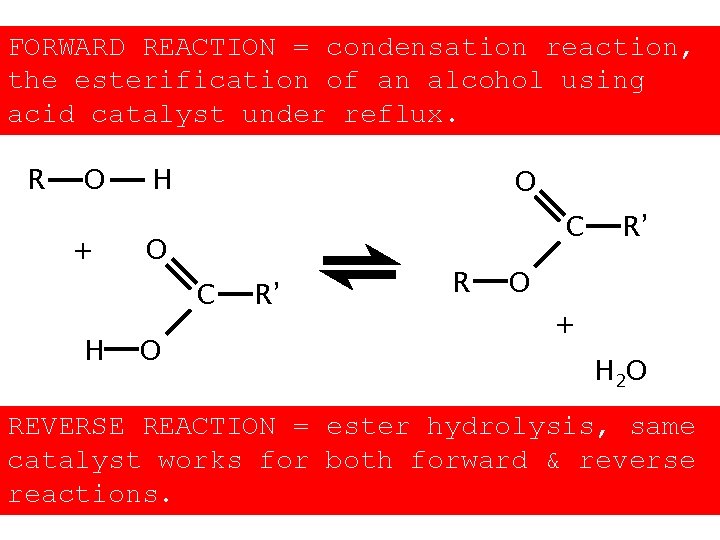
What are they? How are they made? üFormed when an alcohol reacts with a carboxylic acid. üVery slow reaction, unless! an acid catalyst used (usually sulphuric acid) üA condensation reaction üThe condensation reaction between the hydroxyl group and the carboxylic acid known as esterification. üReverse reaction = ester hydrolysis
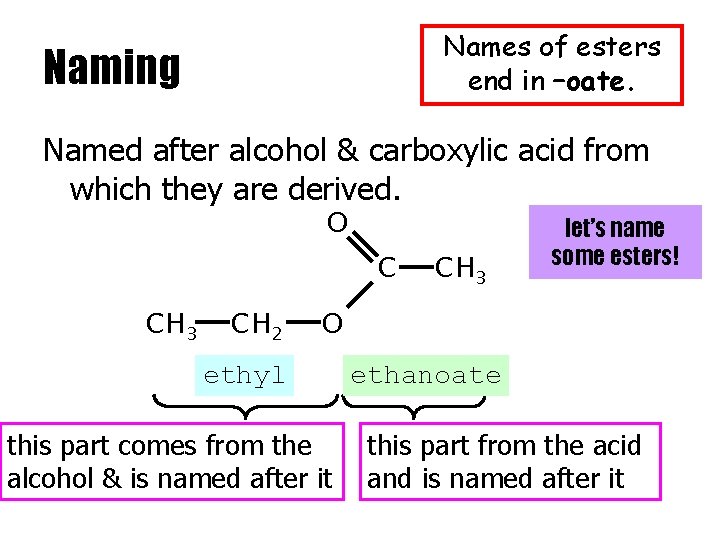
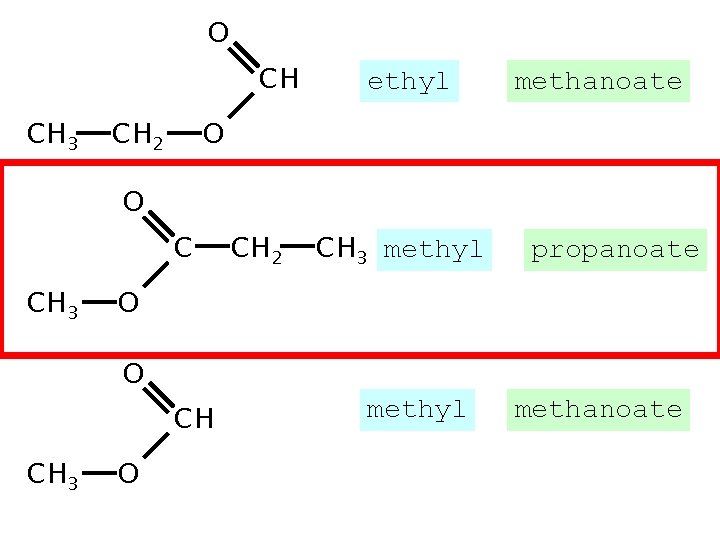
Names of esters end in –oate. Naming Named after alcohol & carboxylic acid from which they are derived. O C CH 3 CH 2 CH 3 let’s name some esters! O ethyl this part comes from the alcohol & is named after it ethanoate this part from the acid and is named after it
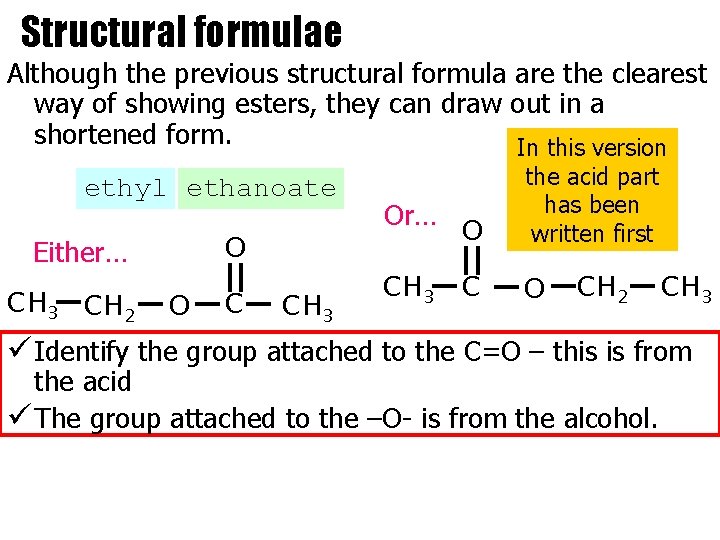
Structural formulae Although the previous structural formula are the clearest way of showing esters, they can draw out in a shortened form. In this version ethyl ethanoate O Either… CH 3 CH 2 O C CH 3 Or… O CH 3 C the acid part has been written first O CH 2 CH 3 ü Identify the group attached to the C=O – this is from the acid ü The group attached to the –O- is from the alcohol.
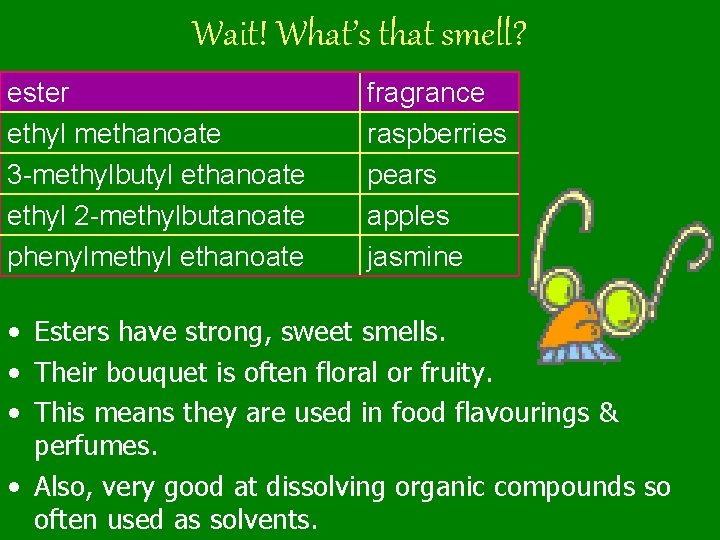
Wait! What’s that smell? ester ethyl methanoate 3 -methylbutyl ethanoate ethyl 2 -methylbutanoate phenylmethyl ethanoate fragrance raspberries pears apples jasmine • Esters have strong, sweet smells. • Their bouquet is often floral or fruity. • This means they are used in food flavourings & perfumes. • Also, very good at dissolving organic compounds so often used as solvents.
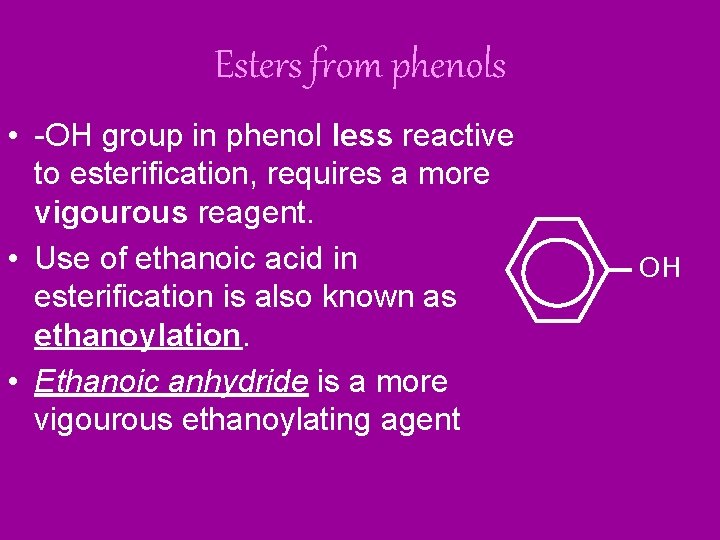
Esters from phenols • -OH group in phenol less reactive to esterification, requires a more vigourous reagent. • Use of ethanoic acid in esterification is also known as ethanoylation. • Ethanoic anhydride is a more vigourous ethanoylating agent OH
Esters from phenols • Ethanoic anhydride used as it is reactive but not too dangerous. • Ethanoyl chloride is much more reactive, but, also toxic and hazardous to use. • Ethanoic anhydride & ethanoyl chloride are described as acylating agents üusing an acylating agent is the only way to esterify a phenol üalcohols can be esterified using acylating agents or by reacting with a carboxylic acid.
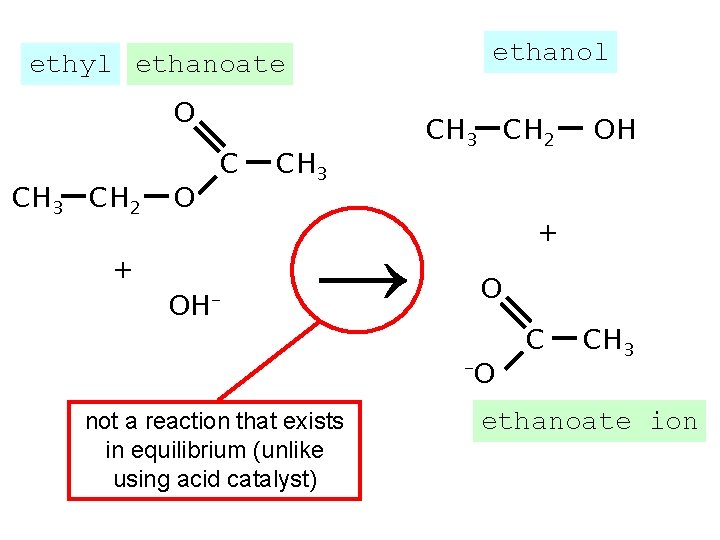
Ester hydrolysis üBreakdown of an ester by water. üProcess sped up by catalysis üCan use an acid to catalyse (H 2 SO 4) üAlkali catalysts (e. g. sodium hydroxide) can also be used but instead of producing carboxylic acid a carboxylate salt is formed. üAlkaline hydrolysis goes to completion & hence is usually preferred.
R O + H O C H O R’ ⇋ O C R O This is why it is a condensation reaction because water is produced! R’ + H 2 O Definition of a condensation reaction = two molecules reacting to form a larger molecule with the elimination of a small molecule such as water
O CH CH 3 CH 2 ethyl methanoate O O C CH 3 methyl propanoate O O CH CH 3 CH 2 O methyl methanoate
FORWARD REACTION = condensation reaction, the esterification of an alcohol using acid catalyst under reflux. R O + H O C H O R’ ⇌ O C R O R’ + H 2 O REVERSE REACTION = ester hydrolysis, same catalyst works for both forward & reverse reactions.
ethanol ethyl ethanoate O CH 3 CH 2 + O C OH- CH 3 → CH 3 CH 2 + O -O not a reaction that exists in equilibrium (unlike using acid catalyst) OH C CH 3 ethanoate ion