English Language Learners Issues Among Parent Involvement Defining

- Slides: 16
English Language Learners: Issues Among Parent Involvement
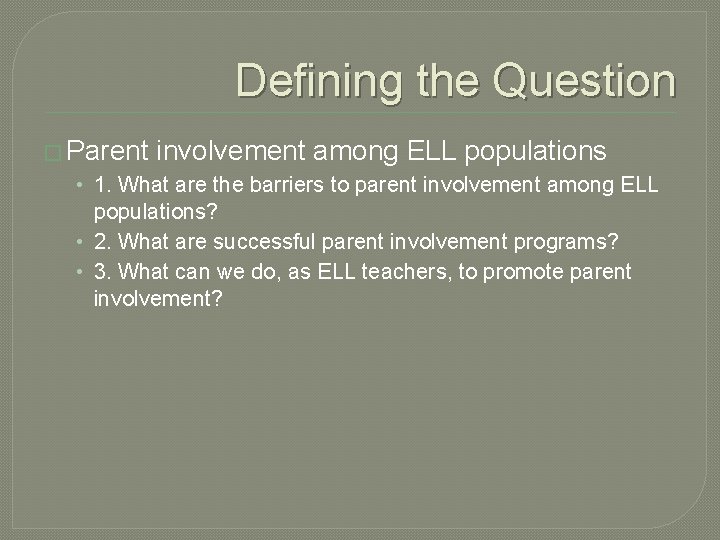
Defining the Question � Parent involvement among ELL populations • 1. What are the barriers to parent involvement among ELL populations? • 2. What are successful parent involvement programs? • 3. What can we do, as ELL teachers, to promote parent involvement?
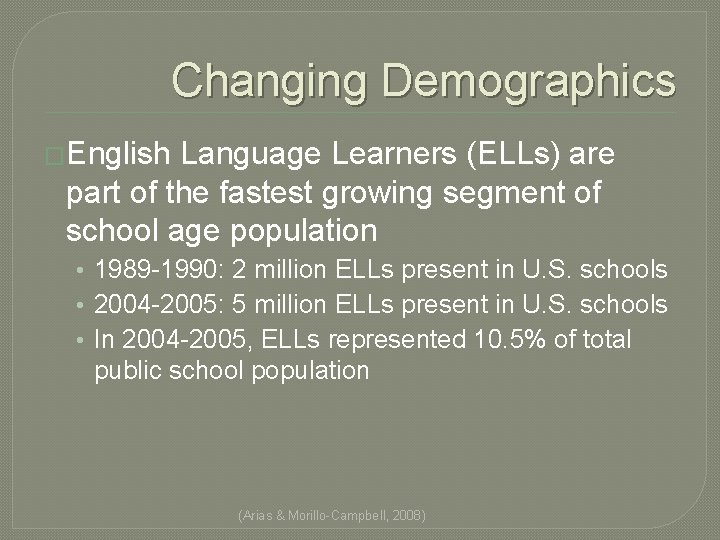
Changing Demographics �English Language Learners (ELLs) are part of the fastest growing segment of school age population • 1989 -1990: 2 million ELLs present in U. S. schools • 2004 -2005: 5 million ELLs present in U. S. schools • In 2004 -2005, ELLs represented 10. 5% of total public school population (Arias & Morillo-Campbell, 2008)
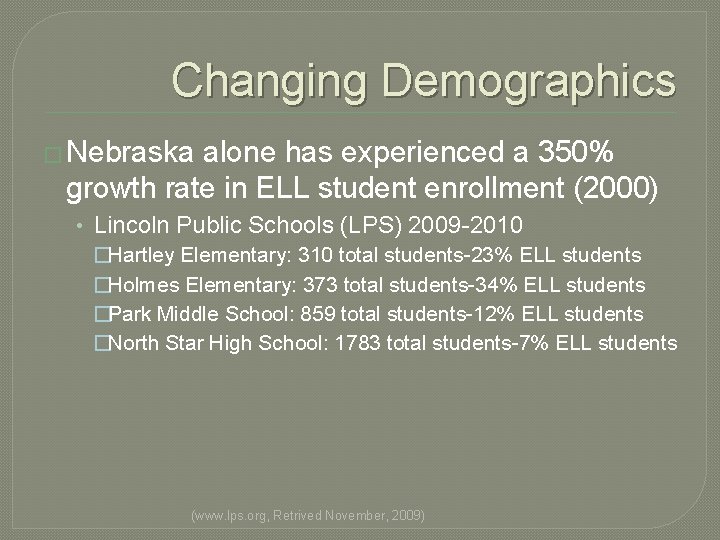
Changing Demographics � Nebraska alone has experienced a 350% growth rate in ELL student enrollment (2000) • Lincoln Public Schools (LPS) 2009 -2010 �Hartley Elementary: 310 total students-23% ELL students �Holmes Elementary: 373 total students-34% ELL students �Park Middle School: 859 total students-12% ELL students �North Star High School: 1783 total students-7% ELL students (www. lps. org, Retrived November, 2009)
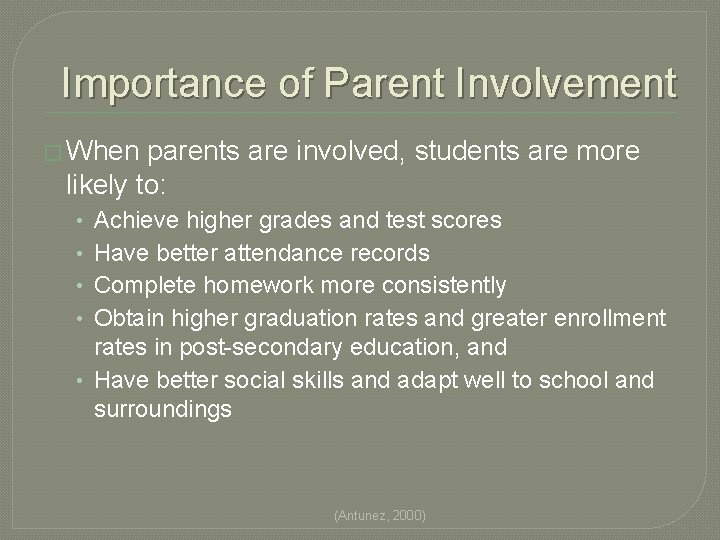
Importance of Parent Involvement � When parents are involved, students are more likely to: Achieve higher grades and test scores Have better attendance records Complete homework more consistently Obtain higher graduation rates and greater enrollment rates in post-secondary education, and • Have better social skills and adapt well to school and surroundings • • (Antunez, 2000)
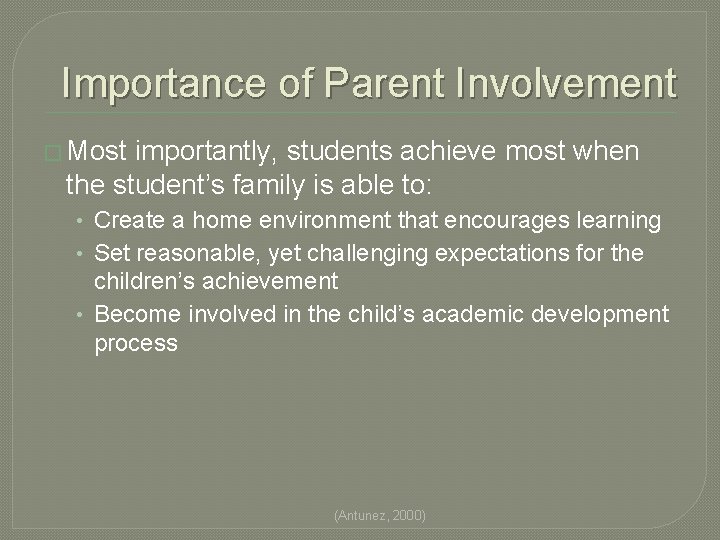
Importance of Parent Involvement � Most importantly, students achieve most when the student’s family is able to: • Create a home environment that encourages learning • Set reasonable, yet challenging expectations for the children’s achievement • Become involved in the child’s academic development process (Antunez, 2000)
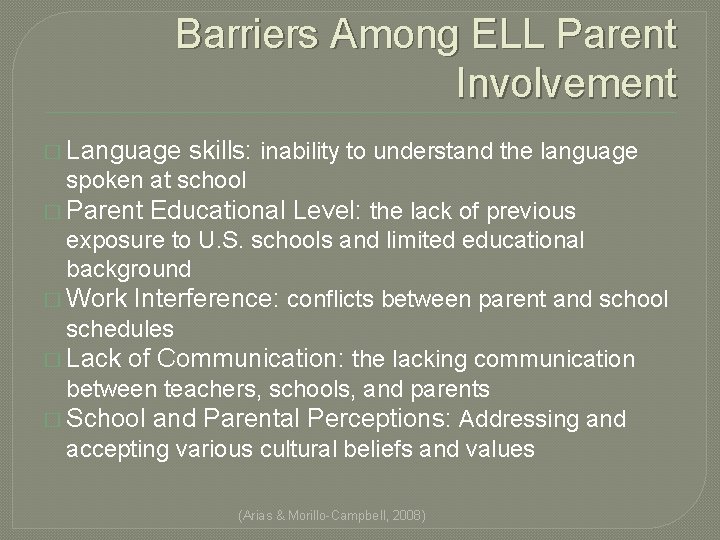
Barriers Among ELL Parent Involvement � Language skills: inability to understand the language spoken at school � Parent Educational Level: the lack of previous exposure to U. S. schools and limited educational background � Work Interference: conflicts between parent and school schedules � Lack of Communication: the lacking communication between teachers, schools, and parents � School and Parental Perceptions: Addressing and accepting various cultural beliefs and values (Arias & Morillo-Campbell, 2008)
Addressing the Issues: Ways to Solve the Problems � Better our communication skills: • Provide home-school coordinators or liaisons • Initiate home visits by teachers • All newsletters are to be sent home in native languages • Create a multilingual homework line • Support the strengths of ELL parents, not their perceived failings (Antunez, 2000)
Addressing the Issues: Ways to Solve the Problems �School and Parental Perceptions • Acknowledge and accept parent’s and student’s cultural values • Incorporate family, cultures, and community into the curriculum (Antunez, 2000)
Addressing the Issues: Ways to Solve the Problems �Logistics • Adjust meetings to accommodate parents work schedules • Provide child care to facilitate parental attendance at school functions • Arrange transportation to facilitate parent and student involvement in school functions (Antunez, 2000)
Addressing the Issues: Ways to Solve the Problems �Perseverance in Maintaining Involvement • Keep ideas new and fresh • Allow parents time to adjust; however, continue to be understanding and accepting of each ELL family’s background • Be consistent with approaches, programs, and communication (Antunez, 2000)
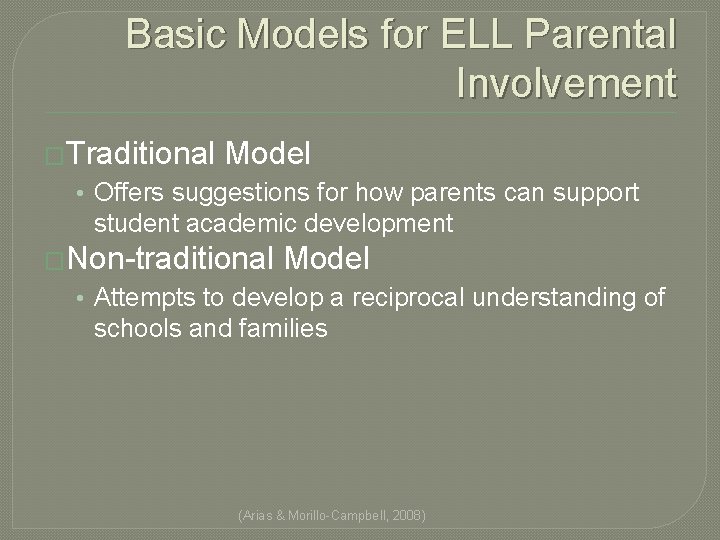
Basic Models for ELL Parental Involvement �Traditional Model • Offers suggestions for how parents can support student academic development �Non-traditional Model • Attempts to develop a reciprocal understanding of schools and families (Arias & Morillo-Campbell, 2008)
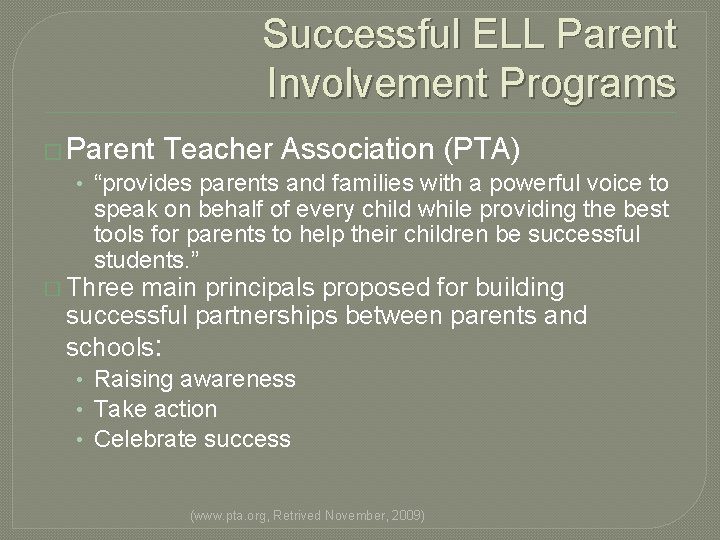
Successful ELL Parent Involvement Programs � Parent Teacher Association (PTA) • “provides parents and families with a powerful voice to speak on behalf of every child while providing the best tools for parents to help their children be successful students. ” � Three main principals proposed for building successful partnerships between parents and schools: • Raising awareness • Take action • Celebrate success (www. pta. org, Retrived November, 2009)
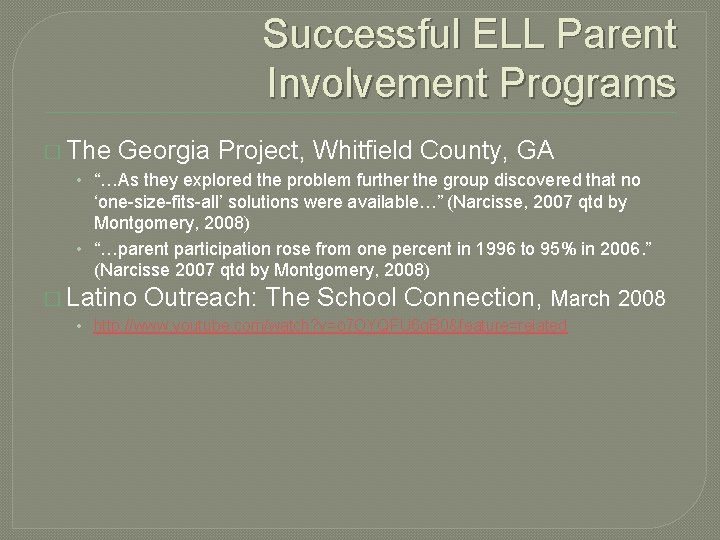
Successful ELL Parent Involvement Programs � The Georgia Project, Whitfield County, GA • “…As they explored the problem further the group discovered that no ‘one-size-fits-all’ solutions were available…” (Narcisse, 2007 qtd by Montgomery, 2008) • “…parent participation rose from one percent in 1996 to 95% in 2006. ” (Narcisse 2007 qtd by Montgomery, 2008) � Latino Outreach: The School Connection, March 2008 • http: //www. youtube. com/watch? v=o 7 OYQFU 6 g. B 0&feature=related
Parent Involvement Organizations � National Parent Teacher Association (PTA) • http: //www. pta. org � National Standards for Parent/Family Involvement Programs • http: //www. pta. org/programs/invstand. htm � Family Resource Center Coalition of Nebraska, Inc. Suite 410 5109 West Scott Road Beatrice, NE 68310 Phone: (402) 223 -6040 Fax: (402) 223 -6043 Email: ptimm@beatrice. k 12. ne. us or bvca@alltel. net Website: http: //www. frccn. org/ � Nebraska Parent Information and Resource Center (PIRC) Suite 200 215 Centennial Mall South Lincoln, NE 68508 Phone: (402) 677 -2684 Toll-Free: (877) 843 -6651 Email: Lstclair@unmc. edu Website: http: //www. Nebraska. PIRC. org/
�“Too often we focus on what is lacking in children’s home environment rather than on the potential resources that might exist in them. ” (Diamond, Wang, & Gomez, 2004)