Electromagnetism Contents Review of Maxwells equations and Lorentz





- Slides: 43
Electromagnetism
Contents • Review of Maxwell’s equations and Lorentz Force Law • Motion of a charged particle under constant Electromagnetic fields • Relativistic transformations of fields • Electromagnetic energy conservation • Electromagnetic waves – Waves in vacuo – Waves in conducting medium • Waves in a uniform conducting guide – Simple example TE 01 mode – Propagation constant, cut-off frequency – Group velocity, phase velocity – Illustrations 2
Reading • J. D. Jackson: Classical Electrodynamics • H. D. Young and R. A. Freedman: University Physics (with Modern Physics) • P. C. Clemmow: Electromagnetic Theory • Feynmann Lectures on Physics • W. K. H. Panofsky and M. N. Phillips: Classical Electricity and Magnetism • G. L. Pollack and D. R. Stump: Electromagnetism 3
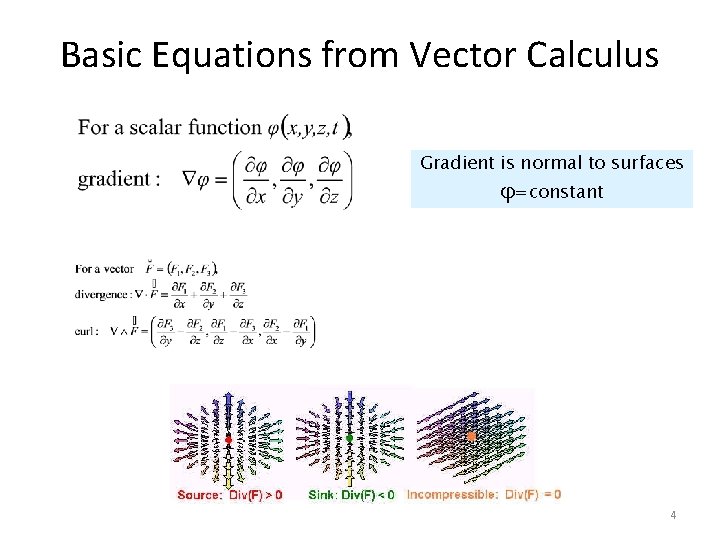
Basic Equations from Vector Calculus Gradient is normal to surfaces =constant 4
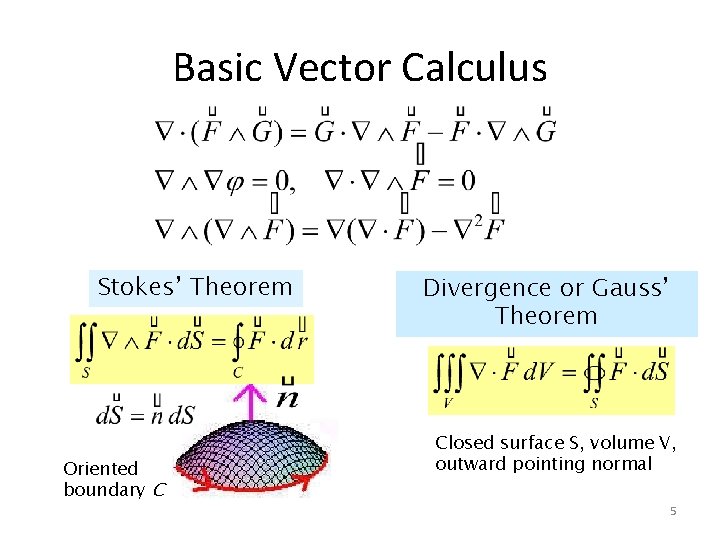
Basic Vector Calculus Stokes’ Theorem Oriented boundary C Divergence or Gauss’ Theorem Closed surface S, volume V, outward pointing normal 5
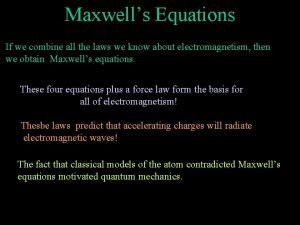
What is Electromagnetism? • The study of Maxwell’s equations, devised in 1863 to represent the relationships between electric and magnetic fields in the presence of electric charges and currents, whether steady or rapidly fluctuating, in a vacuum or in matter. • The equations represent one of the most elegant and concise way to describe the fundamentals of electricity and magnetism. They pull together in a consistent way earlier results known from the work of Gauss, Faraday, Ampère, Biot, Savart and others. • Remarkably, Maxwell’s equations are perfectly consistent with the transformations of special relativity.
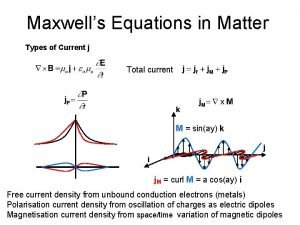
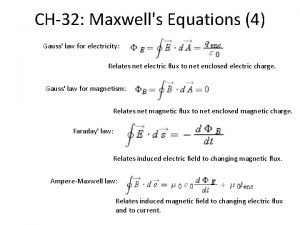
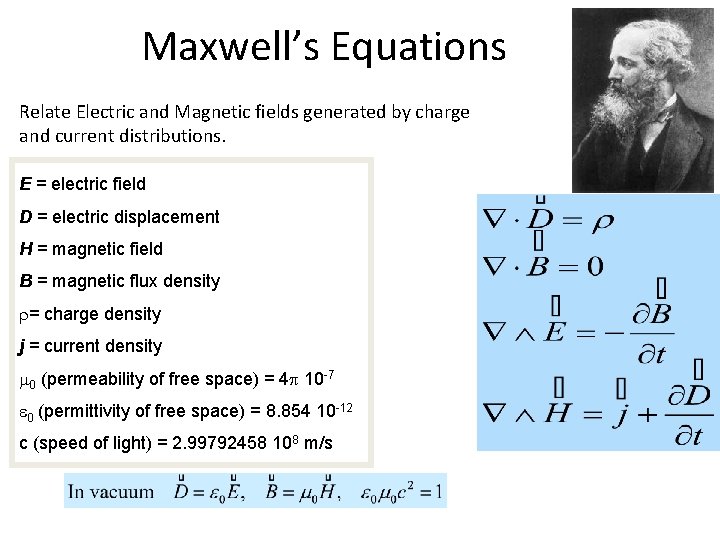
Maxwell’s Equations Relate Electric and Magnetic fields generated by charge and current distributions. E = electric field D = electric displacement H = magnetic field B = magnetic flux density = charge density j = current density 0 (permeability of free space) = 4 10 -7 0 (permittivity of free space) = 8. 854 10 -12 c (speed of light) = 2. 99792458 108 m/s
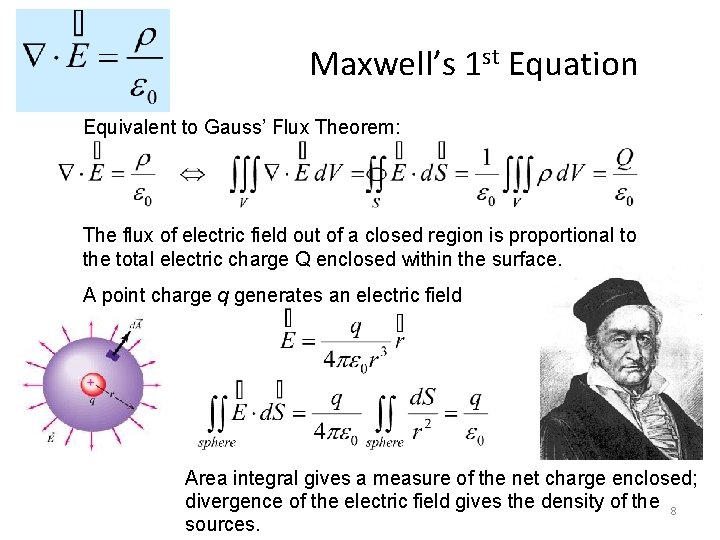
Maxwell’s 1 st Equation Equivalent to Gauss’ Flux Theorem: The flux of electric field out of a closed region is proportional to the total electric charge Q enclosed within the surface. A point charge q generates an electric field Area integral gives a measure of the net charge enclosed; divergence of the electric field gives the density of the 8 sources.
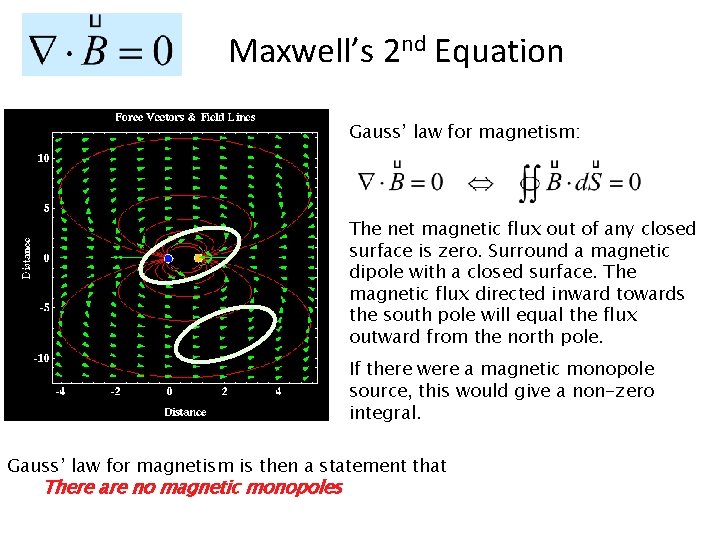
Maxwell’s 2 nd Equation Gauss’ law for magnetism: The net magnetic flux out of any closed surface is zero. Surround a magnetic dipole with a closed surface. The magnetic flux directed inward towards the south pole will equal the flux outward from the north pole. If there were a magnetic monopole source, this would give a non-zero integral. Gauss’ law for magnetism is then a statement that There are no magnetic monopoles
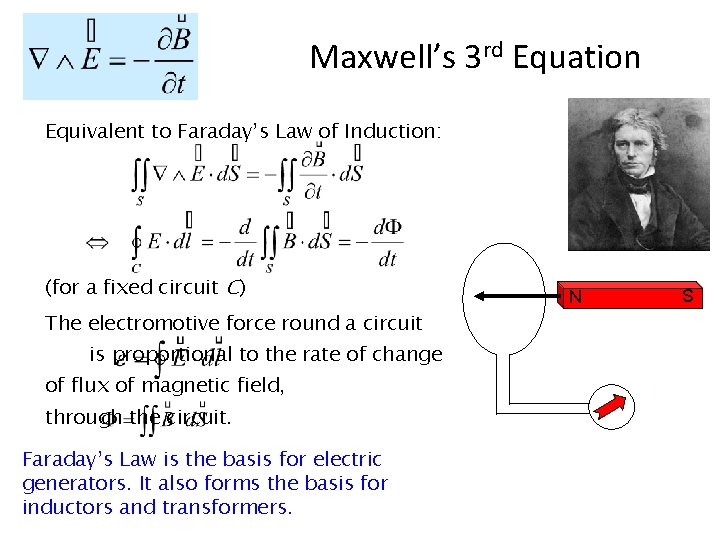
Maxwell’s 3 rd Equation Equivalent to Faraday’s Law of Induction: (for a fixed circuit C) The electromotive force round a circuit is proportional to the rate of change of flux of magnetic field, through the circuit. Faraday’s Law is the basis for electric generators. It also forms the basis for inductors and transformers. N S
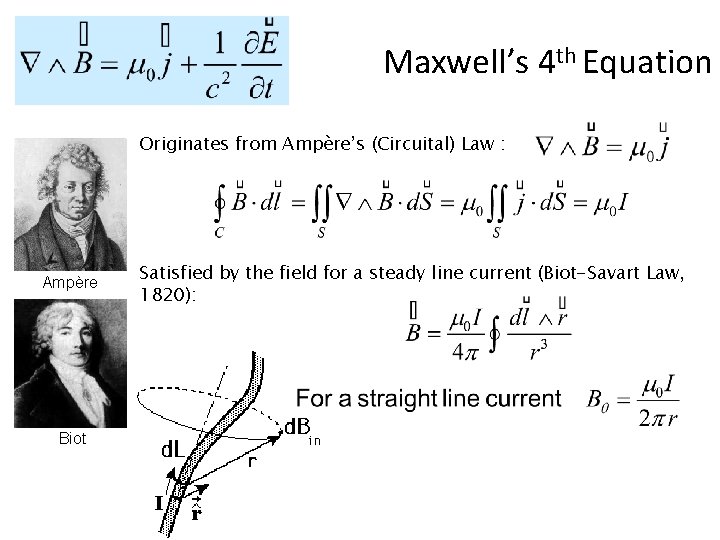
Maxwell’s 4 th Equation Originates from Ampère’s (Circuital) Law : Ampère Biot Satisfied by the field for a steady line current (Biot-Savart Law, 1820):
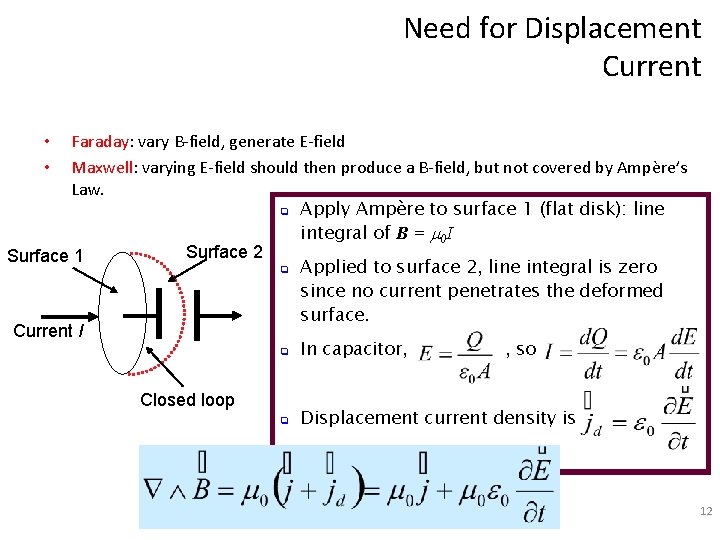
Need for Displacement Current Faraday: vary B-field, generate E-field Maxwell: varying E-field should then produce a B-field, but not covered by Ampère’s Law. q Apply Ampère to surface 1 (flat disk): line integral of B = 0 I Surface 2 Surface 1 q Applied to surface 2, line integral is zero since no current penetrates the deformed surface. Current I q In capacitor, , so • • Closed loop q Displacement current density is 12
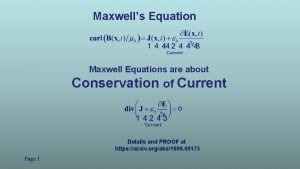
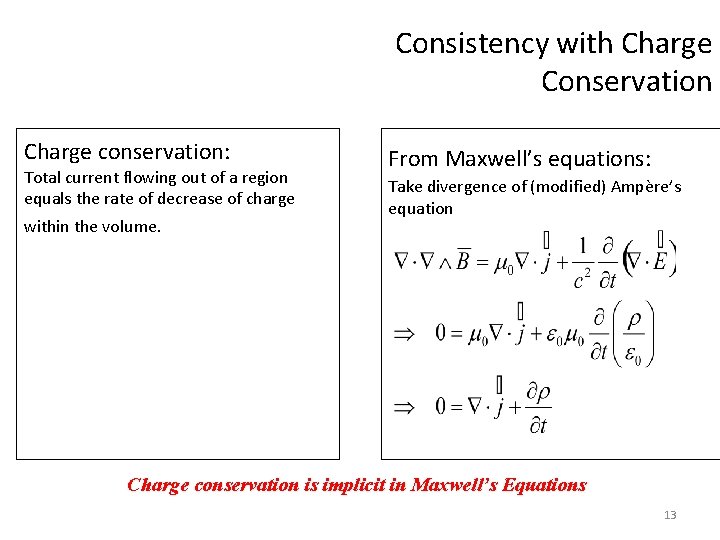
Consistency with Charge Conservation Charge conservation: Total current flowing out of a region equals the rate of decrease of charge within the volume. From Maxwell’s equations: Take divergence of (modified) Ampère’s equation Charge conservation is implicit in Maxwell’s Equations 13
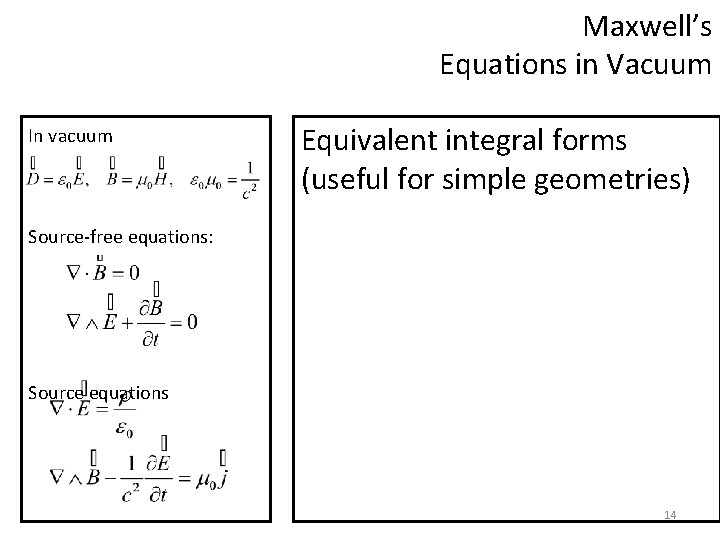
Maxwell’s Equations in Vacuum In vacuum Equivalent integral forms (useful for simple geometries) Source-free equations: Source equations 14
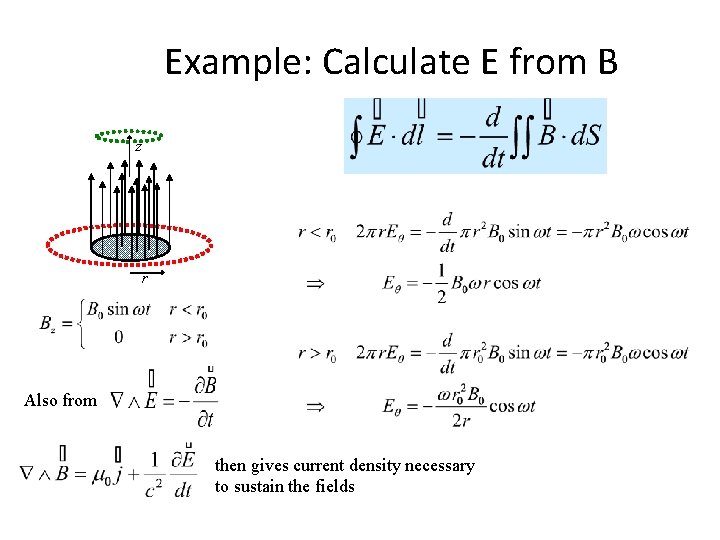
Example: Calculate E from B z r Also from then gives current density necessary to sustain the fields
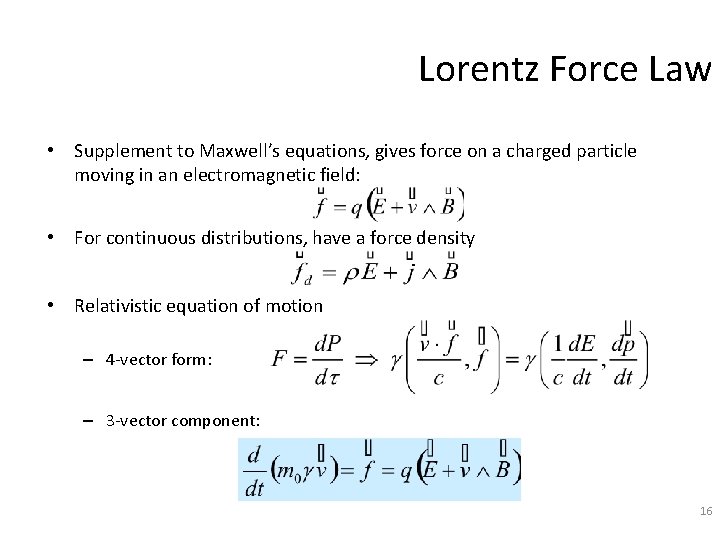
Lorentz Force Law • Supplement to Maxwell’s equations, gives force on a charged particle moving in an electromagnetic field: • For continuous distributions, have a force density • Relativistic equation of motion – 4 -vector form: – 3 -vector component: 16
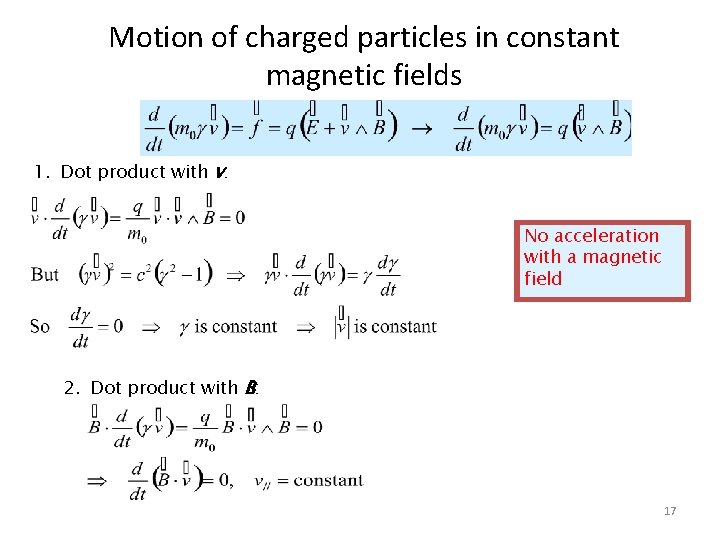
Motion of charged particles in constant magnetic fields 1. Dot product with v: No acceleration with a magnetic field 2. Dot product with B: 17
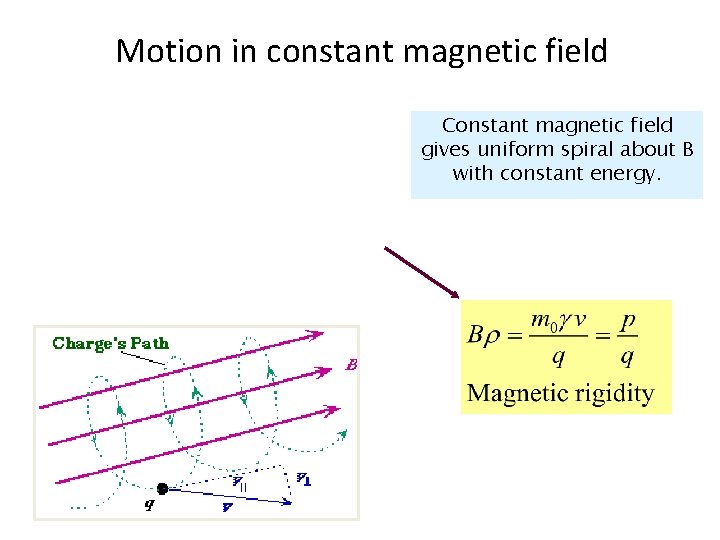
Motion in constant magnetic field Constant magnetic field gives uniform spiral about B with constant energy.
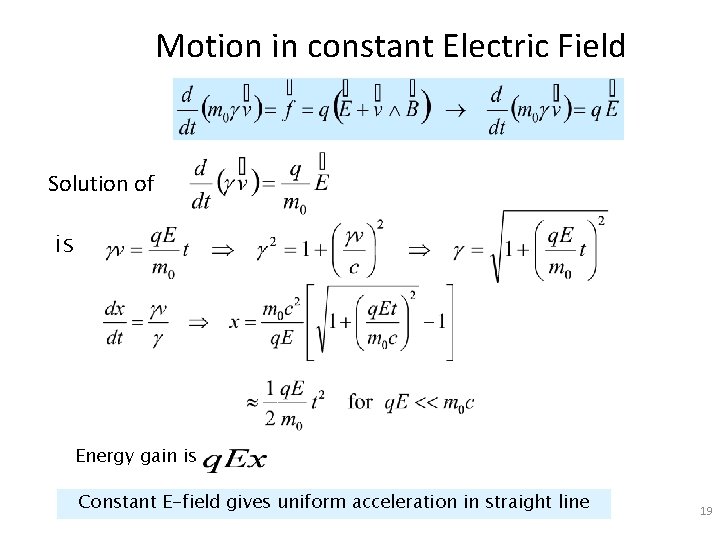
Motion in constant Electric Field Solution of is Energy gain is Constant E-field gives uniform acceleration in straight line 19
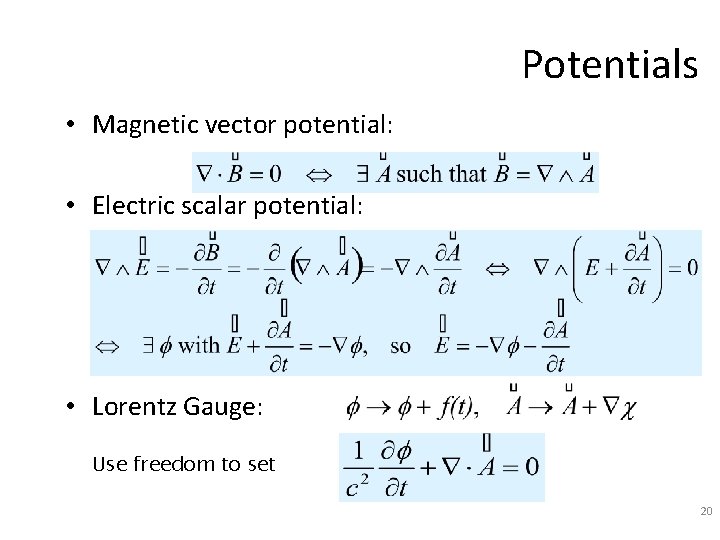
Potentials • Magnetic vector potential: • Electric scalar potential: • Lorentz Gauge: Use freedom to set 20
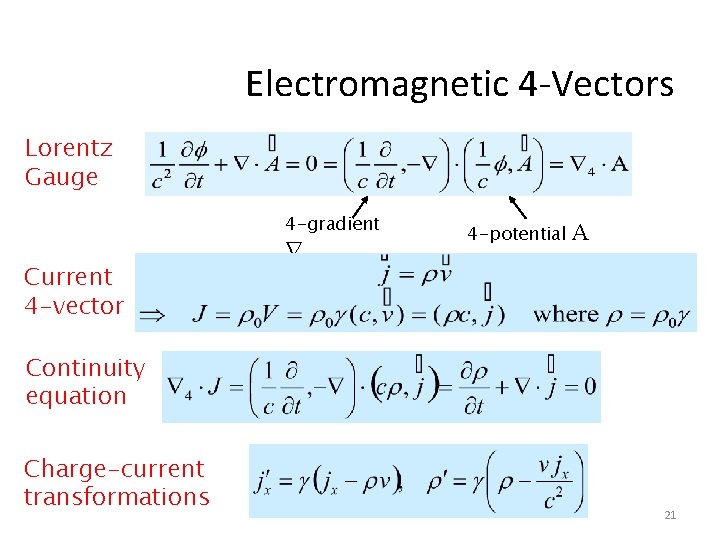
Electromagnetic 4 -Vectors Lorentz Gauge 4 -gradient Current 4 -vector 4 4 -potential A Continuity equation Charge-current transformations 21
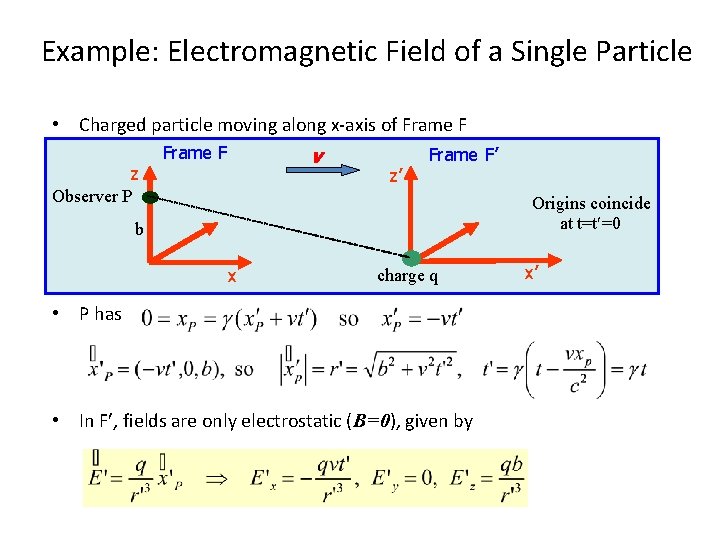
Example: Electromagnetic Field of a Single Particle • Charged particle moving along x-axis of Frame F z Observer P Frame F v z’ Frame F’ Origins coincide at t=t =0 b x charge q • P has • In F , fields are only electrostatic (B=0), given by x’
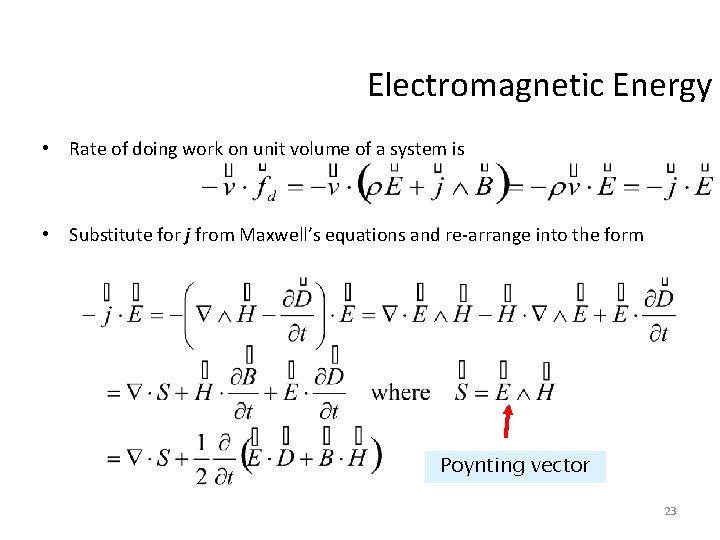
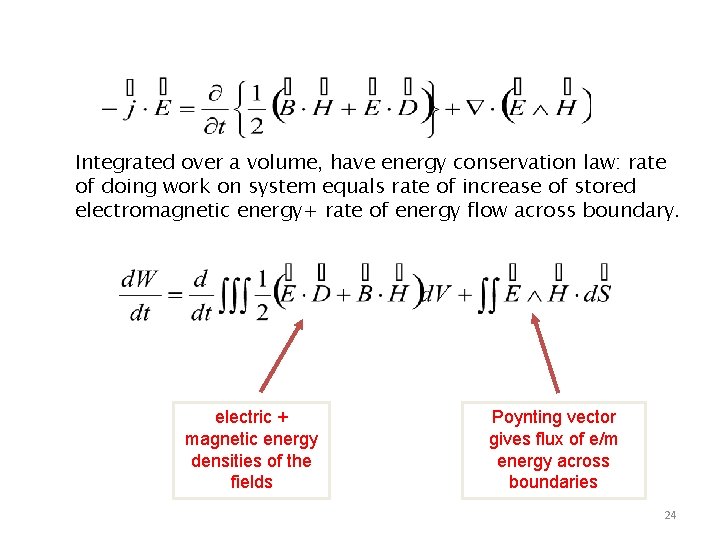
Electromagnetic Energy • Rate of doing work on unit volume of a system is • Substitute for j from Maxwell’s equations and re-arrange into the form Poynting vector 23
Integrated over a volume, have energy conservation law: rate of doing work on system equals rate of increase of stored electromagnetic energy+ rate of energy flow across boundary. electric + magnetic energy densities of the fields Poynting vector gives flux of e/m energy across boundaries 24
Review of Waves • 1 D wave equation is solution • Simple plane wave: Wavelength is Frequency is with general
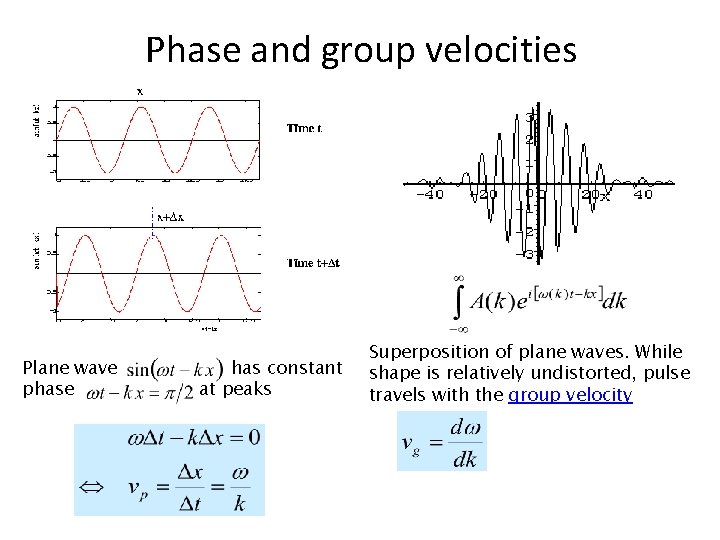
Phase and group velocities Plane wave phase has constant at peaks Superposition of plane waves. While shape is relatively undistorted, pulse travels with the group velocity
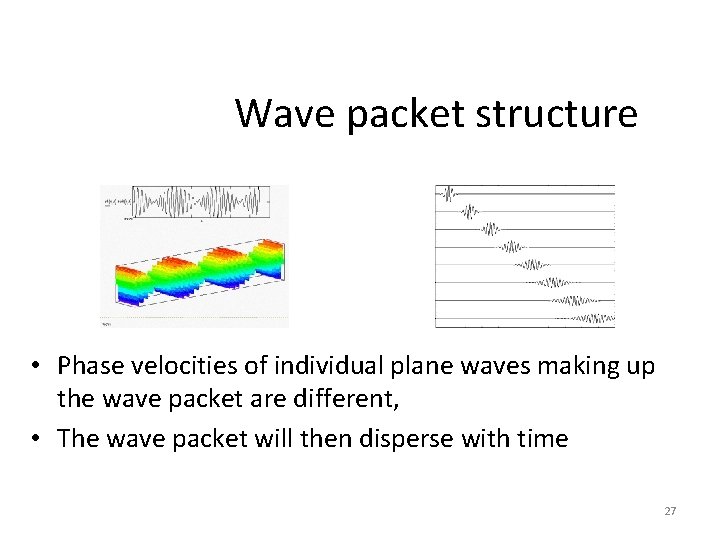
Wave packet structure • Phase velocities of individual plane waves making up the wave packet are different, • The wave packet will then disperse with time 27
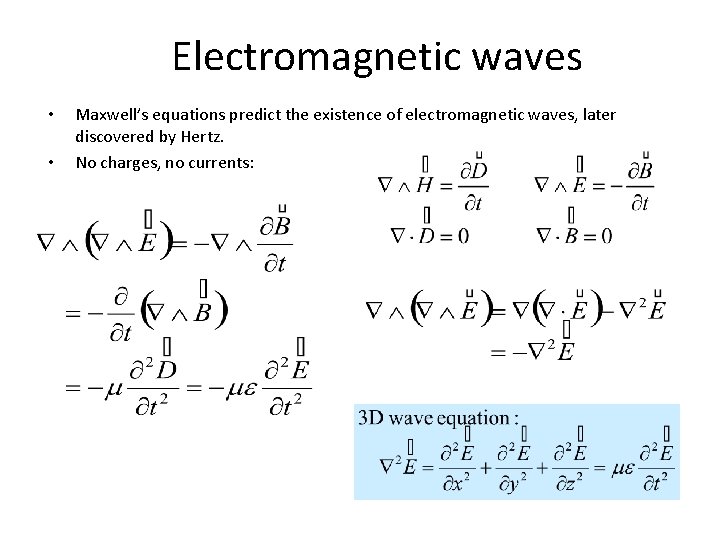
Electromagnetic waves • • Maxwell’s equations predict the existence of electromagnetic waves, later discovered by Hertz. No charges, no currents:
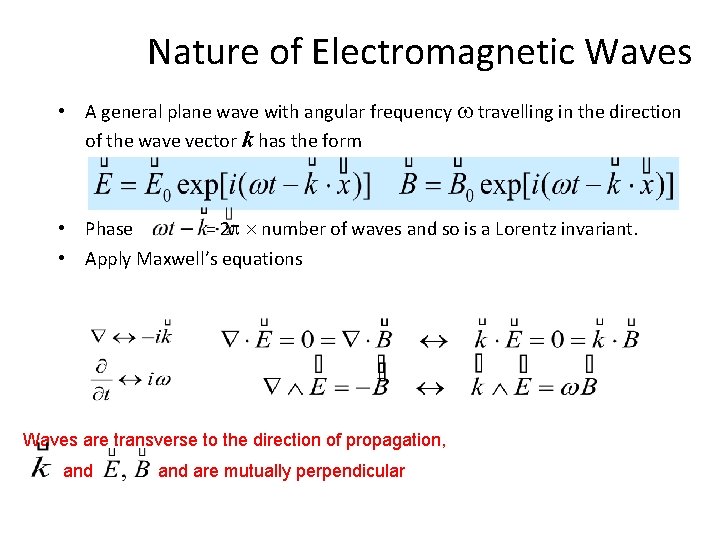
Nature of Electromagnetic Waves • A general plane wave with angular frequency travelling in the direction of the wave vector k has the form • Phase = 2 number of waves and so is a Lorentz invariant. • Apply Maxwell’s equations Waves are transverse to the direction of propagation, and are mutually perpendicular
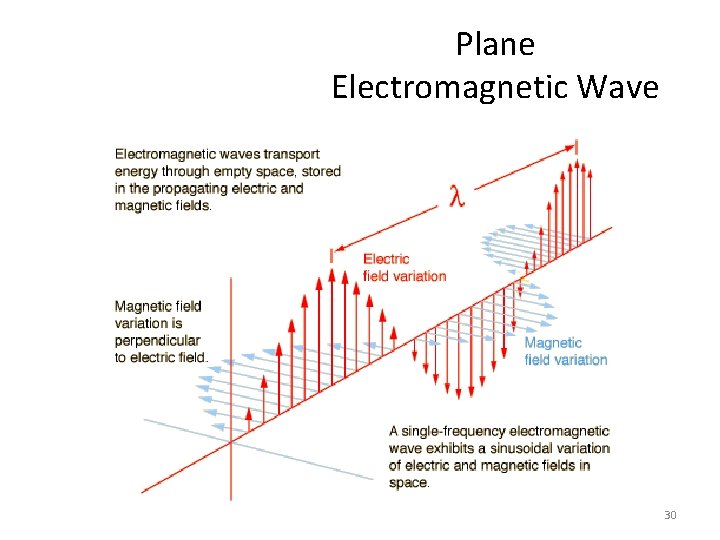
Plane Electromagnetic Wave 30
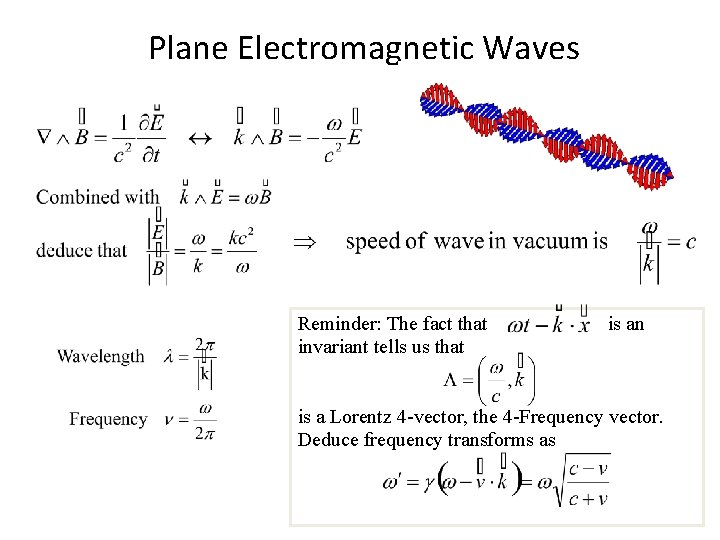
Plane Electromagnetic Waves Reminder: The fact that is an invariant tells us that is a Lorentz 4 -vector, the 4 -Frequency vector. Deduce frequency transforms as
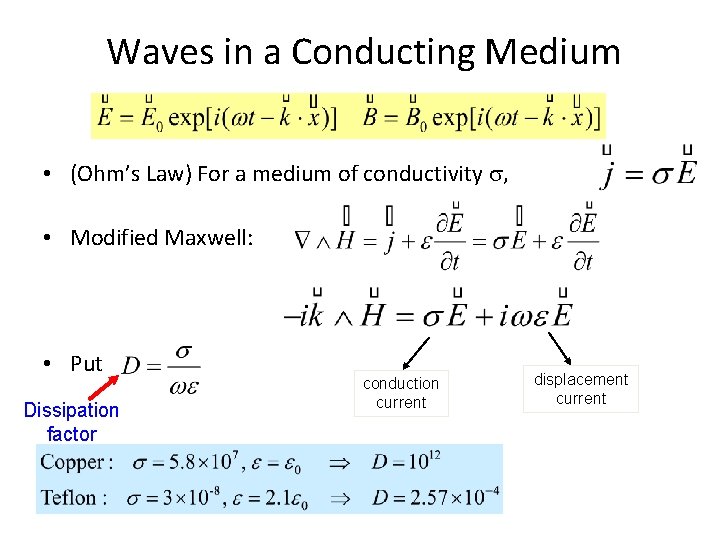
Waves in a Conducting Medium • (Ohm’s Law) For a medium of conductivity , • Modified Maxwell: • Put Dissipation factor conduction current displacement current
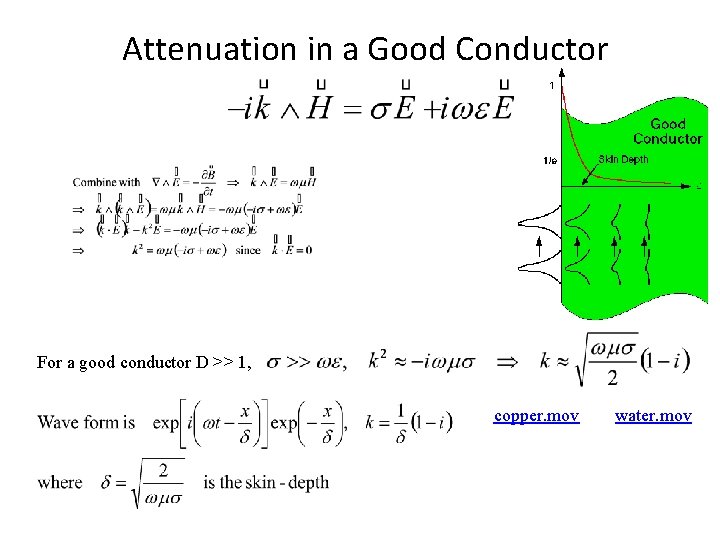
Attenuation in a Good Conductor For a good conductor D >> 1, copper. mov water. mov
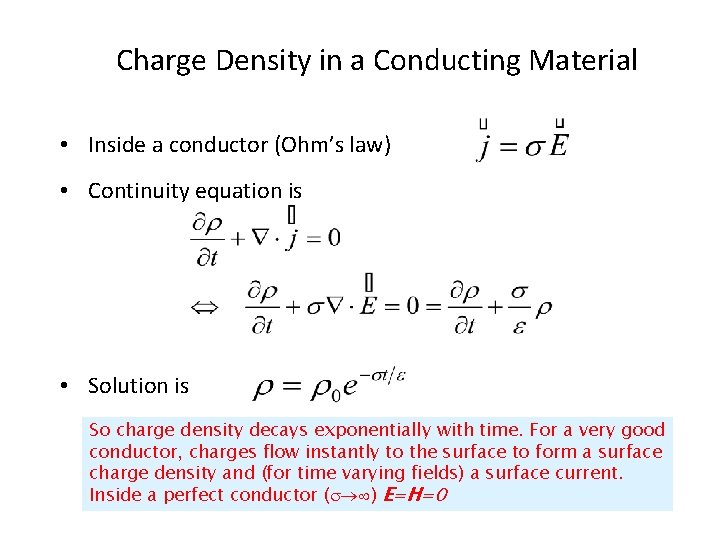
Charge Density in a Conducting Material • Inside a conductor (Ohm’s law) • Continuity equation is • Solution is So charge density decays exponentially with time. For a very good conductor, charges flow instantly to the surface to form a surface charge density and (for time varying fields) a surface current. Inside a perfect conductor ( ) E=H=0
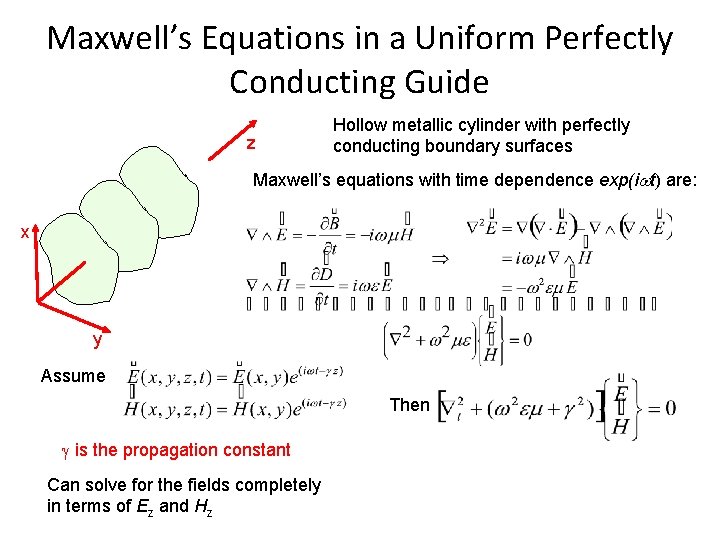
Maxwell’s Equations in a Uniform Perfectly Conducting Guide z Hollow metallic cylinder with perfectly conducting boundary surfaces Maxwell’s equations with time dependence exp(iwt) are: x y Assume Then g is the propagation constant Can solve for the fields completely in terms of Ez and Hz
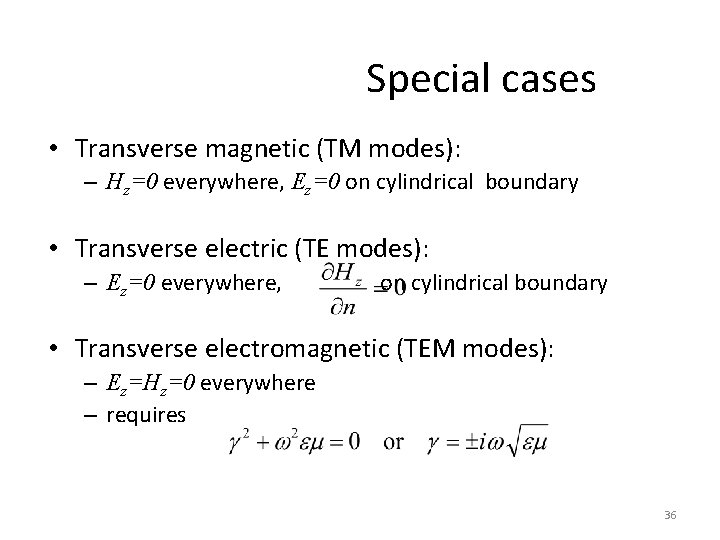
Special cases • Transverse magnetic (TM modes): – Hz=0 everywhere, Ez=0 on cylindrical boundary • Transverse electric (TE modes): – Ez=0 everywhere, on cylindrical boundary • Transverse electromagnetic (TEM modes): – Ez=Hz=0 everywhere – requires 36
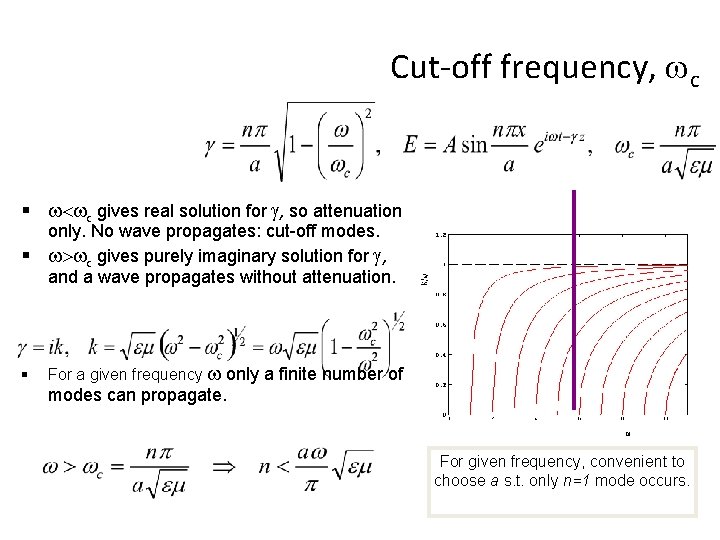
Cut-off frequency, c § < c gives real solution for g, so attenuation only. No wave propagates: cut-off modes. § > c gives purely imaginary solution for g, and a wave propagates without attenuation. § For a given frequency only a finite number of modes can propagate. For given frequency, convenient to choose a s. t. only n=1 mode occurs. 37
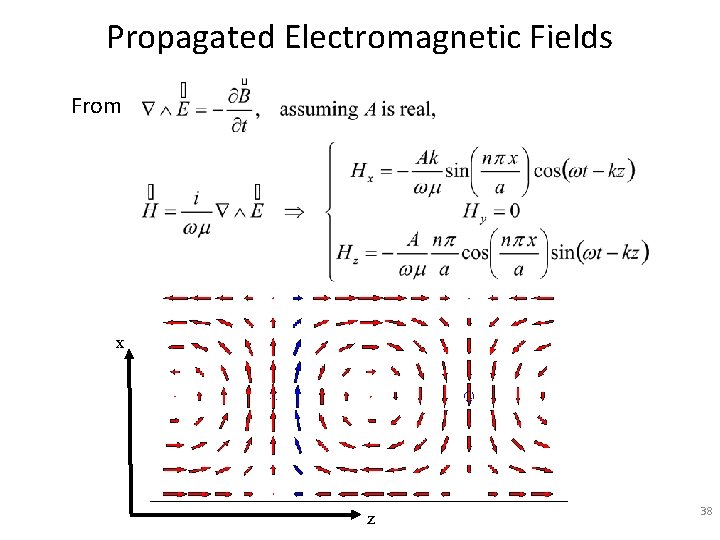
Propagated Electromagnetic Fields From x z 38
Phase and group velocities in the simple wave guide Wave number: Wavelength: Phase velocity: Group velocity: 39
Calculation of Wave Properties • If a=3 cm, cut-off frequency of lowest order mode is • At 7 GHz, only the n=1 mode propagates and 40
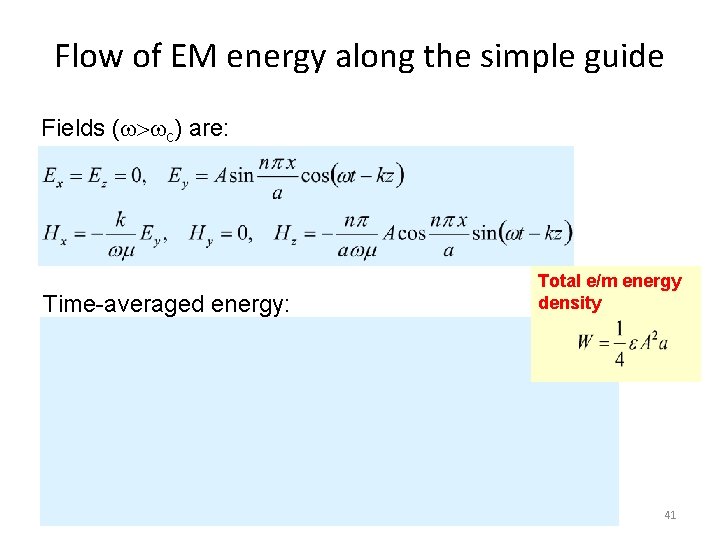
Flow of EM energy along the simple guide Fields ( > c) are: Time-averaged energy: Total e/m energy density 41
Poynting Vector Poynting vector is Time-averaged: Total e/m energy density Integrate over x: So energy is transported at a rate: Electromagnetic energy is transported down the waveguide with the group velocity 42
Thank you