Electrode Kinetics Charge transfer control Activation Polarization kf





- Slides: 12
Electrode Kinetics: Charge transfer control (Activation Polarization) kf kb κ is a transmission coefficient v = k C(0, t) = i/n. FA mole/cm 2 -s = cm/s × mole/cm 3 = (coul/s)(mole/coul)(1/cm 2)
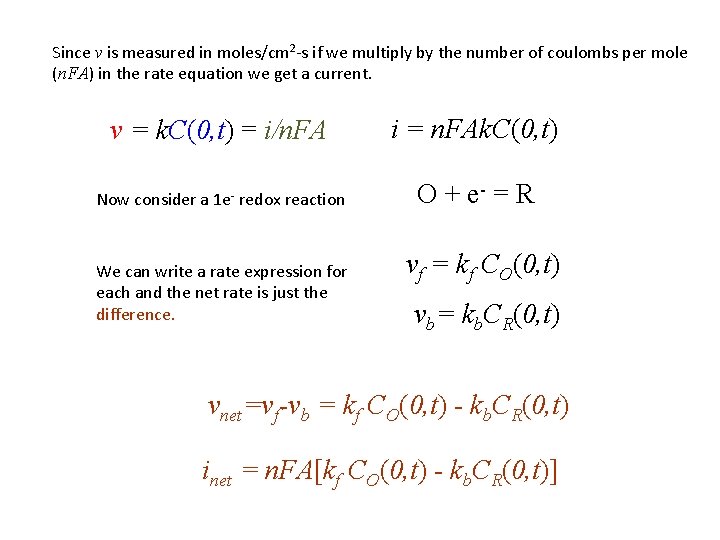
Since v is measured in moles/cm 2 -s if we multiply by the number of coulombs per mole (n. FA) in the rate equation we get a current. v = k. C(0, t) = i/n. FA i = n. FAk. C(0, t) Now consider a 1 e- redox reaction O + e- = R We can write a rate expression for each and the net rate is just the difference. vf = kf CO(0, t) vb= kb. CR(0, t) vnet=vf-vb = kf CO(0, t) - kb. CR(0, t) inet = n. FA[kf CO(0, t) - kb. CR(0, t)]
The effect of applied potential on activation free energy O+e- R Reaction coordinate Apply and E > Eo so that (E-Eo ) > 0. The activation barrier for the anodic reaction has been reduced by and that for the cathodic reduction reaction Has been increased by.
Application of a potential greater than Eo reduces the Act. Barrier for the oxidation (anodic) process and the activation barrier for the reduction (cathodic) process. From our general expression for the rate constant, and these Act. Free energies we write the forward and backward rate constants as, where f = F/RT
Inserting these relations in to inet = n. FA[kf CO(0, t) - kb. CR(0, t)] yields,
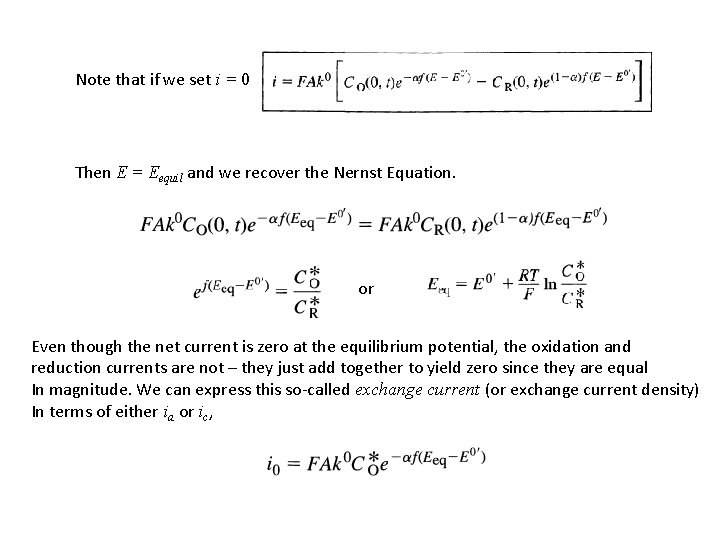
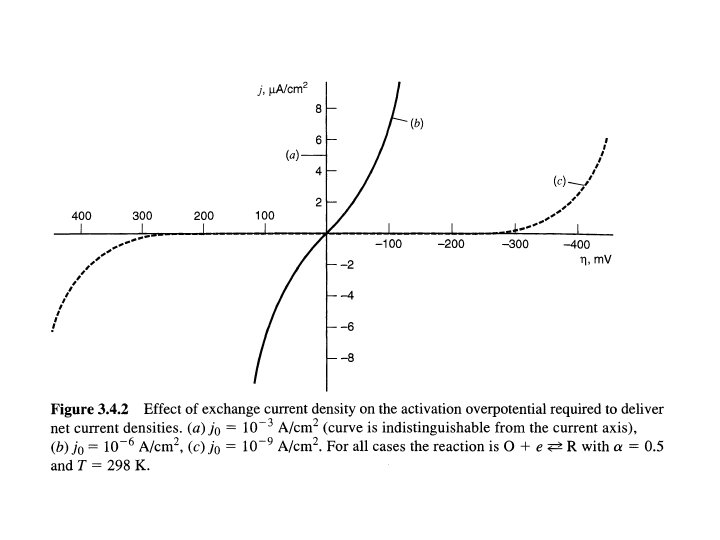
Note that if we set i = 0 Then E = Eequil and we recover the Nernst Equation. or Even though the net current is zero at the equilibrium potential, the oxidation and reduction currents are not – they just add together to yield zero since they are equal In magnitude. We can express this so-called exchange current (or exchange current density) In terms of either ia or ic,
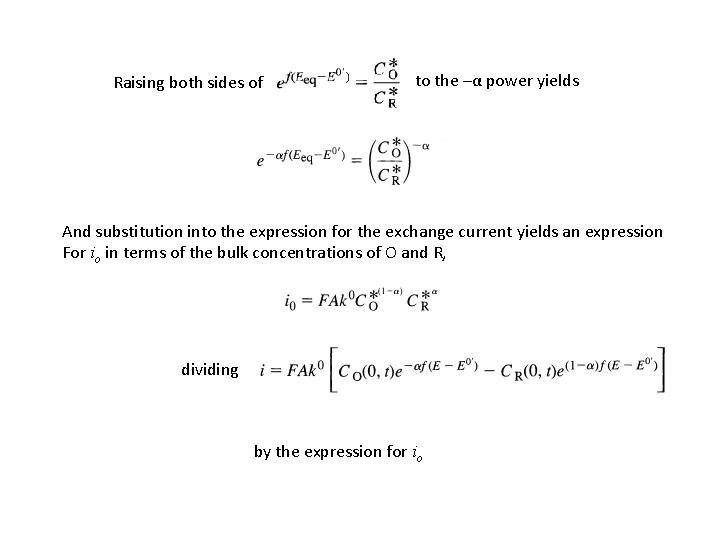
Raising both sides of to the –α power yields And substitution into the expression for the exchange current yields an expression For io in terms of the bulk concentrations of O and R, dividing by the expression for io
and after a bit of algebraic manipulation If the surface and bulk concentrations of O and R are equal then there are NO mass transfer effects. The system is under activation (charge transfer)control. Butler-Volmer Equation
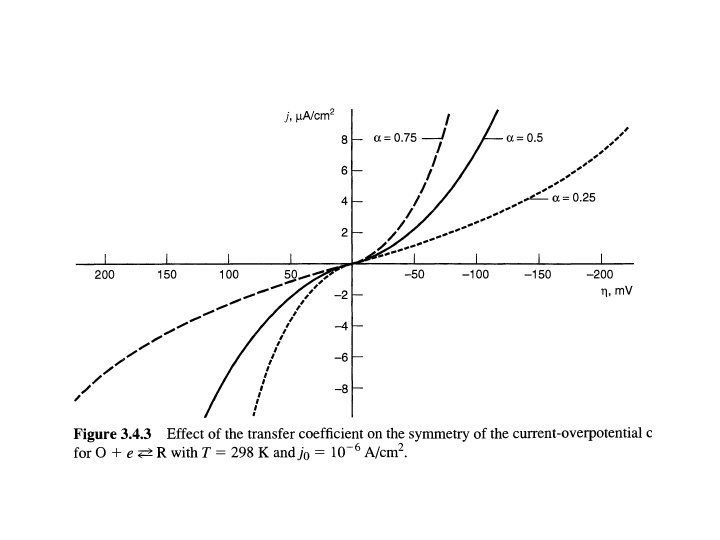
The symmetry factor, α α is dependent on the energy landscape in transitioning from O to R and vice versa. This term together with the io term in the B-V equation contains lots of buried physics, much if it poorly understood.
Butler-Volmer Equation Tafel Plot There are two regimes of behavior: High η: At 298 K this occurs when Low η: charge transfer resistance Rct Tafel Equation