Electric potential Systems of charges Physics 114 9252020

- Slides: 26
Electric potential, Systems of charges Physics 114 9/25/2020 Lecture IV 1
Concepts • Primary concepts: – Electric potential – Electric energy – capacitance • Secondary concepts: – Equipotentials – Electonvolt 9/25/2020 Lecture IV 2
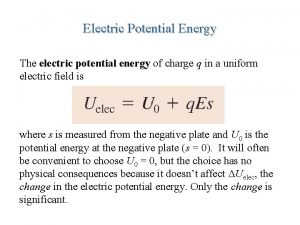
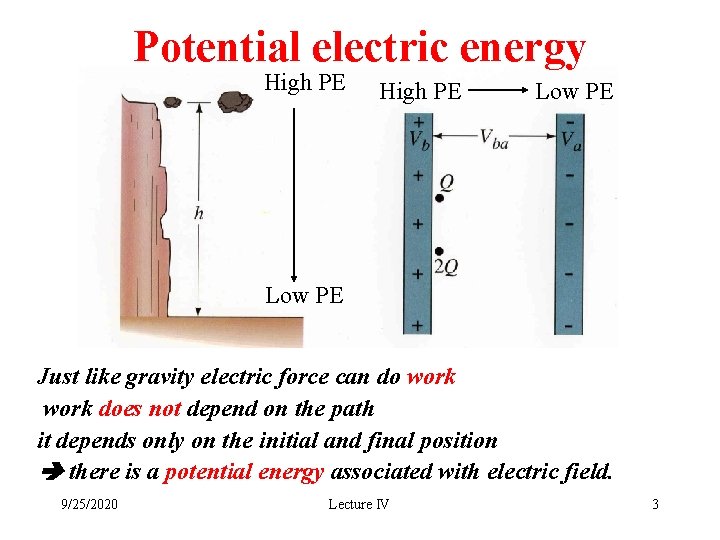
Potential electric energy High PE Low PE Just like gravity electric force can do work does not depend on the path it depends only on the initial and final position there is a potential energy associated with electric field. 9/25/2020 Lecture IV 3
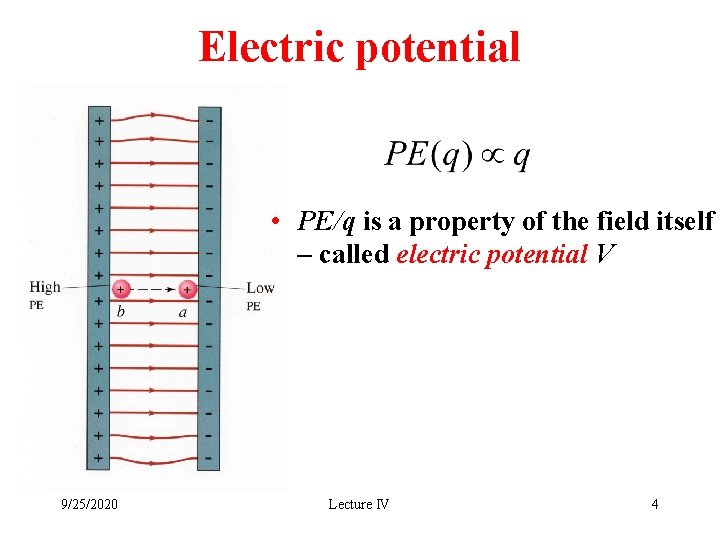
Electric potential • PE/q is a property of the field itself – called electric potential V 9/25/2020 Lecture IV 4
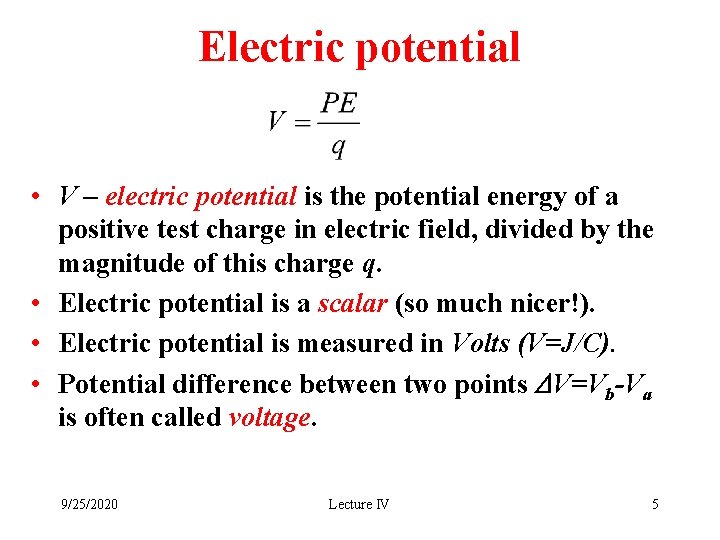
Electric potential • V – electric potential is the potential energy of a positive test charge in electric field, divided by the magnitude of this charge q. • Electric potential is a scalar (so much nicer!). • Electric potential is measured in Volts (V=J/C). • Potential difference between two points DV=Vb-Va is often called voltage. 9/25/2020 Lecture IV 5
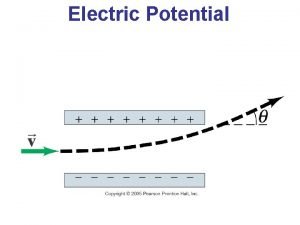
Charges in electric fields b + a E=const Force on charge q: F=q. E Work done by the field to move this charge W=Fd=dq. E W=PEa-PEb=q. Va-q. Vb=-q. DV • d E=DV • E= DV/d, points from high potential to low • Sometimes electric field is measured in V/m =N/C 9/25/2020 Lecture IV 6
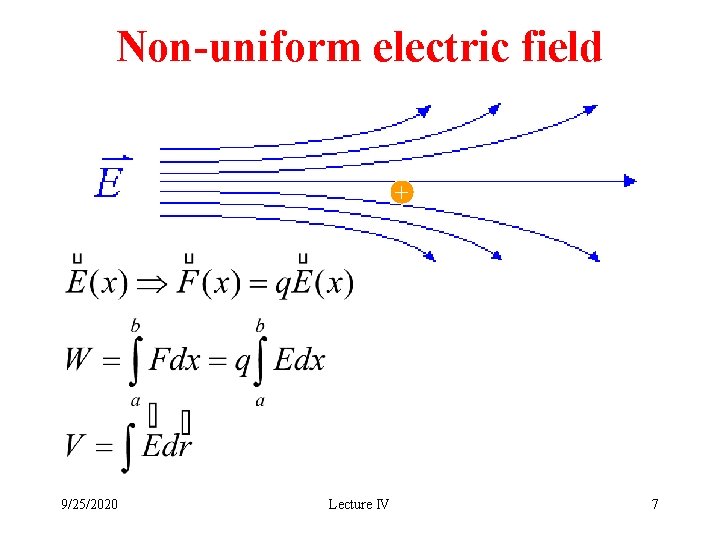
Non-uniform electric field + 9/25/2020 Lecture IV 7
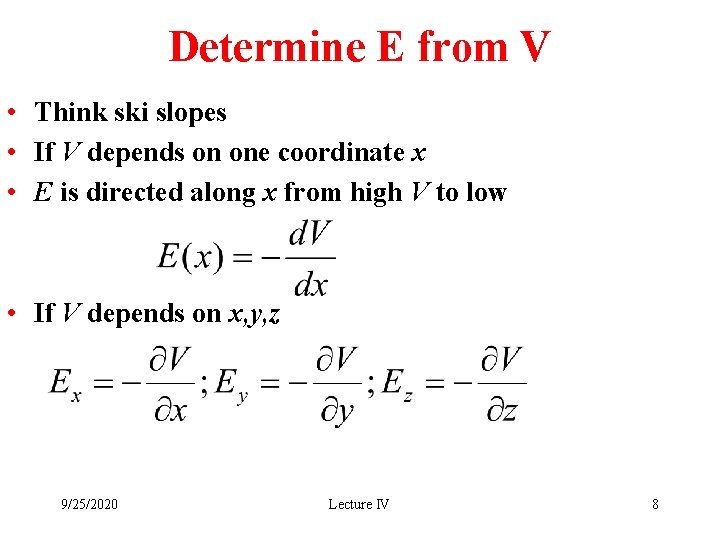
Determine E from V • Think ski slopes • If V depends on one coordinate x • E is directed along x from high V to low • If V depends on x, y, z 9/25/2020 Lecture IV 8
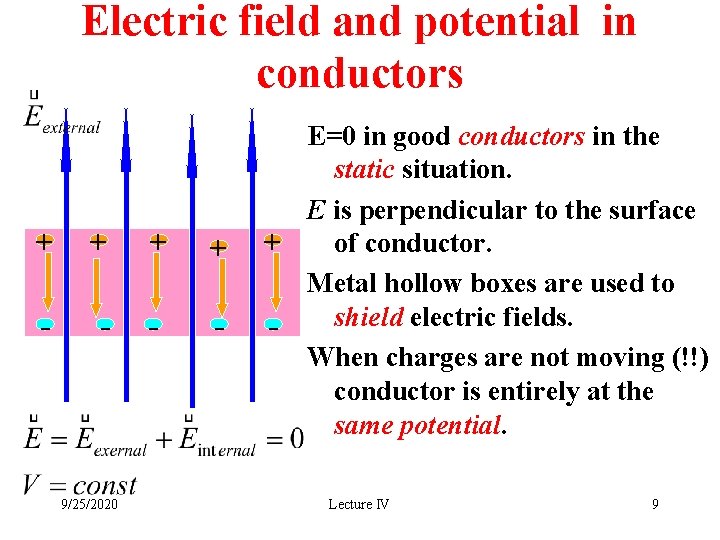
Electric field and potential in conductors + + - - 9/25/2020 E=0 in good conductors in the static situation. E is perpendicular to the surface + of conductor. Metal hollow boxes are used to shield electric fields. When charges are not moving (!!) conductor is entirely at the same potential. Lecture IV 9
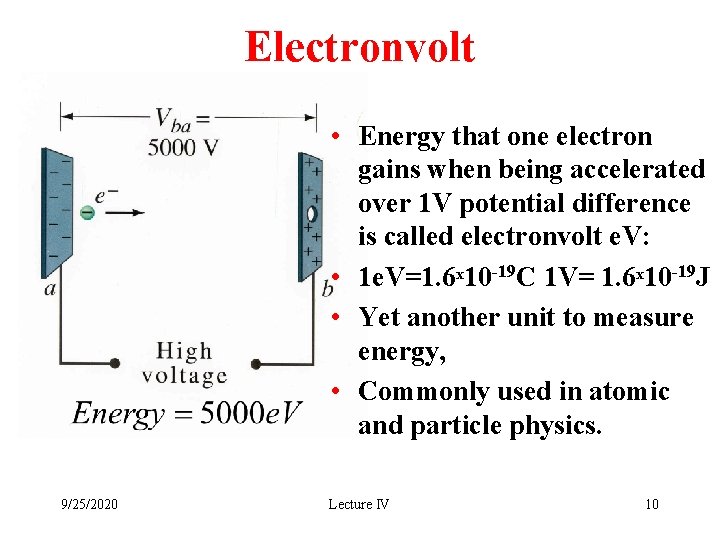
Electronvolt • Energy that one electron gains when being accelerated over 1 V potential difference is called electronvolt e. V: • 1 e. V=1. 6 x 10 -19 C 1 V= 1. 6 x 10 -19 J • Yet another unit to measure energy, • Commonly used in atomic and particle physics. 9/25/2020 Lecture IV 10
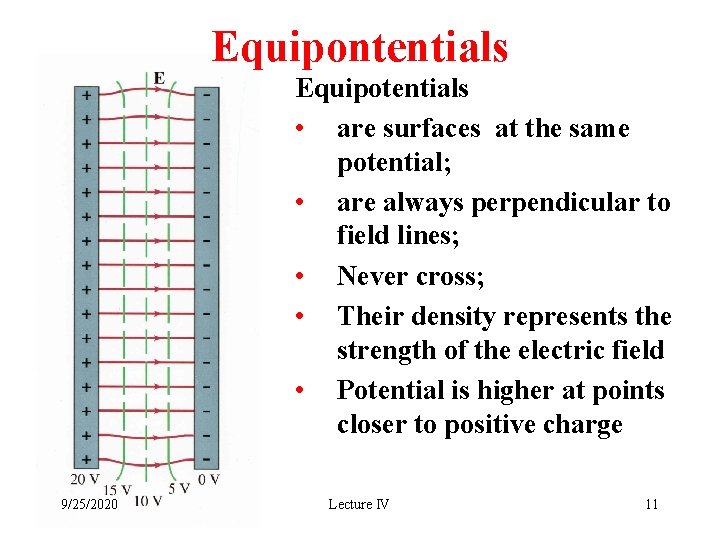
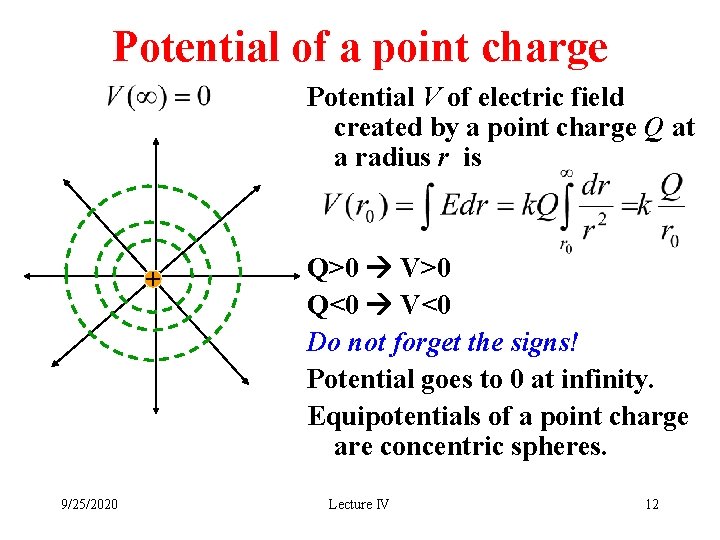
Equipontentials Equipotentials • are surfaces at the same potential; • are always perpendicular to field lines; • Never cross; • Their density represents the strength of the electric field • Potential is higher at points closer to positive charge 9/25/2020 Lecture IV 11
Potential of a point charge Potential V of electric field created by a point charge Q at a radius r is + 9/25/2020 Q>0 V>0 Q<0 V<0 Do not forget the signs! Potential goes to 0 at infinity. Equipotentials of a point charge are concentric spheres. Lecture IV 12
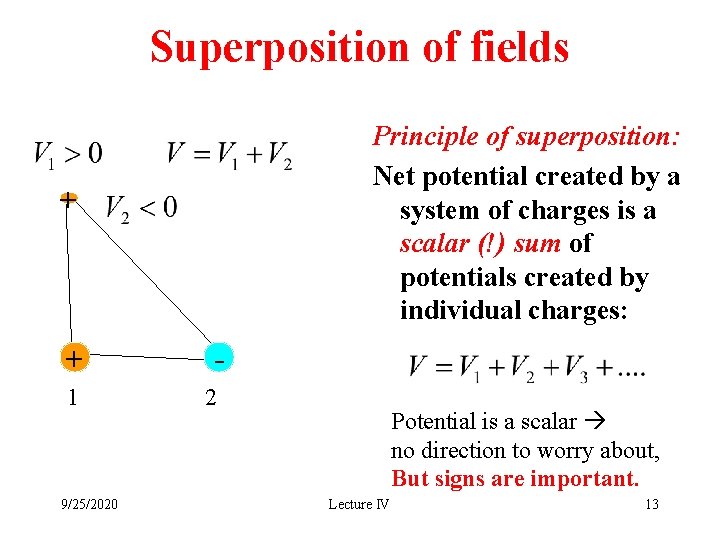
Superposition of fields Principle of superposition: Net potential created by a system of charges is a scalar (!) sum of potentials created by individual charges: + + - 1 2 9/25/2020 Potential is a scalar no direction to worry about, But signs are important. Lecture IV 13
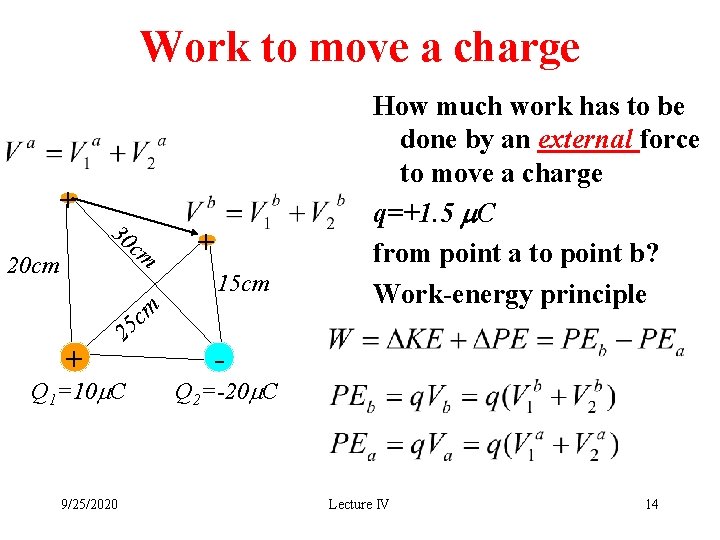
Work to move a charge + 20 cm 30 cm + 15 cm m c 5 + 2 Q 1=10 m. C 9/25/2020 How much work has to be done by an external force to move a charge q=+1. 5 m. C from point a to point b? Work-energy principle - Q 2=-20 m. C Lecture IV 14
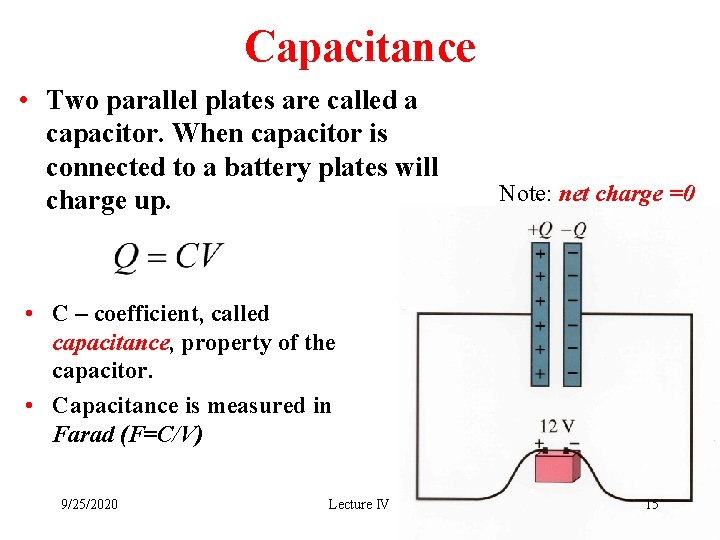
Capacitance • Two parallel plates are called a capacitor. When capacitor is connected to a battery plates will charge up. Note: net charge =0 • C – coefficient, called capacitance, property of the capacitor. • Capacitance is measured in Farad (F=C/V) 9/25/2020 Lecture IV 15
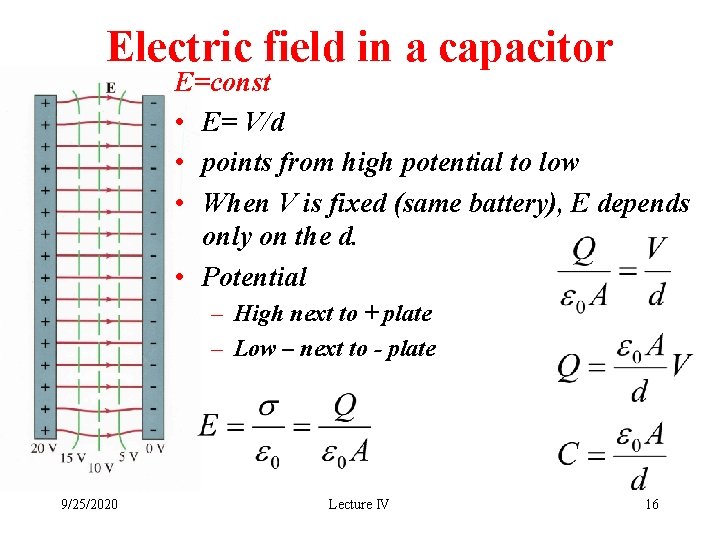
Electric field in a capacitor E=const • E= V/d • points from high potential to low • When V is fixed (same battery), E depends only on the d. • Potential – High next to + plate – Low – next to - plate 9/25/2020 Lecture IV 16
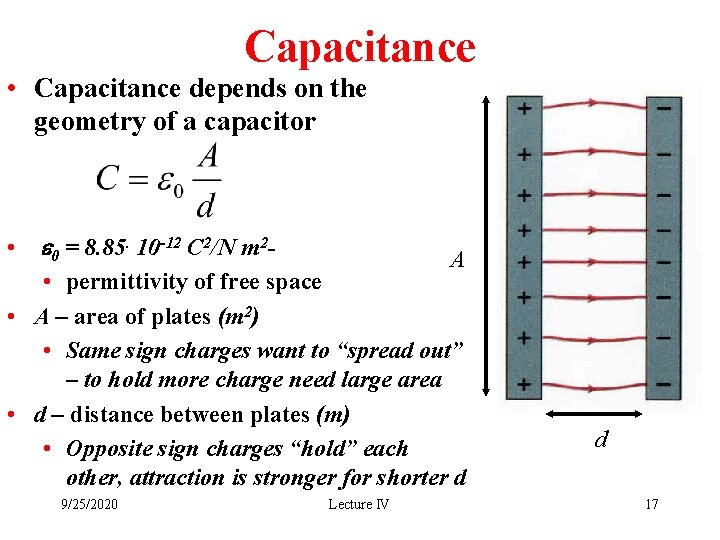
Capacitance • Capacitance depends on the geometry of a capacitor • e 0 = 8. 85. 10 -12 C 2/N m 2 A • permittivity of free space • A – area of plates (m 2) • Same sign charges want to “spread out” – to hold more charge need large area • d – distance between plates (m) • Opposite sign charges “hold” each other, attraction is stronger for shorter d 9/25/2020 Lecture IV d 17
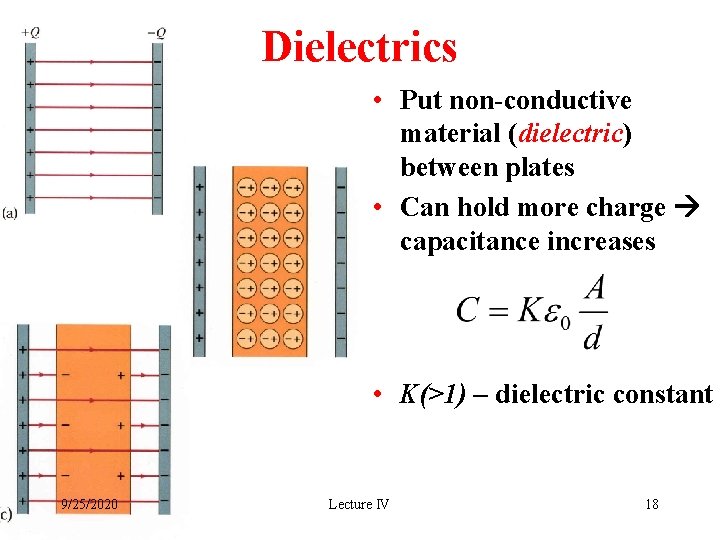
Dielectrics • Put non-conductive material (dielectric) between plates • Can hold more charge capacitance increases • K(>1) – dielectric constant 9/25/2020 Lecture IV 18
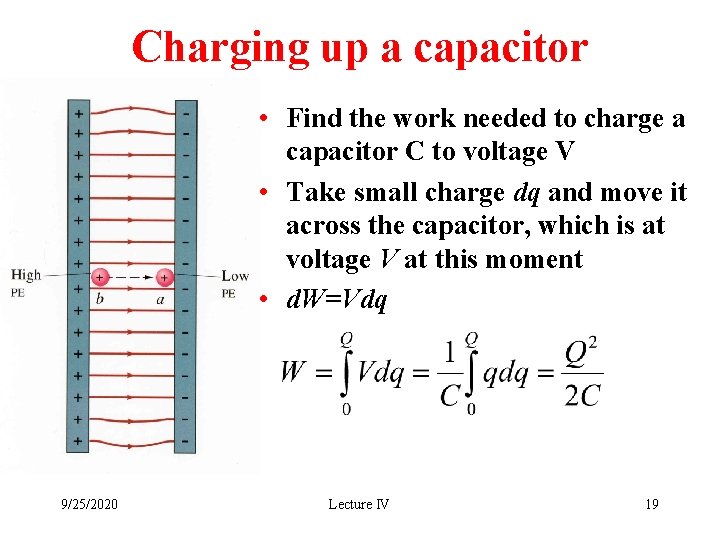
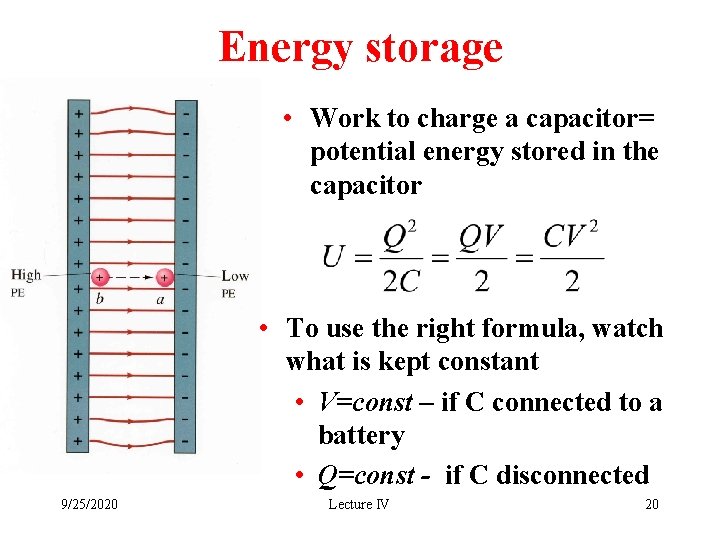
Charging up a capacitor • Find the work needed to charge a capacitor C to voltage V • Take small charge dq and move it across the capacitor, which is at voltage V at this moment • d. W=Vdq 9/25/2020 Lecture IV 19
Energy storage • Work to charge a capacitor= potential energy stored in the capacitor • To use the right formula, watch what is kept constant • V=const – if C connected to a battery • Q=const - if C disconnected 9/25/2020 Lecture IV 20
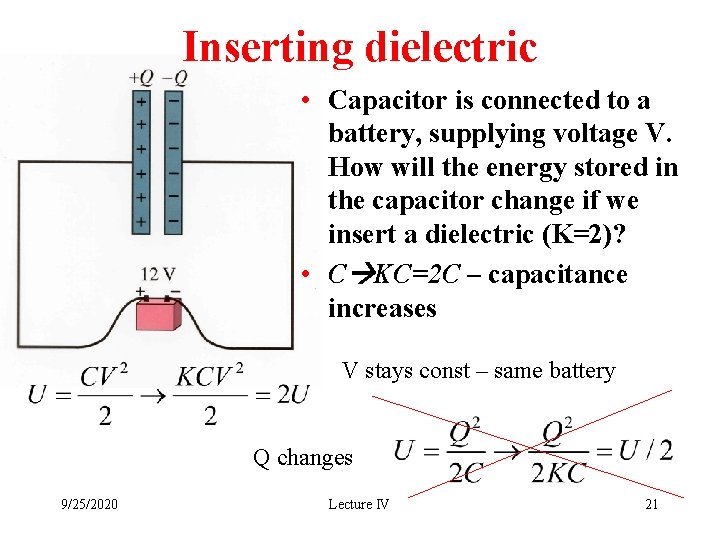
Inserting dielectric • Capacitor is connected to a battery, supplying voltage V. How will the energy stored in the capacitor change if we insert a dielectric (K=2)? • C KC=2 C – capacitance increases V stays const – same battery Q changes 9/25/2020 Lecture IV 21
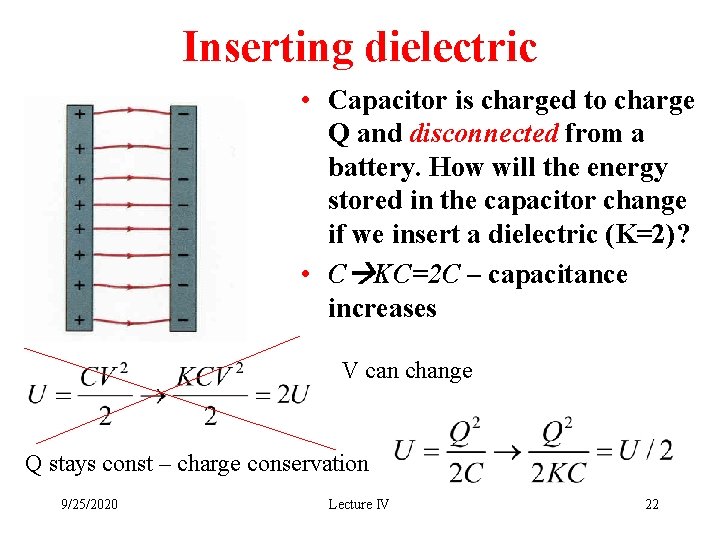
Inserting dielectric • Capacitor is charged to charge Q and disconnected from a battery. How will the energy stored in the capacitor change if we insert a dielectric (K=2)? • C KC=2 C – capacitance increases V can change Q stays const – charge conservation 9/25/2020 Lecture IV 22
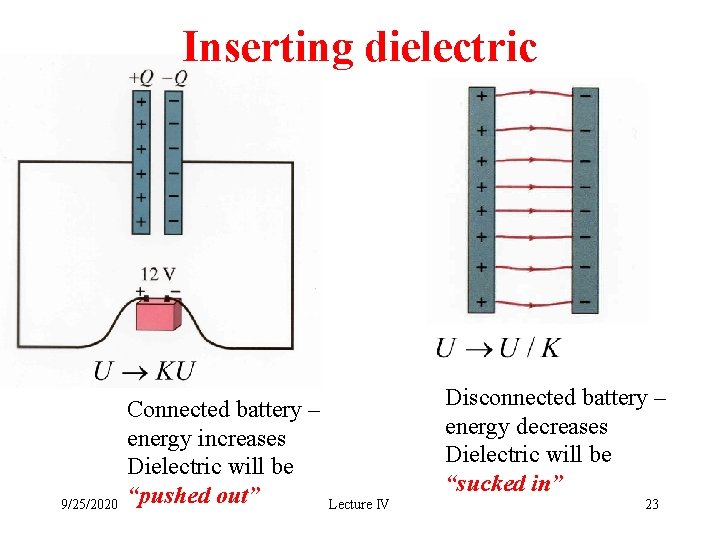
Inserting dielectric 9/25/2020 Connected battery – energy increases Dielectric will be “pushed out” Disconnected battery – energy decreases Dielectric will be “sucked in” Lecture IV 23
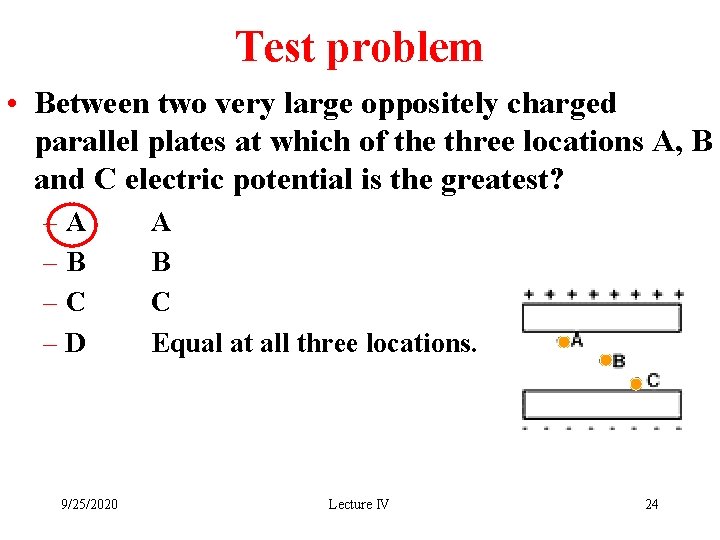
Test problem • Between two very large oppositely charged parallel plates at which of the three locations A, B and C electric potential is the greatest? –A –B –C –D 9/25/2020 A B C Equal at all three locations. Lecture IV 24
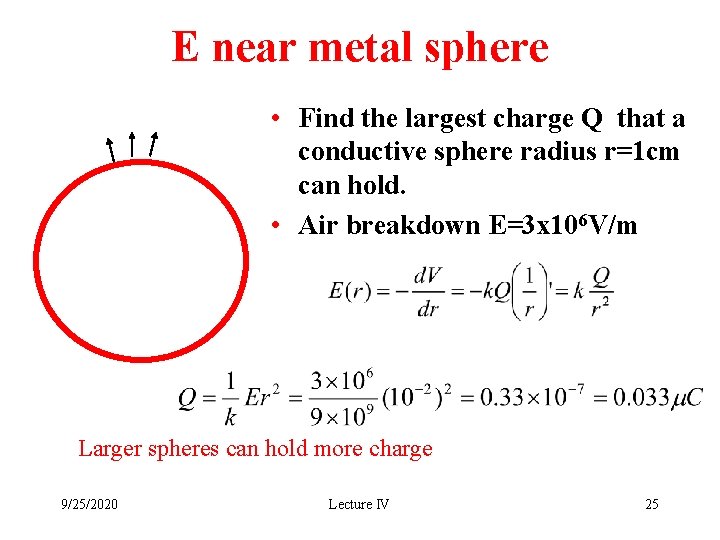
E near metal sphere • Find the largest charge Q that a conductive sphere radius r=1 cm can hold. • Air breakdown E=3 x 10⁶ V/m Larger spheres can hold more charge 9/25/2020 Lecture IV 25
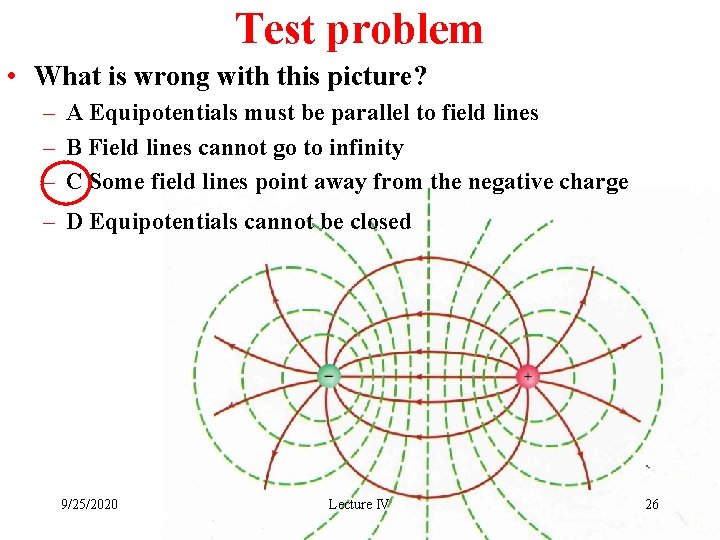
Test problem • What is wrong with this picture? – A Equipotentials must be parallel to field lines – B Field lines cannot go to infinity – C Some field lines point away from the negative charge – D Equipotentials cannot be closed 9/25/2020 Lecture IV 26