Effects of Gender on Old Age Security an
- Slides: 20
Effects of Gender on Old Age Security an Austrian Case Study Dr. Michaela Gstrein IAFFE 2009 Annual Conference Boston (USA), 26 -28. 6. 2009
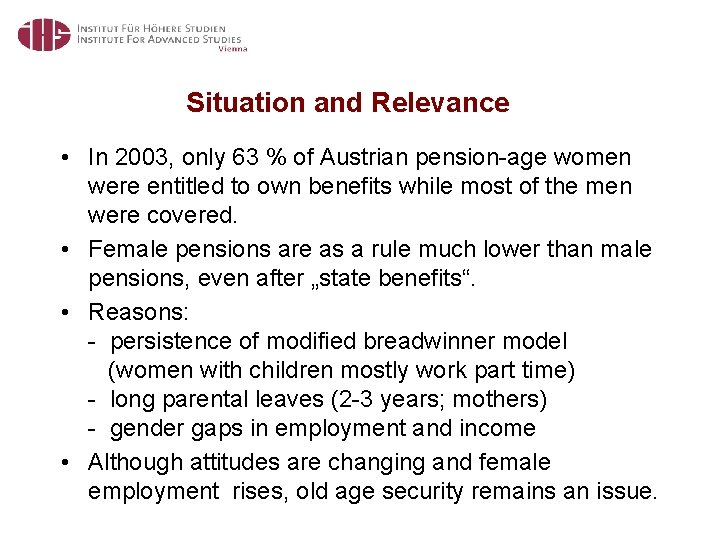
Situation and Relevance • In 2003, only 63 % of Austrian pension-age women were entitled to own benefits while most of the men were covered. • Female pensions are as a rule much lower than male pensions, even after „state benefits“. • Reasons: - persistence of modified breadwinner model (women with children mostly work part time) - long parental leaves (2 -3 years; mothers) - gender gaps in employment and income • Although attitudes are changing and female employment rises, old age security remains an issue.
How does the Austrian System work? • The Austrian (Federal) Pension System is an obligatory but non-capitalized system. • With a nearly non-existant second/third pension pillar, it is the main source of old age security for most Austrians. • Pension entitlement and benefits are linked to labour market participation - thus offering men (with their continuous careers) a much better deal than women. • Correctional factors account for labour market absence (e. g. military service, child bearing, etc. ), • Benefits: with minimum of 15 working years, % of your average total contributions, rise with years worked, with reductions for early pensions (quite common)
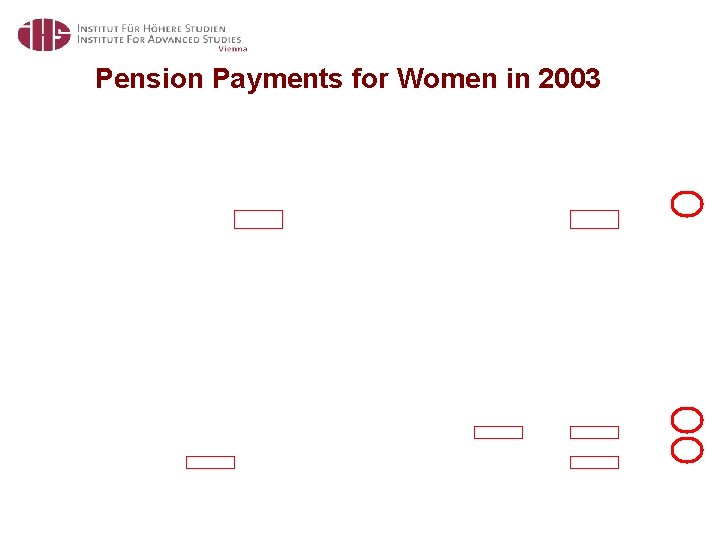
Pension Payments for Women in 2003 Of all Austrian women over 60 years • 2 % of were still working • 63 % received „own“ pension payments, but 24 % only € 0 - 643 (below AGZLRS) and 6% received compensation (to meet threshold). • 20 % received survivor‘s benefits, but 9 % of them below threshold and 7% received compensation (to meet threshold) • 15 % had no pension • 49 % received low „own“ or „survivor‘s benefits“
Pension Payments for Women in 2003
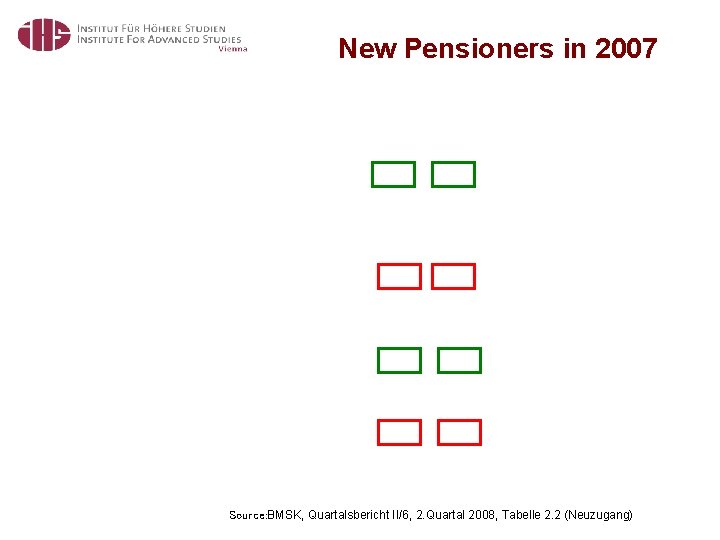
New Pensioners in 2007 Source: BMSK, Quartalsbericht II/6, 2. Quartal 2008, Tabelle 2. 2 (Neuzugang)
Reasons for „Bad/Good Coverage“ change • No/reduced participation => no/low„own“ entitlement Male Breadwinner => Modified Breadwinner and Dual Earner Models growing • Security network within partnership -? number of separations (common) – women perceive need for own job • Discontinuous female working carreers long childbreaks (2 -3 years, mostly mothers, 4 % men) still very common, yet modernized values and role models in childcare • Perception of mothers‘ duties/loyalties still persist, although changing attitudes; higher childcare participation rates (12% 0 -2 year-olds); lower fertilities? , changed employer attitudes (slowly)
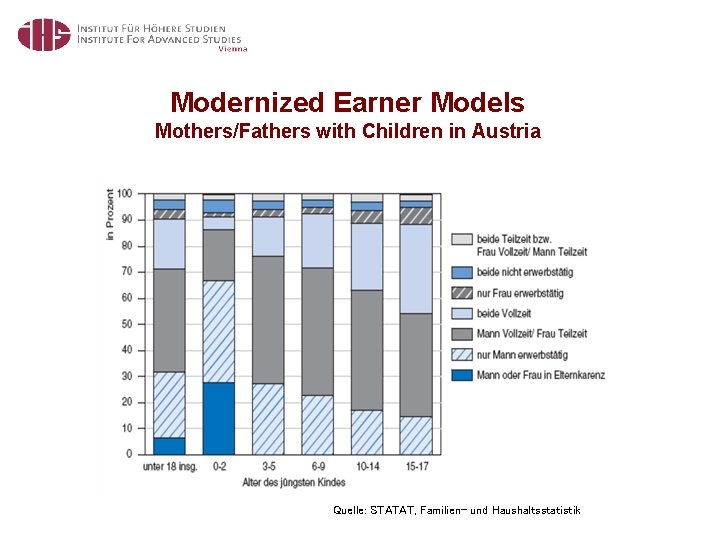
Modernized Earner Models Mothers/Fathers with Children in Austria Quelle: STATAT, Familien- und Haushaltsstatistik
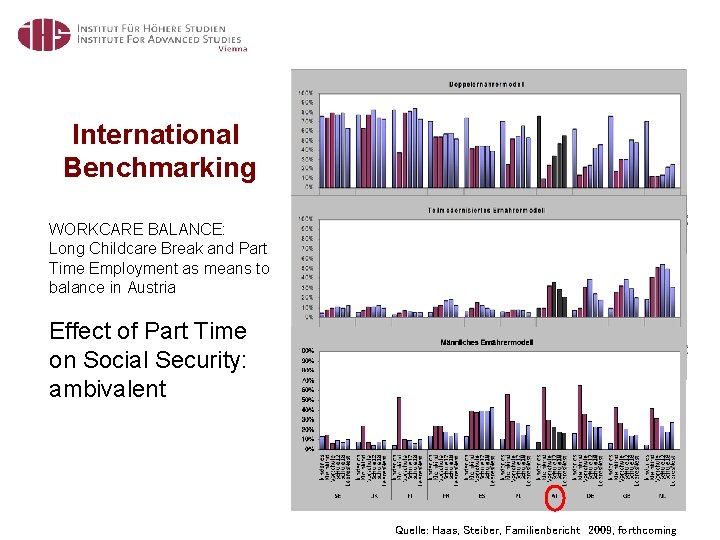
International Benchmarking WORKCARE BALANCE: Long Childcare Break and Part Time Employment as means to balance in Austria Effect of Part Time on Social Security: ambivalent Quelle: Haas, Steiber, Familienbericht 2009, forthcoming
Employment Rates Quelle: IHS basierend auf STATAT
Child-induced Breaks Source: Kapella und Rille-Pfeiffer 2007, S. 23
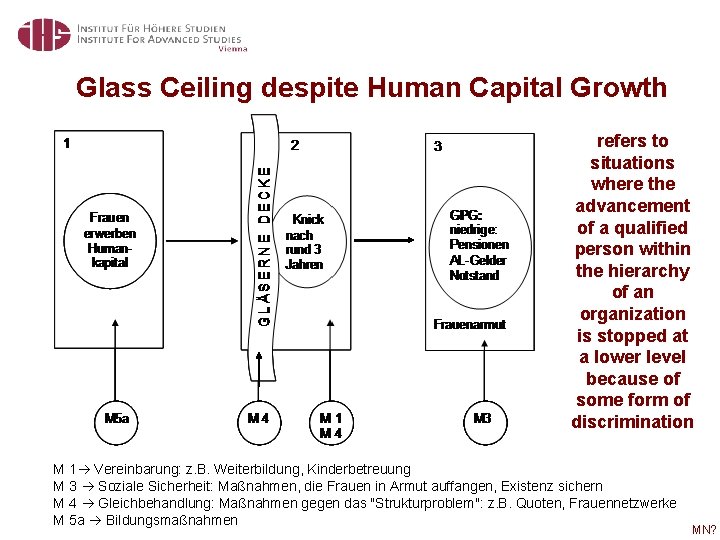
Glass Ceiling despite Human Capital Growth refers to situations where the advancement of a qualified person within the hierarchy of an organization is stopped at a lower level because of some form of discrimination M 1 Vereinbarung: z. B. Weiterbildung, Kinderbetreuung M 3 Soziale Sicherheit: Maßnahmen, die Frauen in Armut auffangen, Existenz sichern M 4 Gleichbehandlung: Maßnahmen gegen das "Strukturproblem": z. B. Quoten, Frauennetzwerke M 5 a Bildungsmaßnahmen MN?
Glass Ceiling Women in Employment and Management (%), EU 27, 2008 Quelle: EK, DG EMPL Datenbank (2008), Frauen und Männer in Entscheidungsprozessen, basierend auf Daten aus Eurostat, LFS; Anmerkungen: Führungspositionen beziehen sich hier auf ISCO (International Standard Classification of Occupations) 121 (Direktor. Inen und Hauptgeschäftsführer. Innen) und 13 (Leiter. Innen kleiner Unternehmen); Gesamtbeschäftigung (100%).
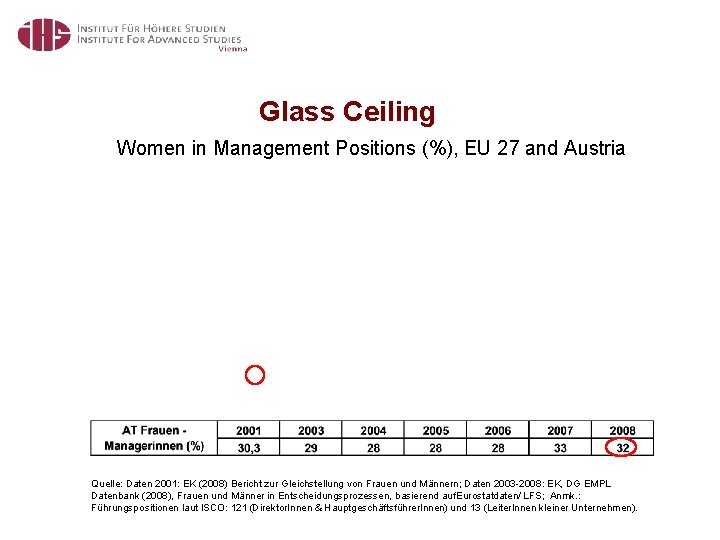
Glass Ceiling Women in Management Positions (%), EU 27 and Austria Quelle: Daten 2001: EK (2008) Bericht zur Gleichstellung von Frauen und Männern; Daten 2003 -2008: EK, DG EMPL Datenbank (2008), Frauen und Männer in Entscheidungsprozessen, basierend auf Eurostatdaten/ LFS; Anmk. : Führungspositionen laut ISCO: 121 (Direktor. Innen & Hauptgeschäftsführer. Innen) und 13 (Leiter. Innen kleiner Unternehmen).
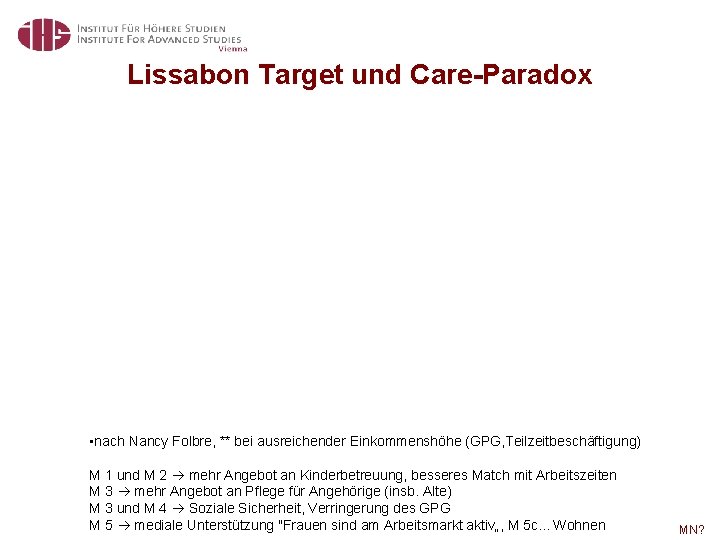
Lissabon Target und Care-Paradox • nach Nancy Folbre, ** bei ausreichender Einkommenshöhe (GPG, Teilzeitbeschäftigung) M 1 und M 2 mehr Angebot an Kinderbetreuung, besseres Match mit Arbeitszeiten M 3 mehr Angebot an Pflege für Angehörige (insb. Alte) M 3 und M 4 Soziale Sicherheit, Verringerung des GPG M 5 mediale Unterstützung "Frauen sind am Arbeitsmarkt aktiv„, M 5 c. . . Wohnen MN?
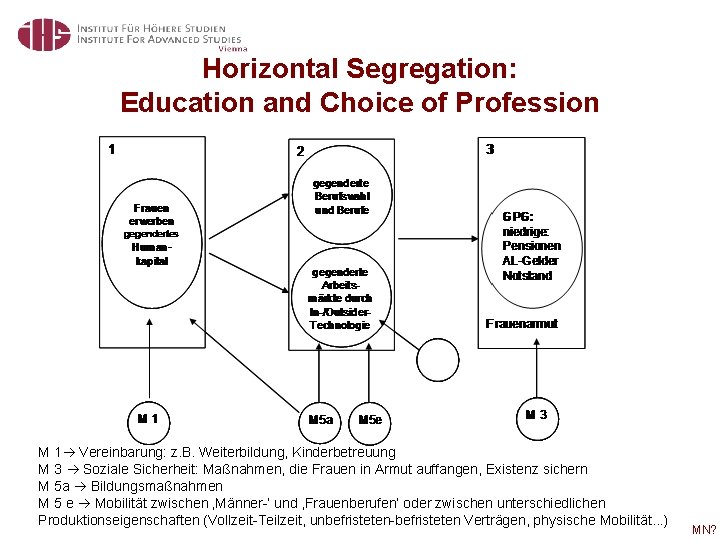
Horizontal Segregation: Education and Choice of Profession M 1 Vereinbarung: z. B. Weiterbildung, Kinderbetreuung M 3 Soziale Sicherheit: Maßnahmen, die Frauen in Armut auffangen, Existenz sichern M 5 a Bildungsmaßnahmen M 5 e Mobilität zwischen ‚Männer-’ und ‚Frauenberufen’ oder zwischen unterschiedlichen Produktionseigenschaften (Vollzeit-Teilzeit, unbefristeten-befristeten Verträgen, physische Mobilität. . . ) MN?
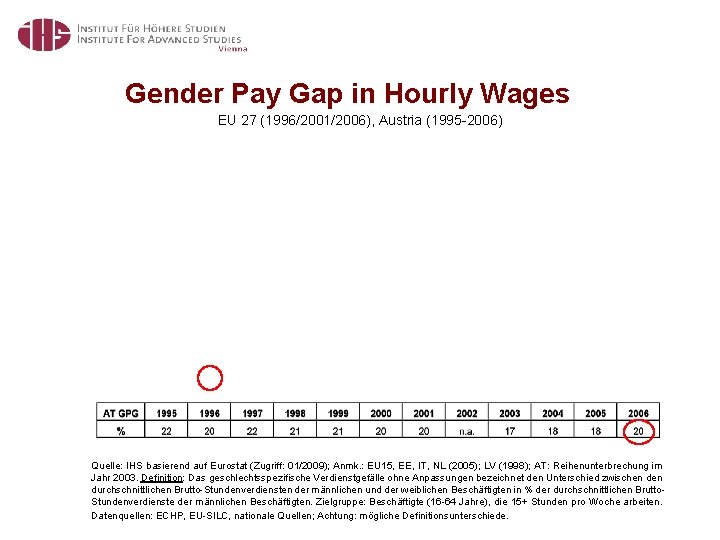
Gender Pay Gap in Hourly Wages EU 27 (1996/2001/2006), Austria (1995 -2006) Quelle: IHS basierend auf Eurostat (Zugriff: 01/2009); Anmk. : EU 15, EE, IT, NL (2005); LV (1998); AT: Reihenunterbrechung im Jahr 2003. Definition: Das geschlechtsspezifische Verdienstgefälle ohne Anpassungen bezeichnet den Unterschied zwischen durchschnittlichen Brutto-Stundenverdiensten der männlichen und der weiblichen Beschäftigten in % der durchschnittlichen Brutto. Stundenverdienste der männlichen Beschäftigten. Zielgruppe: Beschäftigte (16 -64 Jahre), die 15+ Stunden pro Woche arbeiten. Datenquellen: ECHP, EU-SILC, nationale Quellen; Achtung: mögliche Definitionsunterschiede.
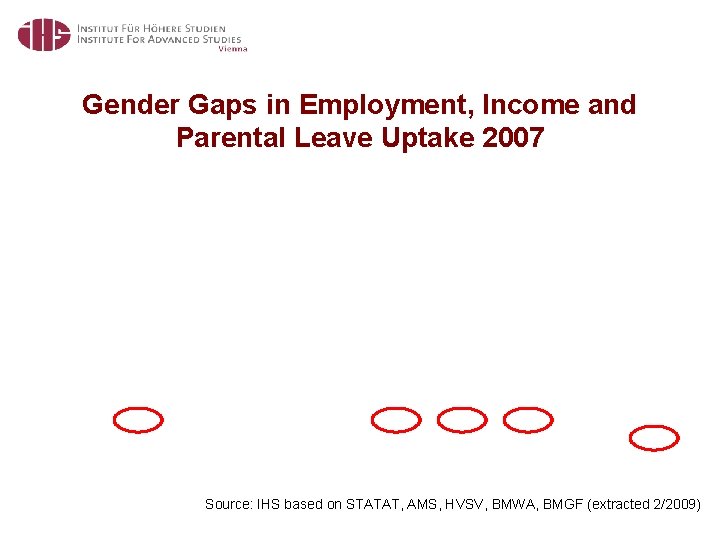
Gender Gaps in Employment, Income and Parental Leave Uptake 2007 Source: IHS based on STATAT, AMS, HVSV, BMWA, BMGF (extracted 2/2009)
Demographic Developments and Crises • • • EU promotes higher female labour market participation – good for women‘ „own social security“. Provide for domestic tasks when women work (old age care, childcare, services) - ? High consumption orientation in today‘s societies: Need for dual earner families Crises: hit mostly male „old fashioned“ jobs in Austria (structural problem). No strong effect on females
Thank you for your attention !