
Sociology Chapter 11 Gender Age and Health Preview




- Slides: 17
Sociology Chapter 11 Gender, Age, and Health Preview Section 1: Gender Section 2: Age and Disability Section 3: Health Chapter Wrap-Up
Sociology Chapter 11 Section 1: Gender Read to Discover • How do gender roles affect the opportunities available to men and women in society? • How are gender roles affected by socialization?
Sociology Chapter 11 Section 1: Gender Traditional American Gender Roles • Female: child care, domestic duties, cooking, housecleaning, the color pink, pastel colors, dolls, frills, polite, gentle, passive, reading, social sciences, arts • Male: economic support, physical safety of the family, the color blue, primary colors, clean lines, adventuresome, aggressive, physically active, science, math
Sociology Chapter 11 Section 1: Gender Question How do gender roles and the selffulfilling prophecy affect women?
Sociology Chapter 11 Section 1: Gender Roles and Socialization • In virtually all societies, gender socialization begins at birth and continues throughout life. • Children learn American gender-role behaviors through socialization, such as in the family or at school.
Sociology Chapter 11 Section 1: Gender Roles and Opportunities • Education—still gender distinctions in degree majors, fewer women pursuing doctoral or professional degrees, and less funding for women’s college athletics • Employment—still a wage gap and a glass ceiling for women • Politics—underrepresented in politics
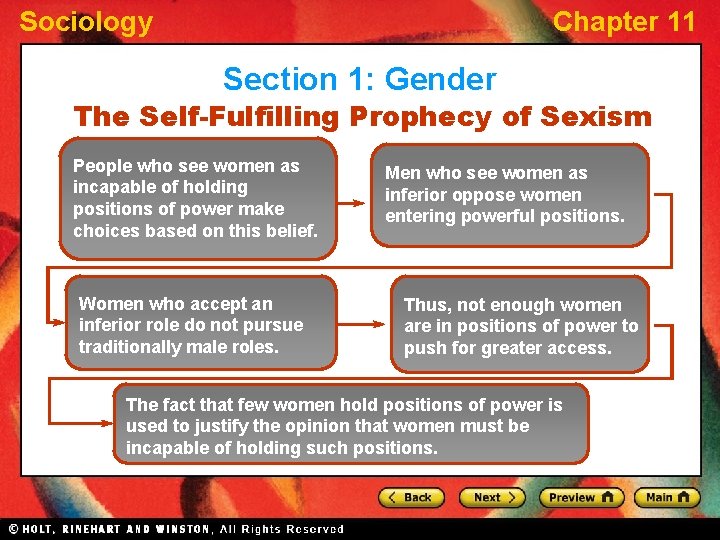
Sociology Chapter 11 Section 1: Gender The Self-Fulfilling Prophecy of Sexism People who see women as incapable of holding positions of power make choices based on this belief. Women who accept an inferior role do not pursue traditionally male roles. Men who see women as inferior oppose women entering powerful positions. Thus, not enough women are in positions of power to push for greater access. The fact that few women hold positions of power is used to justify the opinion that women must be incapable of holding such positions.
Sociology Chapter 11 Section 2: Age and Disability Read to Discover • What effect is the aging of the population having on society? • How is the aging of the population affecting the life chances of older Americans?
Sociology Chapter 11 Section 2: Age and Disability Question How is the aging of the population affecting American society?
Sociology Chapter 11 Section 2: Age and Disability Effects of an Aging Population on American Society Economic Effects Political Effects Rising cost of health care; cost of Social Security; burden to family and younger workers; living longer in retirement Becoming a stronger force; organized voting bloc (AARP, etc. ) focuses on health care, retirement, and Social Security
Sociology Chapter 11 Section 2: Age and Disability Life Chances of Older Americans • Some people claim that government transfer payments like Social Security have made older Americans financially secure at the expense of younger generations. • Older Americans have to deal with poverty, disabilities, illness, prejudice, and discrimination. • Older Americans have become a political force and a topic of debate, thus bringing greater attention to Social Security and Medicare.
Sociology Chapter 11 Section 3: Health Read to Discover • What is the state of health care in the United States? • What are some of the special health-care concerns of various segments of American society?
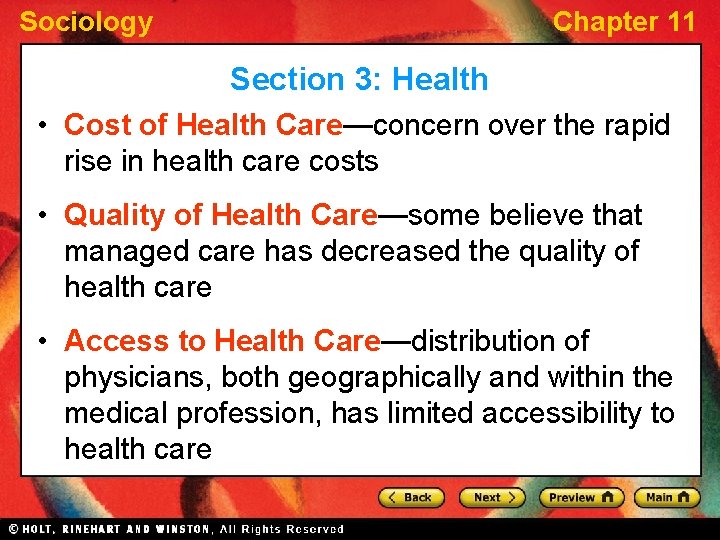
Sociology Chapter 11 Section 3: Health • Cost of Health Care—concern over the rapid rise in health care costs • Quality of Health Care—some believe that managed care has decreased the quality of health care • Access to Health Care—distribution of physicians, both geographically and within the medical profession, has limited accessibility to health care
Sociology Chapter 11 Section 3: Health Question What are the special health-care concerns of various segments of American society?
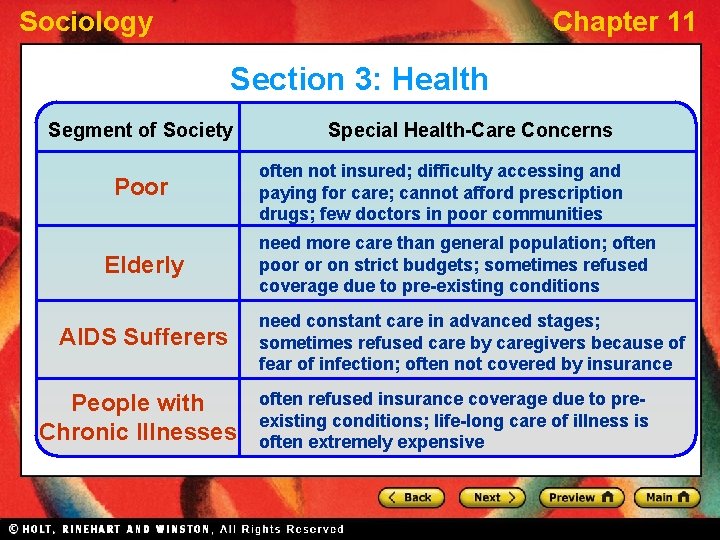
Sociology Chapter 11 Section 3: Health Segment of Society Poor Elderly AIDS Sufferers People with Chronic Illnesses Special Health-Care Concerns often not insured; difficulty accessing and paying for care; cannot afford prescription drugs; few doctors in poor communities need more care than general population; often poor or on strict budgets; sometimes refused coverage due to pre-existing conditions need constant care in advanced stages; sometimes refused care by caregivers because of fear of infection; often not covered by insurance often refused insurance coverage due to preexisting conditions; life-long care of illness is often extremely expensive
Sociology Chapter 11 Section 3: Health • Health Insurance—unequal health care exists between public and private insurance programs • Alternative Medicine—there are few scientific studies on the effectiveness or safety of alternative treatments • AIDS—developed into one of the most serious public-health problems in the U. S. and around the world in just two decades
Sociology Chapter 11 Chapter Wrap-Up Understanding Main Ideas 1. Explain how the wage gap and the glass ceiling can be used to illustrate gender inequality. 2. How has the second shift helped to create a “leisure gap” between men and women? 3. How are gender roles and gender identity related to the experiences of boys and girls? 4. How has the aging of the population affected American society? 5. What effects has the aging of the population had on the opportunities in life available to elderly people? 6. What health-care issues are causing concern among Americans? 7. What is AIDS, and why is it considered such a pressing medical issue?