Economic Equivalence Lecture No 5 Chapter 3 Contemporary
- Slides: 12
Economic Equivalence Lecture No. 5 Chapter 3 Contemporary Engineering Economics Copyright © 2016 Contemporary Engineering Economics, 6 e, GE Park Copyright © 2016, Pearson Education, Ltd. All Rights Reserved
Economic Equivalence q q q What do we mean by “economic equivalence? ” Why do we need to establish an economic equivalence? How do we measure and compare various cash payments received at different points in time? Contemporary Engineering Economics, 6 e, GE Park Copyright © 2016, Pearson Education, Ltd. All Rights Reserved
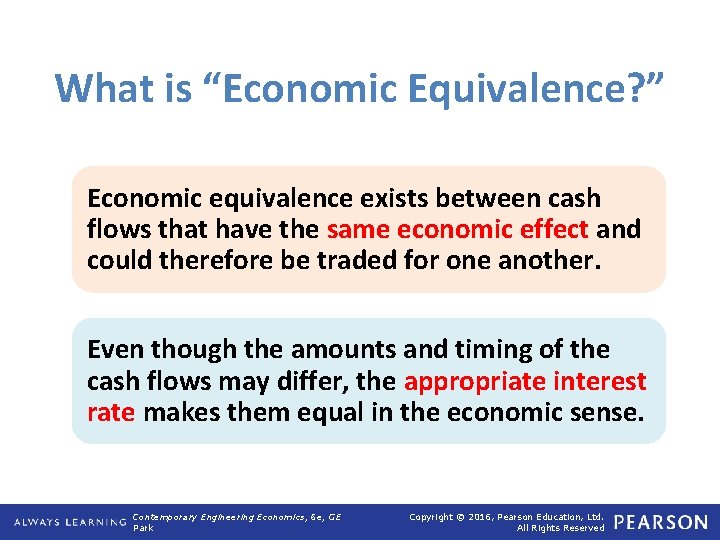
What is “Economic Equivalence? ” Economic equivalence exists between cash flows that have the same economic effect and could therefore be traded for one another. Even though the amounts and timing of the cash flows may differ, the appropriate interest rate makes them equal in the economic sense. Contemporary Engineering Economics, 6 e, GE Park Copyright © 2016, Pearson Education, Ltd. All Rights Reserved
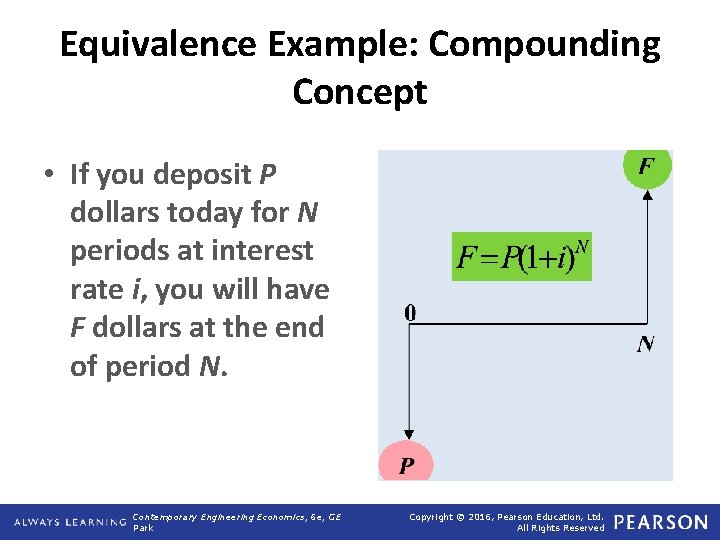
Equivalence Example: Compounding Concept • If you deposit P dollars today for N periods at interest rate i, you will have F dollars at the end of period N. Contemporary Engineering Economics, 6 e, GE Park Copyright © 2016, Pearson Education, Ltd. All Rights Reserved
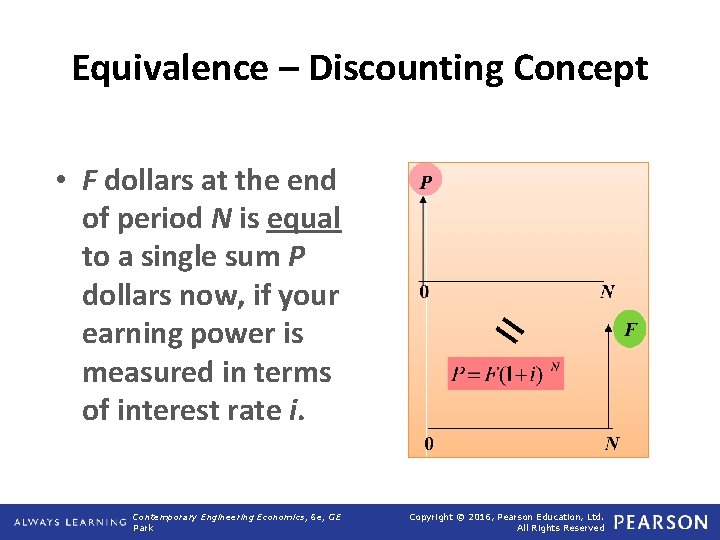
Equivalence – Discounting Concept • F dollars at the end of period N is equal to a single sum P dollars now, if your earning power is measured in terms of interest rate i. Contemporary Engineering Economics, 6 e, GE Park Copyright © 2016, Pearson Education, Ltd. All Rights Reserved
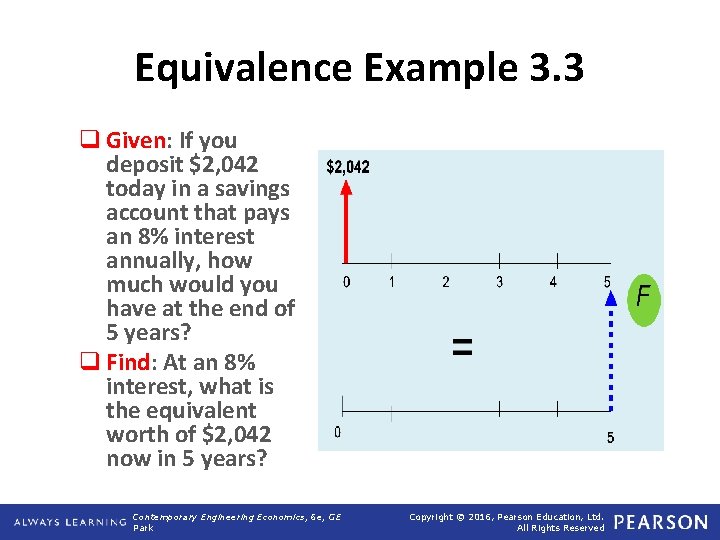
Equivalence Example 3. 3 q Given: If you deposit $2, 042 today in a savings account that pays an 8% interest annually, how much would you have at the end of 5 years? q Find: At an 8% interest, what is the equivalent worth of $2, 042 now in 5 years? Contemporary Engineering Economics, 6 e, GE Park Copyright © 2016, Pearson Education, Ltd. All Rights Reserved
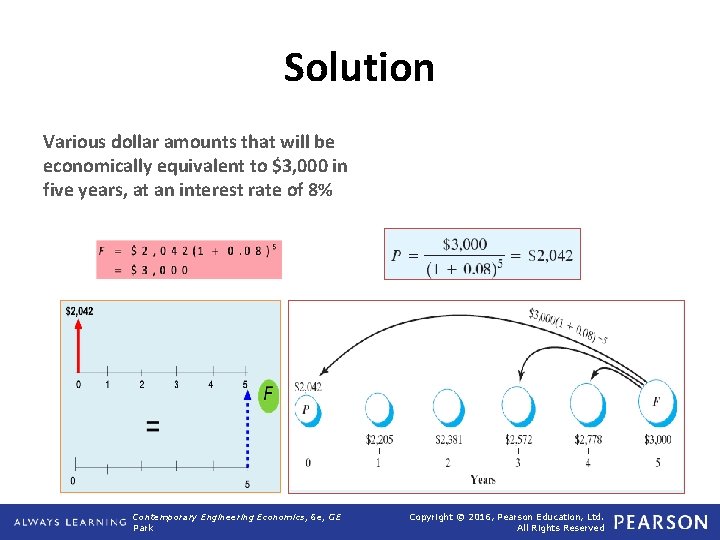
Solution Various dollar amounts that will be economically equivalent to $3, 000 in five years, at an interest rate of 8% Contemporary Engineering Economics, 6 e, GE Park Copyright © 2016, Pearson Education, Ltd. All Rights Reserved
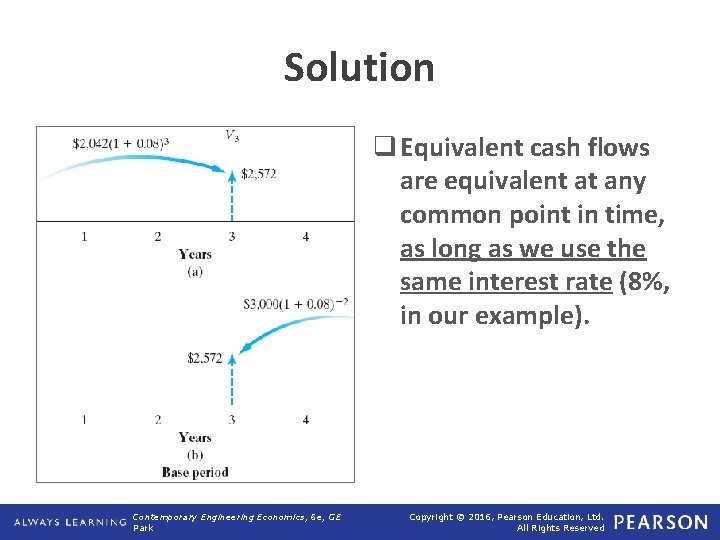
Equivalent Example 3. 4: Cash Flows q. Given: $2, 042 today was equivalent to receiving $3, 000 in five years, at an interest rate of 8%. q. Find: Are these two cash flows are also equivalent at the end of year 3? Contemporary Engineering Economics, 6 e, GE Park Copyright © 2016, Pearson Education, Ltd. All Rights Reserved
Solution q Equivalent cash flows are equivalent at any common point in time, as long as we use the same interest rate (8%, in our example). Contemporary Engineering Economics, 6 e, GE Park Copyright © 2016, Pearson Education, Ltd. All Rights Reserved
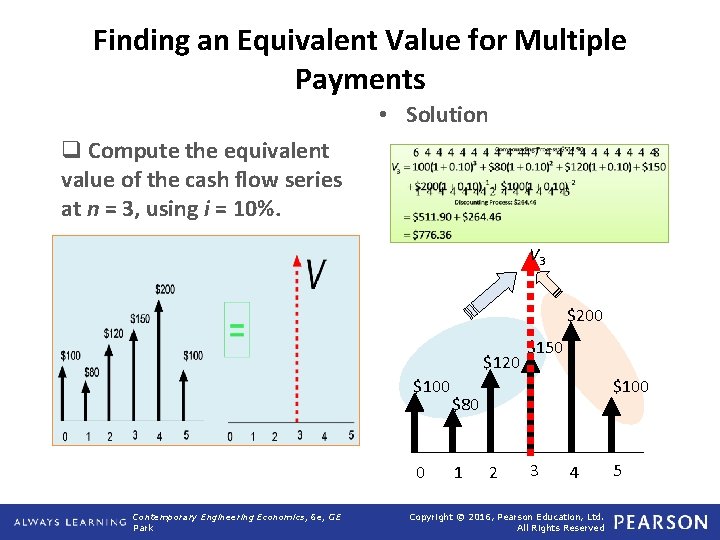
Finding an Equivalent Value for Multiple Payments • Solution q Compute the equivalent value of the cash flow series at n = 3, using i = 10%. V 3 $200 $120 $100 0 Contemporary Engineering Economics, 6 e, GE Park $150 $100 $80 1 2 3 4 Copyright © 2016, Pearson Education, Ltd. All Rights Reserved 5
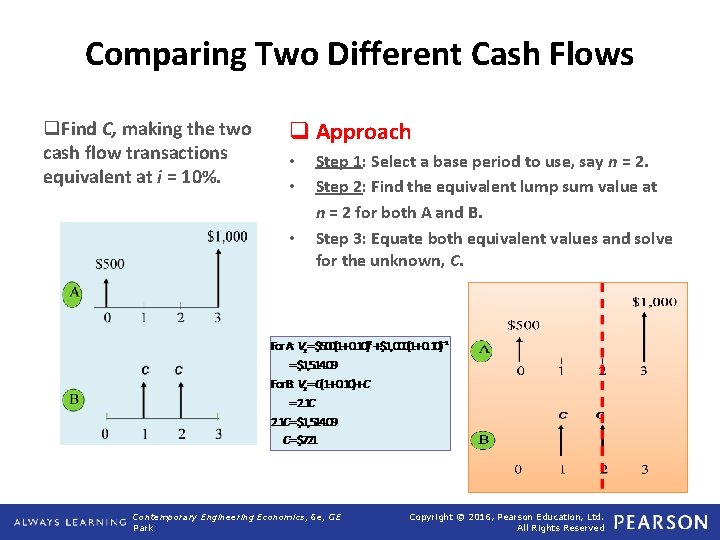
Comparing Two Different Cash Flows q. Find C, making the two cash flow transactions equivalent at i = 10%. q Approach • • • Step 1: Select a base period to use, say n = 2. Step 2: Find the equivalent lump sum value at n = 2 for both A and B. Step 3: Equate both equivalent values and solve for the unknown, C. Contemporary Engineering Economics, 6 e, GE Park Copyright © 2016, Pearson Education, Ltd. All Rights Reserved
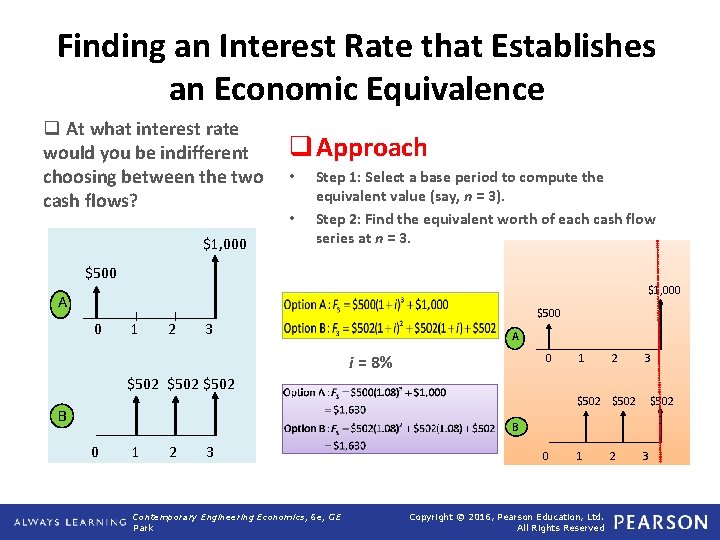
Finding an Interest Rate that Establishes an Economic Equivalence q At what interest rate would you be indifferent choosing between the two cash flows? $1, 000 q Approach • • Step 1: Select a base period to compute the equivalent value (say, n = 3). Step 2: Find the equivalent worth of each cash flow series at n = 3. $500 $1, 000 A 0 1 2 $500 3 A 0 i = 8% 1 2 3 $502 $502 B 0 1 2 3 Contemporary Engineering Economics, 6 e, GE Park 0 1 Copyright © 2016, Pearson Education, Ltd. All Rights Reserved 2 3