Ecological Masculinities Assoc Prof Martin Hultman Chalmers University
- Slides: 15
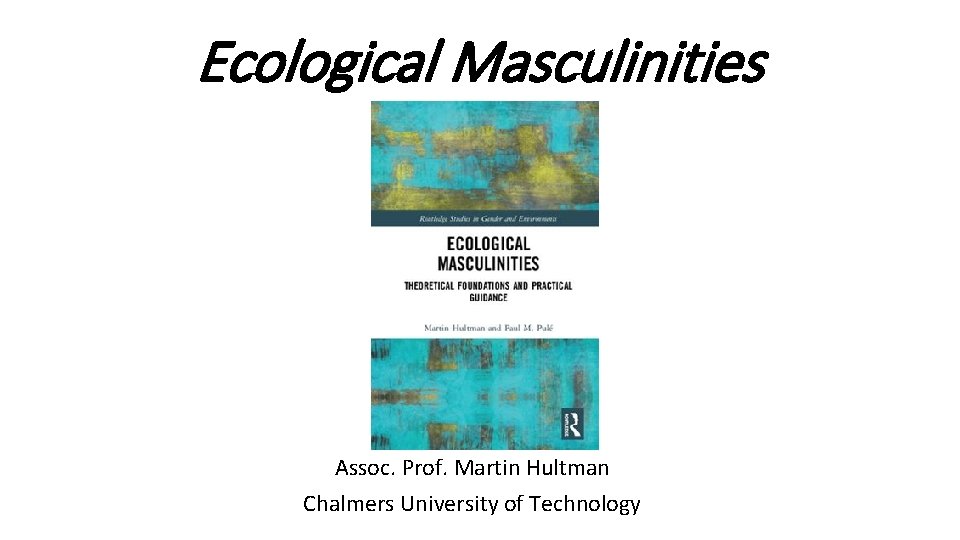
Ecological Masculinities Assoc. Prof. Martin Hultman Chalmers University of Technology
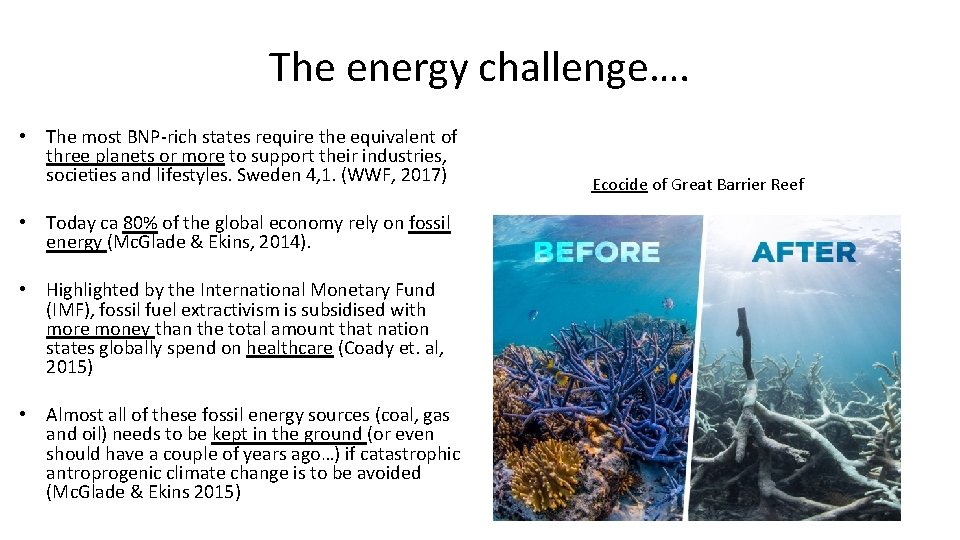
The energy challenge…. • The most BNP-rich states require the equivalent of three planets or more to support their industries, societies and lifestyles. Sweden 4, 1. (WWF, 2017) • Today ca 80% of the global economy rely on fossil energy (Mc. Glade & Ekins, 2014). • Highlighted by the International Monetary Fund (IMF), fossil fuel extractivism is subsidised with more money than the total amount that nation states globally spend on healthcare (Coady et. al, 2015) • Almost all of these fossil energy sources (coal, gas and oil) needs to be kept in the ground (or even should have a couple of years ago…) if catastrophic antroprogenic climate change is to be avoided (Mc. Glade & Ekins 2015) Ecocide of Great Barrier Reef
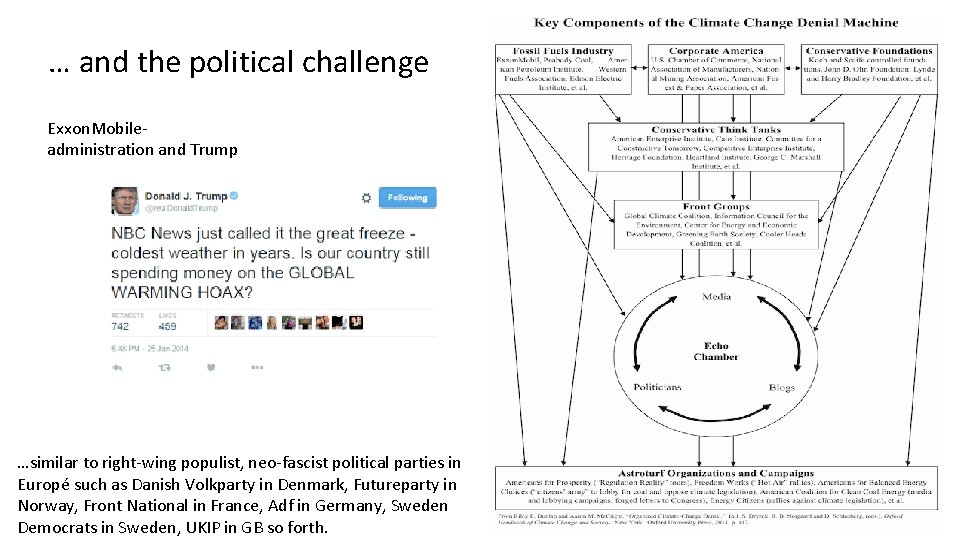
… and the political challenge Exxon. Mobileadministration and Trump …similar to right-wing populist, neo-fascist political parties in Europé such as Danish Volkparty in Denmark, Futureparty in Norway, Front National in France, Adf in Germany, Sweden Democrats in Sweden, UKIP in GB so forth.
Men is the big problem… • 8 richest men own same wealth as rest of the world (Oxfam, 2017) • 10% of the wealthiest are responsible for 45 % of the global greenhouse gas emissions; reaches a four digit factor when move to extreme incomes (Chancel & Piketty, 2015) • Especially white, middle-aged, rich men travel too much, eat too much meat and live in energy intensive buildings (e. g Rätty & Carlsson-Kanyama, 2010). • Climate change denial is connected to ‘the conservative white male effect’ (Mc. Cright and Dunlap, 2015 ) • Paradoxical situation: Men care less about environment and are the perpetrator (in general), still have leading positions in climate negotiations, hold top management positions in global companies and design geo-engineering planetary solutions (e. g Anshelm & Hansson 2014; Buck et al. 2014; Fleming 2007).
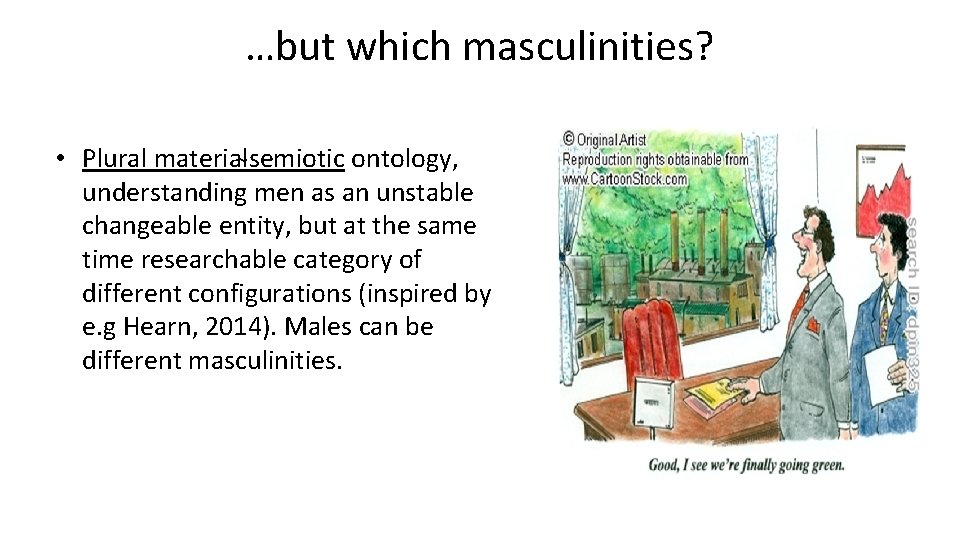
…but which masculinities? • Plural material semiotic ontology, understanding men as an unstable changeable entity, but at the same time researchable category of different configurations (inspired by e. g Hearn, 2014). Males can be different masculinities.
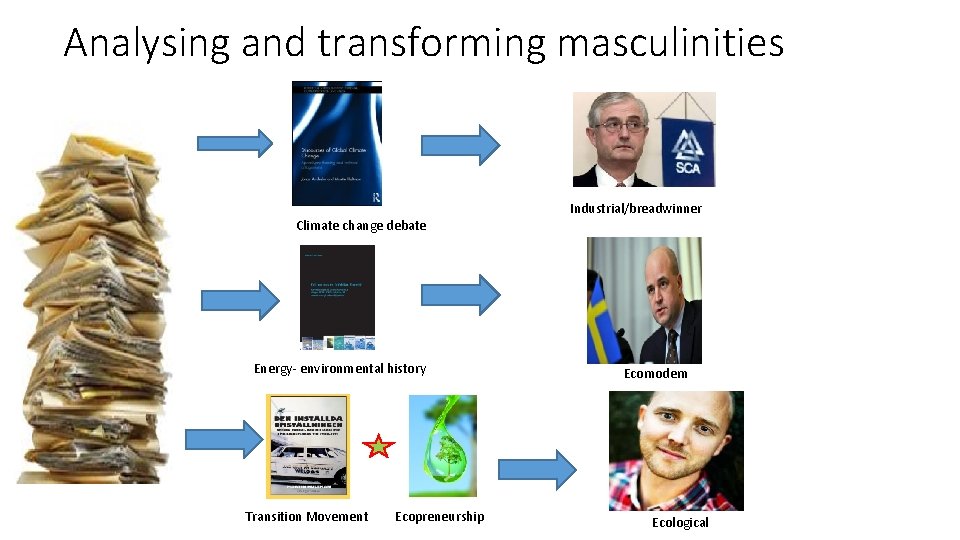
Analysing and transforming masculinities Industrial/breadwinner Climate change debate Energy- environmental history Transition Movement Ecopreneurship Ecomodern Ecological
Some scattered previous research • Limited, no overviews and no conceptualizations (Gaard, 2014; Connell and Pease, 2014; Buckingham, 2015; Mac. Gregor, 2017). • Some interview studies (ex. Connell, 1990; Donalson, 1990; Hultman, 2017+Rural sociological studies). Humans around the global north examples of Ecological Masculinities. These people may be environmental activists, small scale farmers or transition agents in form of ecopreneurs. • Historical studies such as for example in explorations of the Green Man , Wild Man etc. both from an ecofeminist historian perspective (Basford, 1978) as well as from an mythopoetic perspective (Cheetham 2005). This show the contingencies of masculinities as well as environmental politics/norms that in certain periods in history can form supportive structures that make Ecological Masculinities the prefered way to behave. • Ecocritical studies; Protagonists in different forms of literature performing masculinities in the way we are interested in here (Brandt, Woodward, Ouze and more …. ) Experiments in masculinities, or/and materialisations that bring together lived experiences with a need for change
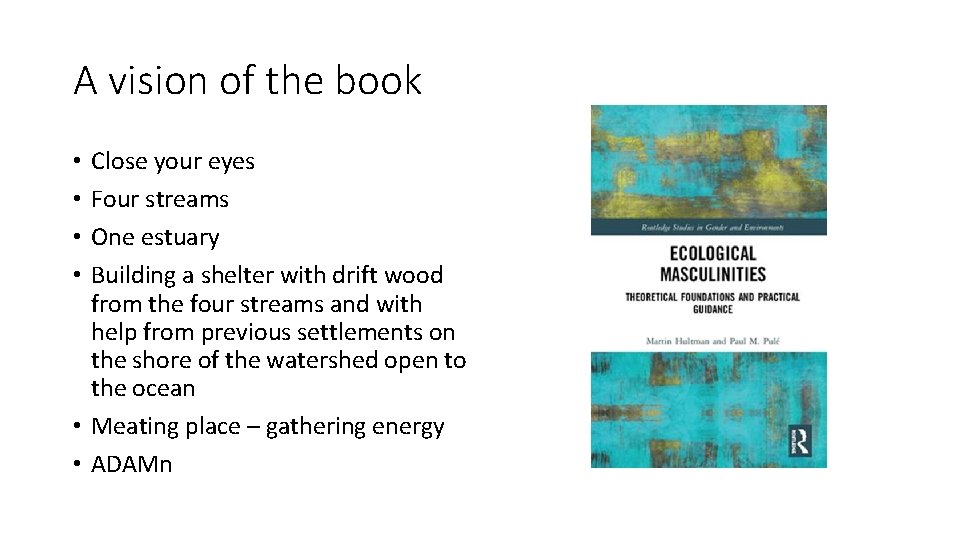
A vision of the book Close your eyes Four streams One estuary Building a shelter with drift wood from the four streams and with help from previous settlements on the shore of the watershed open to the ocean • Meating place – gathering energy • ADAMn • •
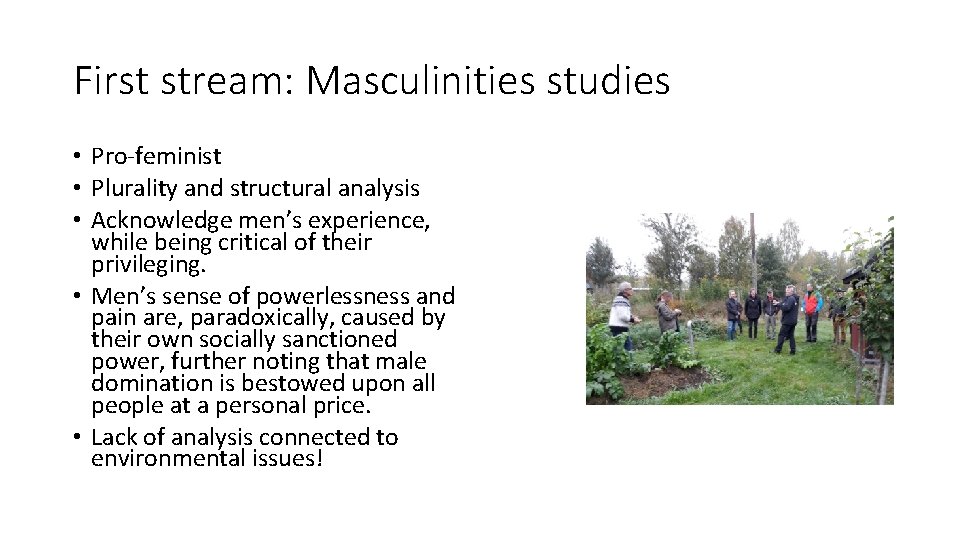
First stream: Masculinities studies • Pro-feminist • Plurality and structural analysis • Acknowledge men’s experience, while being critical of their privileging. • Men’s sense of powerlessness and pain are, paradoxically, caused by their own socially sanctioned power, further noting that male domination is bestowed upon all people at a personal price. • Lack of analysis connected to environmental issues!
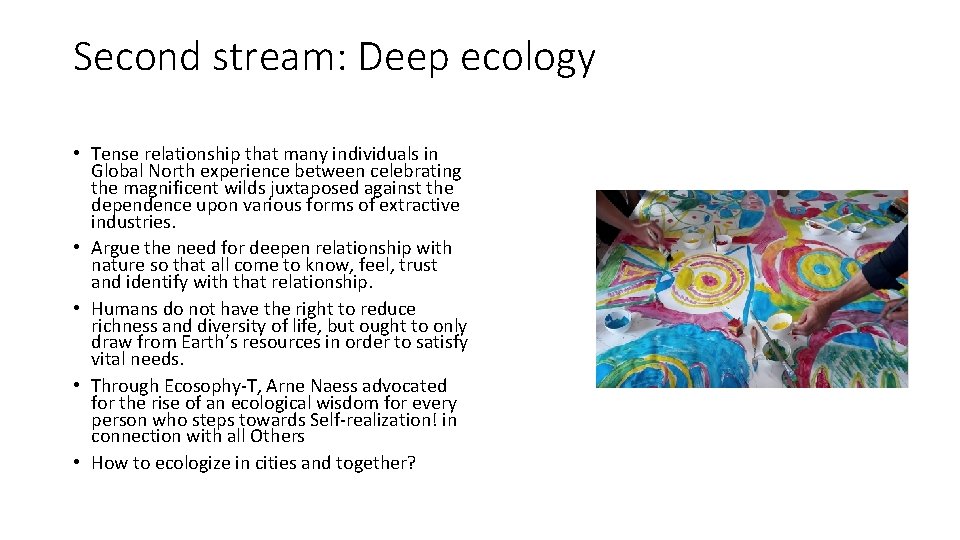
Second stream: Deep ecology • Tense relationship that many individuals in Global North experience between celebrating the magnificent wilds juxtaposed against the dependence upon various forms of extractive industries. • Argue the need for deepen relationship with nature so that all come to know, feel, trust and identify with that relationship. • Humans do not have the right to reduce richness and diversity of life, but ought to only draw from Earth’s resources in order to satisfy vital needs. • Through Ecosophy-T, Arne Naess advocated for the rise of an ecological wisdom for every person who steps towards Self-realization! in connection with all Others • How to ecologize in cities and together?
Third stream: Ecological Feminisms • Issues of power and domination • Gendered violence against women and Earth • Beyond Mothering Earth • Queer ecology and material feminism • Not exploring so much how maculinities can be part of positive change
Fourth stream: Feminist Care theory • Overall malestream care for selected others in a Utilitarian tradition • Western malestream constructs of care, which separate the human mind from embodied exchanges between others and ourselves, giving little if any consideration to notions of the intrinsic value and the equal rights of all of life. • Men have the capacity to care, how could that be directed to the care for glocal commons and humans as well an non-human others?
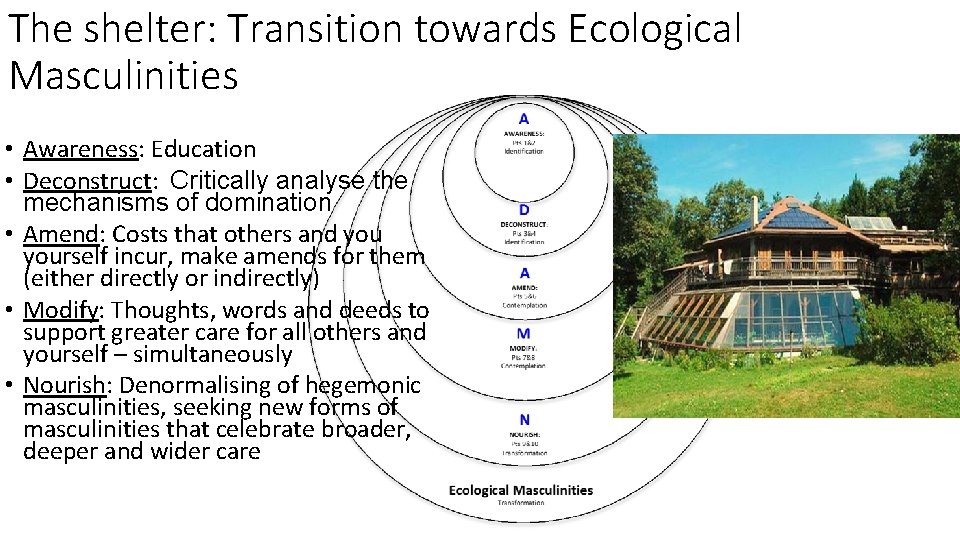
The shelter: Transition towards Ecological Masculinities • Awareness: Education • Deconstruct: Critically analyse the mechanisms of domination • Amend: Costs that others and yourself incur, make amends for them (either directly or indirectly) • Modify: Thoughts, words and deeds to support greater care for all others and yourself – simultaneously • Nourish: Denormalising of hegemonic masculinities, seeking new forms of masculinities that celebrate broader, deeper and wider care
5 min: Beehive, 2 and 2 • What do you see in your own organisation when you reflect with different masculinities? • How does environment and masculinities link together for you? • In what way do you think men, masculinities and enviroment can become an important issue in your research?
Book chapters: Related publications Books: Hultman, Martin and Paul Pulé (2018), Ecological Masculinities, Routledge: London Hultman, Martin et. al. , (kommande) Att ställa frågan. Att konkretisera omställning. Att förlora striden. Svensk energi- och miljöpolitik 19711991. Articles: Kall, A. S. , & Hultman, M. (2018). Pacifismo femminile ed energie rinnovabili su piccola scala. La mobilitazione anti-nucleare nella Svezia degli anni Settanta. La camera blu. Rivista di studi di genere, (18). Hultman, M. , Björk A. & Viinikka, T. (fortcoming), “Far-right and climate change denial. Denouncing environmental challenges via anti-establishment rhetoric, marketing of doubts, industrial/breadwinner masculinities enactments and ethno- nationalism. ”. In Contemporary Environmental Communication by the Far Right in Europe ed. Forchtner, Kølvraa & Wodak London: Routledge Hultman, (2017) “Exploring industrial, ecomodern, and ecological masculinities” in Routledge Handbook of Gender and Environment Edited by Sherilyn Mac. Gregor, Routledge: London Krange, O. Kaltenborn, B. & Hultman, M. (2018). “Cool Dudes in Norway: Climate Change denial among conservative Norwegian Men”. Environmental Sociology. Hultman, Martin (2017) “Industrial-, Ecological-, and Ecomodern Masculinity. Conceptualising forms of masculinities in the environmental field” in Understanding Climate Change through Gender Relations, Edited by Susan Buckingham and Virginie le Masson, Routledge: London Hultman, Martin (2016) Gröna män? Konceptualisering av industrimodern, ekomodern och ekologisk maskulinitet, i Kulturella Perspektiv vol. 1, Special Issue Environmental Humanities ed. Christer Nordlund s. 28 - 39 Hultman, M. and Anshelm, J. (2017). “Masculinities of climate change. Exploring examples of industrial-, ecomodern-, and ecological masculinities in the age of Anthropocene” in Marjorie Cohen ed. Climate Change and Gender in Rich Countries. London: Routledge. Anshelm, J. , & Hultman, M. (2014). A green fatwā? Climate change as a threat to the masculinity of industrial modernity. NORMA: International Journal for Masculinity Studies, 9(2), 8496. Hultman, Martin (2013)”The Making of an Environmental Hero: A History of Ecomodern Masculinity, Fuel Cells and Arnold Schwarzenegger”, Environmental Humanities 2: 83103. Editor: Hultman, Martin & Kall, Ann-Sofie (2016), Genus och miljö - en fruktbar symbios. Introduktion till specialnummer om genus och miljö,