Earthquakes and Seismic Waves C 5 S 2
- Slides: 19
Earthquakes and Seismic Waves C 5 S 2
EARTHQUAKE • Is the shaking that results from the sudden movement of rock along a fault. • Is the shaking that results from the movement of rock beneath Earth’s surface
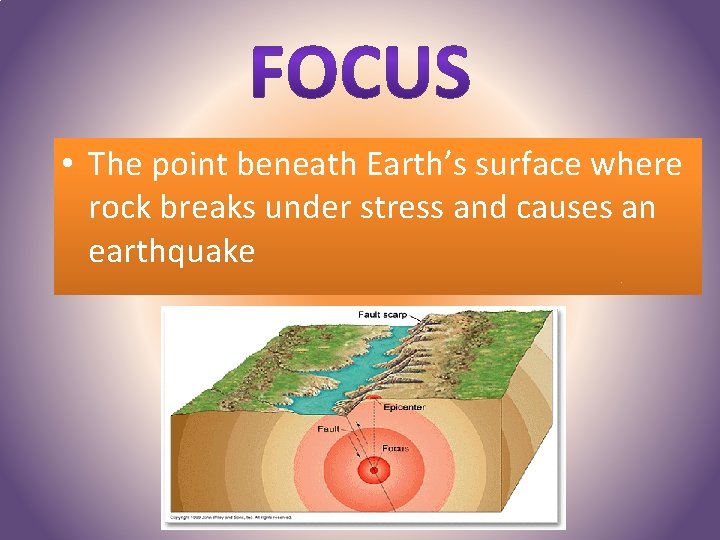
EARTHQUAKES • The forces of plate movement causes earthquakes. Plate movement produces stress in Earth’s crust, adding energy to rock and forming faults. Stress increases along a fault until the rock breaks. An earthquake begins. In seconds, the large amount of stored energy is released.
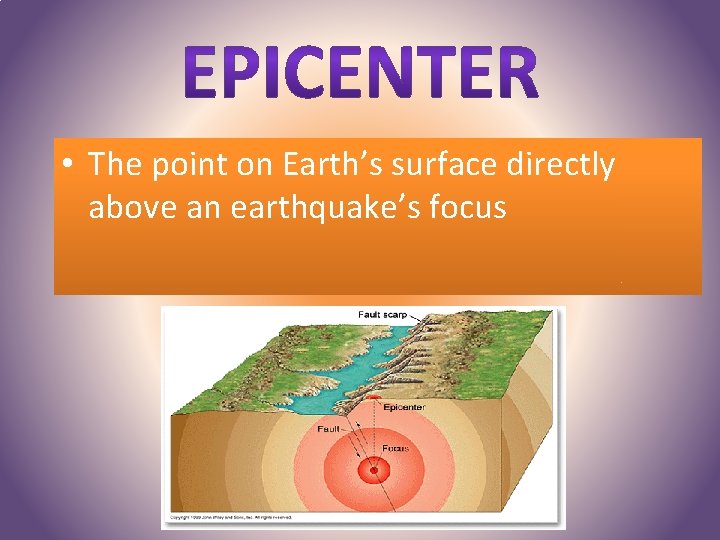
• The point beneath Earth’s surface where rock breaks under stress and causes an earthquake
• The point on Earth’s surface directly above an earthquake’s focus
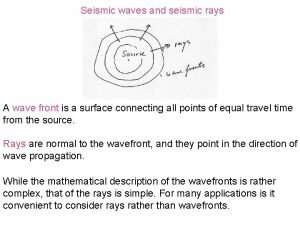
Seismic waves carry energy from an earthquake away from the Focus, through Earth’s interior, and across the surface.
SEISMIC WAVES • There are three types of seismic waves: P waves, S waves, and Surface Waves. • An Earthquake sends out two types of waves from its focus: P waves and S waves. When these two reach the surface at the epicenter, surface waves develop.
• Also known as Primary Wave • A type of seismic wave that compresses and expands the ground like an accordion. P waves can travel through solids and liquids
• Also known as Secondary Waves or Shear waves • A type of seismic wave that moves the ground surface up and down or side to side S waves can not travel through liquids
• A type of seismic wave that forms when P waves and S waves reach Earth’s surface. Surface waves can be shakers (side to side) or rollers (up and down)
There are three commonly used methods of measuring earthquakes: the Mercalli scale, the Richter scale, and the moment magnitude scale(mms).
• A Scale that rates earthquakes according to their intensity and how much damage they cause at a particular place. Twelve steps of the Mercalli scale (pg 185). The same earthquake can have different Mercalli ratings because intensity varies in different locations.
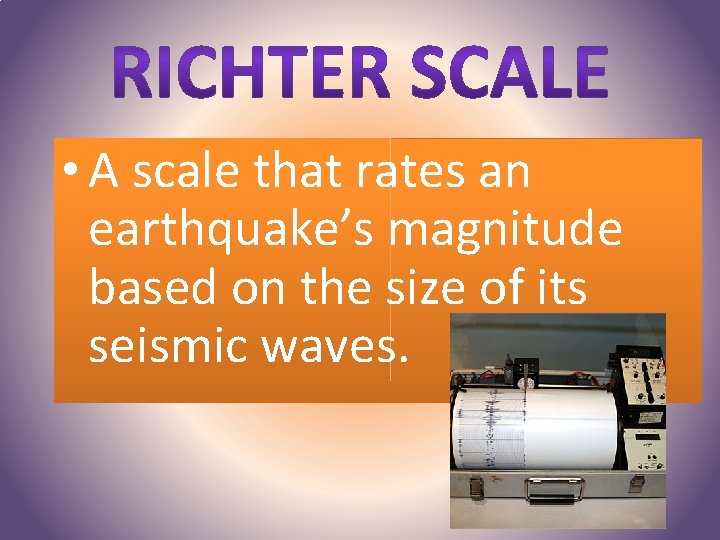
• A scale that rates an earthquake’s magnitude based on the size of its seismic waves.
• A device that records ground movements caused by a seismic waves • The record of an earthquake’s seismic waves produced by a seismograph
MAGNITUDE • The measure of an earthquake’s strength based on seismic waves and movement along faults.
THE MOMENT MAGNITUDE SCALE • A scale that rates an earthquake by estimating the total energy released.
Video • https: //www. youtube. com/watch? v=Yukp 0 b. P k. Qxs • https: //www. youtube. com/watch? v=_YLj. Iv. JXh pg