Dilworths theorem and extremal set theory Partially ordered





- Slides: 27
Dilworth’s theorem and extremal set theory 張雁婷 國立交通大學應用數學系
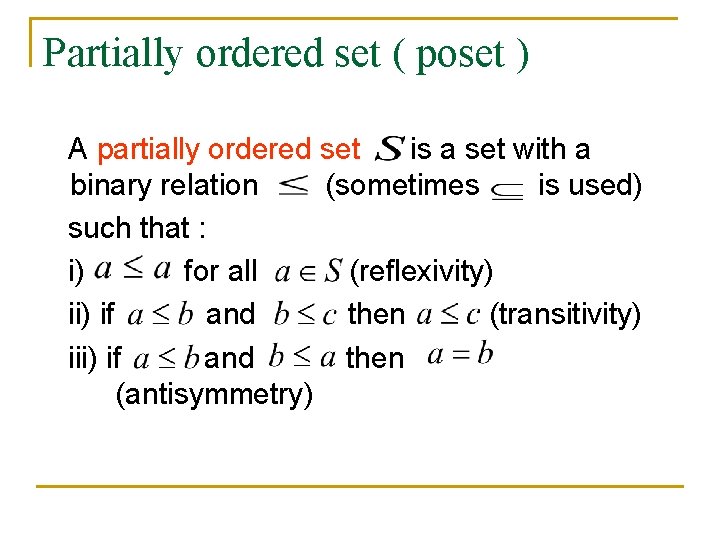
Partially ordered set ( poset ) A partially ordered set is a set with a binary relation (sometimes is used) such that : i) for all (reflexivity) ii) if and then (transitivity) iii) if and then (antisymmetry)
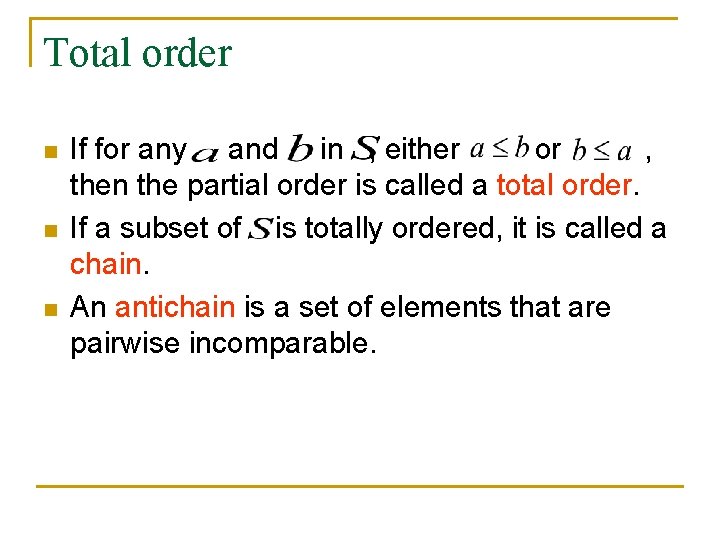
Total order n n n If for any and in , either or , then the partial order is called a total order. If a subset of is totally ordered, it is called a chain. An antichain is a set of elements that are pairwise incomparable.
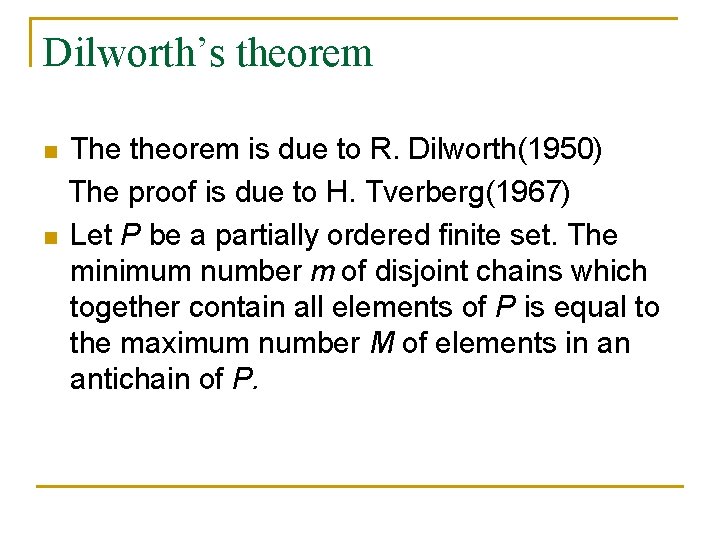
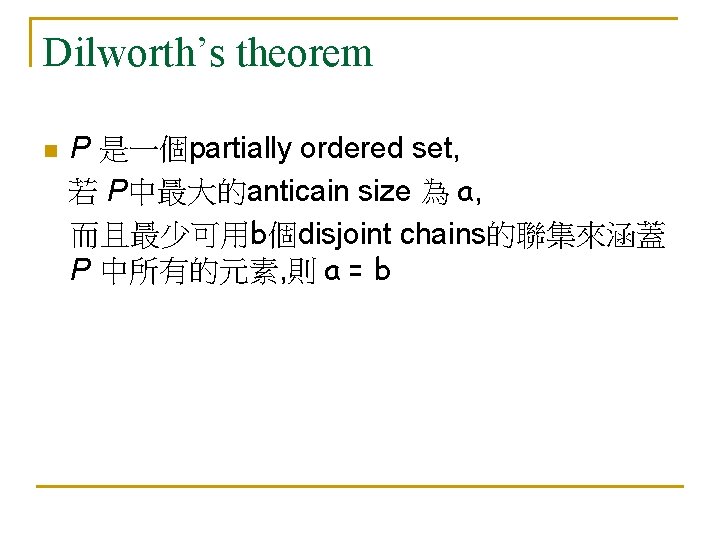
Dilworth’s theorem n n The theorem is due to R. Dilworth(1950) The proof is due to H. Tverberg(1967) Let P be a partially ordered finite set. The minimum number m of disjoint chains which together contain all elements of P is equal to the maximum number M of elements in an antichain of P.
Dilworth’s theorem n P 是一個partially ordered set, 若 P中最大的anticain size 為 a, 而且最少可用b個disjoint chains的聯集來涵蓋 P 中所有的元素, 則 a = b
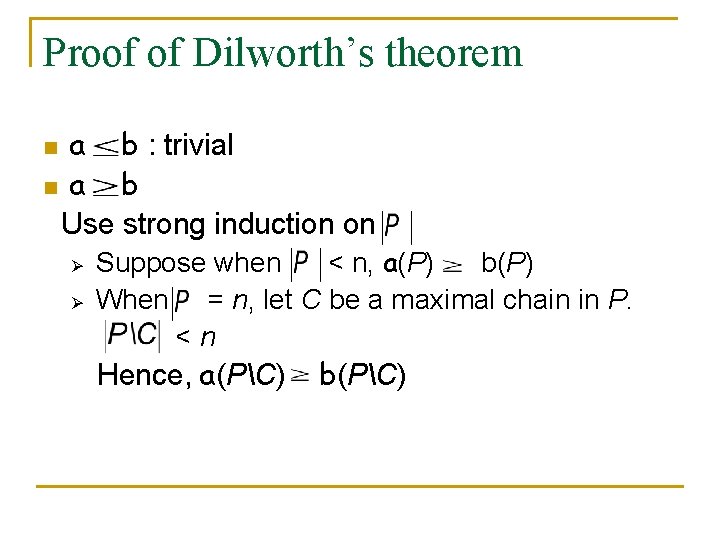
Proof of Dilworth’s theorem a b : trivial n a b Use strong induction on n Ø Ø Suppose when < n, a(P) b(P) When = n, let C be a maximal chain in P. <n Hence, a(PC) b(PC)
Proof of Dilworth’s theorem l If every antichain in PC contains at most a(P)-1 elements, we are done. Ø a(P)-1 a(PC) b(P) b(PC)+1 a(P)-1+1 = a(P)
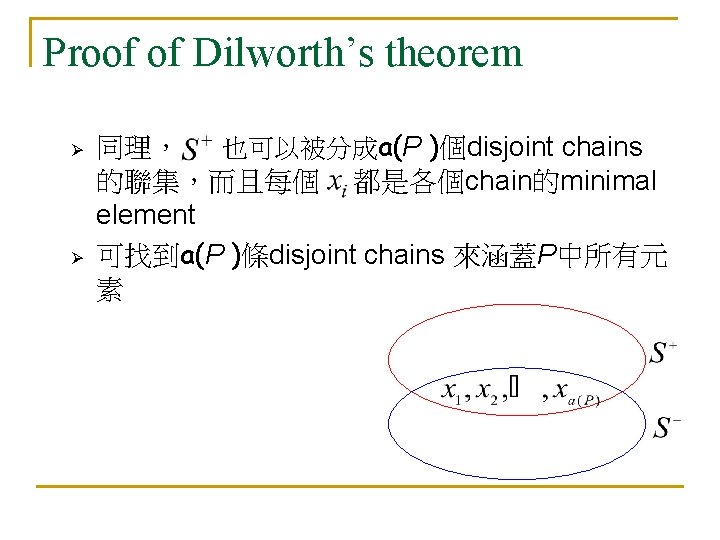
Proof of Dilworth’s theorem l Assume that { in PC. Ø Ø } is an antichain Define C is a maximal chain in P the largest element in C is not in <n b( ) a(P ) 而且每個 都是各個chain的maximal element
Proof of Dilworth’s theorem Ø Ø 同理, 也可以被分成a(P )個disjoint chains 的聯集,而且每個 都是各個chain的minimal element 可找到a(P )條disjoint chains 來涵蓋P中所有元 素
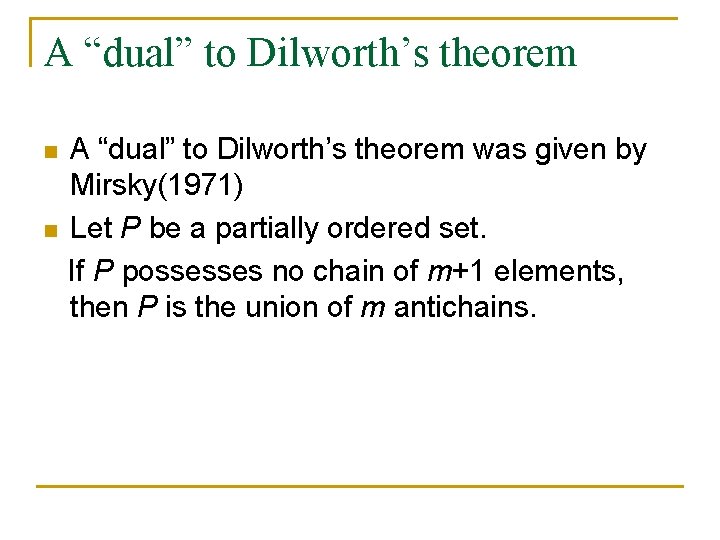
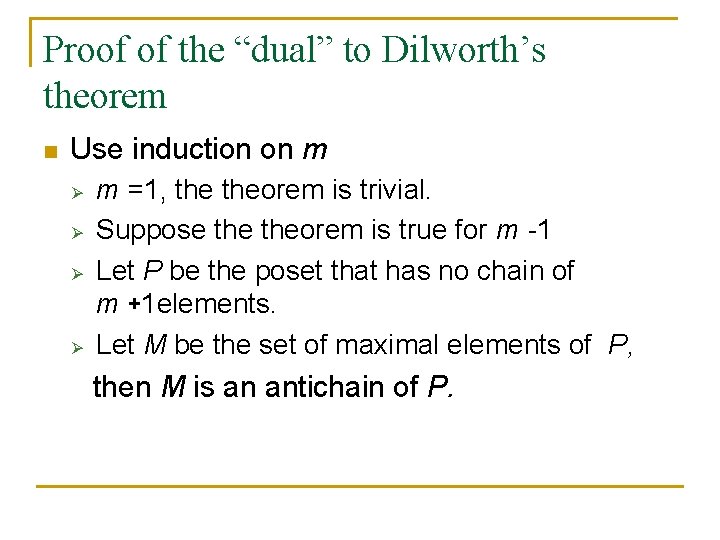
A “dual” to Dilworth’s theorem n n A “dual” to Dilworth’s theorem was given by Mirsky(1971) Let P be a partially ordered set. If P possesses no chain of m+1 elements, then P is the union of m antichains.
Proof of the “dual” to Dilworth’s theorem n Use induction on m Ø Ø m =1, theorem is trivial. Suppose theorem is true for m -1 Let P be the poset that has no chain of m +1 elements. Let M be the set of maximal elements of P, then M is an antichain of P.
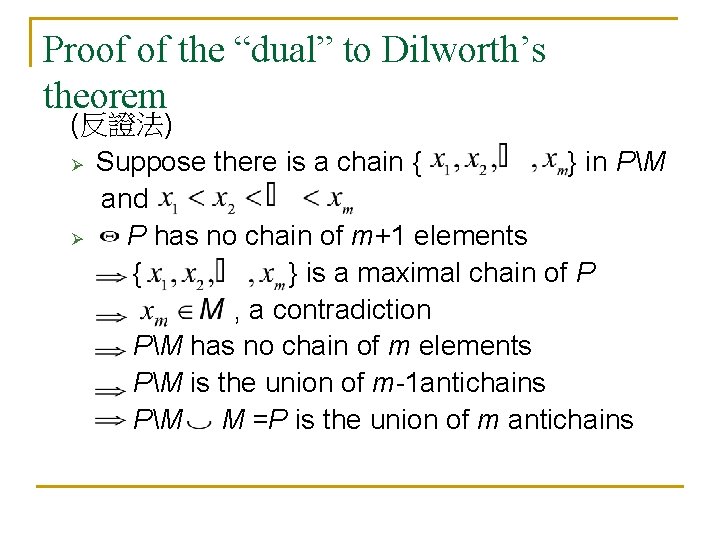
Proof of the “dual” to Dilworth’s theorem (反證法) Ø Suppose there is a chain { } in PM and Ø P has no chain of m+1 elements { } is a maximal chain of P , a contradiction PM has no chain of m elements PM is the union of m-1 antichains PM M =P is the union of m antichains
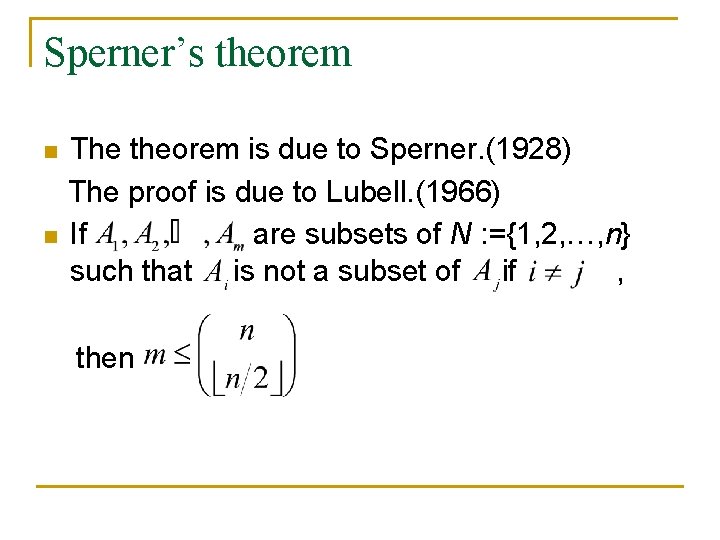
Sperner’s theorem n n The theorem is due to Sperner. (1928) The proof is due to Lubell. (1966) If are subsets of N : ={1, 2, …, n} such that is not a subset of if , then
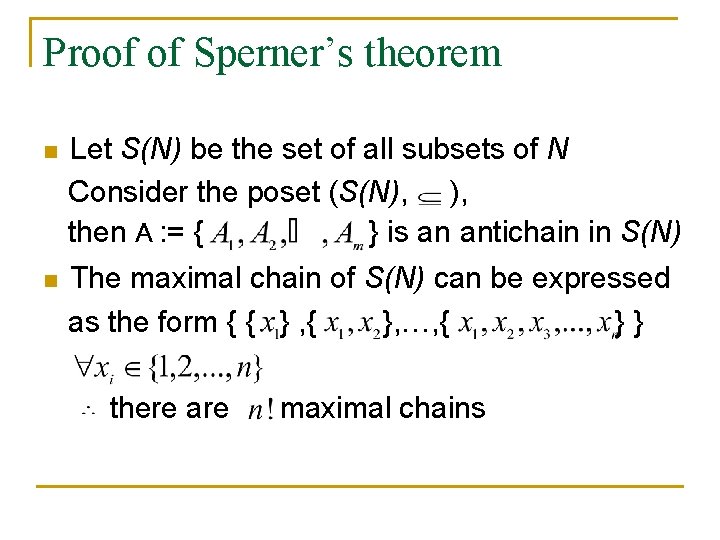
Proof of Sperner’s theorem n Let S(N) be the set of all subsets of N Consider the poset (S(N), ), then A : = { } is an antichain in S(N) n The maximal chain of S(N) can be expressed as the form { { } , { }, …, { }} there are maximal chains
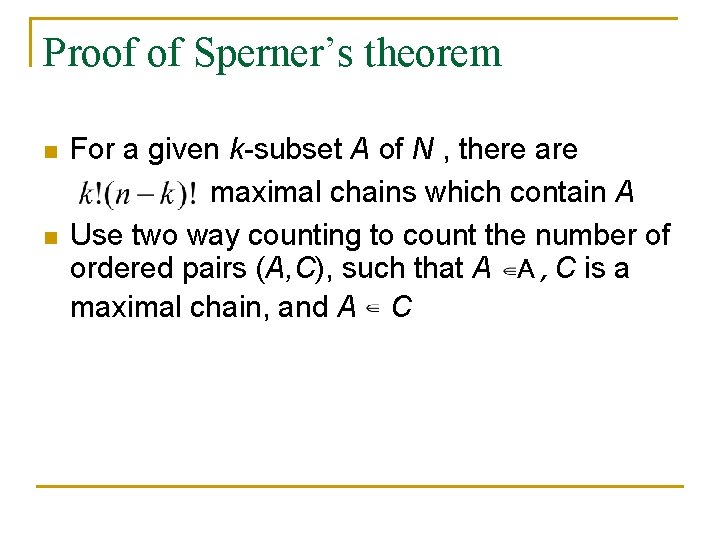
Proof of Sperner’s theorem n n For a given k-subset A of N , there are maximal chains which contain A Use two way counting to count the number of ordered pairs (A, C), such that A A , C is a maximal chain, and A C
Proof of Sperner’s theorem Ø 每個maximal chain裡最多只能有一個member 是來自於同一組antichain # {(A, C )}
Proof of Sperner’s theorem Ø 令A中的k-subsets 的個數為 個, 對每一個A中 的k-subset 而言, 包含此k-subset的maximal chains 會有 個 # {(A, C )} = Ø Hence, Ø
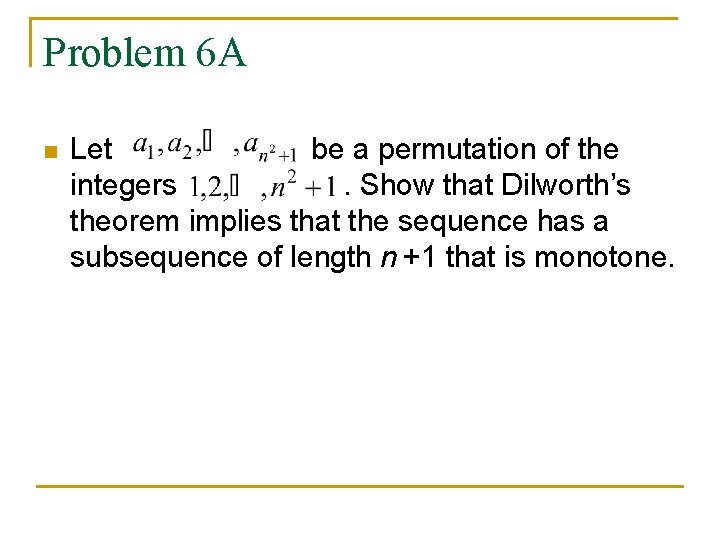
Problem 6 A n Let be a permutation of the integers. Show that Dilworth’s theorem implies that the sequence has a subsequence of length n +1 that is monotone.
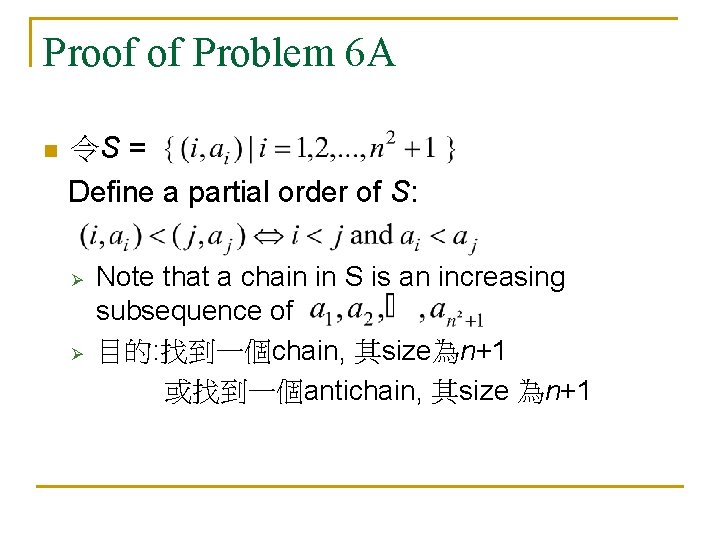
Proof of Problem 6 A n 令S = Define a partial order of S: Ø Ø Note that a chain in S is an increasing subsequence of 目的: 找到一個chain, 其size為n+1 或找到一個antichain, 其size 為n+1
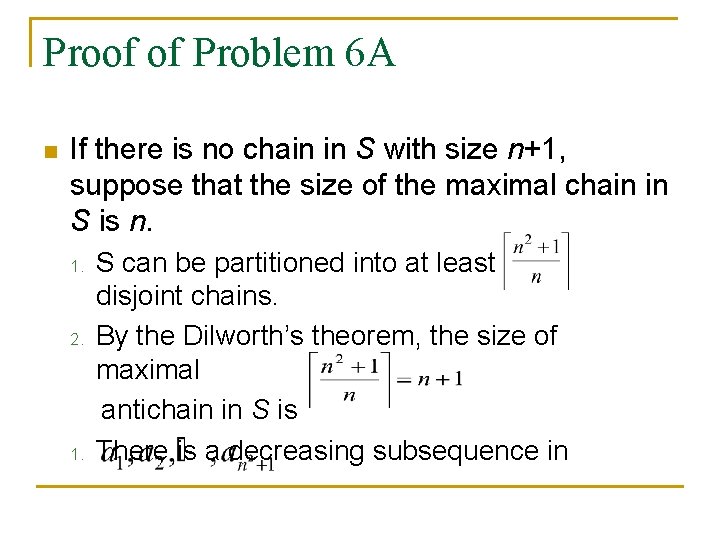
Proof of Problem 6 A n If there is no chain in S with size n+1, suppose that the size of the maximal chain in S is n. 1. 2. 1. S can be partitioned into at least disjoint chains. By the Dilworth’s theorem, the size of maximal antichain in S is There is a decreasing subsequence in
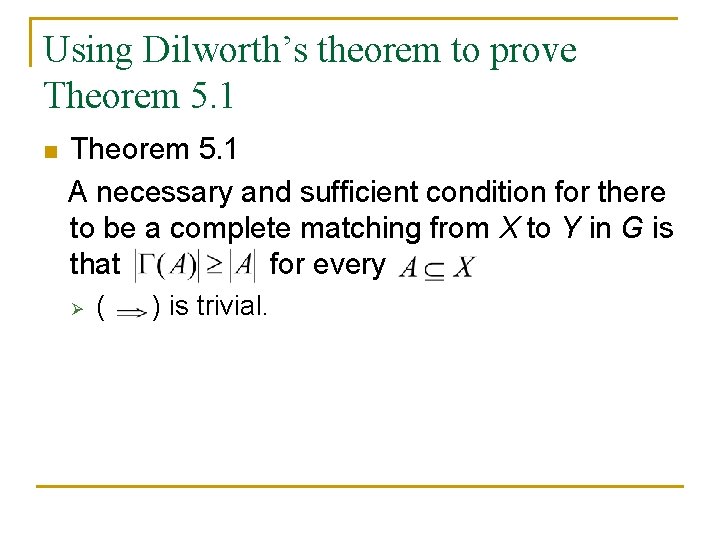
Using Dilworth’s theorem to prove Theorem 5. 1 n Theorem 5. 1 A necessary and sufficient condition for there to be a complete matching from X to Y in G is that for every Ø ( ) is trivial.
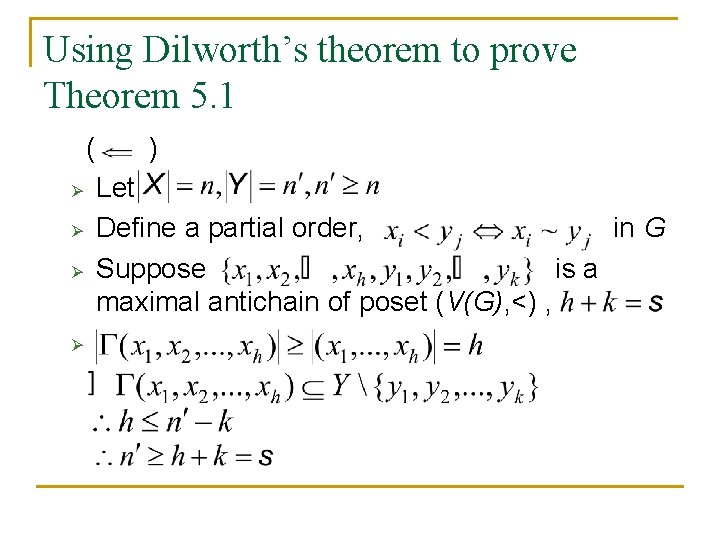
Using Dilworth’s theorem to prove Theorem 5. 1 ( Ø Ø ) Let Define a partial order, in G Suppose is a maximal antichain of poset (V(G), <) ,
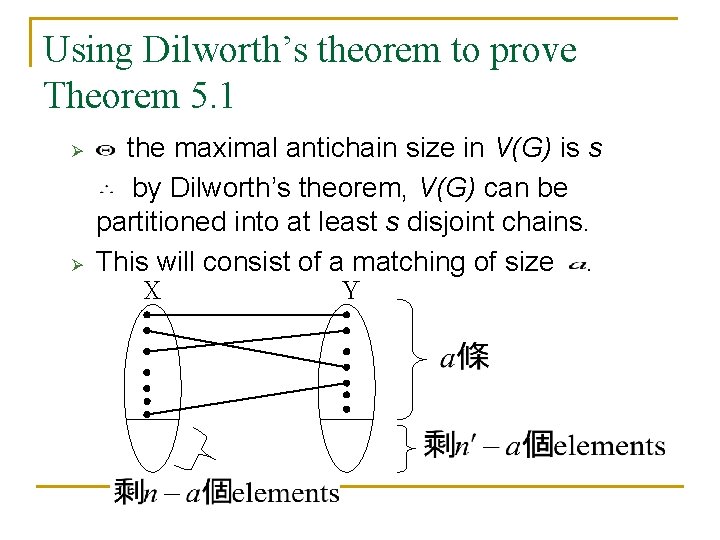
Using Dilworth’s theorem to prove Theorem 5. 1 Ø Ø the maximal antichain size in V(G) is s by Dilworth’s theorem, V(G) can be partitioned into at least s disjoint chains. This will consist of a matching of size. X Y
Using Dilworth’s theorem to prove Theorem 5. 1 Ø Ø We have a complete matching.
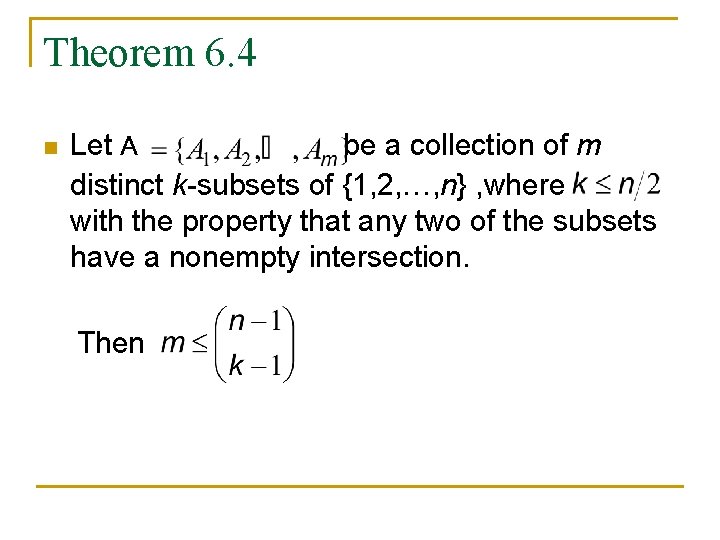
Theorem 6. 4 n Let A be a collection of m distinct k-subsets of {1, 2, …, n} , where with the property that any two of the subsets have a nonempty intersection. Then
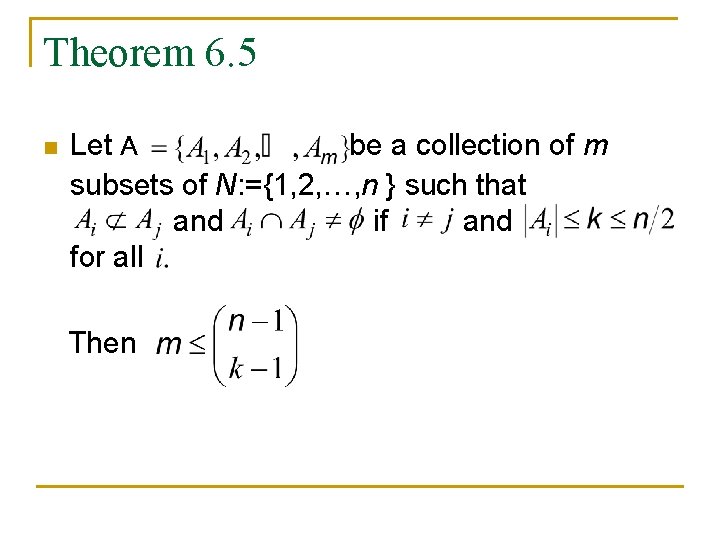
Theorem 6. 5 n Let A be a collection of m subsets of N: ={1, 2, …, n } such that and if and for all Then
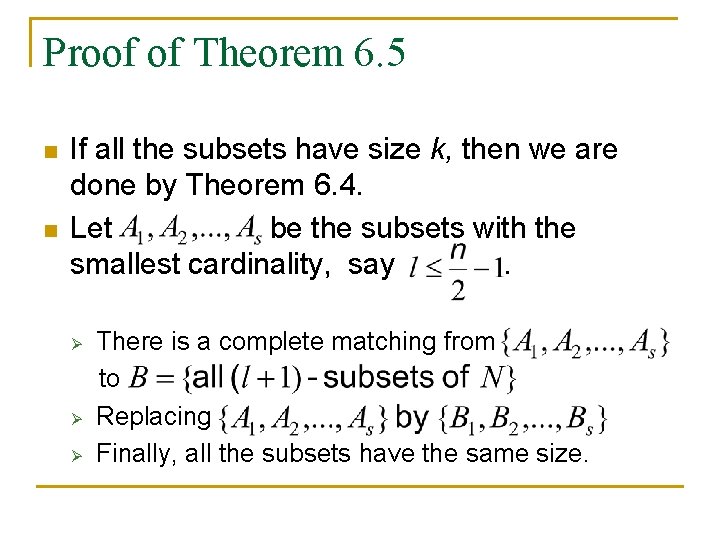
Proof of Theorem 6. 5 n n If all the subsets have size k, then we are done by Theorem 6. 4. Let be the subsets with the smallest cardinality, say. Ø Ø Ø There is a complete matching from to Replacing Finally, all the subsets have the same size.