Digital Lesson Onetoone and Inverse Functions A function
- Slides: 12
Digital Lesson One-to-one and Inverse Functions
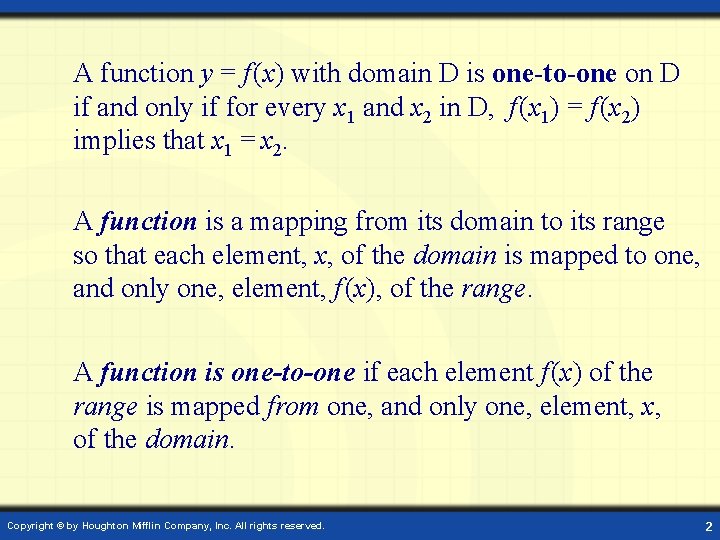
A function y = f (x) with domain D is one-to-one on D if and only if for every x 1 and x 2 in D, f (x 1) = f (x 2) implies that x 1 = x 2. A function is a mapping from its domain to its range so that each element, x, of the domain is mapped to one, and only one, element, f (x), of the range. A function is one-to-one if each element f (x) of the range is mapped from one, and only one, element, x, of the domain. Copyright © by Houghton Mifflin Company, Inc. All rights reserved. 2
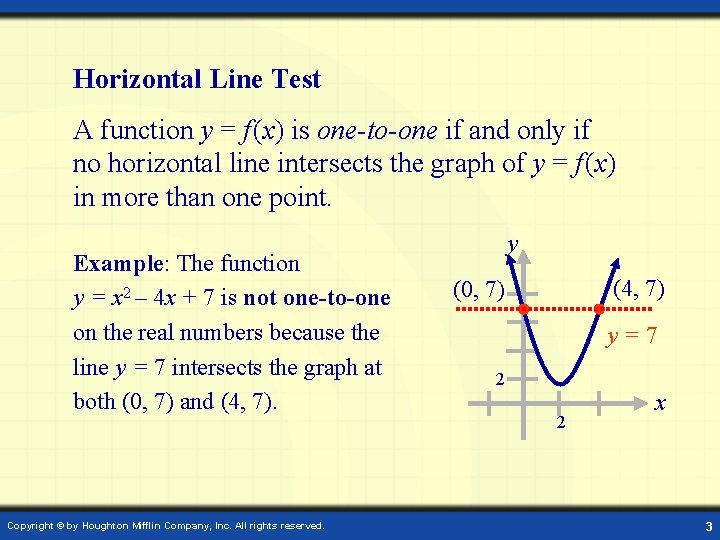
Horizontal Line Test A function y = f (x) is one-to-one if and only if no horizontal line intersects the graph of y = f (x) in more than one point. Example: The function y = x 2 – 4 x + 7 is not one-to-one on the real numbers because the line y = 7 intersects the graph at both (0, 7) and (4, 7). Copyright © by Houghton Mifflin Company, Inc. All rights reserved. y (4, 7) (0, 7) y=7 2 2 x 3
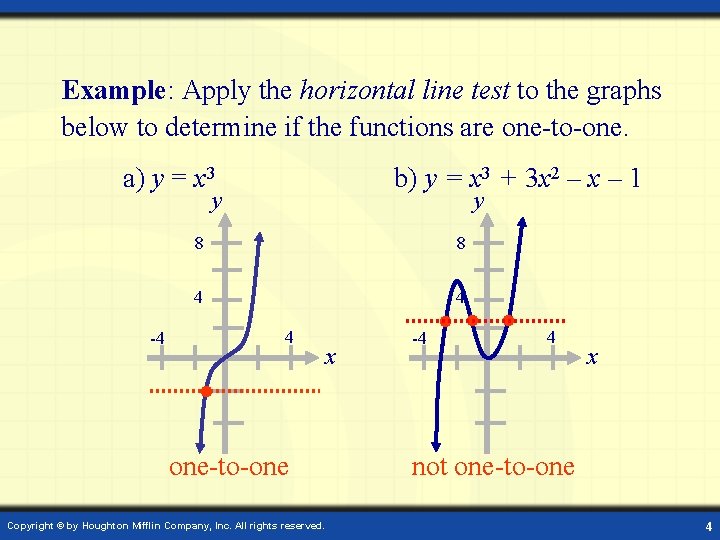
Example: Apply the horizontal line test to the graphs below to determine if the functions are one-to-one. b) y = x 3 + 3 x 2 – x – 1 a) y = x 3 y -4 y 8 8 4 4 4 x one-to-one Copyright © by Houghton Mifflin Company, Inc. All rights reserved. -4 4 x not one-to-one 4
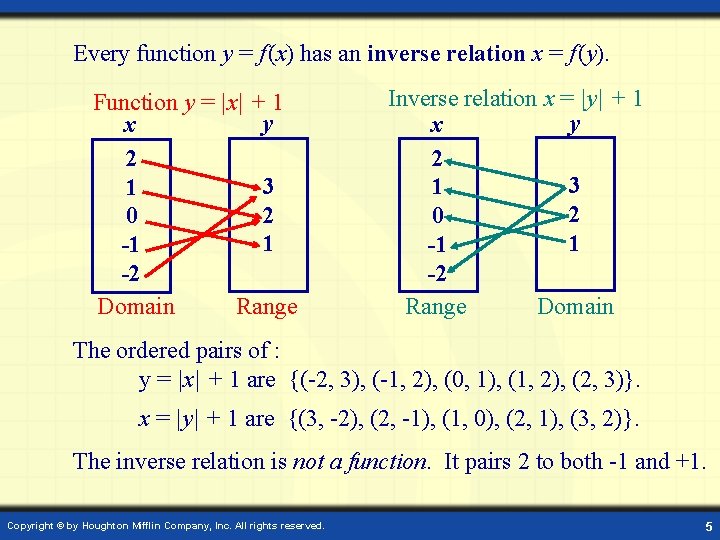
Every function y = f (x) has an inverse relation x = f (y). Function y = |x| + 1 y x 2 3 1 2 0 1 -1 -2 Domain Range Inverse relation x = |y| + 1 y x 2 3 1 2 0 1 -1 -2 Range Domain The ordered pairs of : y = |x| + 1 are {(-2, 3), (-1, 2), (0, 1), (1, 2), (2, 3)}. x = |y| + 1 are {(3, -2), (2, -1), (1, 0), (2, 1), (3, 2)}. The inverse relation is not a function. It pairs 2 to both -1 and +1. Copyright © by Houghton Mifflin Company, Inc. All rights reserved. 5
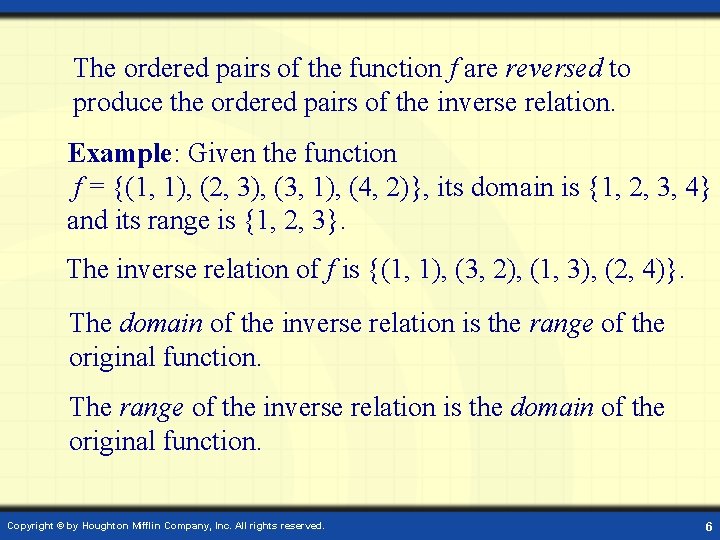
The ordered pairs of the function f are reversed to produce the ordered pairs of the inverse relation. Example: Given the function f = {(1, 1), (2, 3), (3, 1), (4, 2)}, its domain is {1, 2, 3, 4} and its range is {1, 2, 3}. The inverse relation of f is {(1, 1), (3, 2), (1, 3), (2, 4)}. The domain of the inverse relation is the range of the original function. The range of the inverse relation is the domain of the original function. Copyright © by Houghton Mifflin Company, Inc. All rights reserved. 6
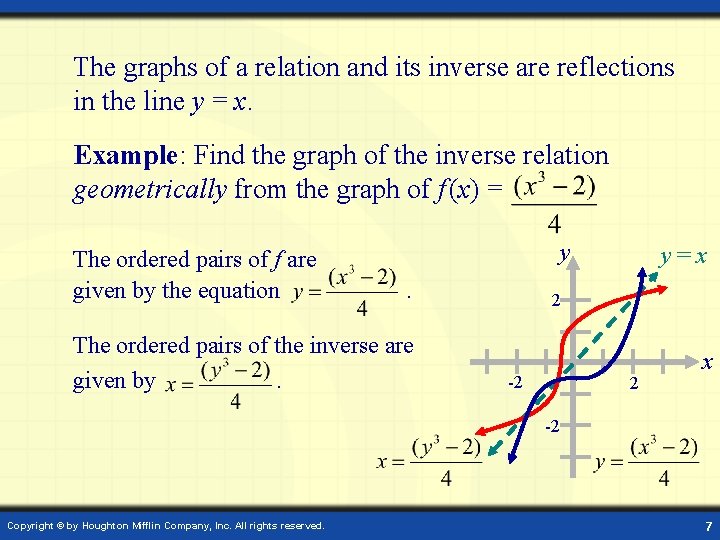
The graphs of a relation and its inverse are reflections in the line y = x. Example: Find the graph of the inverse relation geometrically from the graph of f (x) = The ordered pairs of f are given by the equation y. The ordered pairs of the inverse are given by. y=x 2 -2 2 x -2 Copyright © by Houghton Mifflin Company, Inc. All rights reserved. 7
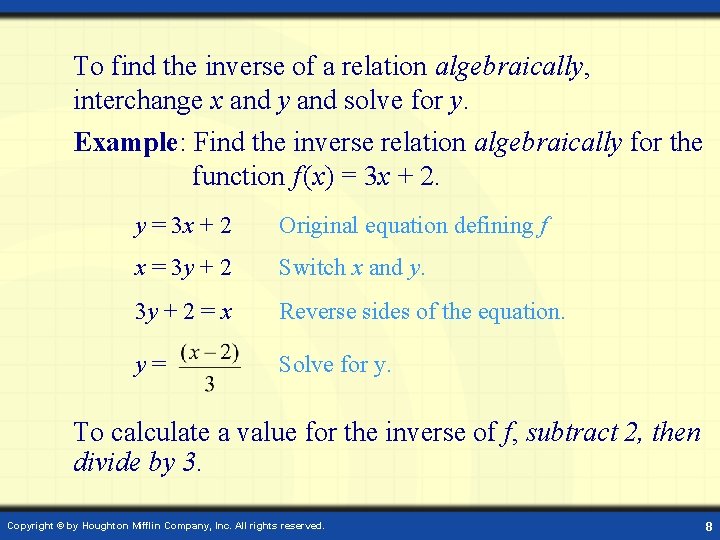
To find the inverse of a relation algebraically, interchange x and y and solve for y. Example: Find the inverse relation algebraically for the function f (x) = 3 x + 2. y = 3 x + 2 Original equation defining f x = 3 y + 2 Switch x and y. 3 y + 2 = x Reverse sides of the equation. y= Solve for y. To calculate a value for the inverse of f, subtract 2, then divide by 3. Copyright © by Houghton Mifflin Company, Inc. All rights reserved. 8
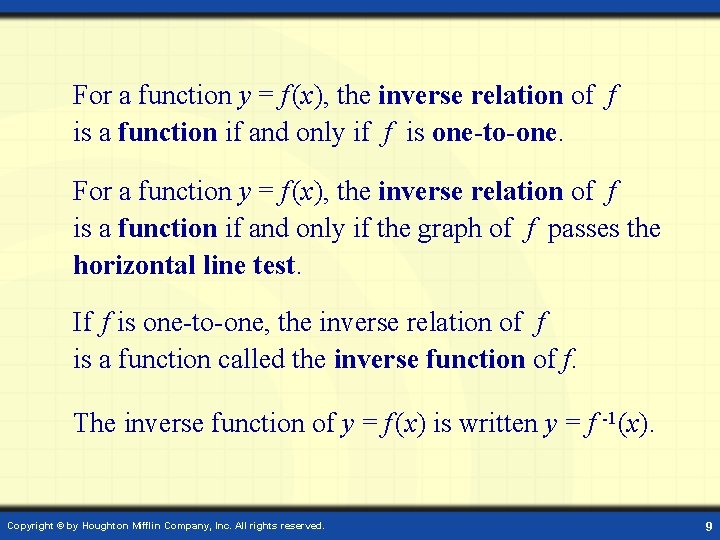
For a function y = f (x), the inverse relation of f is a function if and only if f is one-to-one. For a function y = f (x), the inverse relation of f is a function if and only if the graph of f passes the horizontal line test. If f is one-to-one, the inverse relation of f is a function called the inverse function of f. The inverse function of y = f (x) is written y = f -1(x). Copyright © by Houghton Mifflin Company, Inc. All rights reserved. 9
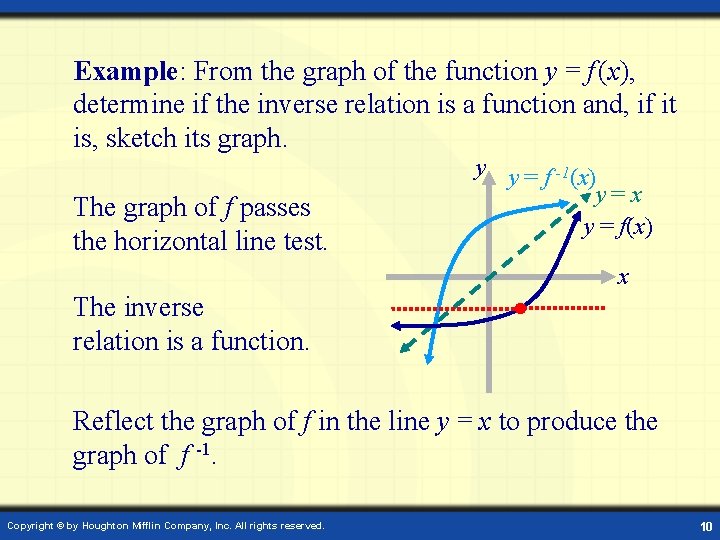
Example: From the graph of the function y = f (x), determine if the inverse relation is a function and, if it is, sketch its graph. The graph of f passes the horizontal line test. y y = f -1(x) y=x y = f(x) x The inverse relation is a function. Reflect the graph of f in the line y = x to produce the graph of f -1. Copyright © by Houghton Mifflin Company, Inc. All rights reserved. 10
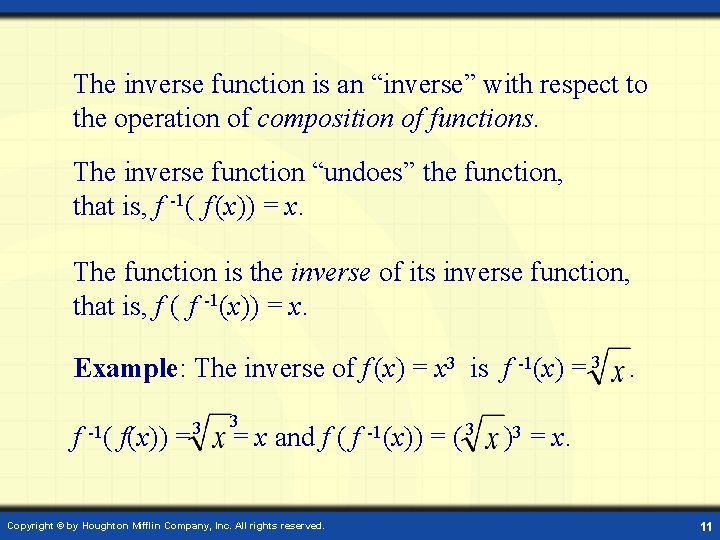
The inverse function is an “inverse” with respect to the operation of composition of functions. The inverse function “undoes” the function, that is, f -1( f (x)) = x. The function is the inverse of its inverse function, that is, f ( f -1(x)) = x. Example: The inverse of f (x) = x 3 is f -1(x) = 3 f -1( f(x)) = 3 3 = x and f ( f -1(x)) = ( 3 Copyright © by Houghton Mifflin Company, Inc. All rights reserved. . )3 = x. 11
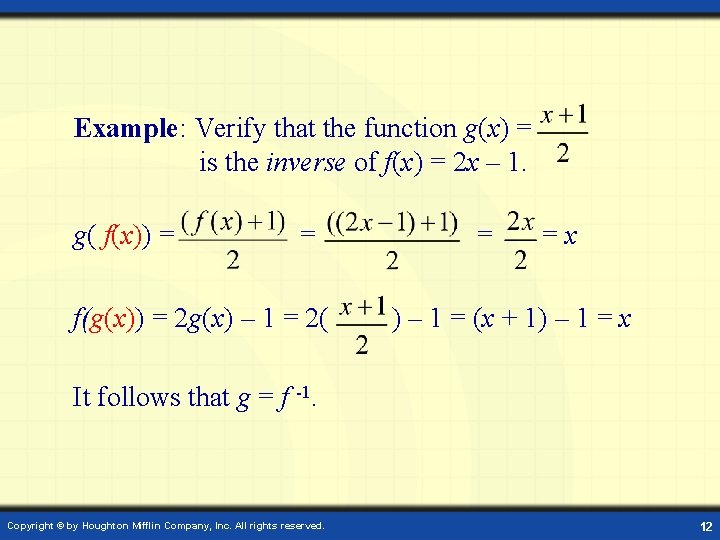
Example: Verify that the function g(x) = is the inverse of f(x) = 2 x – 1. g( f(x)) = = f(g(x)) = 2 g(x) – 1 = 2( = =x ) – 1 = (x + 1) – 1 = x It follows that g = f -1. Copyright © by Houghton Mifflin Company, Inc. All rights reserved. 12