
Chapter 9 Section 2 Composite and Inverse Functions

- Slides: 15
Chapter 9 Section 2 Composite and Inverse Functions Page 676
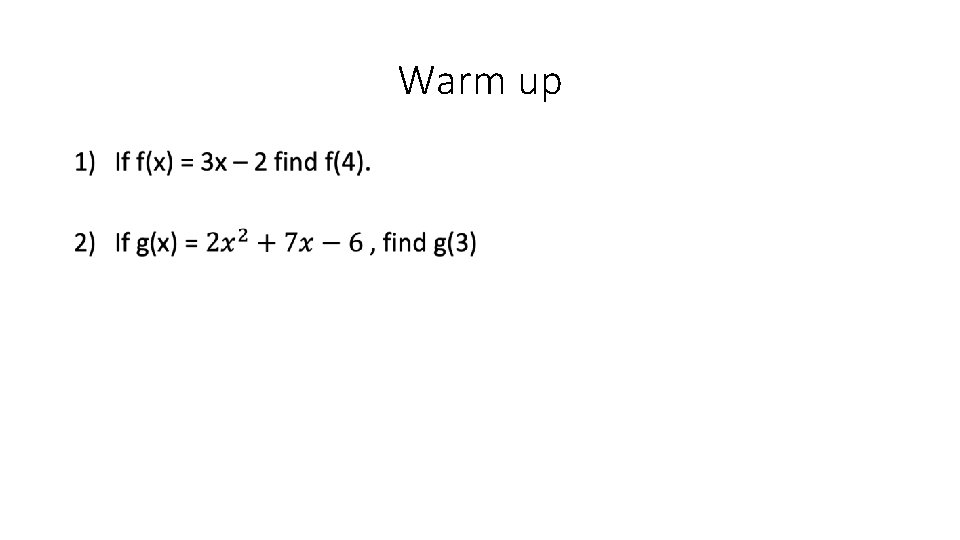
Warm up •
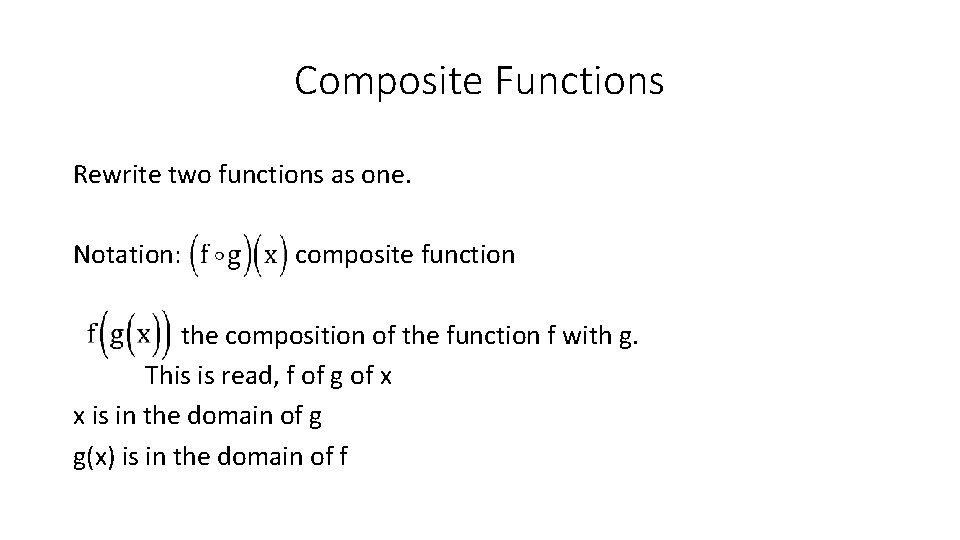
Composite Functions Rewrite two functions as one. Notation: composite function the composition of the function f with g. This is read, f of g of x x is in the domain of g g(x) is in the domain of f
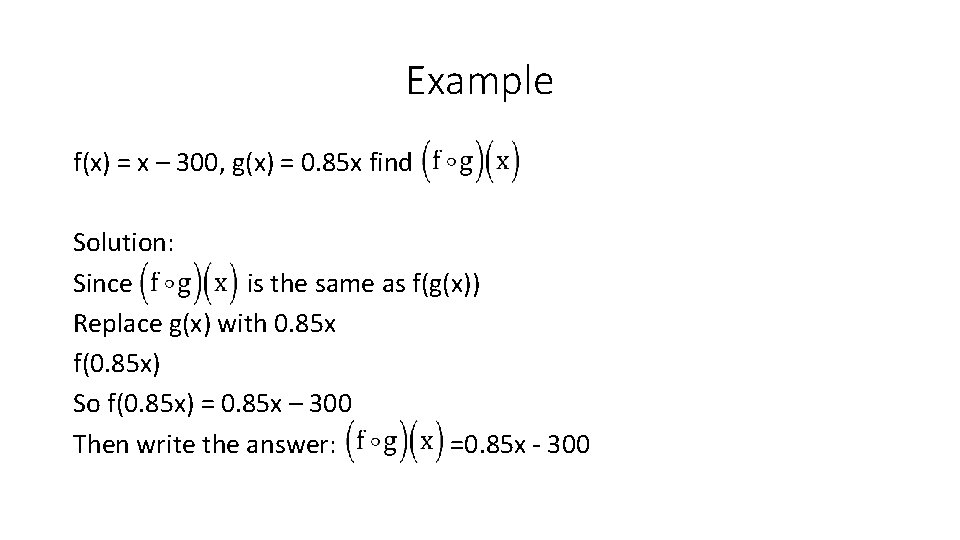
Example f(x) = x – 300, g(x) = 0. 85 x find Solution: Since is the same as f(g(x)) Replace g(x) with 0. 85 x f(0. 85 x) So f(0. 85 x) = 0. 85 x – 300 Then write the answer: =0. 85 x - 300
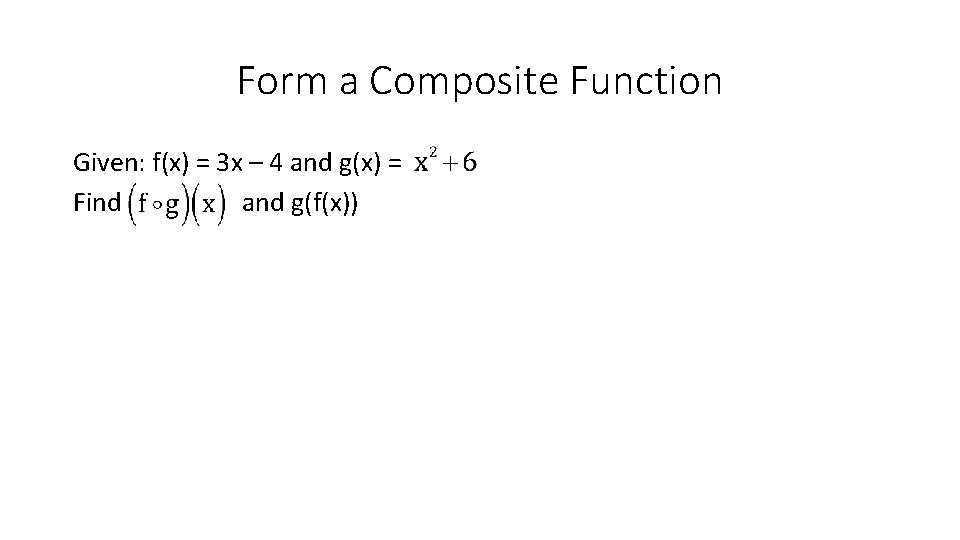
Form a Composite Function Given: f(x) = 3 x – 4 and g(x) = Find and g(f(x))
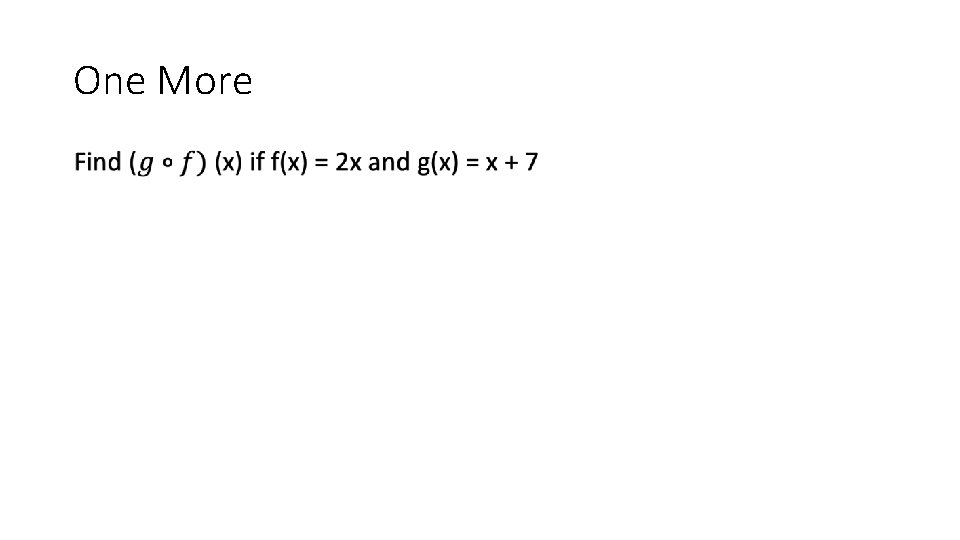
One More •
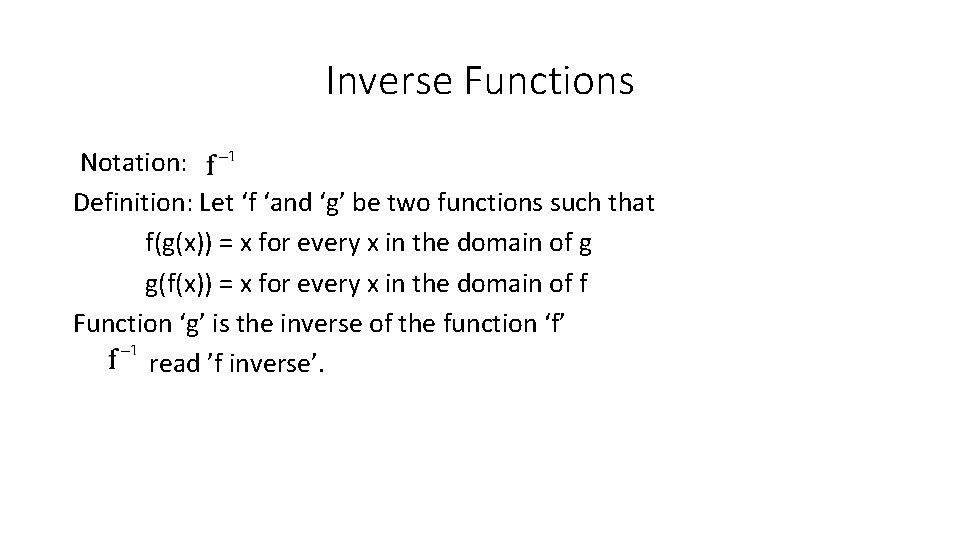
Inverse Functions Notation: Definition: Let ‘f ‘and ‘g’ be two functions such that f(g(x)) = x for every x in the domain of g g(f(x)) = x for every x in the domain of f Function ‘g’ is the inverse of the function ‘f’ read ’f inverse’.
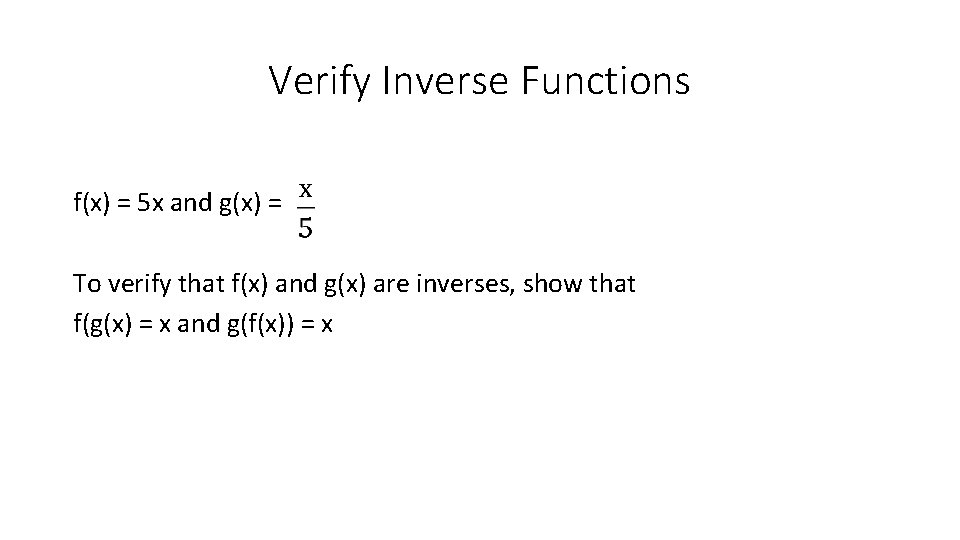
Verify Inverse Functions f(x) = 5 x and g(x) = To verify that f(x) and g(x) are inverses, show that f(g(x) = x and g(f(x)) = x
Find the Inverse of a Function 1) Replace f(x) with ‘y’ in the equation. 2) Interchange ‘x’ and ‘y’ 3) Solve for ‘y’ If the function does not have an inverse, stop. 4) If ‘f’ has an inverse, then replace ‘y’ with
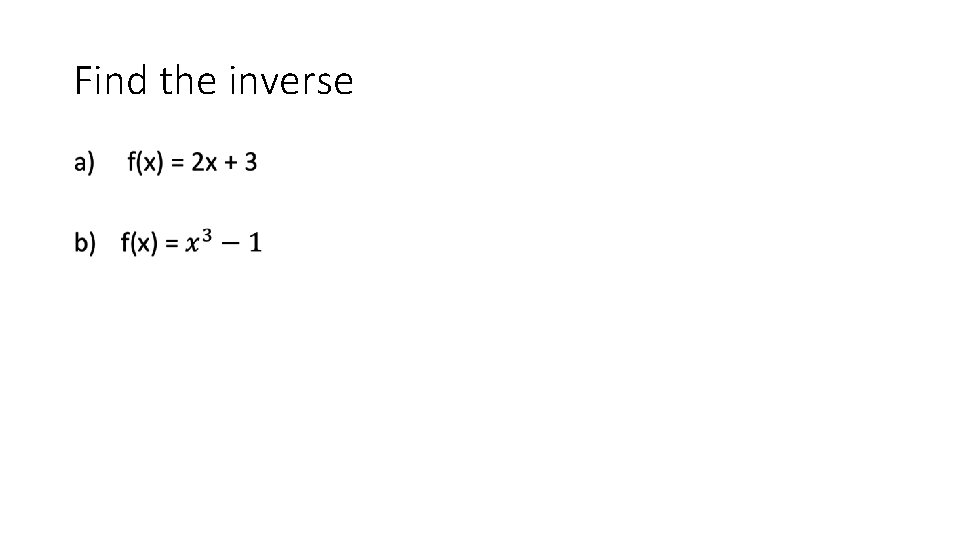
Find the inverse •
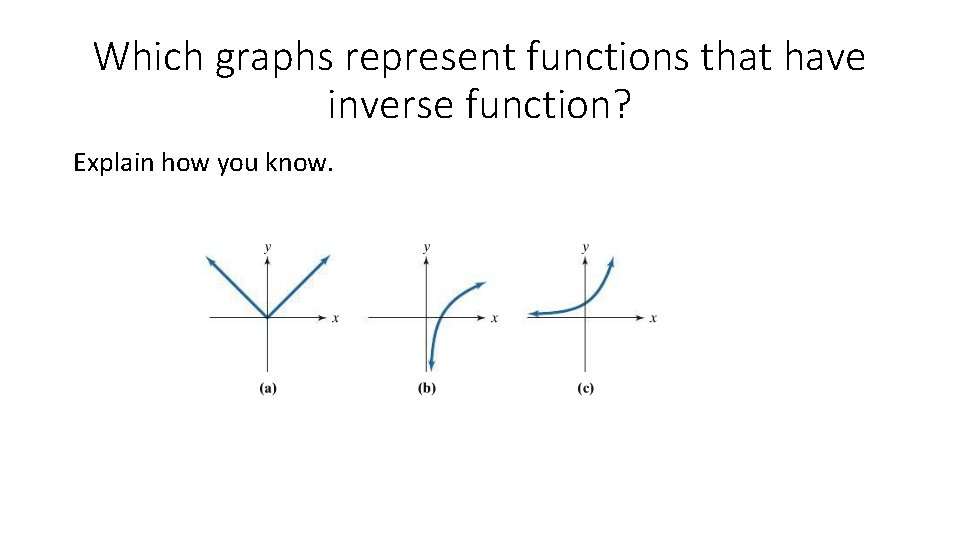
Horizontal Line Test and One-to—One Functions A function ‘f’ has an inverse that is a function, , if there is no horizontal line that interests the graph of the function ‘f’ at more than one point. If the function passes the horizontal line test, the function is call a oneto-one function.
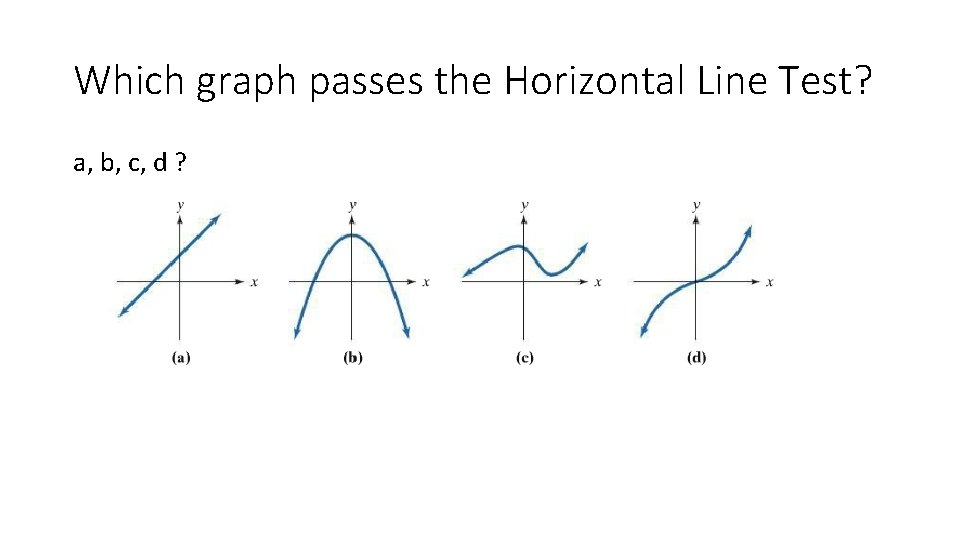
Which graph passes the Horizontal Line Test? a, b, c, d ?
Which graphs represent functions that have inverse function? Explain how you know.
Summary • Composite functions. • Inverse functions. • Horizontal line test.