Diffusion of radiation damage in Fe and FeP





- Slides: 18
Diffusion of radiation damage in Fe and Fe–P systems Stewart Gordon Loughborough University, UK
Introduction } } Collision cascade – result of radiation damage Classical MD of limited timescale Problem: to predict what will happen in the long run Key: discovering the state transitions
The dimer method – 1 Algorithm to find saddle points on a potential surface } System of N atoms – 3 N-dimensional potential surface } No need to guide – exceeds limitations of molecular statics } Previously applied to surface diffusion }
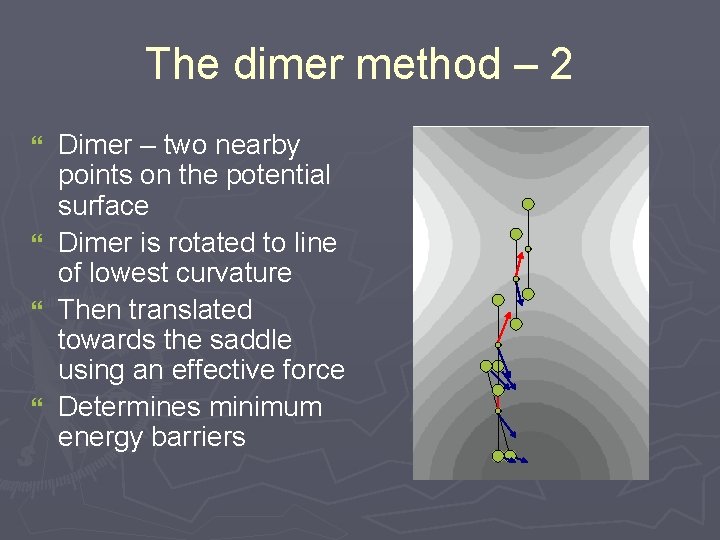
The dimer method – 2 } } Dimer – two nearby points on the potential surface Dimer is rotated to line of lowest curvature Then translated towards the saddle using an effective force Determines minimum energy barriers
Methodology – 1 } } } Fe bcc lattice size: 143 unit cells Isolated defects Total number of atoms: 9827 Relaxed using damped MD Cubic region defines range of moving atoms
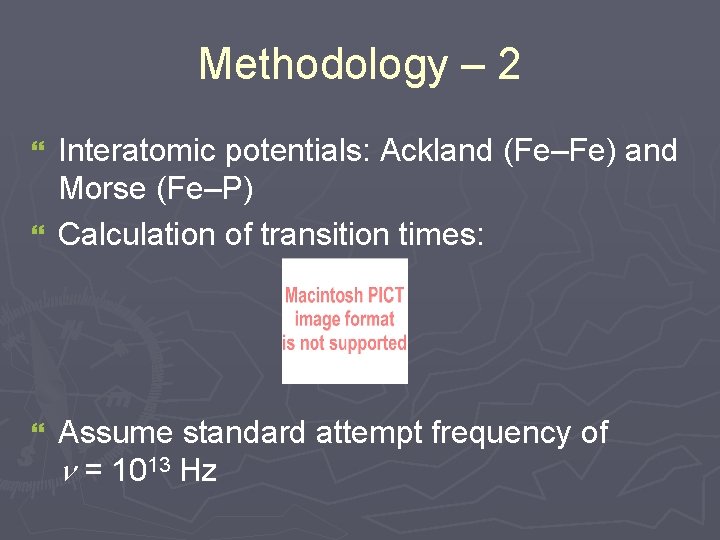
Methodology – 2 Interatomic potentials: Ackland (Fe–Fe) and Morse (Fe–P) } Calculation of transition times: } } Assume standard attempt frequency of n = 1013 Hz
Fe self-interstitial structure } } } Fe bcc lattice Defect: 110 dumbbell Most common defect in collision cascades Fe atom on lattice site Fe interstitial atom Vacancy
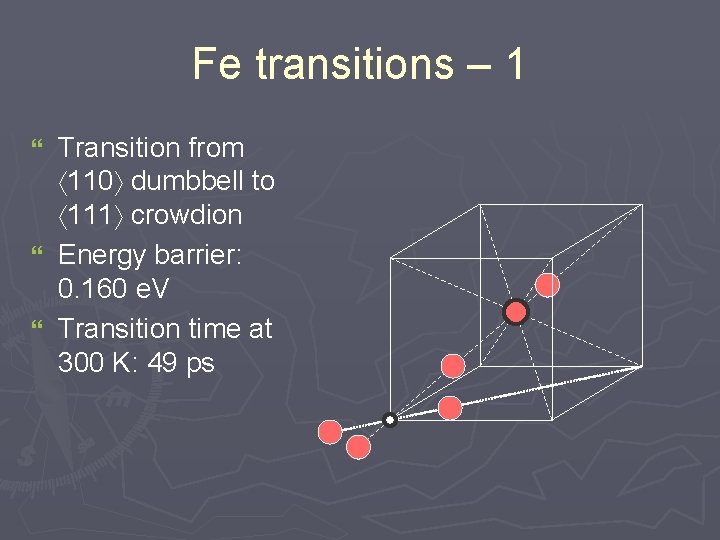
Fe transitions – 1 Transition from 110 dumbbell to 111 crowdion } Energy barrier: 0. 160 e. V } Transition time at 300 K: 49 ps }
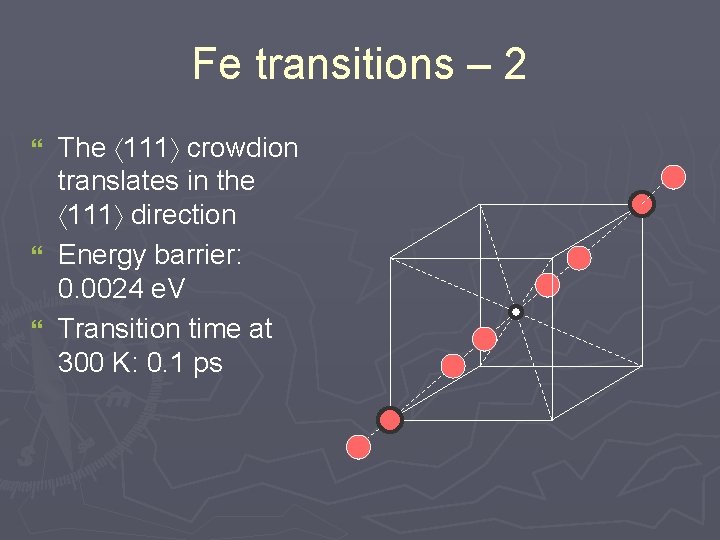
Fe transitions – 2 The 111 crowdion translates in the 111 direction } Energy barrier: 0. 0024 e. V } Transition time at 300 K: 0. 1 ps }
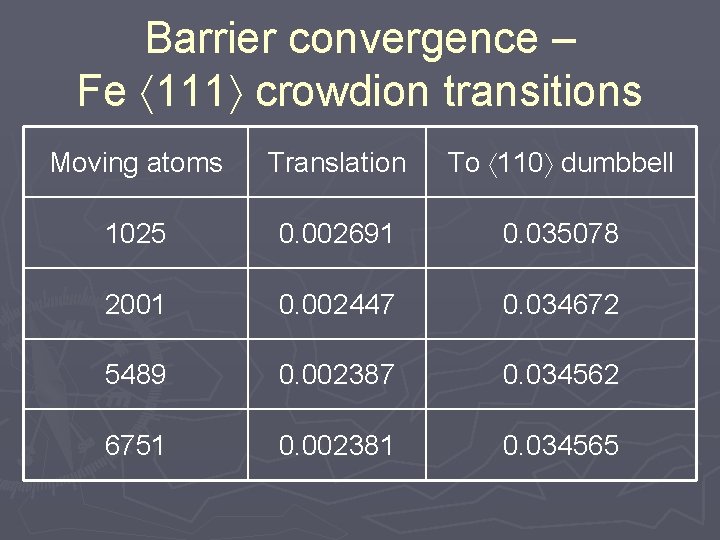
Barrier convergence – Fe 111 crowdion transitions Moving atoms Translation To 110 dumbbell 1025 0. 002691 0. 035078 2001 0. 002447 0. 034672 5489 0. 002387 0. 034562 6751 0. 002381 0. 034565
Fe diffusion mechanism 110 dumbbell changes to 111 crowdion – controlling transition } Crowdion then translates } Returns to 110 dumbbell } Can then explore other 111 directions }
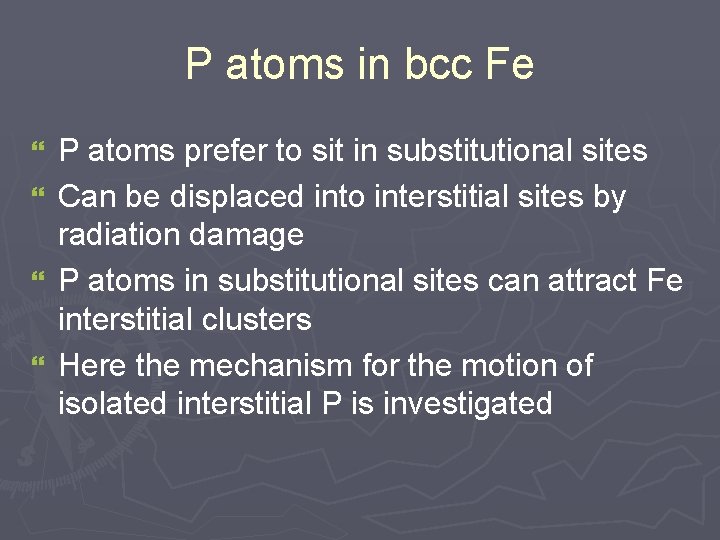
P atoms in bcc Fe } } P atoms prefer to sit in substitutional sites Can be displaced into interstitial sites by radiation damage P atoms in substitutional sites can attract Fe interstitial clusters Here the mechanism for the motion of isolated interstitial P is investigated
P interstitial defect in Fe 110 Fe–P dumbbell } Some very different diffusion mechanisms to be seen } Fe atom on lattice site Fe interstitial atom P interstitial atom Vacancy
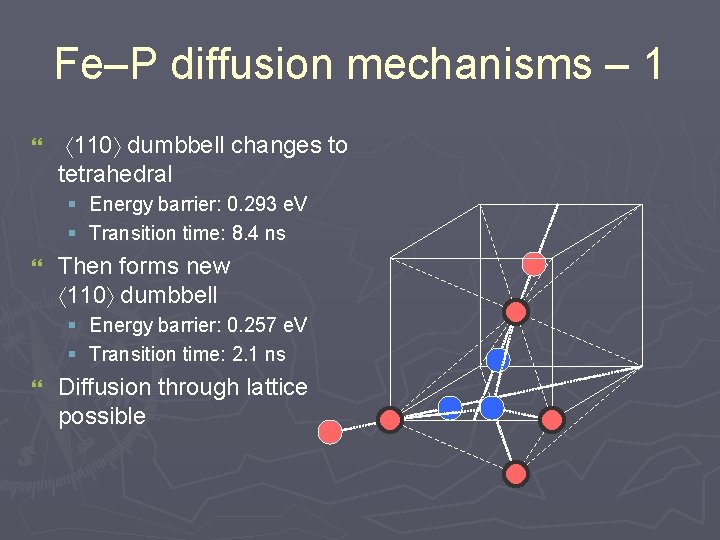
Fe–P diffusion mechanisms – 1 } 110 dumbbell changes to tetrahedral § Energy barrier: 0. 293 e. V § Transition time: 8. 4 ns } Then forms new 110 dumbbell § Energy barrier: 0. 257 e. V § Transition time: 2. 1 ns } Diffusion through lattice possible
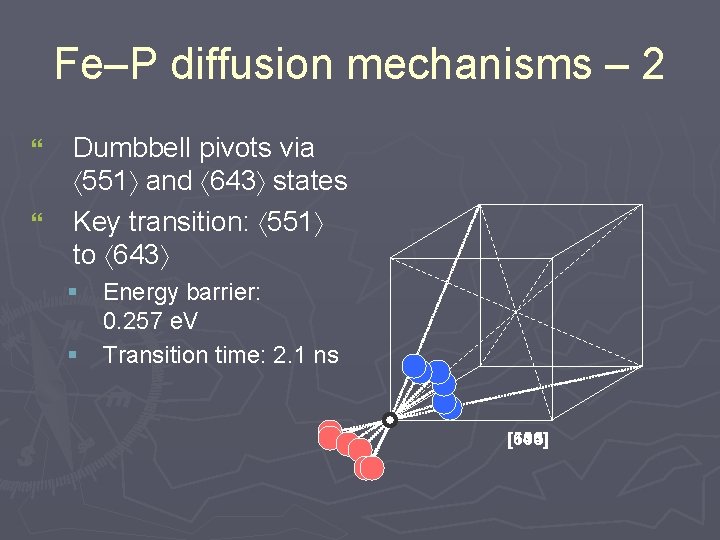
Fe–P diffusion mechanisms – 2 } } Dumbbell pivots via 551 and 643 states Key transition: 551 to 643 § Energy barrier: 0. 257 e. V § Transition time: 2. 1 ns [110] [101] [515] [634] [643] [551]
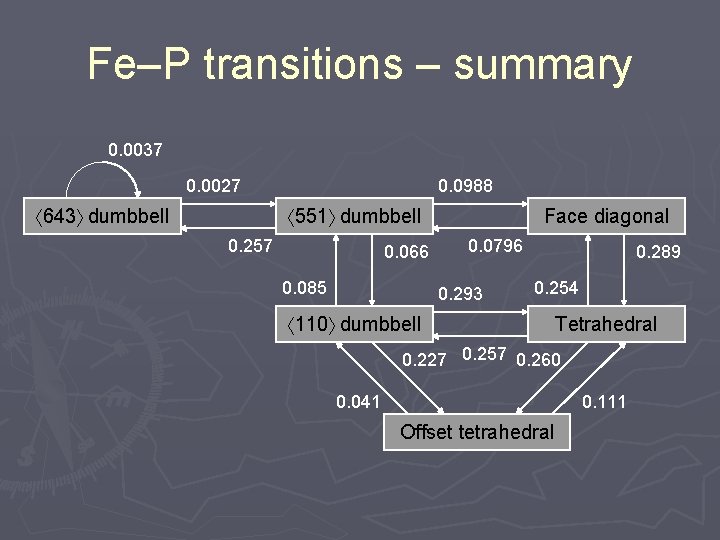
Fe–P transitions – summary 0. 0037 0. 0027 643 dumbbell 0. 0988 551 dumbbell 0. 257 0. 066 0. 085 Face diagonal 0. 0796 0. 293 0. 289 0. 254 110 dumbbell Tetrahedral 0. 227 0. 257 0. 260 0. 041 0. 111 Offset tetrahedral
Conclusions } Dimer method can be applied to bulk problems § More moving atoms needed than for surfaces Unusual transitions can be identified } Diffusion mechanisms for P in Fe have been determined }
Fadeout slide