Developing a Sand Dust Storm Warning Advisory and

- Slides: 25
Developing a Sand & Dust Storm Warning Advisory and Assessment System (SDSWAS) in Asia Node Zhou Qing Liang(Shi Lijuan) CMA 31 Oct. 2016 1
OUTLINE • What’s SDS-WAS? ----Background • What we have done? ----Outcomes • What are we going to do? ----Procedure 2
OUTLINE • What’s SDS-WAS? ----Background • What we have done? ----Outcomes • What are we going to do? ----Procedure 3
Background Established in 2007 l. MISSION To achieve comprehensive, coordinated and sustained observations and modelling capabilities of sand dust storms l In order to • improve the monitoring of sand dust storms • increase the understanding of the dust processes • enhance dust prediction capabilities for mitigation of risks in many affected area (aviation, health impacts, etc. ). 4
Background l It is established as a federation of partners organized around regional nodes ü Northern Africa-Middle East-Europe Node --Spain ü Asian Node –China l Benefits The systematic NRT monitoring of sand dust storm will provide the Asia Node countries with useful information for sand dust storm risk mitigation l Key Regional Player China, Japan, Korea 5
OUTLINE • What’s SDS-WAS? ----Background • What we have done? ----Outcomes • What are we going to do? ----Procedure 6
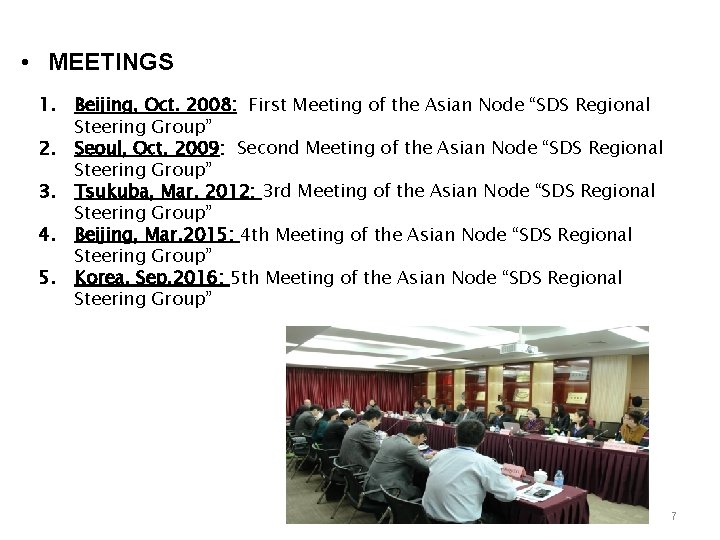
• MEETINGS 1. Beijing, Oct. 2008: First Meeting of the Asian Node “SDS Regional Steering Group” 2. Seoul, Oct. 2009: Second Meeting of the Asian Node “SDS Regional Steering Group” 3. Tsukuba, Mar. 2012: 3 rd Meeting of the Asian Node “SDS Regional Steering Group” 4. Beijing, Mar. 2015: 4 th Meeting of the Asian Node “SDS Regional Steering Group” 5. Korea, Sep. 2016: 5 th Meeting of the Asian Node “SDS Regional Steering Group” 7
• Outcomes of the 4 th WMO SDS-WAS Regional Steering Group for Asia 1. Application for RSMC-ASDF : Agreed to recommend the Asian-RC, hosted by CMA, to apply for the future RSMC-ASDF representing Asian Node, as suggested by all member countries. 8
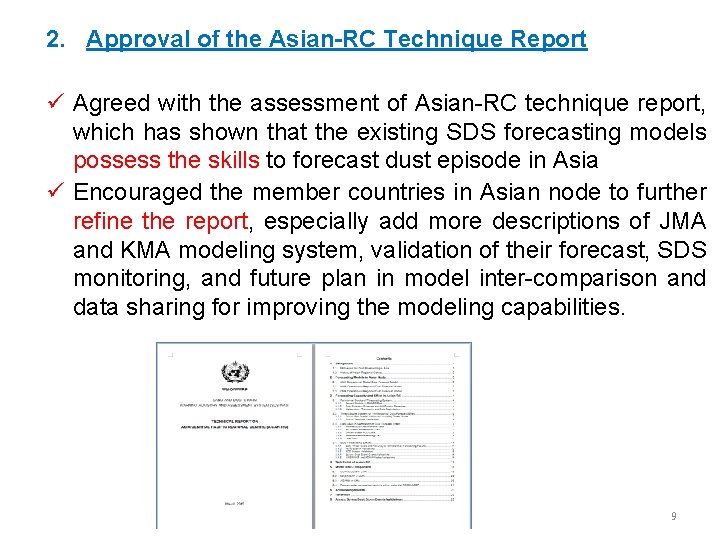
2. Approval of the Asian-RC Technique Report ü Agreed with the assessment of Asian-RC technique report, which has shown that the existing SDS forecasting models possess the skills to forecast dust episode in Asia ü Encouraged the member countries in Asian node to further refine the report, especially add more descriptions of JMA and KMA modeling system, validation of their forecast, SDS monitoring, and future plan in model inter-comparison and data sharing for improving the modeling capabilities. 9
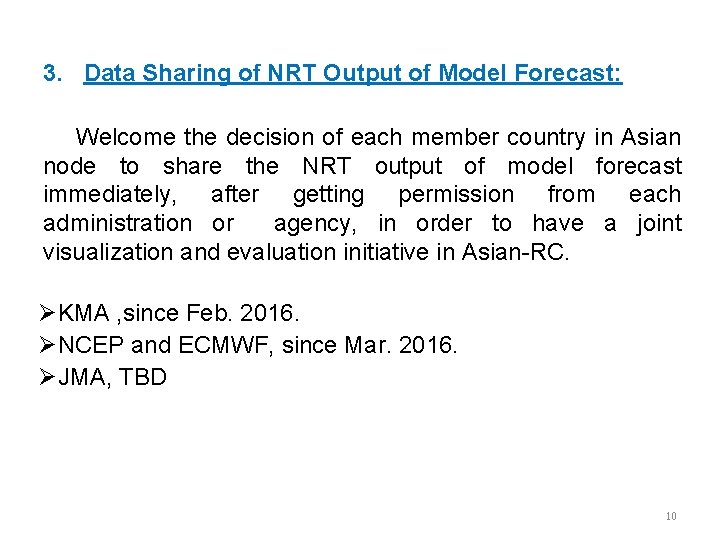
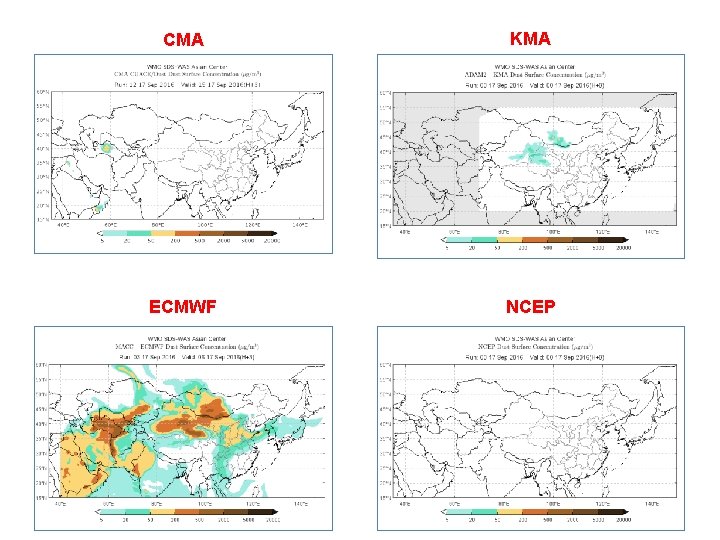
3. Data Sharing of NRT Output of Model Forecast: Welcome the decision of each member country in Asian node to share the NRT output of model forecast immediately, after getting permission from each administration or agency, in order to have a joint visualization and evaluation initiative in Asian-RC. ØKMA , since Feb. 2016. ØNCEP and ECMWF, since Mar. 2016. ØJMA, TBD 10
CMA KMA ECMWF NCEP 11
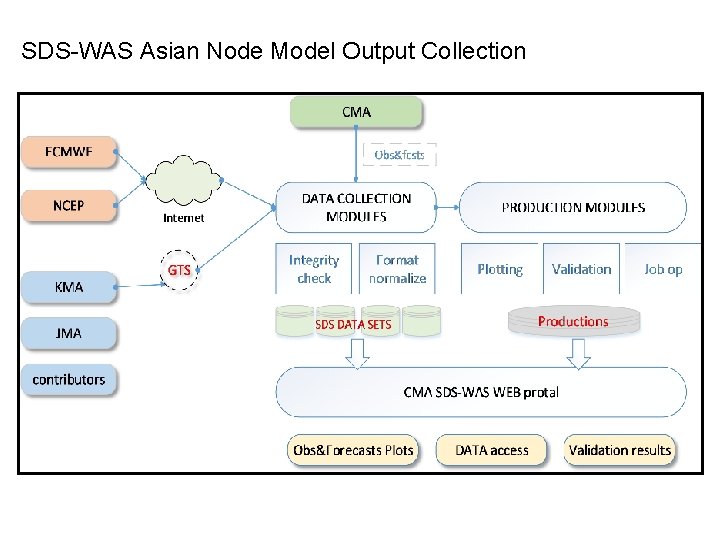
SDS-WAS Asian Node Model Output Collection
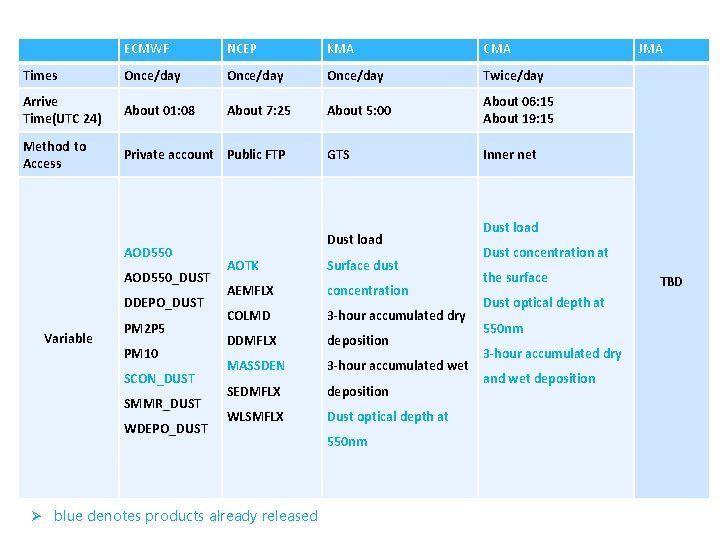
ECMWF NCEP KMA CMA Times Once/day Twice/day Arrive Time(UTC 24) About 01: 08 About 7: 25 About 5: 00 About 06: 15 About 19: 15 Method to Access Private account Public FTP GTS Inner net AOD 550_DUST DDEPO_DUST Variable PM 2 P 5 PM 10 SCON_DUST SMMR_DUST WDEPO_DUST Dust load AOTK Surface dust AEMFLX concentration COLMD 3 -hour accumulated dry DDMFLX deposition MASSDEN 3 -hour accumulated wet SEDMFLX deposition WLSMFLX Dust optical depth at Ø blue denotes products already released 550 nm JMA Dust load Dust concentration at the surface Dust optical depth at 550 nm 3 -hour accumulated dry and wet deposition TBD
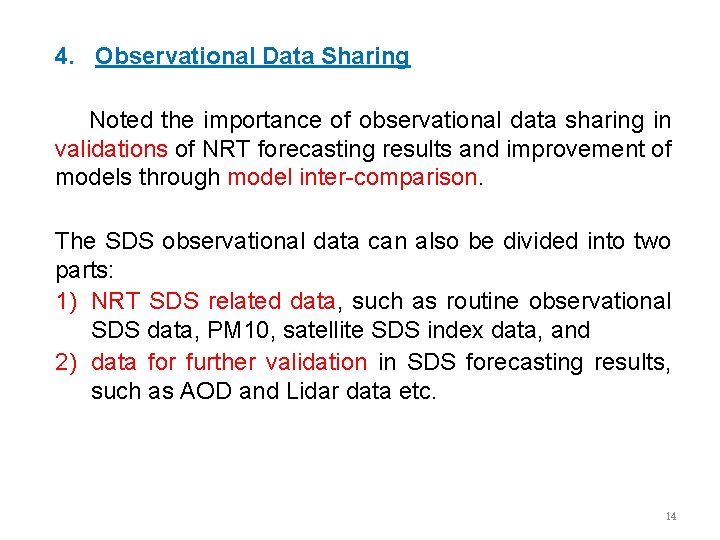
4. Observational Data Sharing Noted the importance of observational data sharing in validations of NRT forecasting results and improvement of models through model inter-comparison. The SDS observational data can also be divided into two parts: 1) NRT SDS related data, such as routine observational SDS data, PM 10, satellite SDS index data, and 2) data for further validation in SDS forecasting results, such as AOD and Lidar data etc. 14
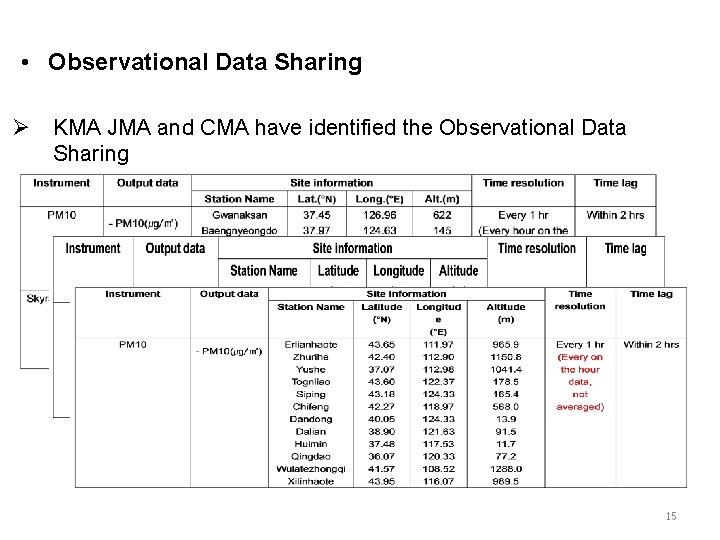
• Observational Data Sharing Ø KMA JMA and CMA have identified the Observational Data Sharing 15
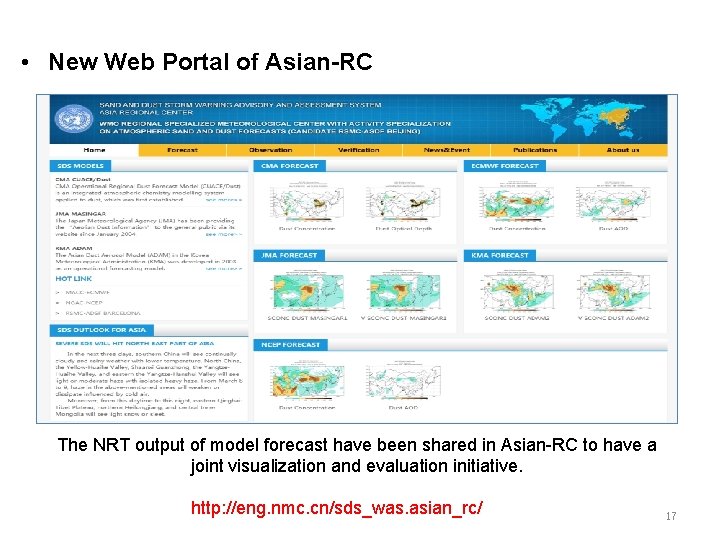
5. New Web Portal of Asian-RC: l Expressed appreciation for the new Regional Node Center Web Portal which now has an updated and general structure for joint visualization and evaluation initiative, and further validation, model inter-comparison and data sharing l agreed that the web portal should serve as the major platform for Asian-RC to support the activities of regional node center to be designated as a RSMC-ASDF BEIJING in future. 16
• New Web Portal of Asian-RC The NRT output of model forecast have been shared in Asian-RC to have a joint visualization and evaluation initiative. http: //eng. nmc. cn/sds_was. asian_rc/ 17
6. Model Inter-comparison Welcomed the interest of members to continue work with model inter-comparisons in order to improve the models’ forecast capability under the support, which may expand cooperation into the area of environmental prediction of such elements as haze, fog and air quality in future. 18
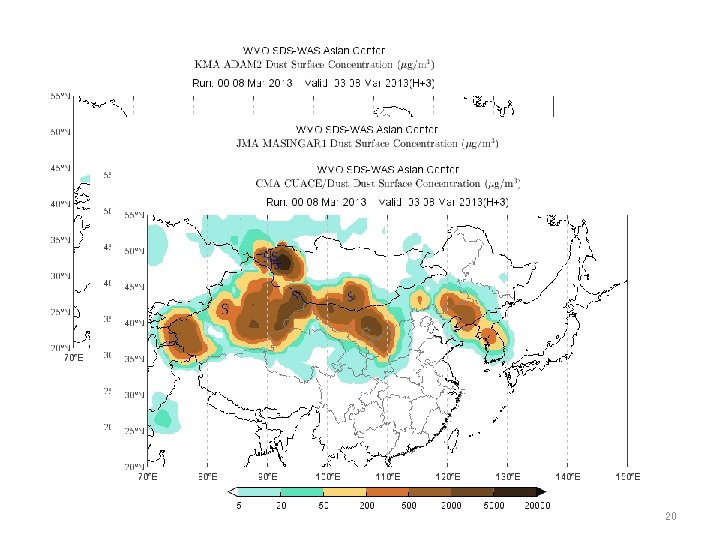
• Model Inter-Comparison Ø KMA JMA and CMA Model Inter-Comparison for 2013 has been conducted Ø NECP ECMWF KMA and CMA model forecasts validation for 2016 has been finished 19
20
OUTLINE • What’s SDS-WAS? ----Background • What we have done? ----Outcomes • What are we going to do? ----Procedure 21
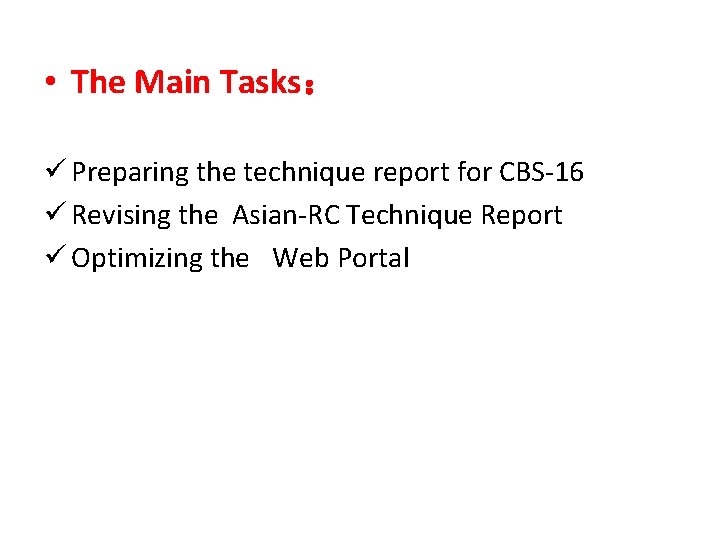
• The Main Tasks: ü Preparing the technique report for CBS-16 ü Revising the Asian-RC Technique Report ü Optimizing the Web Portal
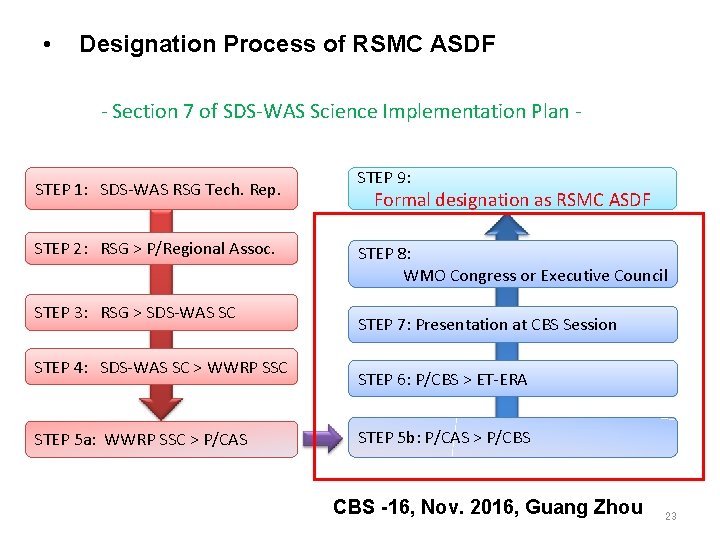
• Designation Process of RSMC ASDF - Section 7 of SDS-WAS Science Implementation Plan - STEP 1: SDS-WAS RSG Tech. Rep. STEP 2: RSG > P/Regional Assoc. STEP 3: RSG > SDS-WAS SC STEP 4: SDS-WAS SC > WWRP SSC STEP 5 a: WWRP SSC > P/CAS STEP 9: Formal designation as RSMC ASDF STEP 8: WMO Congress or Executive Council STEP 7: Presentation at CBS Session STEP 6: P/CBS > ET-ERA STEP 5 b: P/CAS > P/CBS -16, Nov. 2016, Guang Zhou 23
Transition to operational activities good example Operation” of “Research to 24
Thank you ! 25