Develop Americas Airmen Today for Tomorrow Systems Engineering
- Slides: 29
Develop America's Airmen Today. . . for Tomorrow Systems Engineering Case Studies Charles M. Garland Air Force Center for Systems Engineering (937) 255 -3355 x 3368 Charles. Garland@us. af. mil Dr John Colombi October 3, 2008 Dept of Systems and Engineering Mgt Air Force Institute of Technology
Agenda Develop America's Airmen Today. . . for Tomorrow § Air Force Center for Systems Engineering § Case Studies § Case Framework/ Approach § Learning Principles § Teaching Systems Engineering Cases
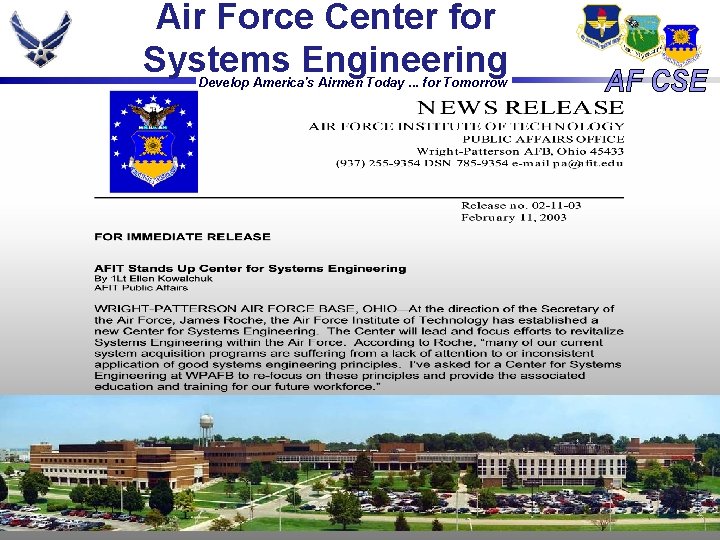
Air Force Center for Systems Engineering Develop America's Airmen Today. . . for Tomorrow
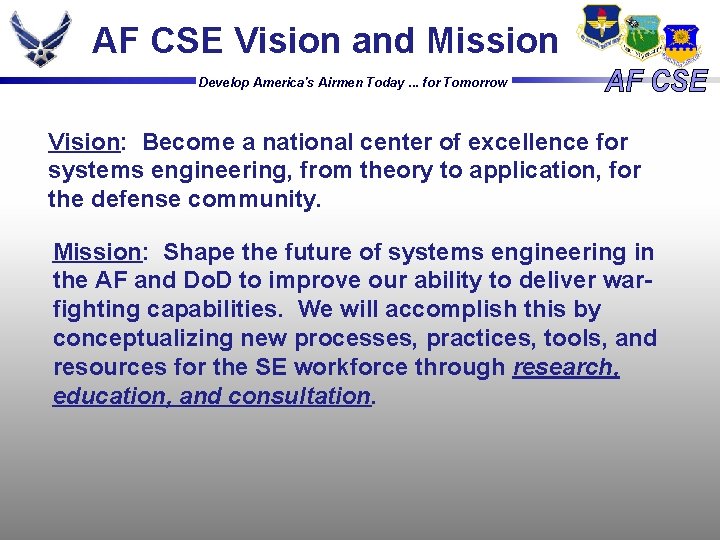
AF CSE Vision and Mission Develop America's Airmen Today. . . for Tomorrow Vision: Become a national center of excellence for systems engineering, from theory to application, for the defense community. Mission: Shape the future of systems engineering in the AF and Do. D to improve our ability to deliver warfighting capabilities. We will accomplish this by conceptualizing new processes, practices, tools, and resources for the SE workforce through research, education, and consultation.
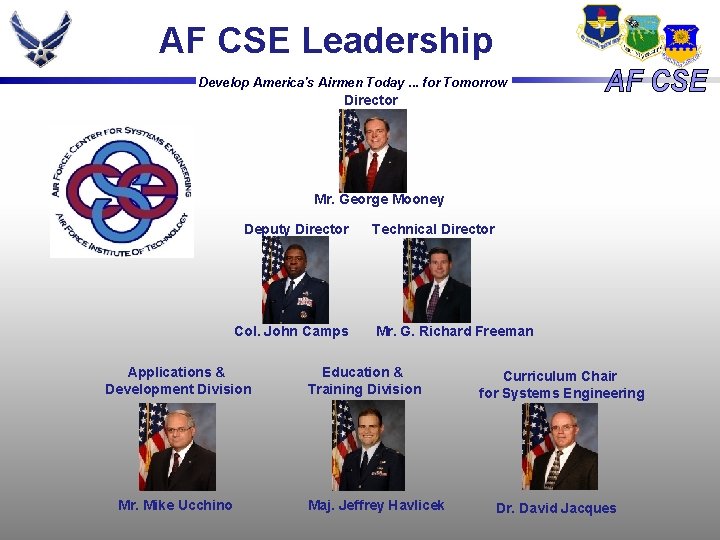
AF CSE Leadership Develop America's Airmen Today. . . for Tomorrow Director Mr. George Mooney Deputy Director Col. John Camps Applications & Development Division Mr. Mike Ucchino Technical Director Mr. G. Richard Freeman Education & Training Division Maj. Jeffrey Havlicek Curriculum Chair for Systems Engineering Dr. David Jacques
Systems Engineering Case Studies Develop America's Airmen Today. . . for Tomorrow § Began under the academic oversight of a Subcommittee on Systems Engineering to the Air University Board of Visitors § Chaired by Air Force Chief Scientist Dr. Alex Levis § Selected four programs for initial case studies (Hubble Space Telescope, Theater Battle Management Core System, F-111, and C-5) § AF CSE Strategic Plan for Case Studies § Five year plan updated every three years § Identified, evaluated, and prioritized candidate programs
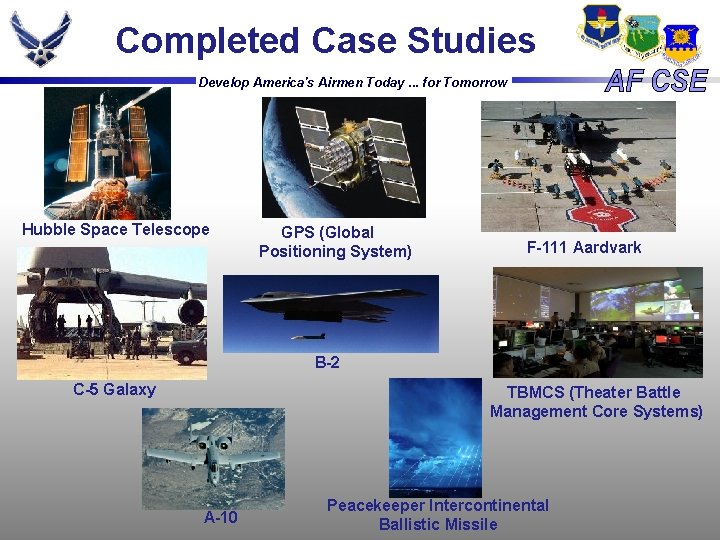
Completed Case Studies Develop America's Airmen Today. . . for Tomorrow Hubble Space Telescope GPS (Global Positioning System) F-111 Aardvark B-2 C-5 Galaxy TBMCS (Theater Battle Management Core Systems) A-10 Peacekeeper Intercontinental Ballistic Missile
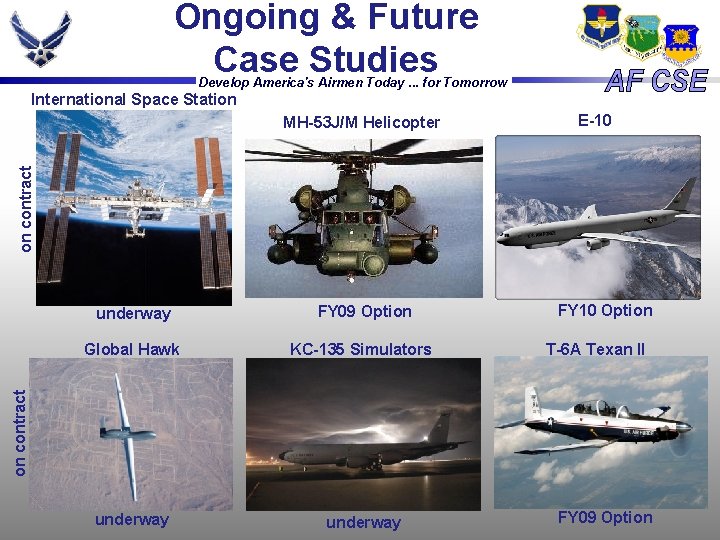
Ongoing & Future Case Studies Develop America's Airmen Today. . . for Tomorrow International Space Station E-10 on contract MH-53 J/M Helicopter FY 09 Option Global Hawk KC-135 Simulators underway FY 10 Option T-6 A Texan II on contract underway FY 09 Option
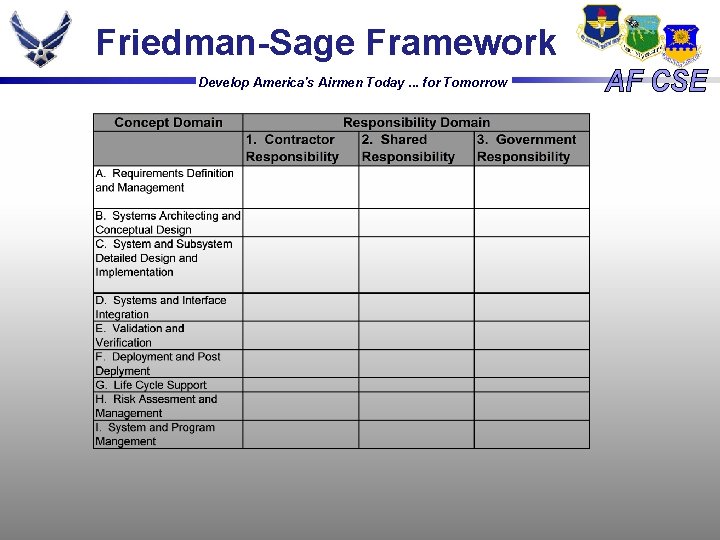
Friedman-Sage Framework Develop America's Airmen Today. . . for Tomorrow § Based on student heuristics, developed by: § Dr George Friedman: University of Southern California § Dr Andy Sage: George Mason University § Comprised of 9 concept domains (rows) & 3 responsibility domains (columns) § Rows represent phases in SE life cycle & necessary process and systems management support § Columns depict responsibilities from both sides of the program (industry and government) § Derived into matrix - Identifies learning principles § Used to organize the case writing * Case Studies of Systems Engineering and Management in Systems Acquisition. Systems Engineering, Vol. 7, No. 1, 2004
Friedman-Sage Framework Develop America's Airmen Today. . . for Tomorrow
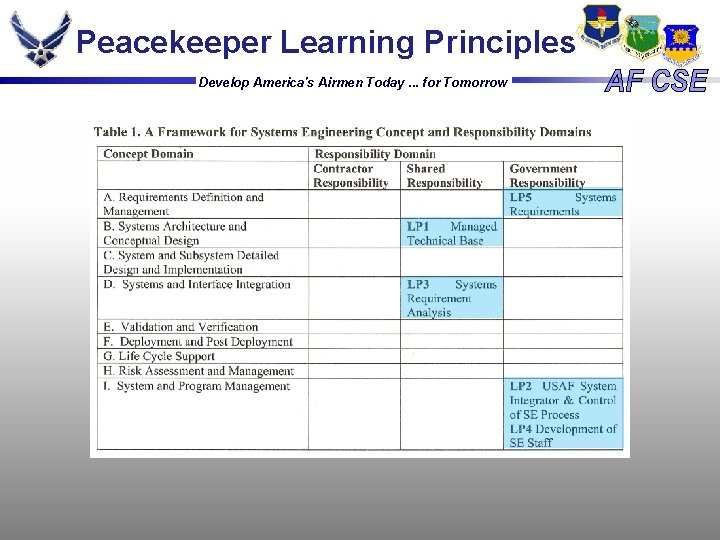
Peacekeeper Learning Principles Develop America's Airmen Today. . . for Tomorrow
Peacekeeper LP 1 Develop America's Airmen Today. . . for Tomorrow Development commands must manage their technology base to optimize progress over several programs. § Ballistic Missile Office (BMO) developed and managed a technology base that spanned several programs § Atlas, Titan, Minuteman, Peacekeeper and Small ICBM § This matured technologies such as: § Solid rocket propellants § Nozzle manufacture § Liquid fueled engines § Guidance systems
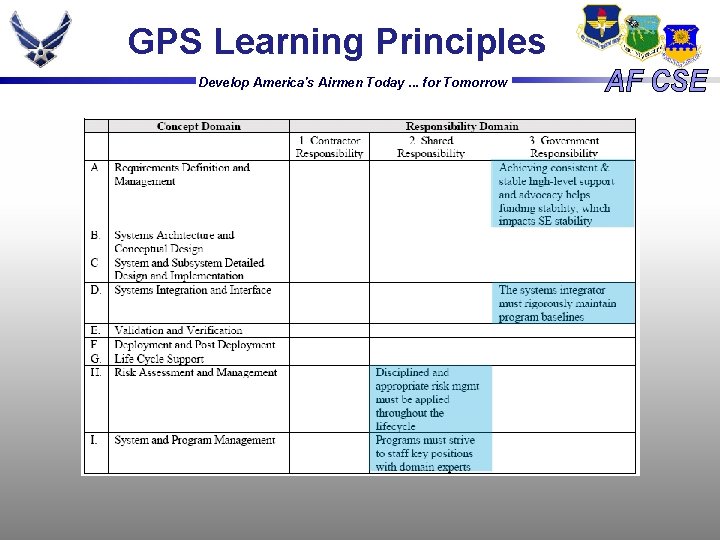
GPS Learning Principles Develop America's Airmen Today. . . for Tomorrow
GPS Learning Principle 2 Develop America's Airmen Today. . . for Tomorrow The systems integrator must rigorously maintain program baselines § Joint Program Office (JPO) retained the role of managing and controlling the systems specification § This allowed control of functional baseline § JPO derived and constructed an “agreed-to” set of systems requirements that became the program baseline § Performance/Risk/Cost trade studies against functional baseline § Interface Control Working Group managed the functional requirements of the allocated baseline § Processes gave JPO first-hand knowledge and insight into risks at lowest level
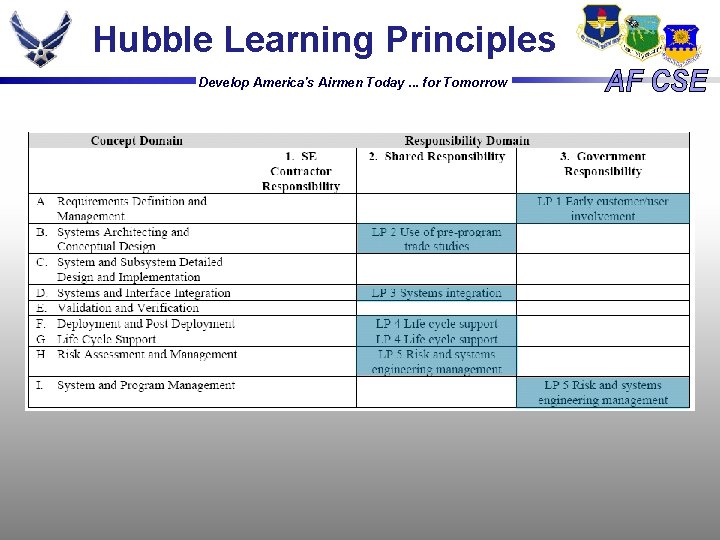
Hubble Learning Principles Develop America's Airmen Today. . . for Tomorrow
Hubble Learning Principle Develop America's Airmen Today. . . for Tomorrow For complex programs, the number of players (government and contractor) demands that the program be structured to cope with high risk factors in many management and technical areas § Contractors Lockheed (LMSC) and Perkin-Elmer (P-E) “owned” very significant and unique program risk areas § LM was the overall integrator § P-E was the technical expert in the critical optical system § Lack of insight into quality assurance led directly to the primary mirror defects, in spite of substantial evidence otherwise
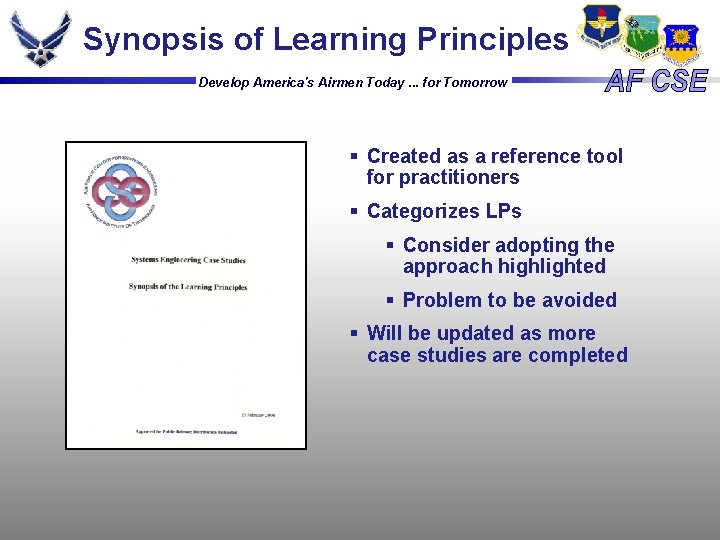
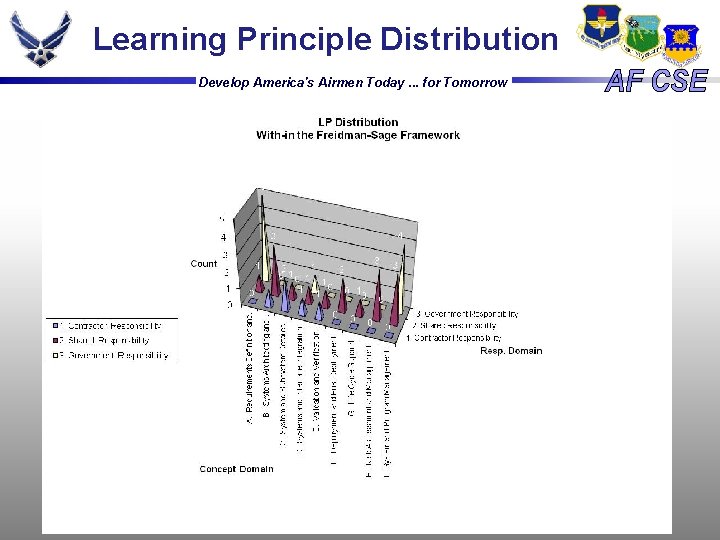
Synopsis of Learning Principles Develop America's Airmen Today. . . for Tomorrow § Created as a reference tool for practitioners § Categorizes LPs § Consider adopting the approach highlighted § Problem to be avoided § Will be updated as more case studies are completed
Learning Principle Distribution Develop America's Airmen Today. . . for Tomorrow
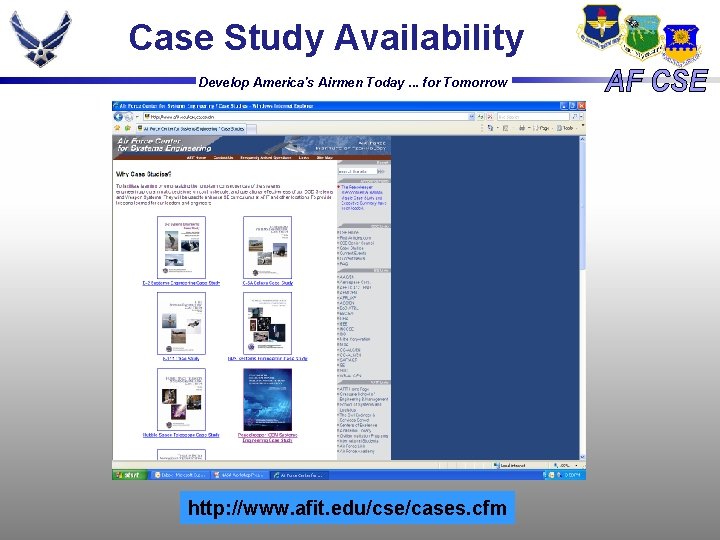
Case Study Availability Develop America's Airmen Today. . . for Tomorrow http: //www. afit. edu/cse/cases. cfm
Case Study Audience? Develop America's Airmen Today. . . for Tomorrow § Support teaching of Systems Engineering principles § Systems engineering/ programmatic decisions § Operational effectiveness § Processes, principles, tools § Decision material § Highlight the importance of skills from multiple functional areas, including multiple engineering disciplines § Audience – students in a classroom? § Audience – practitioners (engineers/management) throughout the organization? § Can a single case address both?
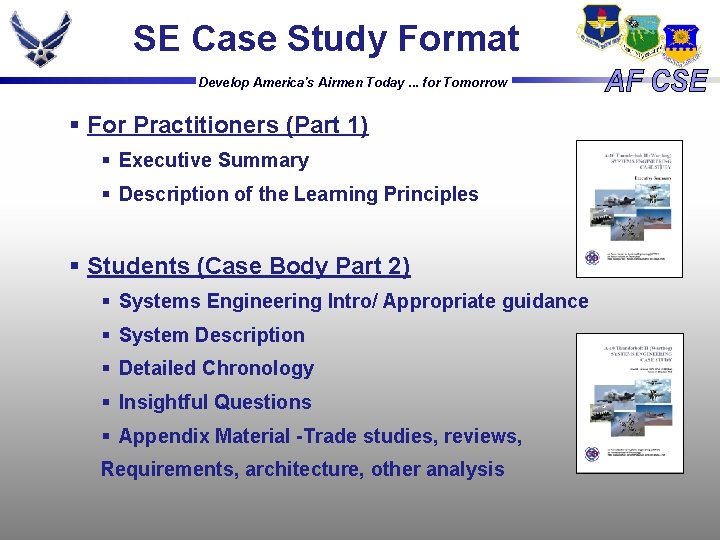
SE Case Study Format Develop America's Airmen Today. . . for Tomorrow § Format is different for the audience § Students § Typical Harvard Business School case § Chronologic story emphasizing decision making § Shorter length of typically 10 -30 pages § No “answers”, guided discussion and personal discovery § Practitioners § Executive Summary § Detailed treatment of Systems Engineering activity § What to avoid - What to emphasize/apply § We attempt to blend both
SE Case Study Format Develop America's Airmen Today. . . for Tomorrow § For Practitioners (Part 1) § Executive Summary § Description of the Learning Principles § Students (Case Body Part 2) § Systems Engineering Intro/ Appropriate guidance § System Description § Detailed Chronology § Insightful Questions § Appendix Material -Trade studies, reviews, Requirements, architecture, other analysis
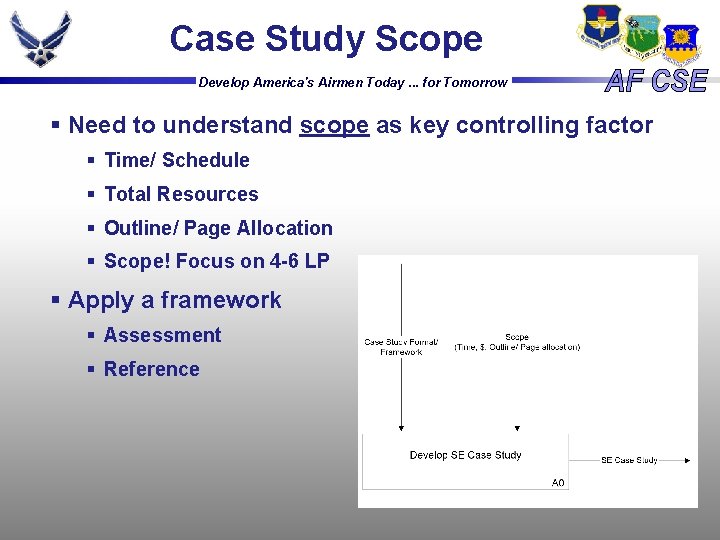
Case Study Scope Develop America's Airmen Today. . . for Tomorrow § Need to understand scope as key controlling factor § Time/ Schedule § Total Resources § Outline/ Page Allocation § Scope! Focus on 4 -6 LP § Apply a framework § Assessment § Reference
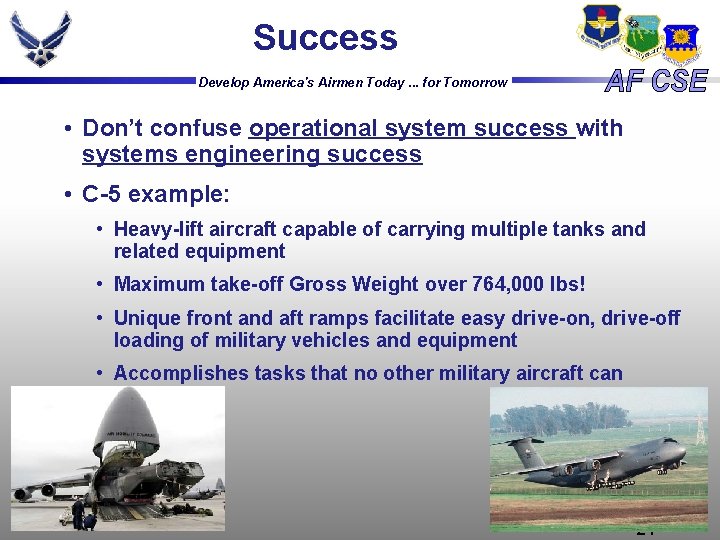
Success Develop America's Airmen Today. . . for Tomorrow • Don’t confuse operational system success with systems engineering success • C-5 example: • Heavy-lift aircraft capable of carrying multiple tanks and related equipment • Maximum take-off Gross Weight over 764, 000 lbs! • Unique front and aft ramps facilitate easy drive-on, drive-off loading of military vehicles and equipment • Accomplishes tasks that no other military aircraft can 24
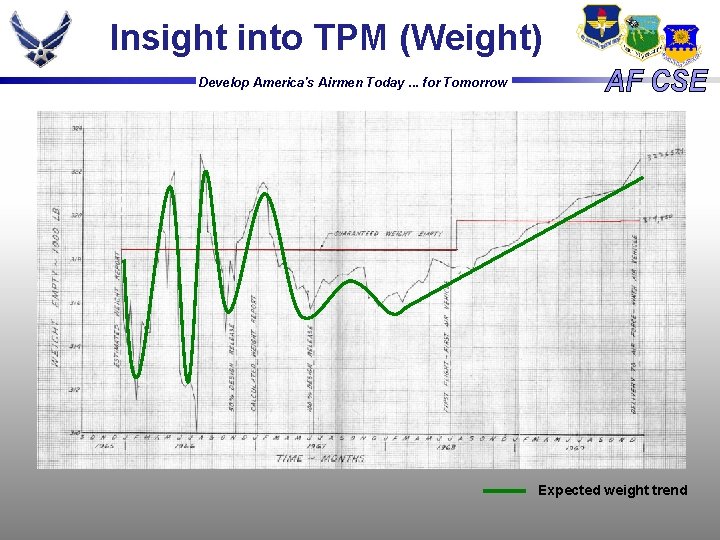
C-5 Success Synopsis Develop America's Airmen Today. . . for Tomorrow So while a very successful operational aircraft, but § LP #2. Total Package Procurement Concept (TPPC) was a fixedprice, incentive fee contract strategy for the design, development, and production of 58 aircraft. § Invented to control cost growth – underlying cause for overruns § LP #3. A Weight Empty Guarantee was included in the specification and in the contract as a cost penalty for each delivered overweight aircraft. § Contract Penalty: $10, 000 per pound per delivered aircraft § Dominated the traditionally balanced requirements resulting in a major shortfalls in wing and pylon fatigue life § Negative effects of forcing (out-of-balance) one system parameter § Trend in forcing an aircraft from “nominal” weight
Insight into TPM (Weight) Develop America's Airmen Today. . . for Tomorrow Expected weight trend
Teaching* Develop America's Airmen Today. . . for Tomorrow § How best to teach (Systems Engineering)? § Wrong question § How best do students learn? § Student centered § Discussion based § Active Learning *Participant Centered Learning and the Case Method, Harvard Business School Publishing
Participant Centered Learning Develop America's Airmen Today. . . for Tomorrow § Harvard Business School Participant-Centered Learning and the Case Method § Typically a class will cover a 2 -3 key points (LPs) § No Lecturing § Students don’t have the LPs… need to discovery as a class § Students must apply course material together with experience § Listen to other students § Professor will elicit student participation § “How do you know that …? ” § “What do you think about …? ” “Why? ” § Professor questions, listens and responds § Organize responses, ask more questions, summarize
Summary Develop America's Airmen Today. . . for Tomorrow § Feedback suggests these can be very effective to support Graduate and Continuous Learning courses § Provide real-world, well-known examples § Target an organization / domain § Do. D examples for Do. D students § NASA examples for NASA students § Provide for practitioners and resident students § Use a student-led Case Study pedagogical approach