
Chapter 1 Marketing Today and Tomorrow Marketing Management







- Slides: 53
Chapter 1: Marketing Today and Tomorrow Marketing & Management Mrs. Piotrowski 1
SECTION 1: WHAT IS MARKETING? 2
Marketing Misconception Many people only think of advertising and selling when they think of marketing. Let’s prove them wrong… 3
Definition of Marketing is the creation and maintenance of satisfying exchange relationships. Huh? 4
A large consumer products company may introduce as many as 100 new products a year. On average, only 5% are successful. Why do you think this is? 5
Marketing is Everywhere • You see marketing every day… – Advertisements – Product transports – Market researchers • You are involved in marketing when you… – Make a purchase – Decide whether to pay with cash or credit – Pay to have an item shipped to your house 6
Understanding marketing concepts will help you… • Make better purchasing decisions. • Develop your leadership skills. • Learn skills needed for many highpaying careers. 7
Make a list of business activities you feel are examples of marketing. What jobs and careers could be related to these activities? 8
All Businesses Use Marketing Businesses directly involved in marketing: • Advertising agencies • Marketing research firms • Telemarketers Businesses with major marketing activities: • Retailers • Banks • Real estate agencies • Insurance agencies • Automobile dealers Businesses with limited marketing roles: • Law offices • Medical centers • Government agencies • Public utilities 9
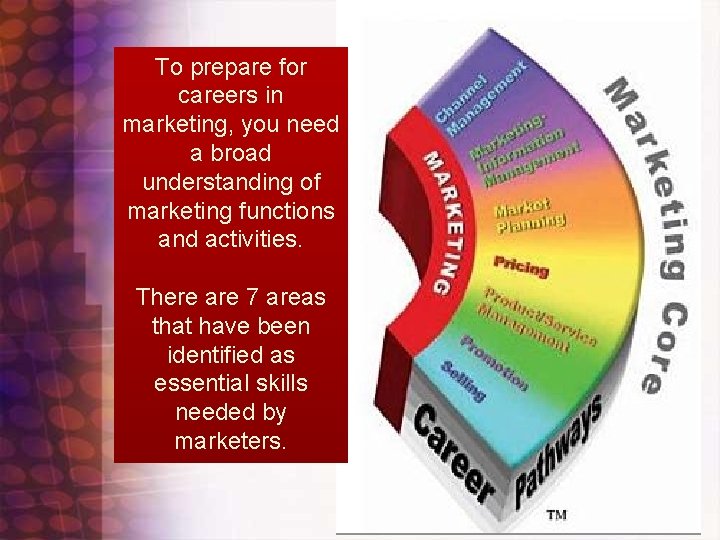
To prepare for careers in marketing, you need a broad understanding of marketing functions and activities. There are 7 areas that have been identified as essential skills needed by marketers. 10
Marketing Functions #1 Market Planning Identifying and understanding the markets a company wants to serve and developing effective marketing strategies for each market. EXAMPLE: Pepsi targets many different markets and diversifies their advertising to attract each market. 11
Marketing Functions #2 Product & Service Management Assisting in the design and development of products and services to meet the needs of prospective customers. EXAMPLE: Apple combined the technologies of an i. Pod, cell phone, and Internet browser to produce the i. Phone. 12
Marketing Functions #3 Distribution Determining the best methods and procedures to be used so prospective customers are able to locate, obtain, and use the products and services of an organization. EXAMPLE: Car rental companies pre-arrange rental agreements so everything is ready to go when the customer arrives. 13
Marketing Functions #4 Pricing Establishing and communicating the value of products and services to prospective customers. EXAMPLE: A home construction company offers customized decorating and furnishings included with a new build. 14
Marketing Functions #5 Promotion Communicating information to prospective customers through advertising and other promotional methods to encourage them to purchase the organization’s products and services. EXAMPLE: Colleges mail brochures to prospective students. 15
Marketing Functions #6 Selling Direct, personal communications with prospective customers in order to assess needs and satisfy those needs with appropriate products and services. EXAMPLE: Foot Locker posts a picture of Nike’s newest sneaker on its Facebook page and asks what customers think. 16
Marketing Functions #7 Marketing-Information Management Obtaining, managing, and using market information to improve decision making and the performance of marketing objectives. EXAMPLE: Use of electronic scanners at supermarket checkouts. 17
Marketing Functions #8 Financing Budgeting for necessary financing, and providing financial assistance to customers to assist them with purchasing products and services. EXAMPLE: Car manufacturers have their own financing organizations to provide loans to their customers. 18
Marketing Functions #9 Risk Management Providing security for products, personnel, and customers and reducing the risk associated with marketing decisions and activities. EXAMPLE: A credit card company seeking to shift their marketing message to small business owners' business needs. 19
SECTION 2: BUSINESS NEEDS MARKETING 20
Make a list of products you have purchased that you later found out were not what you expected. . LVE SO Why did you make the purchase? What did you do when you became dissatisfied? How do you think businesses could do a better job of satisfying customers in situations like yours? 21
Why does business need marketing? • To help them sell their product to more customers by: – Informing customers about their product’s existence – Informing customers where to buy their product – Determining customers’ needs and wants 22
The Need for Marketing • Some people believe that if a company has a good product, it doesn’t need marketing, however, if a customer does not know about the product, doesn’t know where to purchase it, is unable to get to the place where it is sold, cannot afford the price of the product, or does not believe the product is a good value, the product will not be purchased. 23
The Need for Marketing • Marketing cannot be successful if the product is not what the customer wants or is a poor quality product. If a product is purchased and the customer is unhappy with it, they will return it and/or if they don’t return it, it is unlikely the customer will buy the same product again. 24
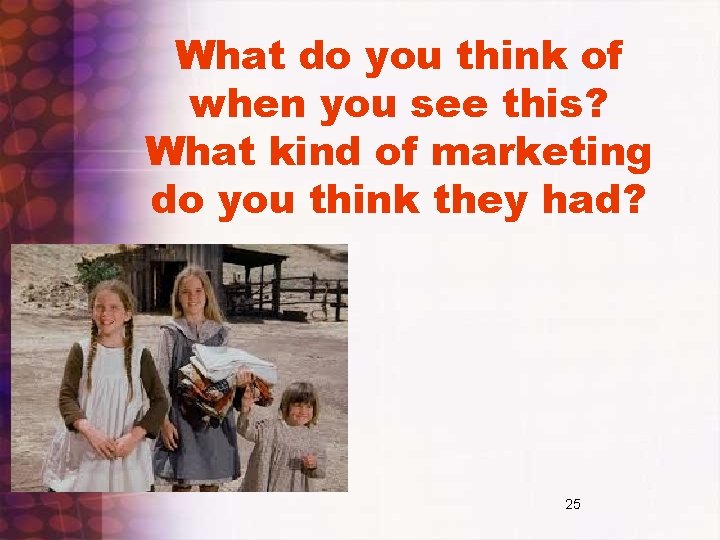
What do you think of when you see this? What kind of marketing do you think they had? 25
The Need for Marketing • The ways marketing is used have changed over the years, but the need for marketing has not. • Back in history, some people were selfsufficient where they made everything they needed by themselves. Often it wasn’t possible to obtain everything needed because of poor weather, competition with other people, sickness, or lack of skill. 26
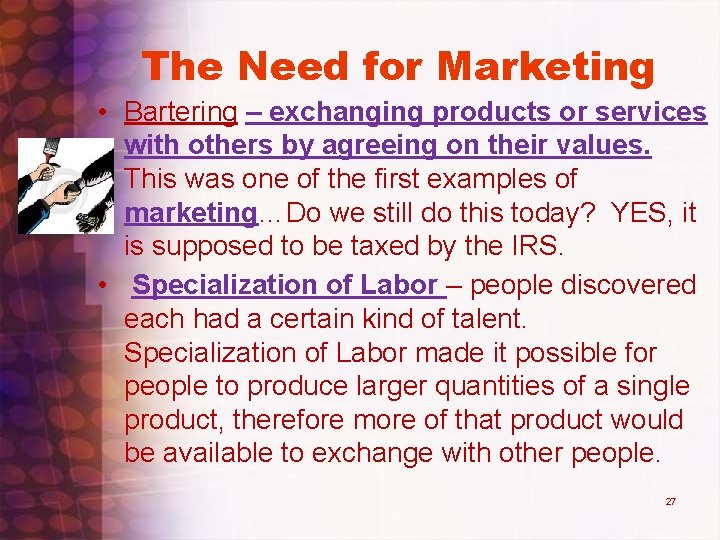
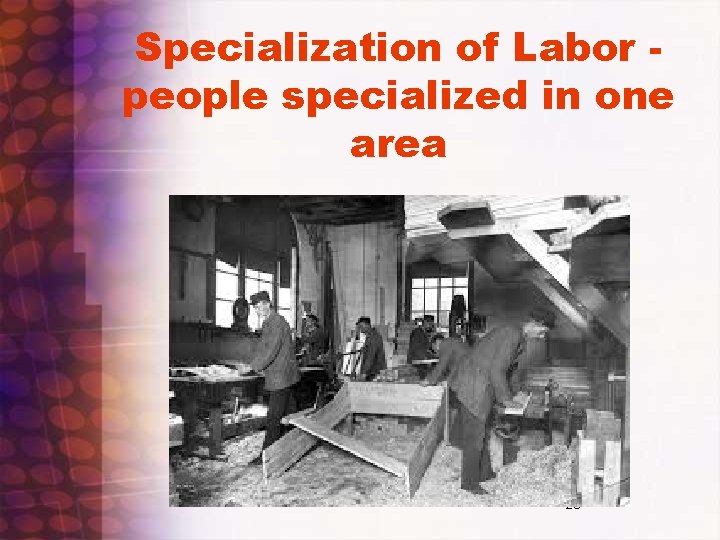
The Need for Marketing • Bartering – exchanging products or services with others by agreeing on their values. • This was one of the first examples of marketing…Do we still do this today? YES, it is supposed to be taxed by the IRS. • Specialization of Labor – people discovered each had a certain kind of talent. Specialization of Labor made it possible for people to produce larger quantities of a single product, therefore more of that product would be available to exchange with other people. 27
Specialization of Labor people specialized in one area 28
What if they didn’t want what the other offered? • That is whey the money system came about…. to assist with the exchange process. • Money Systems – this occurred because bartering wasn’t available. Not all people needed the products to reach agreement of what products were worth so that they could be exchanged directly. A money system established the use of currency as a recognized medium of exchange. 29
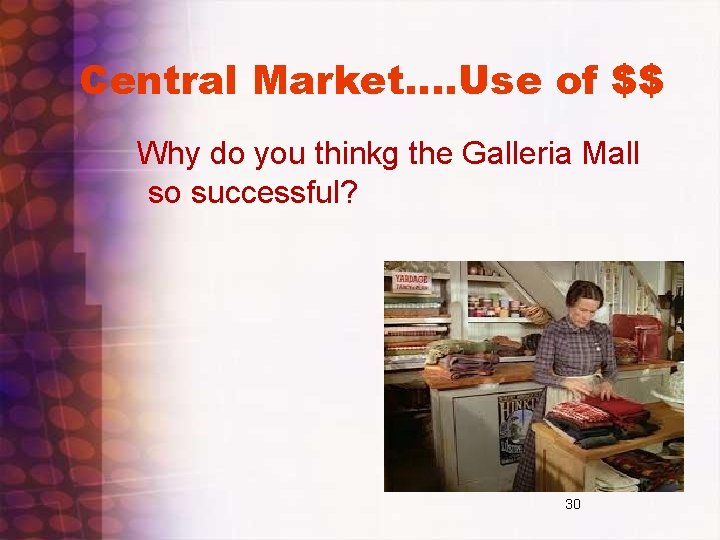
Central Market…. Use of $$ Why do you thinkg the Galleria Mall so successful? 30
Let’s look at page 4 of your workbook… Work you the person next to you to solve the bartering puzzle. 31
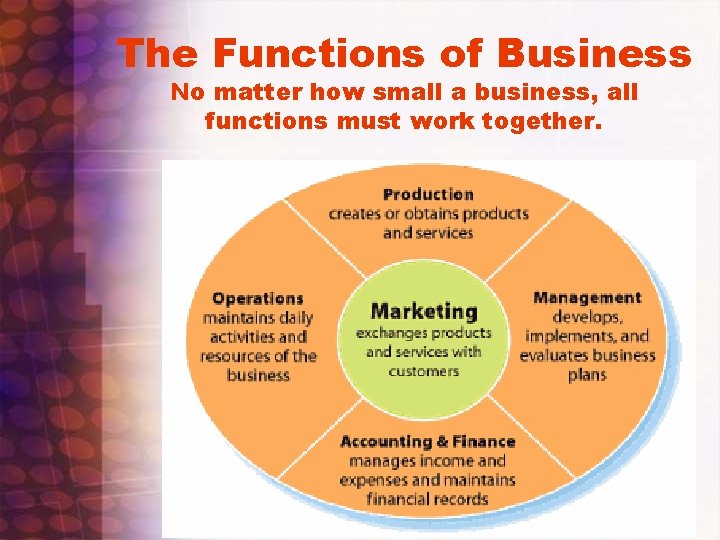
The Functions of Business No matter how small a business, all functions must work together. 32
Who failed in these examples? ? ? • Mighty Taco - Love their food, but the eating are is filthy. . . won’t go there anymore. . . they lost $$ –Operations. . cleaners, janitors 33
Who failed in these examples? ? ? • Panara Bread - Love their cinnamon crunch bagel, but at 3: 30 on the way home they don’t have any left. . . I don’t stop on way home anymore. . . they lost $$$ –Production - don’t make enough to last day 34
Who failed in these examples? ? ? • Kohl’s - I love shopping there, but whenever I get my bill it is wrong and it takes me 2 phone calls to fix it. . . I don’t shop there anymore. . . they lost $$ –Accounting/Financial Dept. . . do the billing correctly 35
Who failed in these examples? ? ? • Tops Supermarket - like the store, can’t stand the attitude on the cashiers and they are always asking me for donations. . . I shop at Wegmans. . . they lost $$ –Management - training of staff, managing objectives 36
The Functions of Business How can the lack of coordination among the business functions affect a company? 37
SECTION 3: UNDERSTANDING THE MARKETING CONCEPT 38
You are on the new product development team in the marketing department of a company. How will you identify what products your customers want to own? Once you know what the customer wants, how will you introduce the product to them? 39
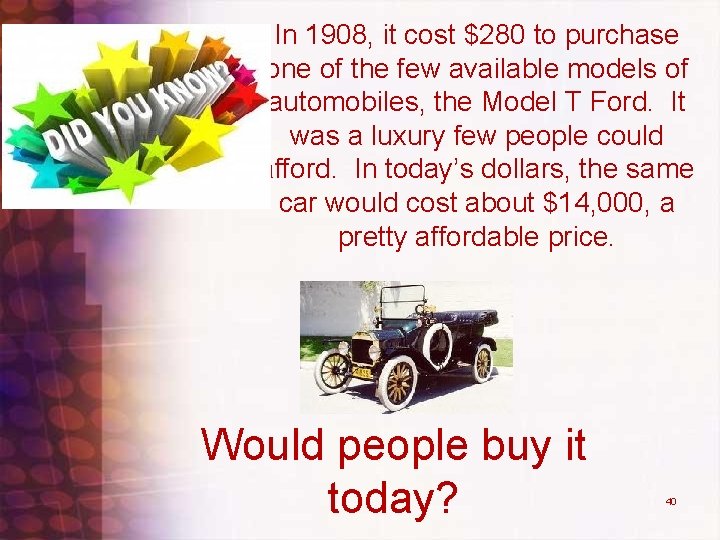
In 1908, it cost $280 to purchase one of the few available models of automobiles, the Model T Ford. It was a luxury few people could afford. In today’s dollars, the same car would cost about $14, 000, a pretty affordable price. Would people buy it today? 40
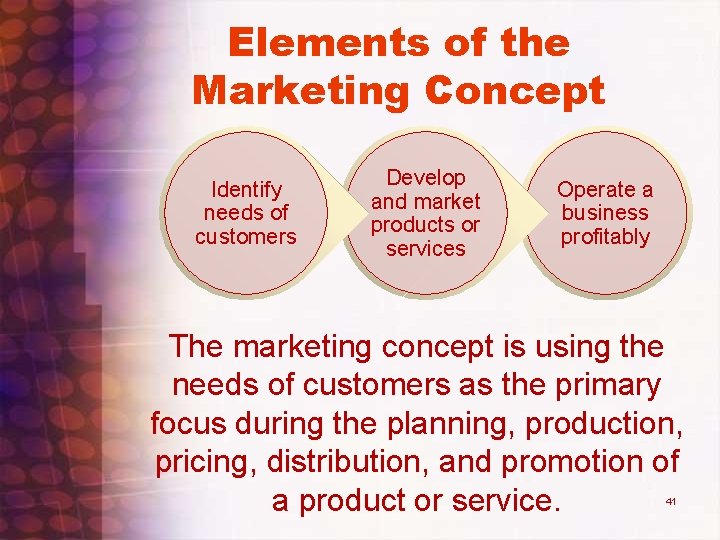
Elements of the Marketing Concept Identify needs of customers Develop and market products or services Operate a business profitably The marketing concept is using the needs of customers as the primary focus during the planning, production, pricing, distribution, and promotion of a product or service. 41
Identify the Market • The first step in implementing the marketing concept is to identify the market(s) the company wants to serve. – A market is a description of a unique group of prospective customers a business wants to serve, along with their location. 42
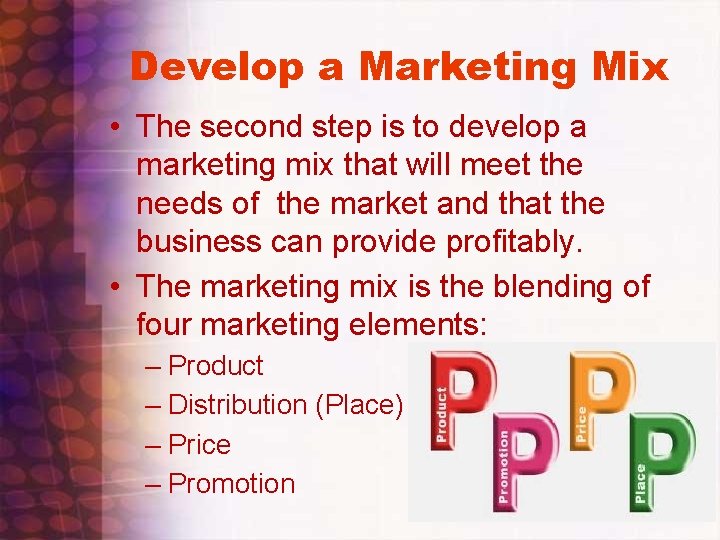
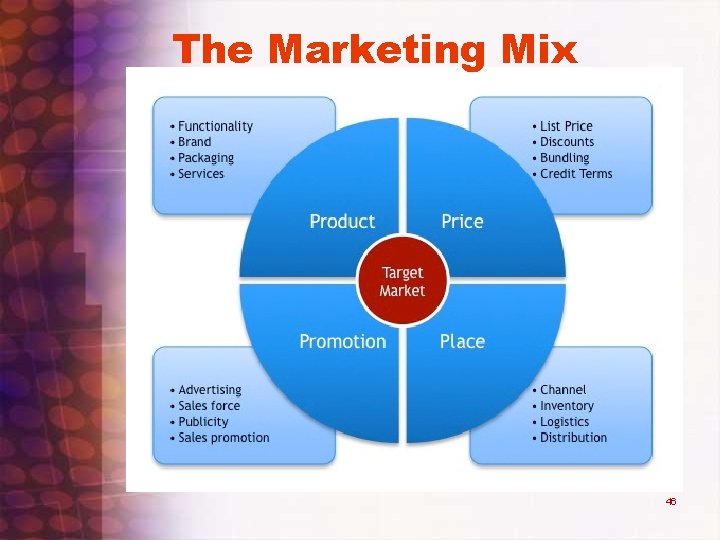
Develop a Marketing Mix • The second step is to develop a marketing mix that will meet the needs of the market and that the business can provide profitably. • The marketing mix is the blending of four marketing elements: – Product – Distribution (Place) – Price – Promotion 43
Elements of the Marketing Mix • PRODUCT – anything offered to a market by the business to satisfy needs, including physical products, services, and ideas. • DISTRIBUTION (PLACE) – includes the location and methods used to make the product available to customers. 44
Elements of the Marketing Mix • PRICE – the amount that customers pay and the methods of increasing the value of the product to the customers. • PROMOTION – the methods used and information communicated to encourage customers to purchase and to increase their satisfaction. 45
The Marketing Mix 46
SECTION 4: THE CHANGING ROLE OF MARKETING 47
Make a list of 3 non-business organizations. . LVE SO How can using marketing benefit these organizations? Identify 1 specific way that marketing functions can be used by each organization. 48
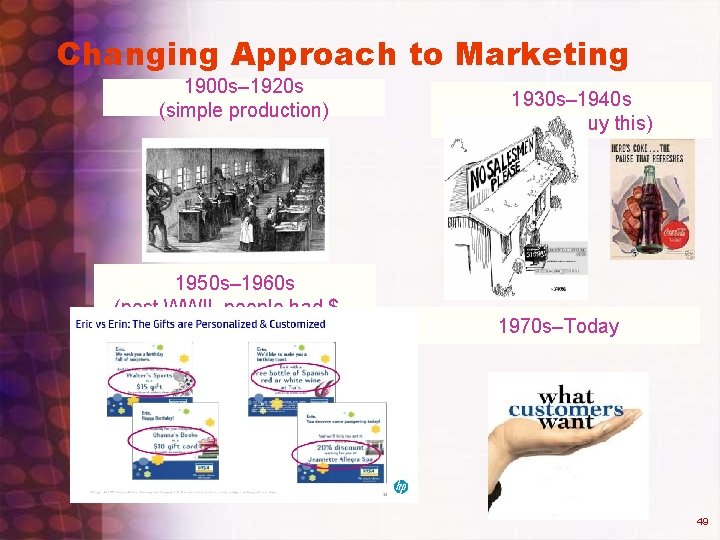
Changing Approach to Marketing 1900 s– 1920 s (simple production) 1950 s– 1960 s (post WWII. . people had $. . . Find a way to get them to buy with you) 1930 s– 1940 s (buy this, buy this) 1970 s–Today 49
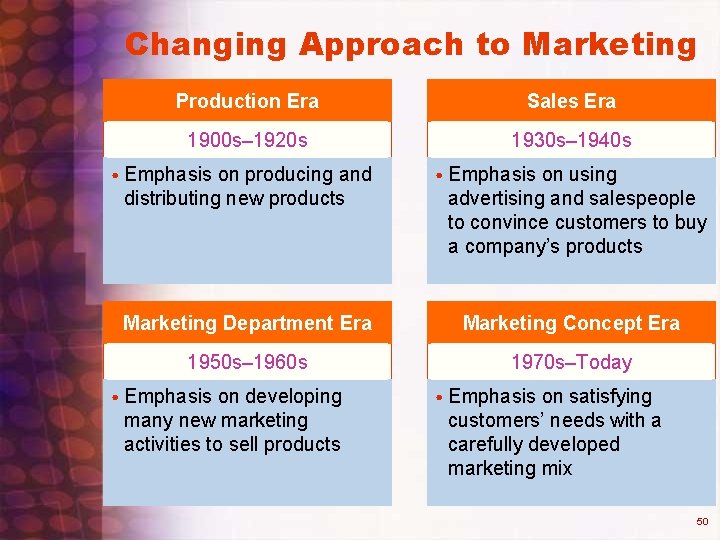
Changing Approach to Marketing Production Era Sales Era 1900 s– 1920 s 1930 s– 1940 s • Emphasis on producing and distributing new products • Emphasis on using advertising and salespeople to convince customers to buy a company’s products Marketing Department Era Marketing Concept Era 1950 s– 1960 s 1970 s–Today • Emphasis on developing many new marketing activities to sell products • Emphasis on satisfying customers’ needs with a carefully developed marketing mix 50
Make a list of companies or businesses you have made multiple purchases from. Why do you keep returning to these companies to make purchases? 51
Improving the Marketing Concept • Relationship Marketing focuses on developing loyal customers who continue to purchase from the business for a long period of time. • Why do this? – Customers prefer to buy from a business they know and trust. – It costs businesses a great deal of money to identify new customers. 52
Improving the Marketing Concept • Employee Empowerment is an approach to customer service that gives employees the authority to solve many customer problems. • Why do this? – Businesses are represented by their employees. If employees cannot help them, customers will quickly become dissatisfied and look for another place to shop. 53