DES All Comers Trials A Perspective Richard Kuntz
- Slides: 12
DES All Comers Trials A Perspective Richard Kuntz, MD, MSc Chief Scientific, Clinical and Regulatory Officer Medtronic
Setting • Drug Eluting Stents can be applied throughout the coronary tree under a wide spectrum of clinical scenarios (sometimes ambiguous indications) • Initial approved indications have been limited to relatively simple applications • There is limited consensus on the dimensions of risk and classification of applications that should lead to discrete indications
Motivations • The model of new device approval under constrained indications with further indication expansion under the guidance of practice is challenged • The categorization of indications and the definition of practice boundaries is complicated • The reliance on development of a map of multiple focused RCTs to cover the discrete geographies of all practical applications of any new device is impractical. • There is a desire to widen the applications of DES
Considerations • One must define the universe of applicability of coronary DES • One must define the classes and boundaries of the applications • One must determine the dimensions of risk and underlying risk models • Process the above information and determine the value of an all comers trial, and the boundaries of “all comers. ”
One must define the universe of applicability of coronary DES • Do we intend to study all anatomical applications – LM, tubular lesions, bifurcations – Thrombus, restenosis, atherosclerosis – Natives, grafts • Do we intend to study all clinical applications – Effort angina, silent ischemia/ACS, acute MI
One must define the classes and boundaries of the applications • Single lesions, multiple lesions • Single vessels, multiple vessels, Long/short lesions • Big, small vessels • Clinical Syndromes – Elective, ACS, AMI
One must determine the dimensions of risk and underlying risk models • This is the tricky part • Is the risk of interest lesion length, vessel size, diabetes/no diabetes, etc? • Are these risks linearly related? – Can they be modeled simply • Is this model applicable to the various definitions of all comers?
Process the information and determine the value of an all comers trial, and the boundaries of “all comers. ” • If there are several dimensions of lesion characteristics and clinical syndromes that can be risk modeled, then an “all comers” approach may be valid and efficient. • Even so, there will be several classes of interest, and the type I error must be considered for planned analyses not covered by summary statistics • Some classes, may not be modeled efficiently, so all comers may have important pre-specified class analyses that will cost in sample size.
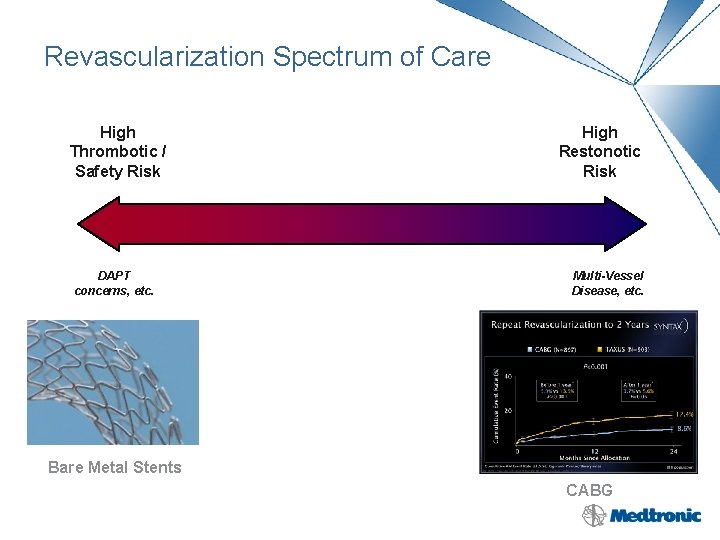
Revascularization Spectrum of Care High Thrombotic / Safety Risk DAPT concerns, etc. High Restonotic Risk Multi-Vessel Disease, etc. Bare Metal Stents CABG
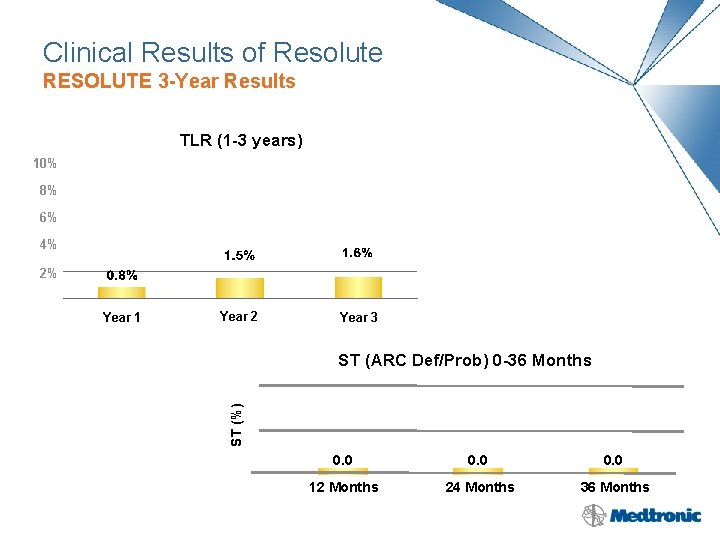
Clinical Results of Resolute RESOLUTE 3 -Year Results TLR (1 -3 years) 10% 8% 6% 4% 2% Year 2 Year 3 ST (ARC Def/Prob) 0 -36 Months ST (%) Year 1 0. 0 12 Months 24 Months 36 Months
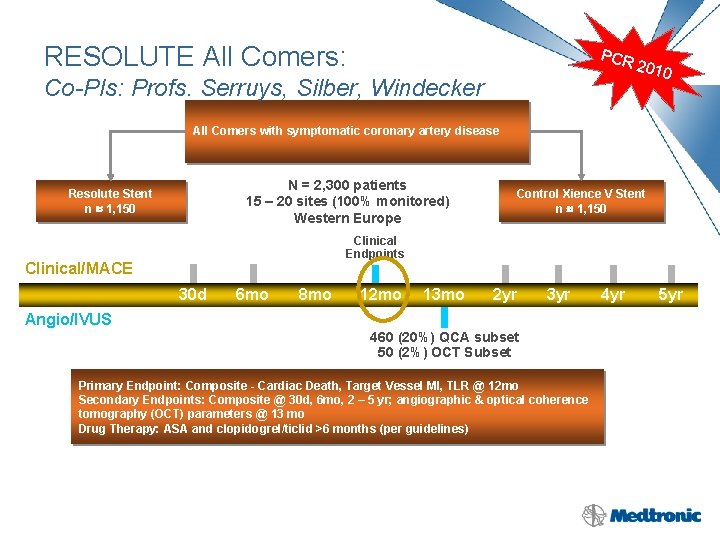
RESOLUTE All Comers: PCR Co-PIs: Profs. Serruys, Silber, Windecker 2010 All Comers with symptomatic coronary artery disease N = 2, 300 patients 15 – 20 sites (100% monitored) Western Europe Resolute Stent n 1, 150 Control Xience V Stent n 1, 150 Clinical Endpoints Clinical/MACE 30 d 6 mo 8 mo 12 mo 13 mo 2 yr 3 yr Angio/IVUS 460 (20%) QCA subset 50 (2%) OCT Subset Primary Endpoint: Composite - Cardiac Death, Target Vessel MI, TLR @ 12 mo Secondary Endpoints: Composite @ 30 d, 6 mo, 2 – 5 yr; angiographic & optical coherence tomography (OCT) parameters @ 13 mo Drug Therapy: ASA and clopidogrel/ticlid >6 months (per guidelines) 4 yr 5 yr
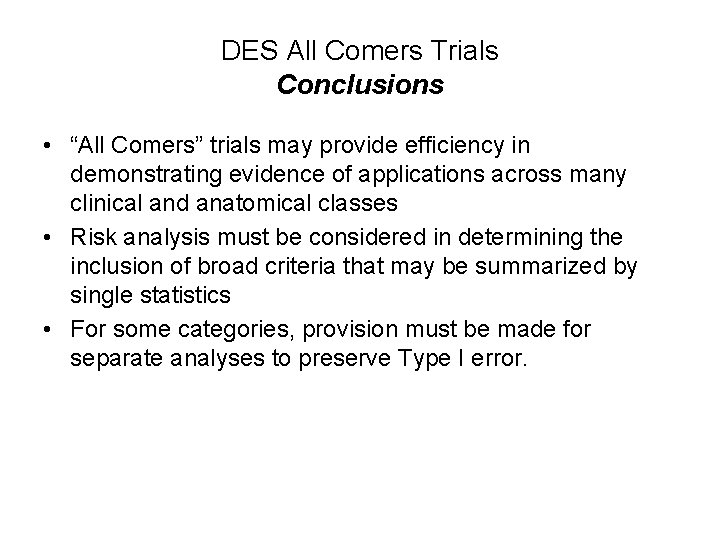
DES All Comers Trials Conclusions • “All Comers” trials may provide efficiency in demonstrating evidence of applications across many clinical and anatomical classes • Risk analysis must be considered in determining the inclusion of broad criteria that may be summarized by single statistics • For some categories, provision must be made for separate analyses to preserve Type I error.