
The MOS Background and XMMESAS K D Kuntz
The MOS Background (and XMM-ESAS) K. D. Kuntz The Henry A. Rowland Dept of P&A Johns Hopkins University And occasionally GSFC With PN additions from S. L. Snowden GSFC
Overview • Review of the Goddard/ESAS method • Update on instrument/detector evolution (a purely phenomenological approach) • Future updates & automation • A few notes about the PN from SLS
Method Review: Philosophy • Emission from the Galactic ISM fills the FOV – Sufficiently faint that it must be summed over large regions in order to produce a good spectrum • The same is true of extended extragalactic emission (e. g. galaxies & clusters) • Background subtraction method must provide good statistics over large regions of the FOV • And still be sensitive to the small-scale spatial/temporal variations in the detector
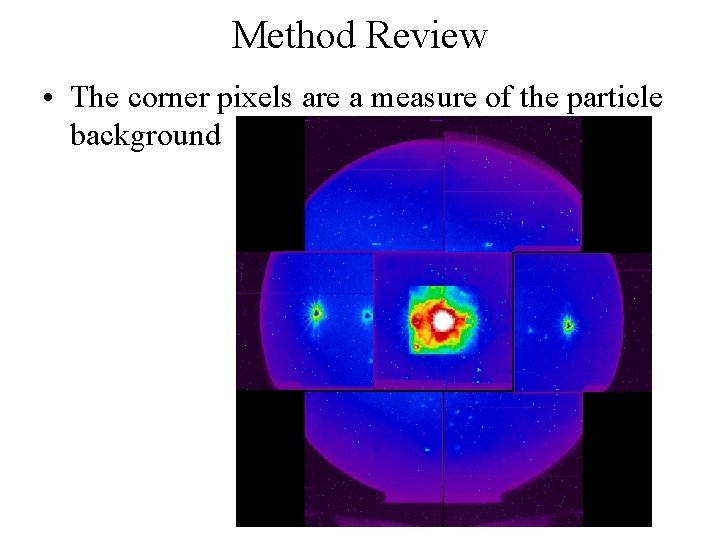
Method Review • The corner pixels are a measure of the particle background
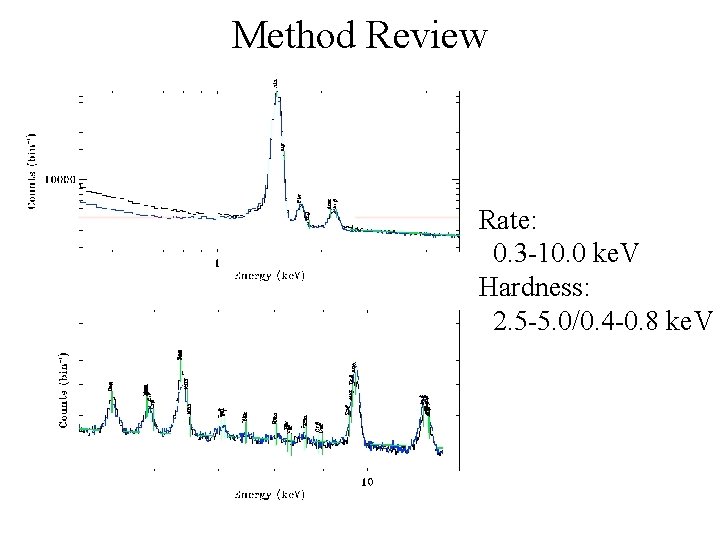
Method Review • The corner pixels are a measure of the quiescent particle background (QPB) for a given observation • There are not enough counts in the corner pixels of a single observation for a robust characterization of the background…so • Measure the rate and hardness ratio for your observation and then… • Augment with corner spectra from other obsids that have the same rate and hardness ratio
Method Review Rate: 0. 3 -10. 0 ke. V Hardness: 2. 5 -5. 0/0. 4 -0. 8 ke. V
Method Review • The corner pixels are a measure of the quiescent particle background (QPB) for a given observation • There are not enough counts in the corner pixels of a single observation for a robust characterization of the background…so • Measure the rate and hardness ratio for your observation and then… • Augment with corner spectra from other obsids that have the same rate and hardness ratio
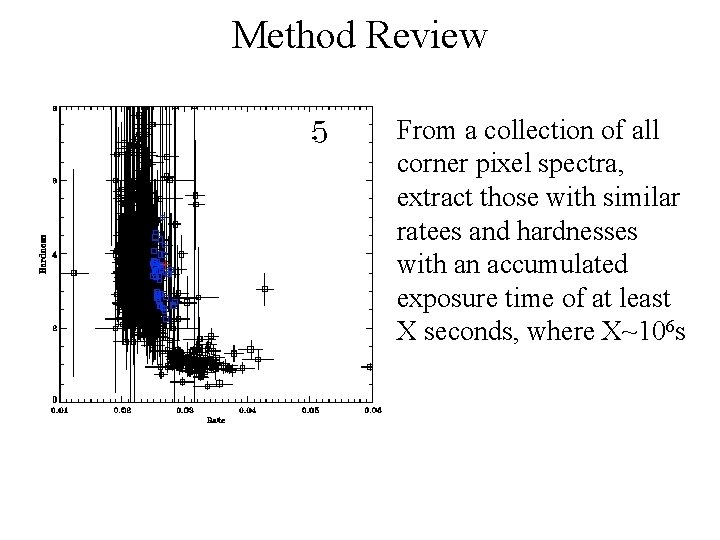
Method Review From a collection of all corner pixel spectra, extract those with similar ratees and hardnesses with an accumulated exposure time of at least X seconds, where X~106 s
Method Review • The corner pixels are a measure of the quiescent particle background (QPB) for a given observation • There are not enough counts in the corner pixels of a single observation for a robust characterization of the background…so • Measure the rate and hardness ratio for your observation and then… • Augment with corner spectra from other obsids that have the same rate and hardness ratio
Method Review • The corner pixel spectrum is not representative of the QPB spectrum within the FOV • The filter-wheel-closed (FWC) data do not reflect the obsid-to-obsid variation • Assume that overall changes in spectral shape seen in the corner pixel data are reflected in the FWC data • FOV = FWC*observed corner/FWC corner
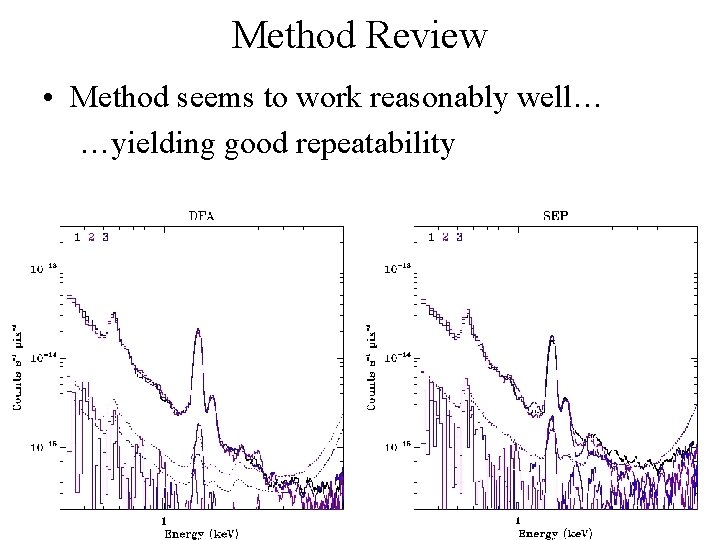
Method Review • Method seems to work reasonably well… …yielding good repeatability
Method Review • Must maintain up-to-date – Databases of corner pixel spectra – Databases of FWC images • (in particular we need to make sure we continue to accumulate new FWC data) • “Eternal vigilance” for instrumental changes – Ensure that method remains valid
Current QPB Update • Using all obsids public before September 2008 • Removed all time intervals with Soft Proton (SP) flare contamination • Removed all obsids with clean time < 5 ks
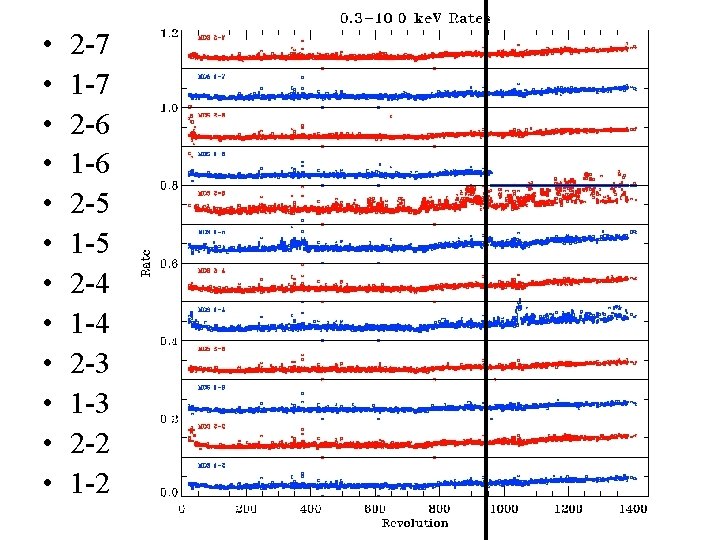
• • • 2 -7 1 -7 2 -6 1 -6 2 -5 1 -5 2 -4 1 -4 2 -3 1 -3 2 -2 1 -2 Current QPB Update
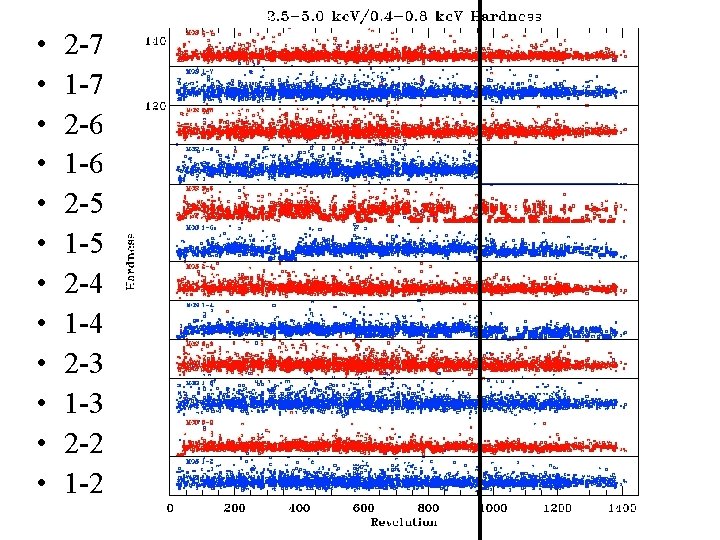
• • • 2 -7 1 -7 2 -6 1 -6 2 -5 1 -5 2 -4 1 -4 2 -3 1 -3 2 -2 1 -2
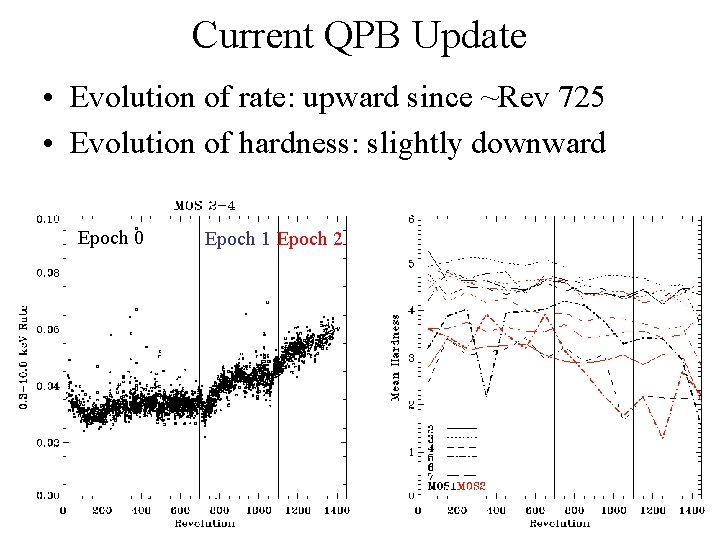
Current QPB Update • Evolution of rate: upward since ~Rev 725 • Evolution of hardness: slightly downward Epoch 0 Epoch 1 Epoch 2
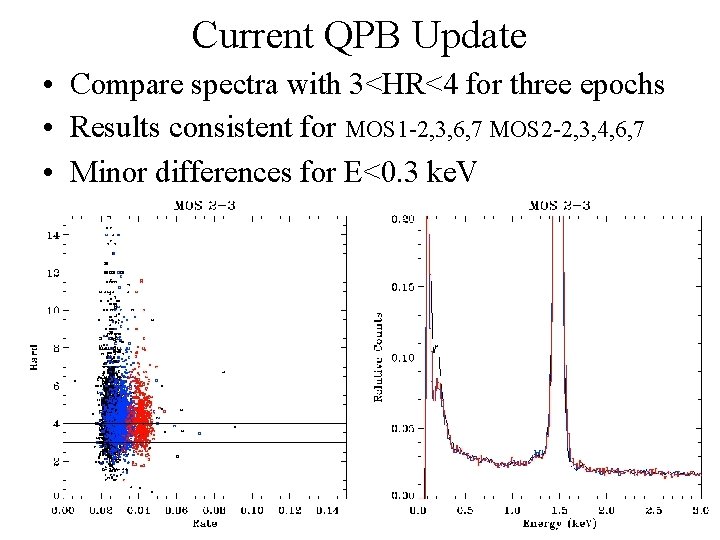
Current QPB Update • Compare spectra with 3<HR<4 for three epochs • Results consistent for MOS 1 -2, 3, 6, 7 MOS 2 -2, 3, 4, 6, 7 • Minor differences for E<0. 3 ke. V
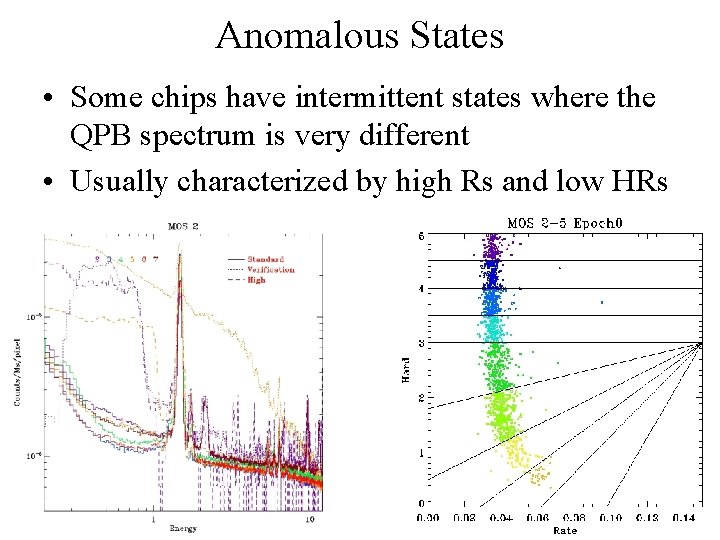
Anomalous States • Some chips have intermittent states where the QPB spectrum is very different • Usually characterized by high Rs and low HRs
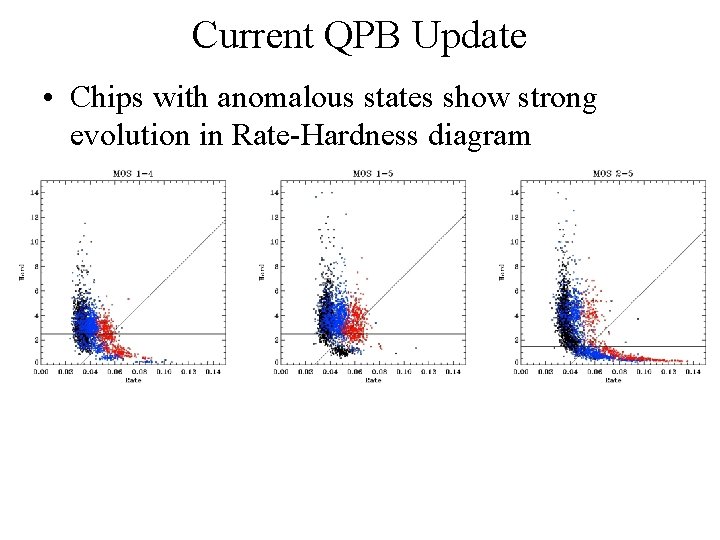
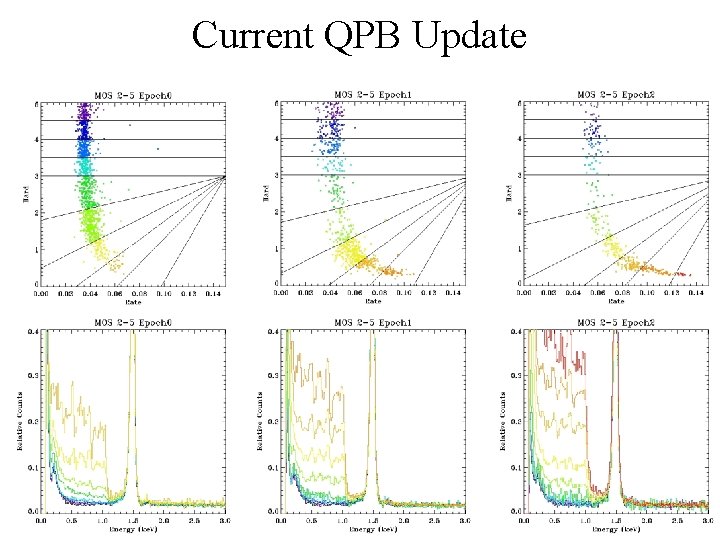
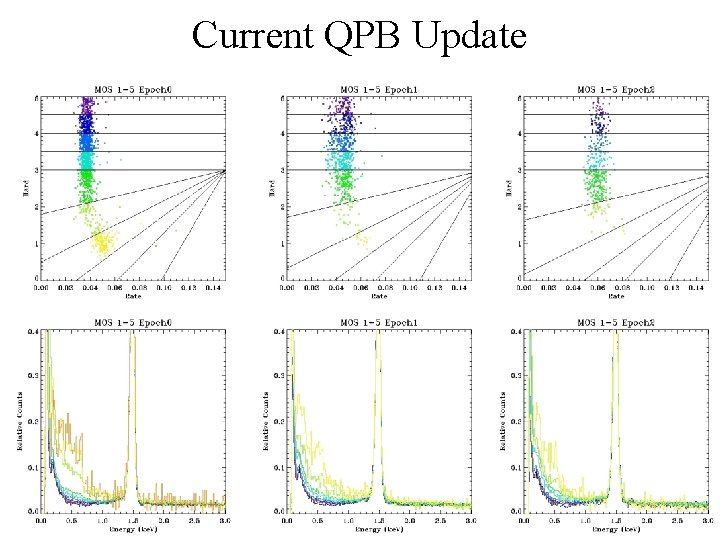
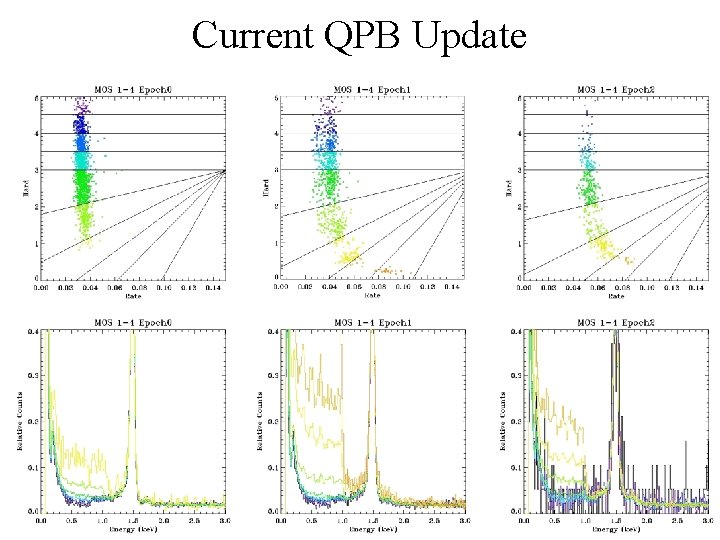
Current QPB Update • Chips with anomalous states show strong evolution in Rate-Hardness diagram
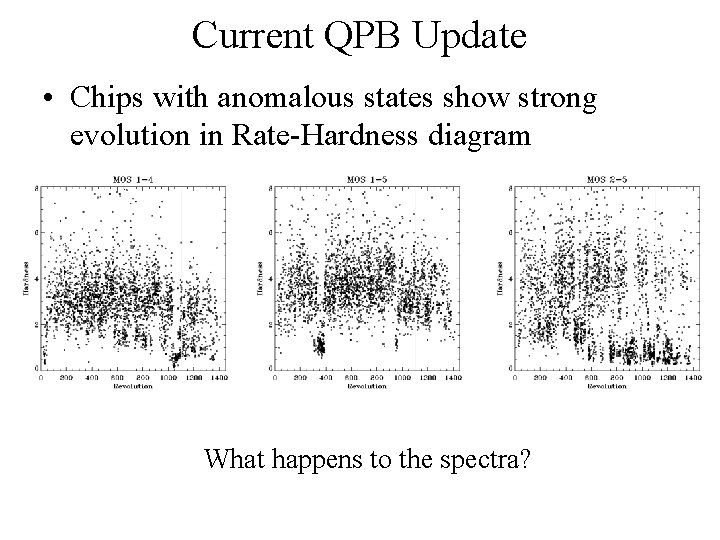
Current QPB Update • Chips with anomalous states show strong evolution in Rate-Hardness diagram What happens to the spectra?
Current QPB Update
Current QPB Update
Current QPB Update
Current QPB Update • MOS 2 -5 – Currently in anomalous state for the bulk of time – Spectral shape stable – but very strong • MOS 1 -5 – Incidence of anomalous states currently low – Spectral shape unstable • MOS 1 -4 – Currently in anomalous state for ~50% of time – Spectral shape unstable • Data from chips in anomalous states should probably be discarded for low surface brightness studies • Spectral shapes in non-anomalous times stable • Will need to re-write descriptions for anomalous states

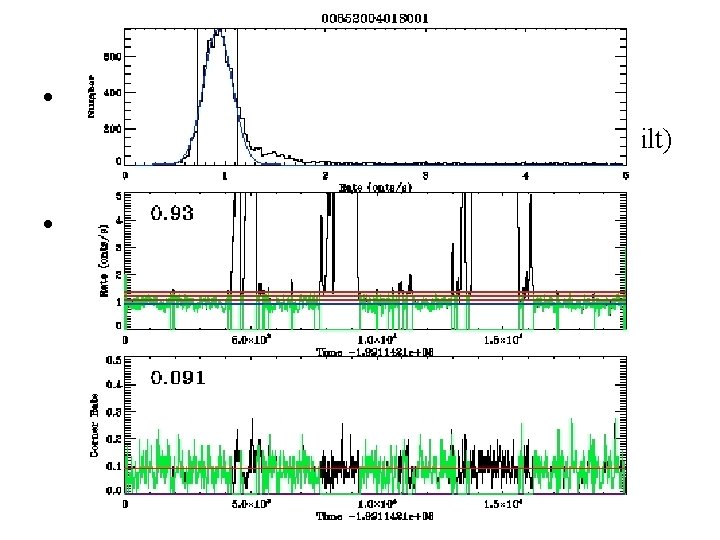
Future QPB Updates • Past Construction – Filtered out periods with strong SP flares (~espfilt) – Hand selection of obsids for inclusion • Current Construction (not yet released) – Filtered out periods with strong SP flares – Selection of obsids • Histogram Center < 4 • Histogram Width < 0. 175 • Cleaned exposure time > 5 ks – Roughly reproduces by-hand process
Future QPB Updates • Future construction – Must use automatic selection of obsids – Use parameters describing “good” obsids? – Rethink this process…
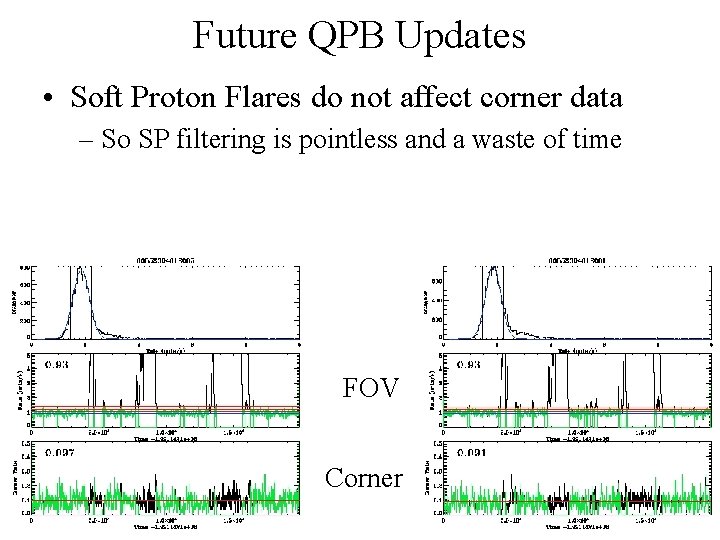
Future QPB Updates • Soft Proton Flares do not affect corner data – So SP filtering is pointless and a waste of time FOV Corner
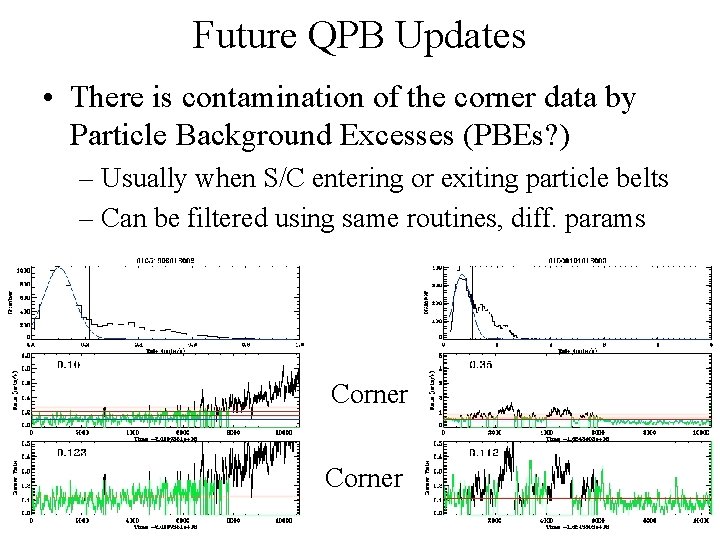
Future QPB Updates • There is contamination of the corner data by Particle Background Excesses (PBEs? ) – Usually when S/C entering or exiting particle belts – Can be filtered using same routines, diff. params Corner
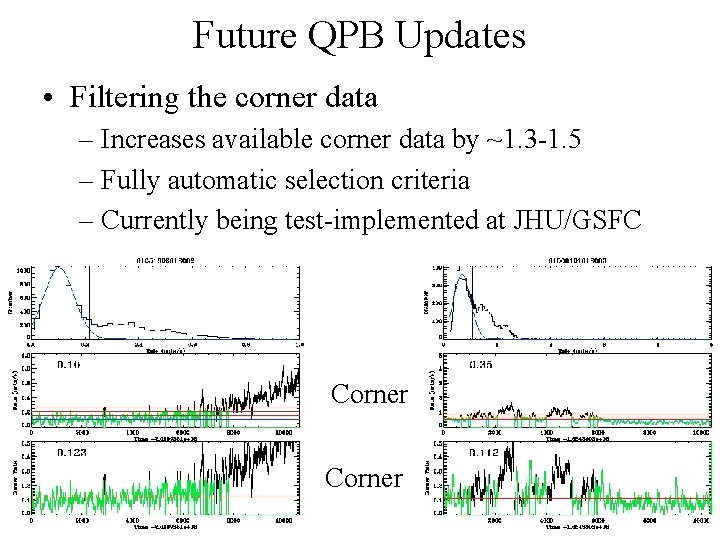
Future QPB Updates • Filtering the corner data – Increases available corner data by ~1. 3 -1. 5 – Fully automatic selection criteria – Currently being test-implemented at JHU/GSFC Corner

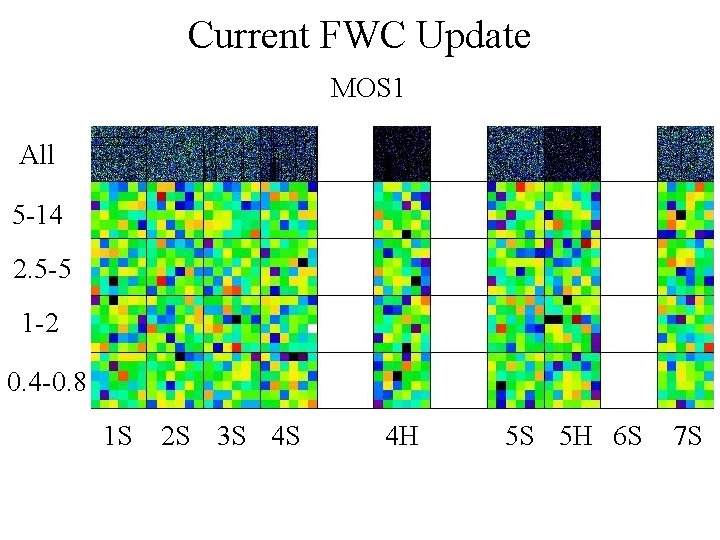
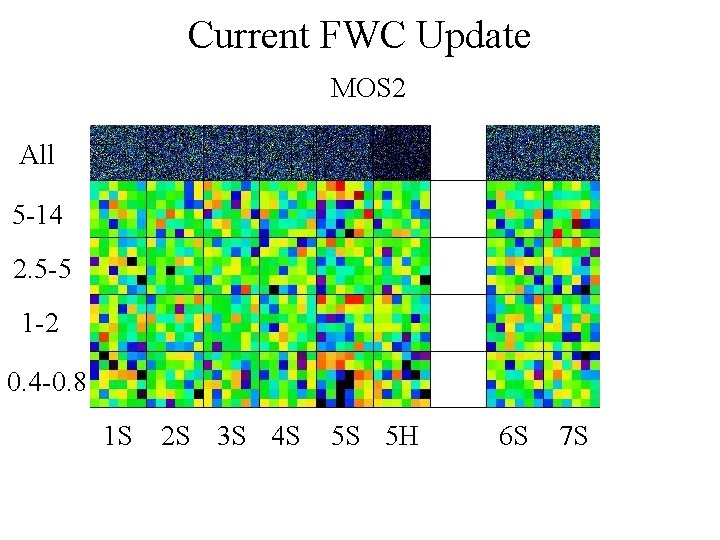
Current FWC Update • MOS FWC campaign to determine whether the FWC images/spectra are temporally variable – Compare FWC data for 1130<rev w/ rev>1130 – Construct images of (post-1130/pre-1130) -1
Current FWC Update MOS 1 All 5 -14 2. 5 -5 1 -2 0. 4 -0. 8 1 S 2 S 3 S 4 S 4 H 5 S 5 H 6 S 7 S
Current FWC Update MOS 2 All 5 -14 2. 5 -5 1 -2 0. 4 -0. 8 1 S 2 S 3 S 4 S 5 S 5 H 6 S 7 S
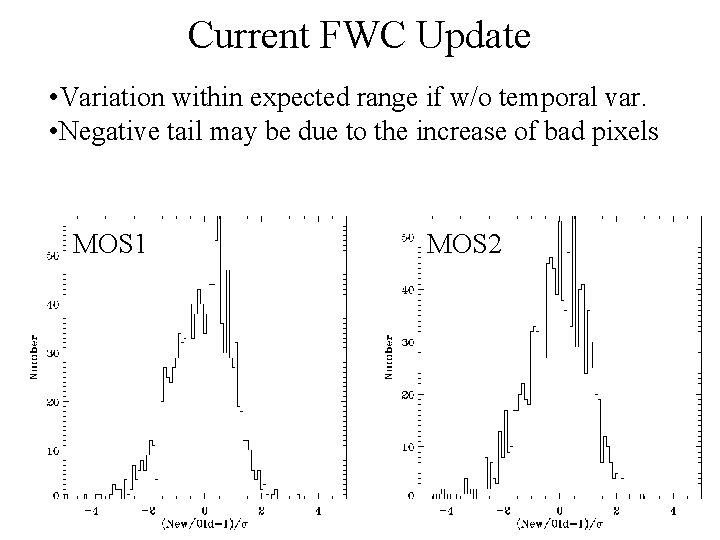
Current FWC Update • Variation within expected range if w/o temporal var. • Negative tail may be due to the increase of bad pixels MOS 1 MOS 2
Current FWC Update • MOS FWC campaign to determine whether the FWC images/spectra are temporally variable – Compare FEC for 1130<rev w/ rev>1130 – Construct (post-1130/pre-1130) -1 images – Compare spectra
Current FWC Update • MOS FWC campaign to determine whether the FWC images/spectra are temporally variable – Compare FEC for 1130<rev w/ rev>1130 – Construct (post-1130/pre-1130) -1 images • No significant signs of temporal variability – Compare spectra • No significant signs of temporal variability • Continued monitoring necessary – Every nth calclosed slew to be converted to closed
Future FWC Updates • Difficult to make automatic – Must inspect each observation of each chip to determine whether chip in standard or anomalous state – Anomalous state definitions are evolving with time, so dependent on up-to-date inspection of corner data. • Given rate at which FWC data accumulates, human interaction no big deal

PN in ESAS • PN software nearly complete – Needs testing on additional data sets – Possible over-estimation of background – Data probably not useful below ~0. 4 ke. V or above 7. 2 ke. V
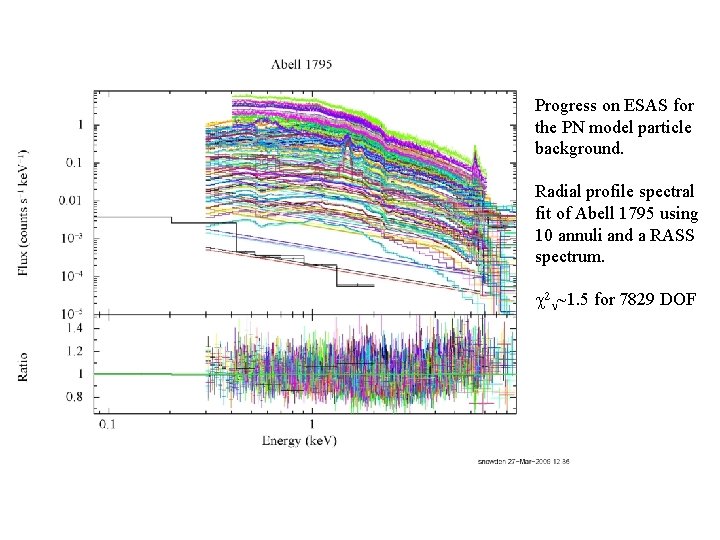
Progress on ESAS for the PN model particle background. Radial profile spectral fit of Abell 1795 using 10 annuli and a RASS spectrum. ~1. 5 for 7829 DOF
PN in ESAS • PN software nearly complete – Needs testing on additional data sets – Possible over-estimation of background – Data probably not useful below ~0. 4 ke. V or above 7. 2 ke. V • PN QPB (&FWC? ) databases constructed – QPB shows little temporal variation • PN flare vignetting images constructed
FINE
- Slides: 43