Department of Human Resource Management The Offshoring of







- Slides: 22
Department of Human Resource Management The Offshoring of Contact Centre and Business Services – A Briefing Professor Phil Taylor University of Strathclyde 25 July 2011 Unite the Union, Birmingham
Department of Human Resource Management Structure of Presentation 1. Origins and growth of offshoring from the UK 2. Drivers of offshoring 3. Constraints upon offshoring 4. The development of the market in India 5. Labour supply in India 6. Cost differentials – the financial case? 7. Quality of service 8. Return of services from India 9. Data protection 10. Corporate Social Responsibility 11. Conclusion
Department of Human Resource Management 1. Origins and Growth of Offshoring • Offshoring obviously not a new phenomenon • Internationalisation of manufacturing, finance etc. • Globalisation of business services from mid-1990 s from US to India – GE, Amex – largely back-office • Digitilisation and technological developments created the potential for remote delivery • Call centres – transform the loci and processes of interactive service work – ACDs • Economies of scale apply also to back office and shared services • UK ‘voice’ offshoring preceded by IT/back office
Department of Human Resource Management • • 2002 -2004: - the first offshoring wave from the UK Prudential and the threatened closure of Reading HSBC and the transfer of 4, 500 jobs Then a raft of Financial Services companies – Abbey, LTSB, Barclays, Norwich Union-Aviva, RSA, Churchill, Esure, AXA, Zurich, Friends Provident etc Diverse sectors followed – telecoms (BT etc), travel & holiday (NRES, Th. Cook), utilities (Power. Gen) Public sector– NHS (Xansa/ Steria), Capita, Vertex Herd mentality often driven by the need to maximise shareholder value – maximise profits, reduce costs Cost case could be questioned
Department of Human Resource Management 2. Drivers of Offshoring ‘They’re quicker at answering the phones, highly motivated and keen to come to work every day…Staff are hugely enthusiastic. They dress well. A lot have degrees…the performance of the UK is inferior. The quality of the work overseas is exceptionally high’. (Whitson, CEO HSBC, August 2002) • Virtuous Indian workers v UK slackers • Seamless relocation and substitutability of labour • Principle driver missing from quote - expectation or perception of significant cost savings • Other factors but quality subordinated to profit
Department of Human Resource Management • Cost reduction often related to business volumes and scale economies • Availability of skills and educated workforce • Offshore repetitive work • Improved customer service • 24/7 and improved operational flexibility • Synergies across a company’s operations • A component element in restructuring or reengineering programmes • ‘Taylorism through export’ • Difficulties recruiting in the UK
Department of Human Resource Management 3. Constraints - disadvantages • Accent, linguistic misunderstanding, cultural difference • Difficulties in exercising control from a distance • Customer perceptions problems, damage to brand • Unanticipated costs of start-up and ramp-up • Negative impact on morale of UK workforce • Technical difficulties For all these reasons and more…. • Many companies did not believe that the advantages outweighed the disadvantages • ‘Refuseniks’ – quality and cost trade-off
Department of Human Resource Management 4. Development of BPO market in India Year Employment in BPO % rate of growth 2002 107, 000 n/a 2003 171, 000 58. 8 2004 216, 000 26. 3 2005 316, 000 46. 3 2006 409, 000 29. 4 2007 553, 000 35. 2 2008 704, 000 27. 3 2009 738, 000 4. 6 2010 770, 000 4. 1 2011 835, 000 8. 4
Department of Human Resource Management • Growth rates caused deep problems – legacy • HR ‘challenges’ of recruitment, training, retention and most important of all – attrition • Overheating in the Tier 1 cities – some moves to Tier 2 and 3 cities • Still 90% of services delivered from 7 locations – Mumbai, NCR, Bangalore, NCR, Chennai, Pune and Kolkota • No escape from rising costs and skill shortages • Despite the slower growth rates since 2008 the return of many problems
Department of Human Resource Management
Department of Human Resource Management
Department of Human Resource Management
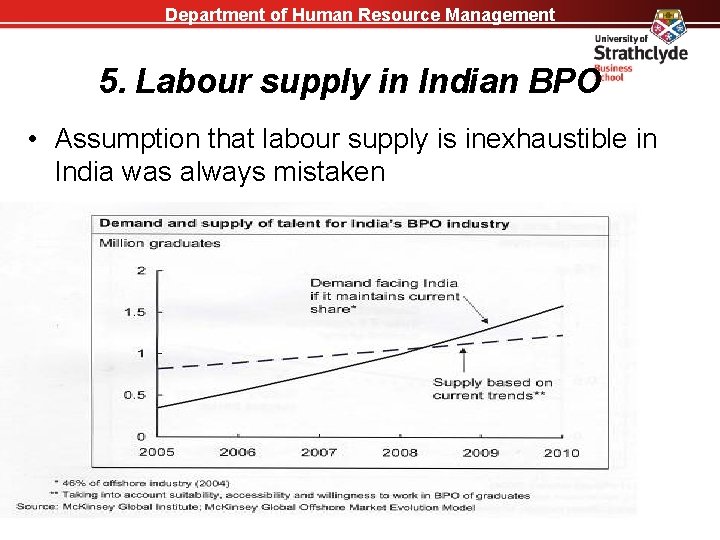
Department of Human Resource Management 5. Labour supply in Indian BPO • Assumption that labour supply is inexhaustible in India was always mistaken
Department of Human Resource Management ‘While India has an ample supply of talent, it is largely trainable and not employable’ (Nasscom, 2010: 178) • • • Only 3 -5% of applicants successful Considerable investment in language training Attrition – ‘push’ and ‘pull’ ‘Official figures hugely underestimate the problem Probably 65 -75% average but often 100% or more Recession slowed rate temporarily – recent Indian Chamber of Commerce report – 55 -65% • Managerial and supervisory attrition acute • Impacts hugely on quality of service
Department of Human Resource Management 6. Cost differentials – the financial case • • Nasscom – labour costs rising by 10 -15 p. a. Most acute for particular skills Overall savings – Nasscom est. 40 -60% (2002) Reduced to 40 -50% (2004 -2007) Synthesising evidence – 25 -40% (2005 -2007) By 2009 – Nassom saying 30% still obtainable Depends on volume, nature of the service, complexity, level of attrition, where located etc. • Other costs – ‘redundancy’, transportation, infrastructure etc. • In terms of the cost v quality – balance shifting
Department of Human Resource Management ‘Off-shoring does reduce the headcount cost, there’s no question about it. We all know it but what happens to the process, the function, the divisional cost? An interesting benchmark aggregate for North America where we look at the capital market for banks, we looked at a mechanism called cost per trade defined as how much does it cost. We profiled 24 banks on this and we looked at what was the cost per trade…from this data there’s no conclusive proof to say that offshoring has actually systematically reduced the cost per trade. Startling!. . . How is that possible? We did reduce the cost [when offshored] but we dropped productivity as well. In fact faster than the cost of the import’. (N. Kaka, Mc. Kinsey India, Nasscom Leadership Forum, Mumbai, 9 th February, 2011)
Department of Human Resource Management • New Call Telecom moving call centre from India to Burnley after three years in Mumbai • Increased costs ‘Employees (in the UK) are loyal, unemployment rates are quite high. In contrast, in India jobs are plentiful and we suffer a lot from attrition. A similar call centre down the road may offer a more lucrative salary and pull staff away and we have to keep going out there for retraining’. (Nigel Eastwood, Chief Executive) http: //www. bbc. co. uk/news/uk-england-lancashire-14025904 • The financial case is thus becoming increasingly questionable
Department of Human Resource Management 7. Quality of service • • • Fifteen years education in English does not necessarily equip Indian agents with the linguistic capabilities deemed by demand supply co’s Prescribing performance through SLAs are problematic Scripting and algorithmic procedures are problematic Attrition interrupts service continuity ‘Bounce back’, ‘escalation’, ‘data cleansing’ More true for highly sensitive voice services but also applies to the non-customer facing back office Mass market offshored but not premium customers The pint of Guinness analogy Considerable evidence of customer dissatisfaction and resistance – damage to brand
Department of Human Resource Management 8. Return of services from India • Earlier evidence from Abbey, just after Santander ‘Given the risk to our reputation of moving the jobs offshore, you want the service to be top notch. If it isn’t top notch, then why are you there’. Powergen (Nick Holler, M. D. , June 2006 ‘Offshore call centres may have their place for certain industries. However, we believe that we can best achieve industry-leading customer service by operating solely in the UK. When customers contact us, they need to be confident that their query will be resolved quickly. Although the cost of overseas outsourcing can be low, we’re simply nor prepared to achieve savings at the risk or expense of customer satisfaction’ (Financial Times, 16 th June 2006)
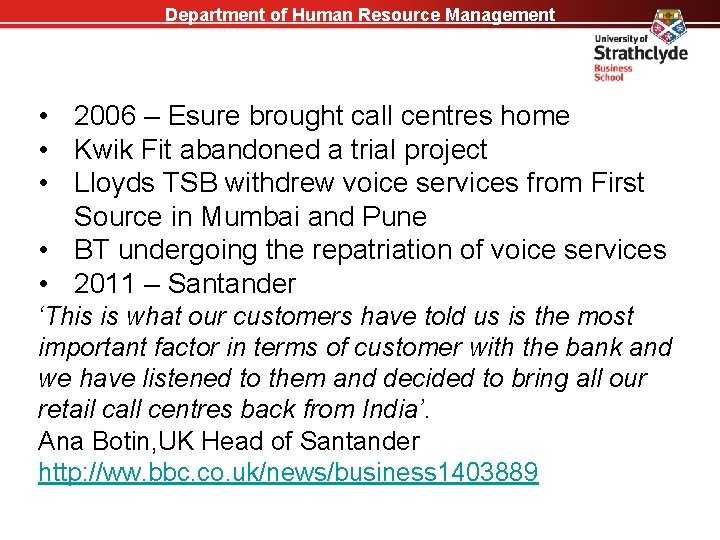
Department of Human Resource Management • 2006 – Esure brought call centres home • Kwik Fit abandoned a trial project • Lloyds TSB withdrew voice services from First Source in Mumbai and Pune • BT undergoing the repatriation of voice services • 2011 – Santander ‘This is what our customers have told us is the most important factor in terms of customer with the bank and we have listened to them and decided to bring all our retail call centres back from India’. Ana Botin, UK Head of Santander http: //ww. bbc. co. uk/news/business 1403889
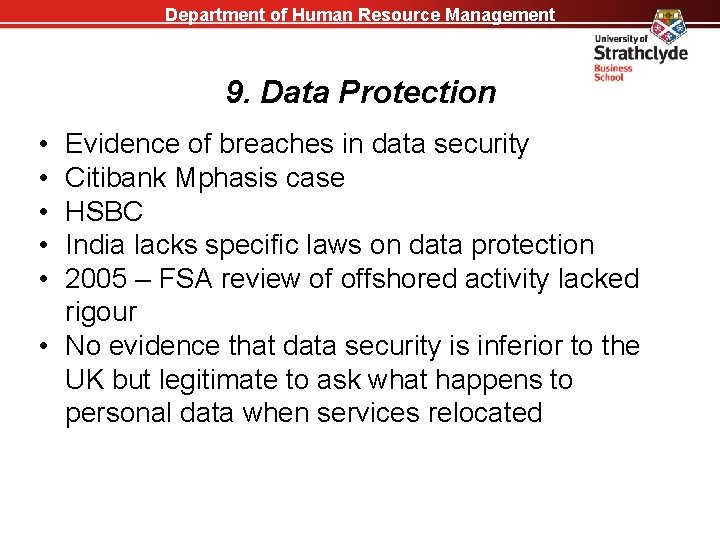
Department of Human Resource Management 9. Data Protection • • • Evidence of breaches in data security Citibank Mphasis case HSBC India lacks specific laws on data protection 2005 – FSA review of offshored activity lacked rigour • No evidence that data security is inferior to the UK but legitimate to ask what happens to personal data when services relocated
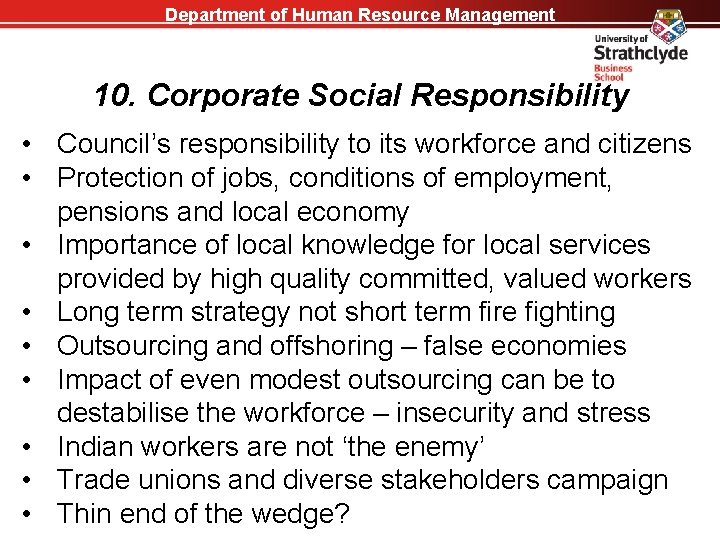
Department of Human Resource Management 10. Corporate Social Responsibility • Council’s responsibility to its workforce and citizens • Protection of jobs, conditions of employment, pensions and local economy • Importance of local knowledge for local services provided by high quality committed, valued workers • Long term strategy not short term fire fighting • Outsourcing and offshoring – false economies • Impact of even modest outsourcing can be to destabilise the workforce – insecurity and stress • Indian workers are not ‘the enemy’ • Trade unions and diverse stakeholders campaign • Thin end of the wedge?