Department of Computer Science Undergraduate Events More details

- Slides: 22
Department of Computer Science Undergraduate Events More details @ https: //my. cs. ubc. ca/students/development/events Deloitte Info Session Co-op Info Session Mon. , Sept 14 6 – 7 pm DMP 310 Thurs. , Sept 17 12: 30 – 1: 30 pm MCLD 202 Google Info Table Simba Technologies Tech Talk/Info Session Mon. , Sept 14 10 – 11: 30 am; 2 – 4 pm Reboot Cafe Google Alkumni/Intern Panel Tues. , Sept 15 6 – 7: 30 pm DMP 310 Mon. , Sept 21 6 – 7 pm DMP 310 EA Info Session Tues. , Sept 22 6 – 7 pm DMP 310
Intelligent Systems (AI-2) Computer Science cpsc 422, Lecture 3 Sep, 14, 2015 CPSC 422, Lecture 3 Slide 2
Lecture Overview Markov Decision Processes • Formal Specification and example • Policies and Optimal Policy • Intro to Value Iteration CPSC 422, Lecture 3 3
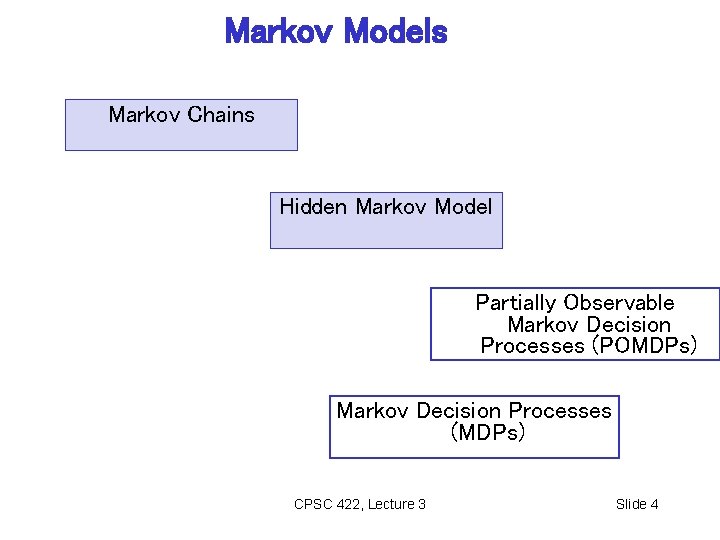
Markov Models Markov Chains Hidden Markov Model Partially Observable Markov Decision Processes (POMDPs) Markov Decision Processes (MDPs) CPSC 422, Lecture 3 Slide 4
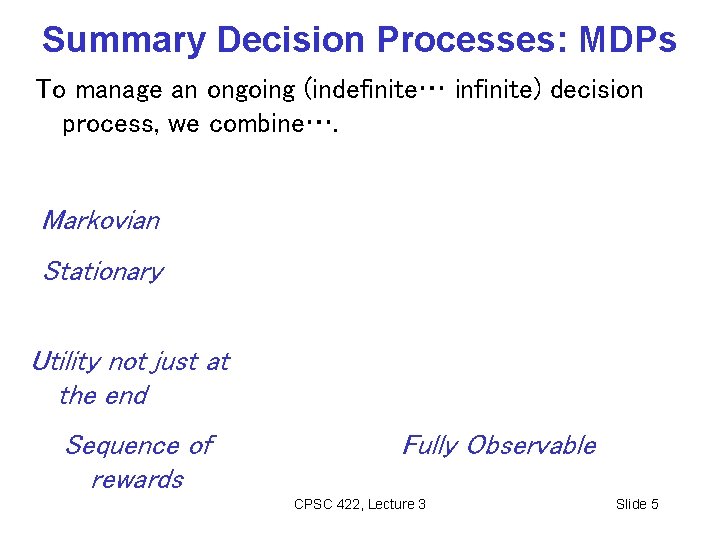
Summary Decision Processes: MDPs To manage an ongoing (indefinite… infinite) decision process, we combine…. Markovian Stationary Utility not just at the end Sequence of rewards Fully Observable CPSC 422, Lecture 3 Slide 5
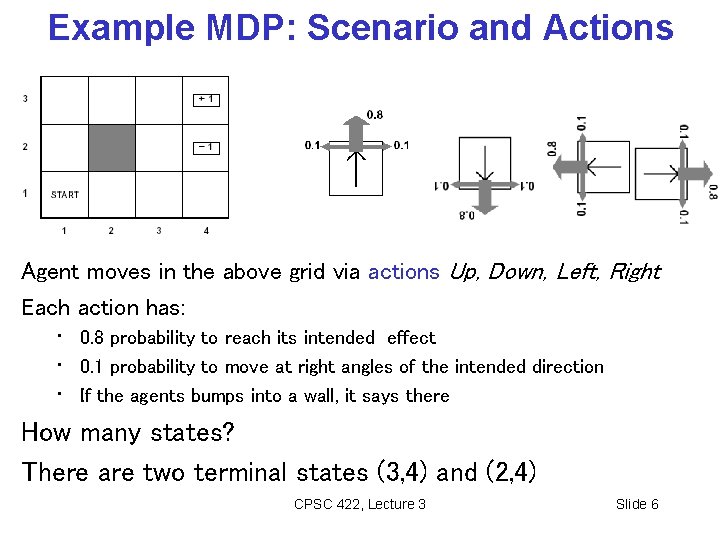
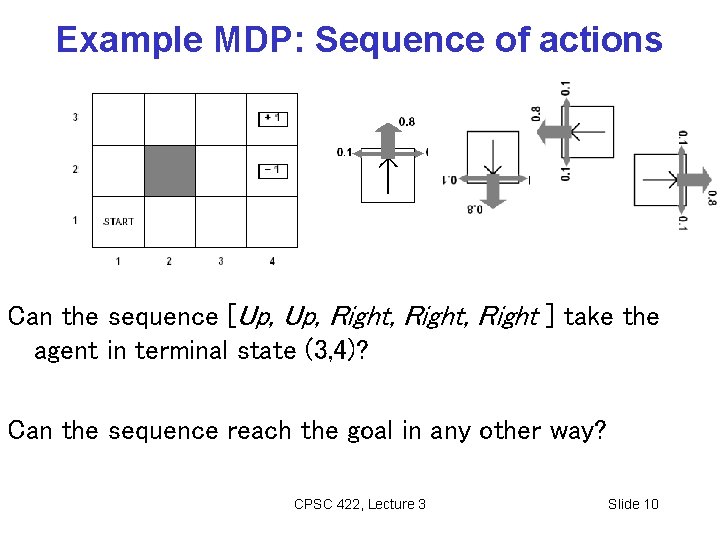
Example MDP: Scenario and Actions Agent moves in the above grid via actions Up, Down, Left, Right Each action has: • 0. 8 probability to reach its intended effect • 0. 1 probability to move at right angles of the intended direction • If the agents bumps into a wall, it says there How many states? There are two terminal states (3, 4) and (2, 4) CPSC 422, Lecture 3 Slide 6
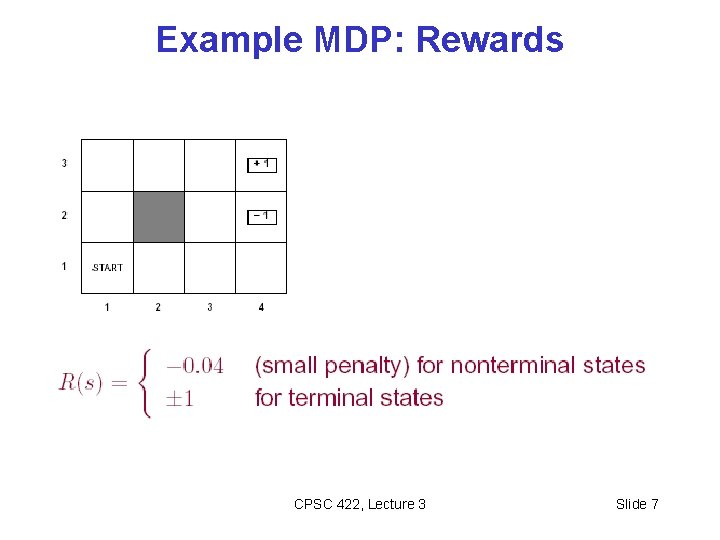
Example MDP: Rewards CPSC 422, Lecture 3 Slide 7
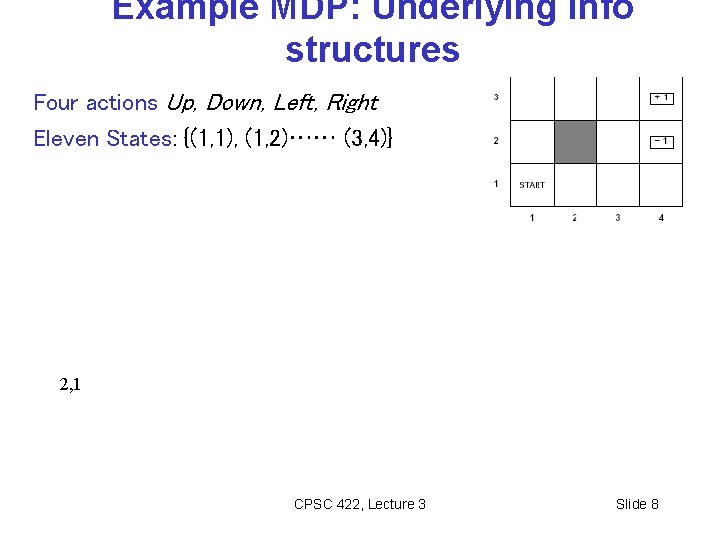
Example MDP: Underlying info structures Four actions Up, Down, Left, Right Eleven States: {(1, 1), (1, 2)…… (3, 4)} 2, 1 CPSC 422, Lecture 3 Slide 8
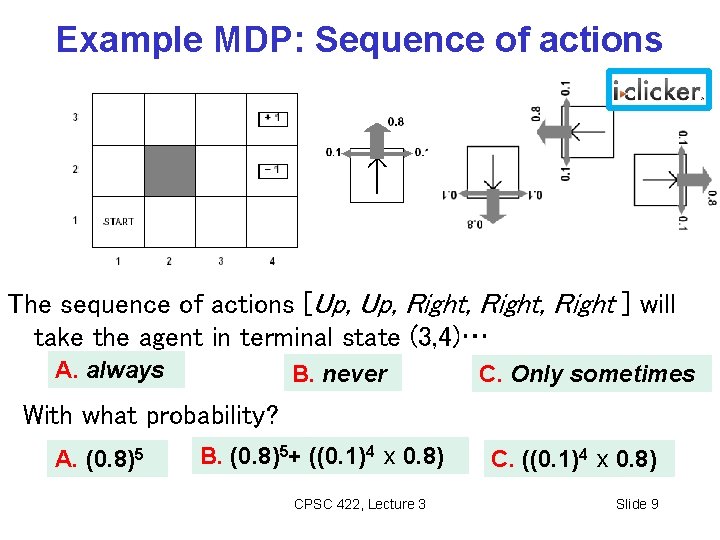
Example MDP: Sequence of actions The sequence of actions [Up, Right, Right ] will take the agent in terminal state (3, 4)… A. always B. never C. Only sometimes With what probability? A. (0. 8)5 B. (0. 8)5+ ((0. 1)4 x 0. 8) CPSC 422, Lecture 3 C. ((0. 1)4 x 0. 8) Slide 9
Example MDP: Sequence of actions Can the sequence [Up, Right, Right ] take the agent in terminal state (3, 4)? Can the sequence reach the goal in any other way? CPSC 422, Lecture 3 Slide 10
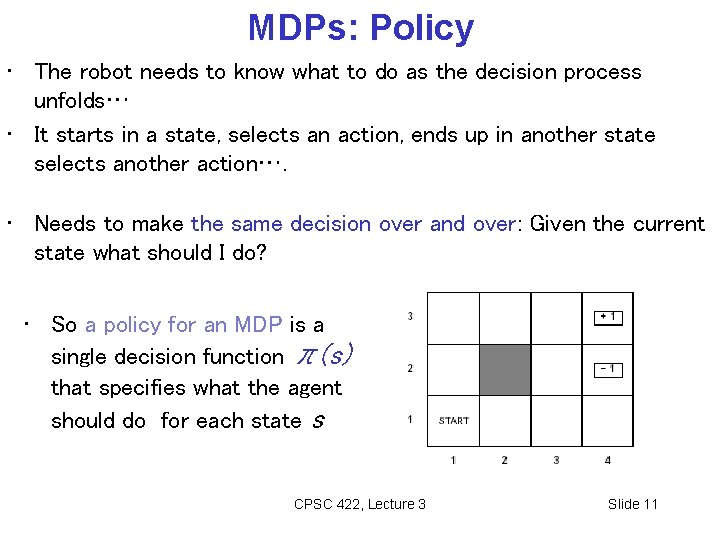
MDPs: Policy • The robot needs to know what to do as the decision process unfolds… • It starts in a state, selects an action, ends up in another state selects another action…. • Needs to make the same decision over and over: Given the current state what should I do? • So a policy for an MDP is a single decision function π(s) that specifies what the agent should do for each state s CPSC 422, Lecture 3 Slide 11
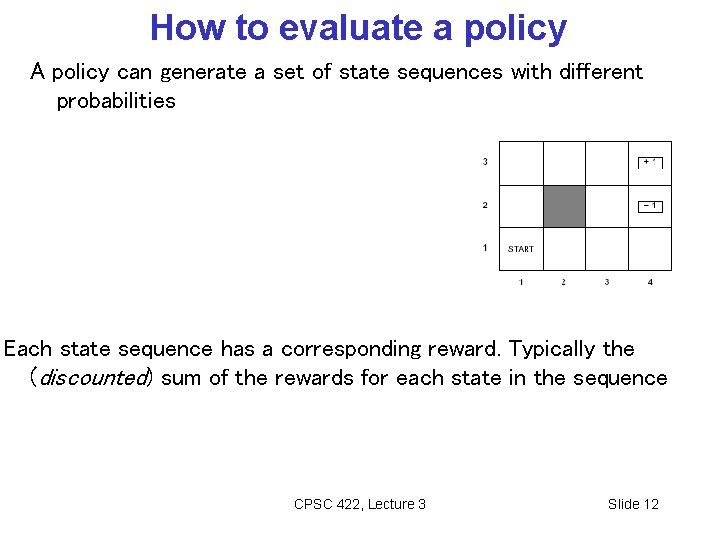
How to evaluate a policy A policy can generate a set of state sequences with different probabilities Each state sequence has a corresponding reward. Typically the (discounted) sum of the rewards for each state in the sequence CPSC 422, Lecture 3 Slide 12
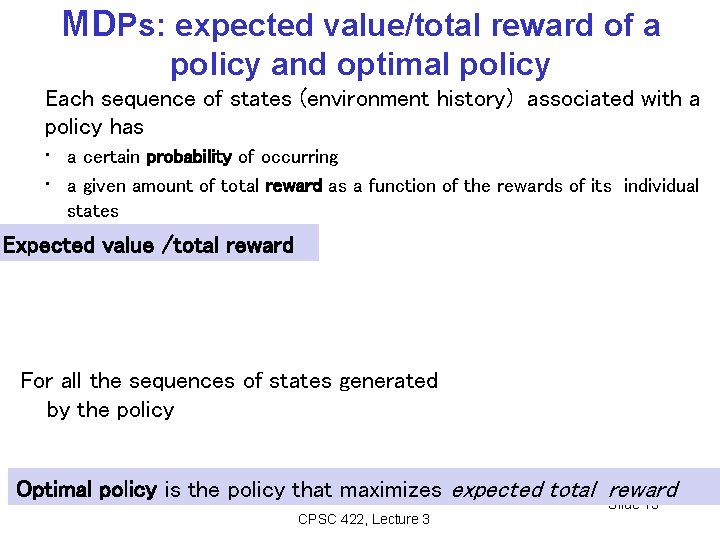
MDPs: expected value/total reward of a policy and optimal policy Each sequence of states (environment history) associated with a policy has • a certain probability of occurring • a given amount of total reward as a function of the rewards of its individual states Expected value /total reward For all the sequences of states generated by the policy Optimal policy is the policy that maximizes expected total reward CPSC 422, Lecture 3 Slide 13
Lecture Overview Markov Decision Processes • Formal Specification and example • Policies and Optimal Policy • Intro to Value Iteration CPSC 422, Lecture 3 14
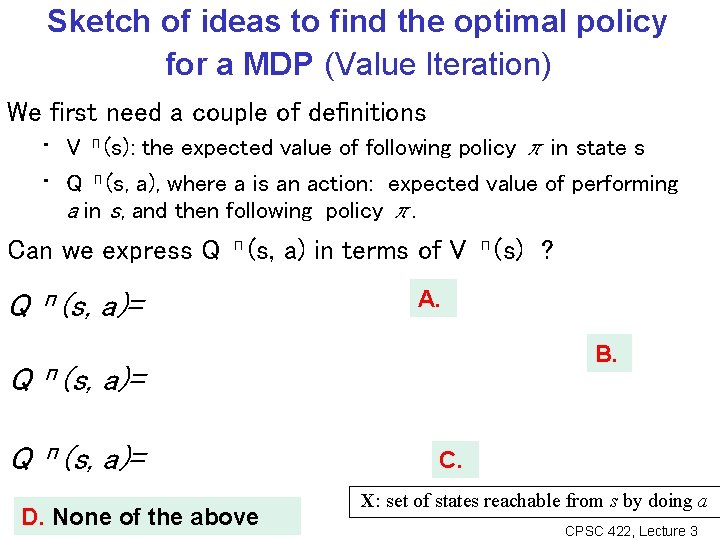
Sketch of ideas to find the optimal policy for a MDP (Value Iteration) We first need a couple of definitions • V п(s): the expected value of following policy π in state s • Q п(s, a), where a is an action: expected value of performing a in s, and then following policy π. Can we express Q п(s, a) in terms of V п(s) ? Q п(s, a)= A. B. Q п(s, a)= D. None of the above C. X: set of states reachable from s by doing a Slide 15 CPSC 422, Lecture 3
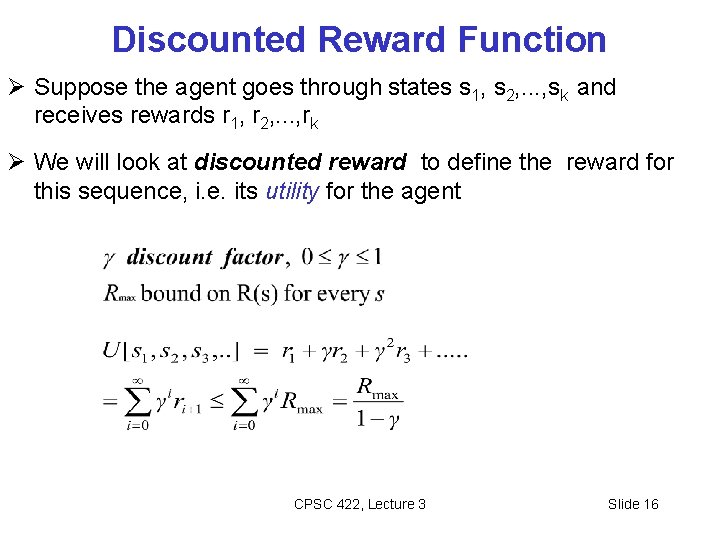
Discounted Reward Function Suppose the agent goes through states s 1, s 2, . . . , sk and receives rewards r 1, r 2, . . . , rk We will look at discounted reward to define the reward for this sequence, i. e. its utility for the agent CPSC 422, Lecture 3 Slide 16
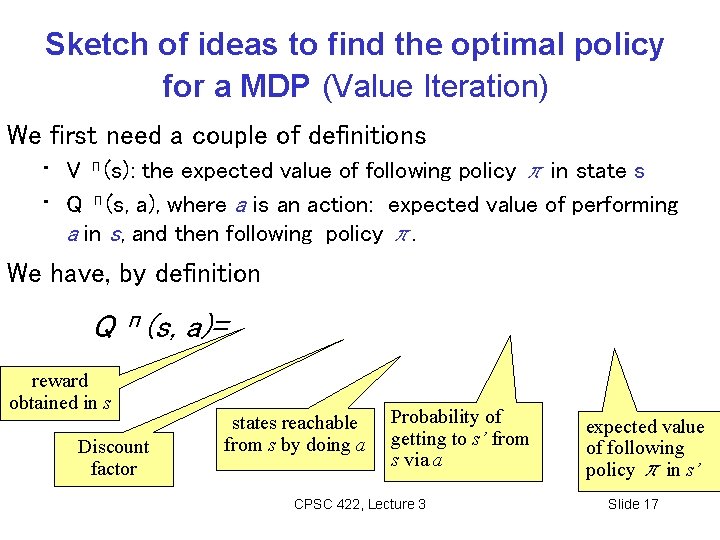
Sketch of ideas to find the optimal policy for a MDP (Value Iteration) We first need a couple of definitions • V п(s): the expected value of following policy π in state s • Q п(s, a), where a is an action: expected value of performing a in s, and then following policy π. We have, by definition Q п(s, a)= reward obtained in s Discount factor states reachable from s by doing a Probability of getting to s’ from s via a CPSC 422, Lecture 3 expected value of following policy π in s’ Slide 17
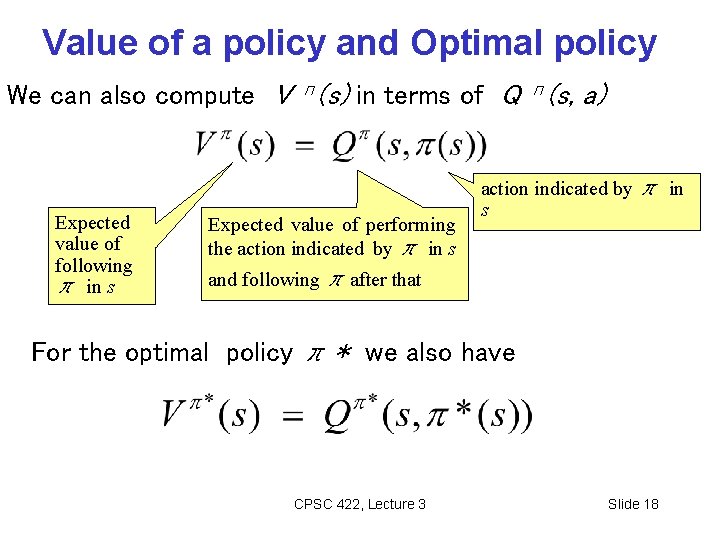
Value of a policy and Optimal policy We can also compute V п(s) in terms of Q п(s, a) Expected value of following π in s Expected value of performing the action indicated by π in s and following π after that For the optimal policy π * we also have CPSC 422, Lecture 3 Slide 18
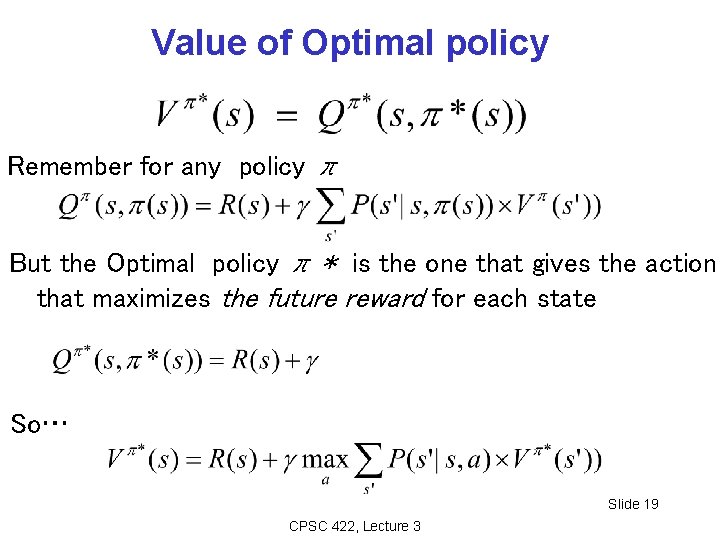
Value of Optimal policy Remember for any policy π But the Optimal policy π * is the one that gives the action that maximizes the future reward for each state So… Slide 19 CPSC 422, Lecture 3
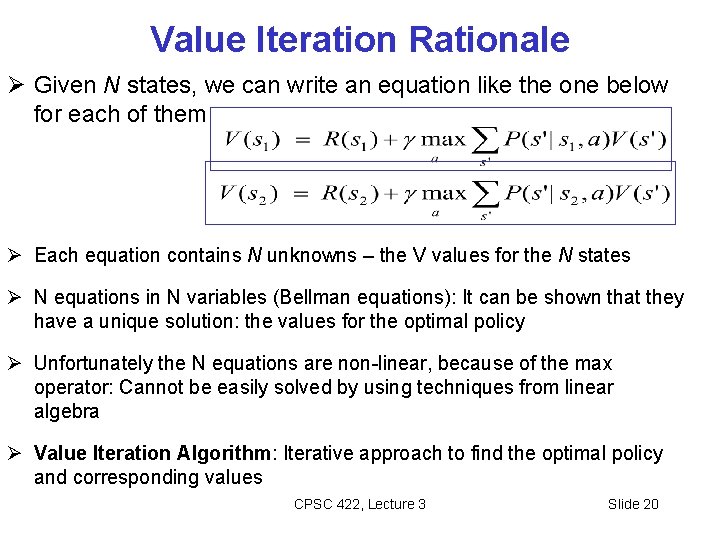
Value Iteration Rationale Given N states, we can write an equation like the one below for each of them Each equation contains N unknowns – the V values for the N states N equations in N variables (Bellman equations): It can be shown that they have a unique solution: the values for the optimal policy Unfortunately the N equations are non-linear, because of the max operator: Cannot be easily solved by using techniques from linear algebra Value Iteration Algorithm: Iterative approach to find the optimal policy and corresponding values CPSC 422, Lecture 3 Slide 20
Learning Goals for today’s class You can: • Compute the probability distribution on states given a sequence of actions in an MDP • Define a policy for an MDP • Define and Justify a discounted reward function • Derive the Bellman equations on which Value Iteration is based (we will likely finish this in the next lecture) CPSC 422, Lecture 3 Slide 22
TODO for Wed Read textbook • 9. 5. 3 Value Iteration For Fro: CPSC 422, Lecture 3 Slide 23