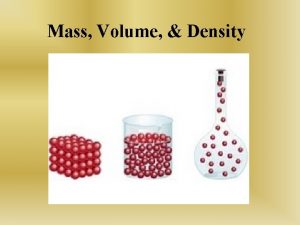
Density is the mass per unit volume of
- Slides: 10
Density is the mass per unit volume of an object
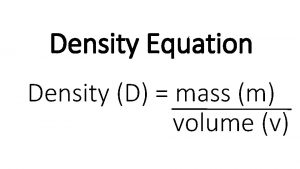
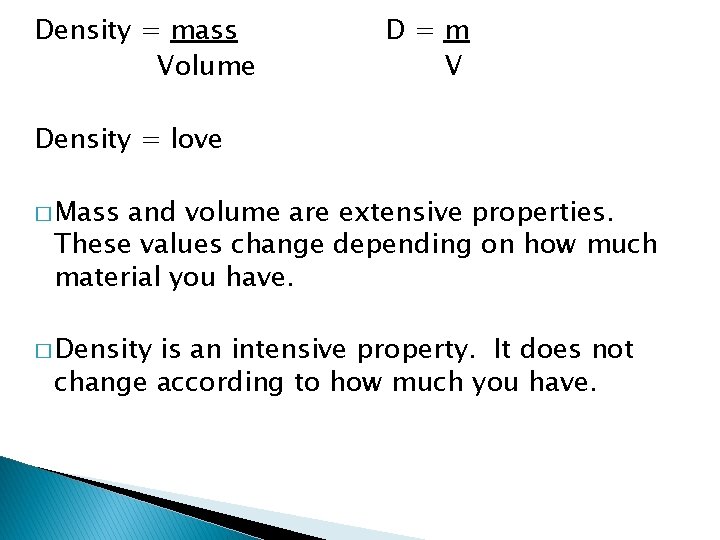
Density = mass Volume D=m V Density = love � Mass and volume are extensive properties. These values change depending on how much material you have. � Density is an intensive property. It does not change according to how much you have.
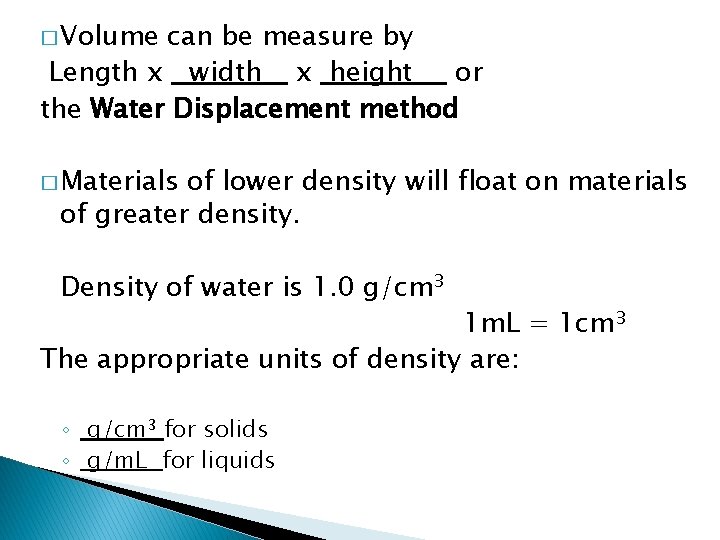
� Volume can be measure by Length x width x height or the Water Displacement method � Materials of lower density will float on materials of greater density. Density of water is 1. 0 g/cm 3 1 m. L = 1 cm 3 The appropriate units of density are: ◦ g/cm 3 for solids ◦ g/m. L for liquids
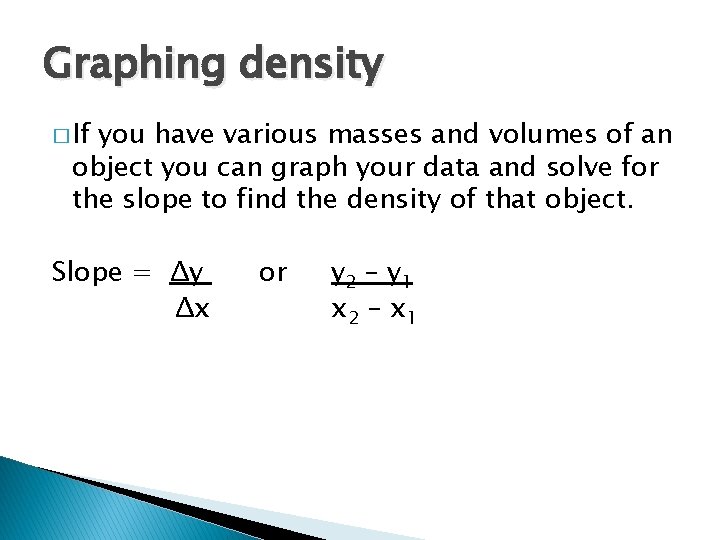
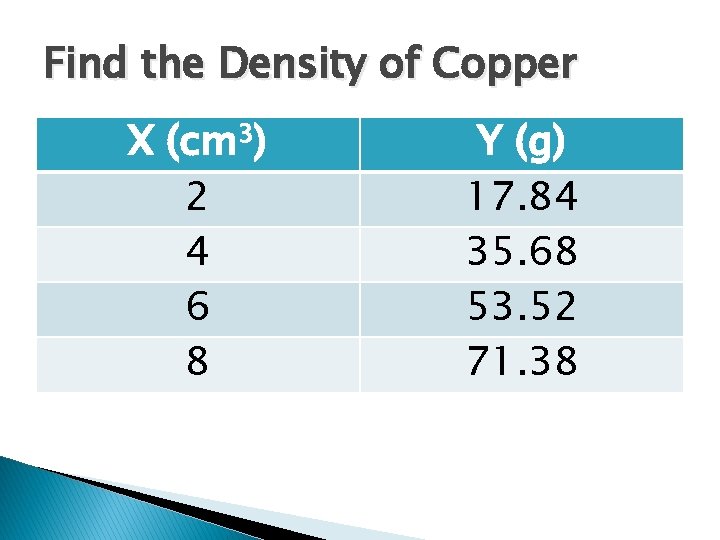
Graphing density � If you have various masses and volumes of an object you can graph your data and solve for the slope to find the density of that object. Slope = Δy Δx or y 2 – y 1 x 2 – x 1
Find the Density of Copper X (cm 3) 2 4 6 8 Y (g) 17. 84 35. 68 53. 52 71. 38
Graph � Plot X vs Y graph
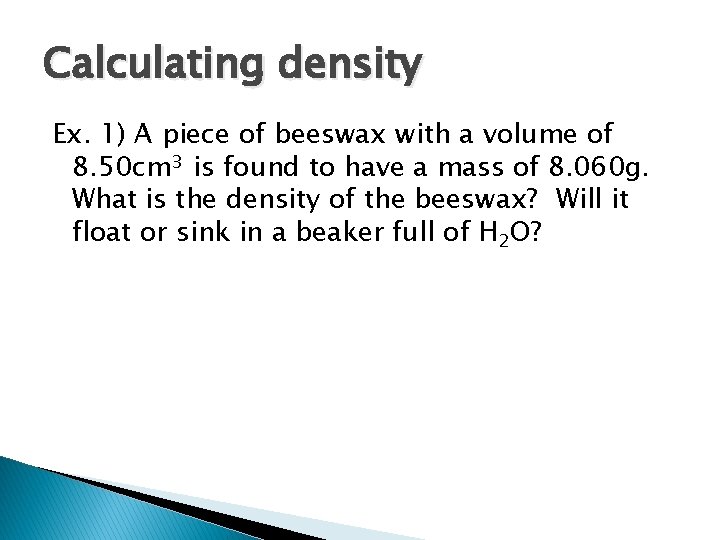
Calculating density Ex. 1) A piece of beeswax with a volume of 8. 50 cm 3 is found to have a mass of 8. 060 g. What is the density of the beeswax? Will it float or sink in a beaker full of H 2 O?
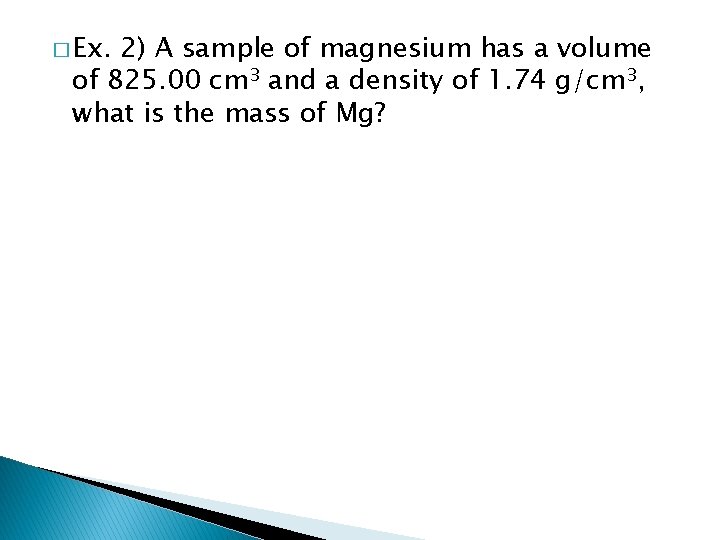
� Ex. 2) A sample of magnesium has a volume of 825. 00 cm 3 and a density of 1. 74 g/cm 3, what is the mass of Mg?
Ex. 3) The volume of water in a graduated cylinder is 27. 0 m. L. A piece of lead is slowly dropped into the cylinder giving the volume to become 130. 2 m. L. Given that lead’s density is 11. 3 g/cm 3 what is the mass of Pb?
� Ex. 4) An empty beaker has a mass of 25. 83 g. When it is filled with mercury, it’s new mass is 225. 3 g. If the density of mercury is 13. 60 g/cm 3, what is the volume of the beaker?