Dating and Courtship Courtship Allows people to win




- Slides: 14
Dating and Courtship
Courtship • Allows people to ‘win’ the affection of those to whom they are attracted • Most societies have ‘rituals’ - men have to prove their ability to being able to provide and women be the ‘alluring’ and nurturing
In Canada? • Are there still courtship rituals in today’s modern Canadian society?
Early Canada • In early Canadians followed the British system – men had to leave ‘calling cards’ with families that they wished to visit • Young ladies and their mothers had ‘at homes’ where young men were invited to tea • Each young man was expected to compete for the young lady’s attention
Bundling • In agricultural communities, the practice of bundling occurred • Because of the distance between farms etc, afternoon visits were difficult, so families practiced ‘bundling’ • The young couple were allowed to be tucked into bed together – with a board in between, in order to ‘get to know’ each other • However the result was that almost 1/3 of brides were pregnant on their wedding day!
Dating • During the 2 oth century, the concept of dating began • Young people would meet at church or community events, such as dances etc and went out initially in larger groups of friends • By the 1920 s men began taking the initiative and asking women out and paying for the event • 1930’s – the idea of ‘going out’ meant you were an exclusive couple but not necessarily discussing marriage
• 1950 s – Western idea of ‘romantic love’ – dating, falling ‘in love’ and then marriage • “Market experience perspective” – dating was effective because you could get to know the person , judge their character etc and then decide on the characteristics that you were looking for in a ‘mate’ • Bernard Murnstein – individuals pass their dates through a series of ‘filters’ to screen out unacceptable partners and to select someonemre like themselves
Murstein’s Filter Theory • Bernard Murstein explained the relationship among dating, social homogamy, and social exchange as a multi-step process. He uses the analogy of ‘sifting’ to suggest that individuals pass their dates through a series of ‘filters’ to screen out unacceptable marriage partners. This process of filtering leads an individual to only let one acceptable partner through, which ultimately leads to marriage.
• Field of Eligibles Who is out there, the general population Propinquity Filter Who is close to us. An available group to choose from. (proximity ) Attraction Filter (Physical Attraction/Personality) • Judgment based on appearance and individual characteristics
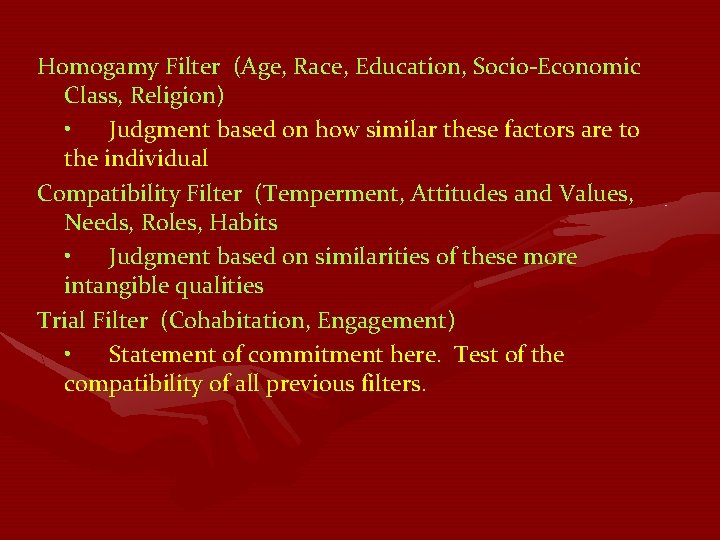
Homogamy Filter (Age, Race, Education, Socio-Economic Class, Religion) • Judgment based on how similar these factors are to the individual Compatibility Filter (Temperment, Attitudes and Values, Needs, Roles, Habits • Judgment based on similarities of these more intangible qualities Trial Filter (Cohabitation, Engagement) • Statement of commitment here. Test of the compatibility of all previous filters.
Decision Filter • Final decision is made here to see if individual is the right choice • Marriage
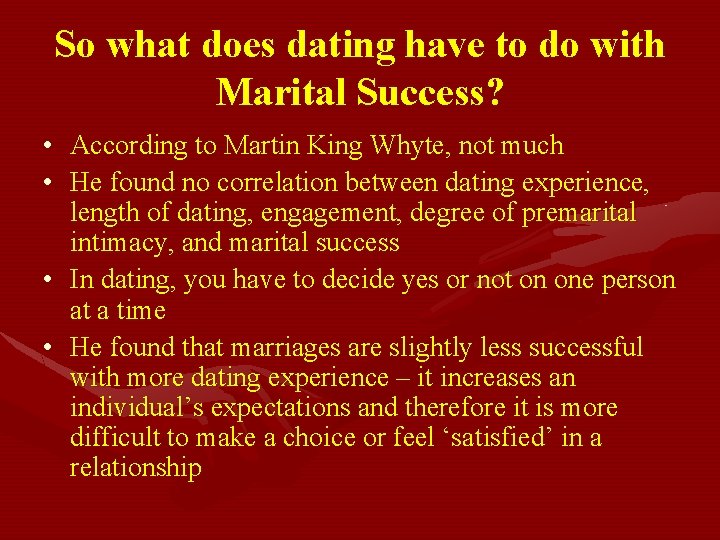
So what does dating have to do with Marital Success? • According to Martin King Whyte, not much • He found no correlation between dating experience, length of dating, engagement, degree of premarital intimacy, and marital success • In dating, you have to decide yes or not on one person at a time • He found that marriages are slightly less successful with more dating experience – it increases an individual’s expectations and therefore it is more difficult to make a choice or feel ‘satisfied’ in a relationship
If Dating is not an indicator of marital success, what is? • Actually, love • Whyte found that being in love when you marry is the best indicator of marital success • The process of getting to know someone is increasingly, in our society, being combined with sexual intimacy before marriage • To the point that , if you think about Sternberg, the expression of passion through sexual activity precedes the development of intimacy and commitment to the relationship
The 21 st Century • courtship behaviour of Canadians have changed • Cohabitation and the delay in marriage are changing society’s norms • The idea of ‘being with someone’ seems to always have a sexual connotation or expectation of that happening • The text book speaks of a shift from ‘competing’ to win someone’s affection to being very selective about what the other has to offer • There is a much less formal pattern of courtship today – and it is a much more complicated process