DATA COLLECTION AND AAC GOALS Why measure and


- Slides: 20
DATA COLLECTION AND AAC GOALS
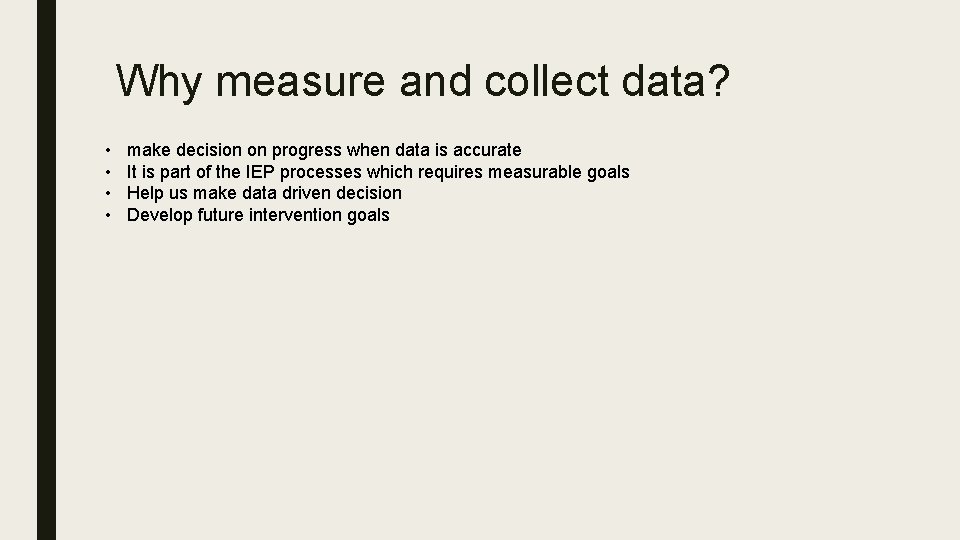
Why measure and collect data? • • make decision on progress when data is accurate It is part of the IEP processes which requires measurable goals Help us make data driven decision Develop future intervention goals
What data to collect ? ■ I will show you a list of data that can be collected with AAC clients to help guide you to develop goals for the clients and to record performance
Data on operational skills ■ Accesses skills: accuracy and communication rate ■ Key features, such as turning the device on and off ■ Safe transportation with accesses to the device. Example; device is mounted in all classroom
Data on Linguistic skills ■ Vocabulary; core and fringe vocabulary ■ Syntax (word order /combination), example: responses to aided language stimulation/modeling ■ Morphology. Example; plurals
Data on social communication ■ Reason to communicate; – Requests – Comments – Give information – Asks for information ■ Discourse skills; – -initiate communication – Maintain communication – Terminate communication
Key points for collecting data ■ The easier it is to record the data, the more likely we are to be accurate. how is this achieved by Pre- Prepared Data Sheet
HERE ARE SAMPLE EXAMPLES OF FORMS AND TOOLS FOR COLLECTING DATA
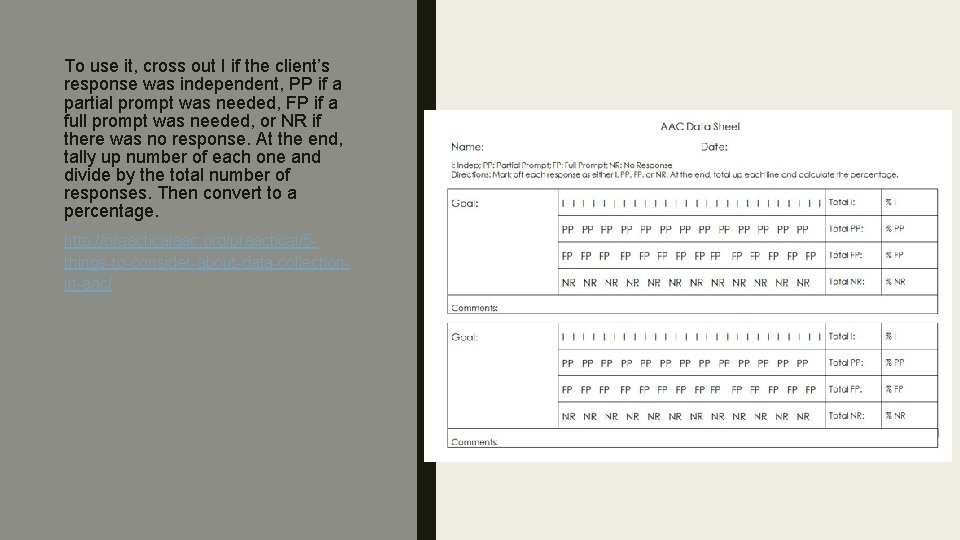
To use it, cross out I if the client’s response was independent, PP if a partial prompt was needed, FP if a full prompt was needed, or NR if there was no response. At the end, tally up number of each one and divide by the total number of responses. Then convert to a percentage. http: //praacticalaac. org/praactical/5 things-to-consider-about-data-collectionin-aac/
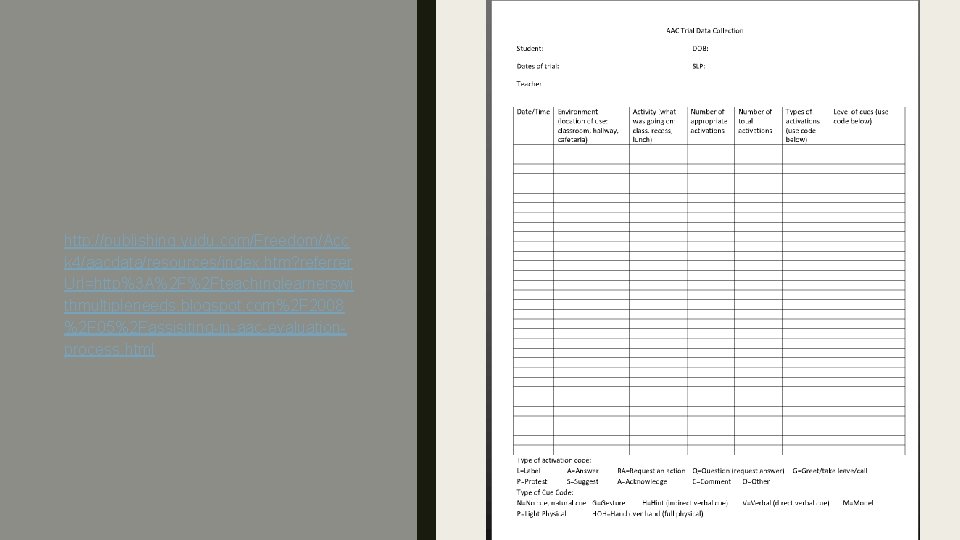
http: //publishing. yudu. com/Freedom/Acc k 4/aacdata/resources/index. htm? referrer Url=http%3 A%2 F%2 Fteachinglearnerswi thmultipleneeds. blogspot. com%2 F 2008 %2 F 05%2 Fassisiting-in-aac-evaluationprocess. html
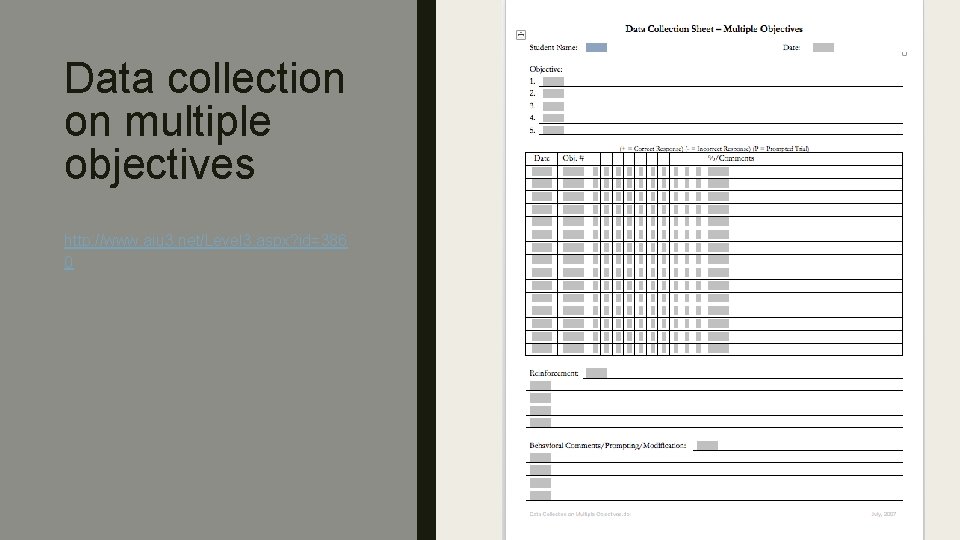
Data collection on multiple objectives http: //www. aiu 3. net/Level 3. aspx? id=386 0
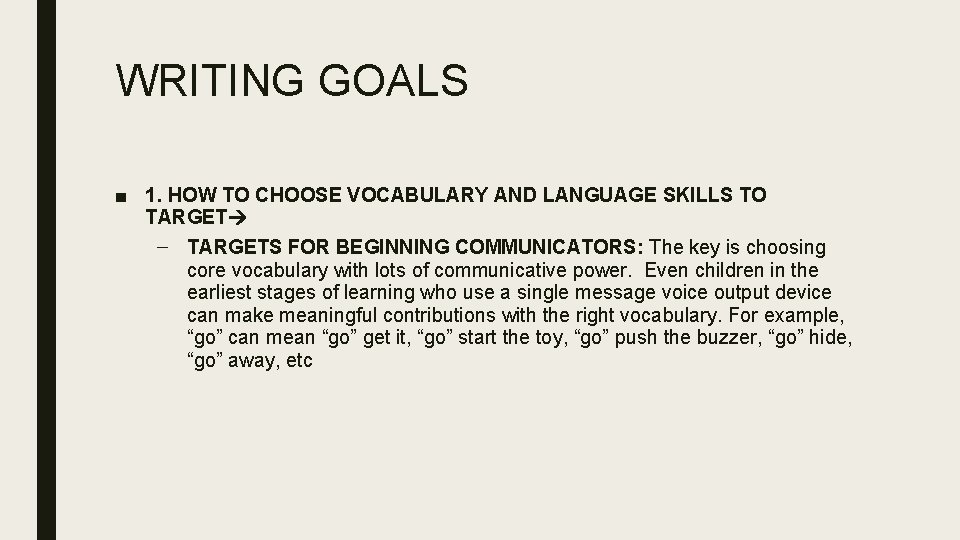
WRITING GOALS ■ 1. HOW TO CHOOSE VOCABULARY AND LANGUAGE SKILLS TO TARGET – TARGETS FOR BEGINNING COMMUNICATORS: The key is choosing core vocabulary with lots of communicative power. Even children in the earliest stages of learning who use a single message voice output device can make meaningful contributions with the right vocabulary. For example, “go” can mean “go” get it, “go” start the toy, “go” push the buzzer, “go” hide, “go” away, etc
■ 2. INCLUDE LEVEL OF PROMPTING IN THE GOAL
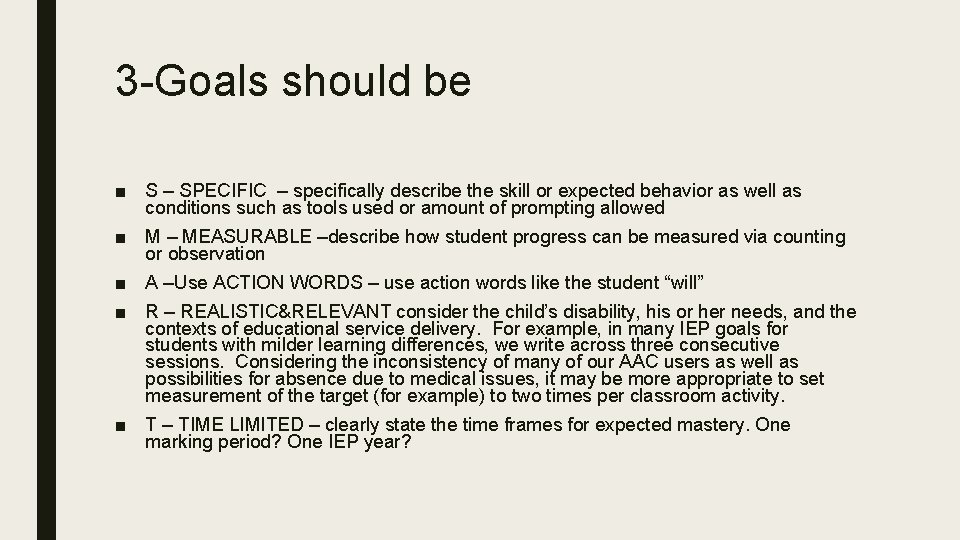
3 -Goals should be ■ S – SPECIFIC – specifically describe the skill or expected behavior as well as conditions such as tools used or amount of prompting allowed ■ M – MEASURABLE –describe how student progress can be measured via counting or observation ■ A –Use ACTION WORDS – use action words like the student “will” ■ R – REALISTIC&RELEVANT consider the child’s disability, his or her needs, and the contexts of educational service delivery. For example, in many IEP goals for students with milder learning differences, we write across three consecutive sessions. Considering the inconsistency of many of our AAC users as well as possibilities for absence due to medical issues, it may be more appropriate to set measurement of the target (for example) to two times per classroom activity. ■ T – TIME LIMITED – clearly state the time frames for expected mastery. One marking period? One IEP year?
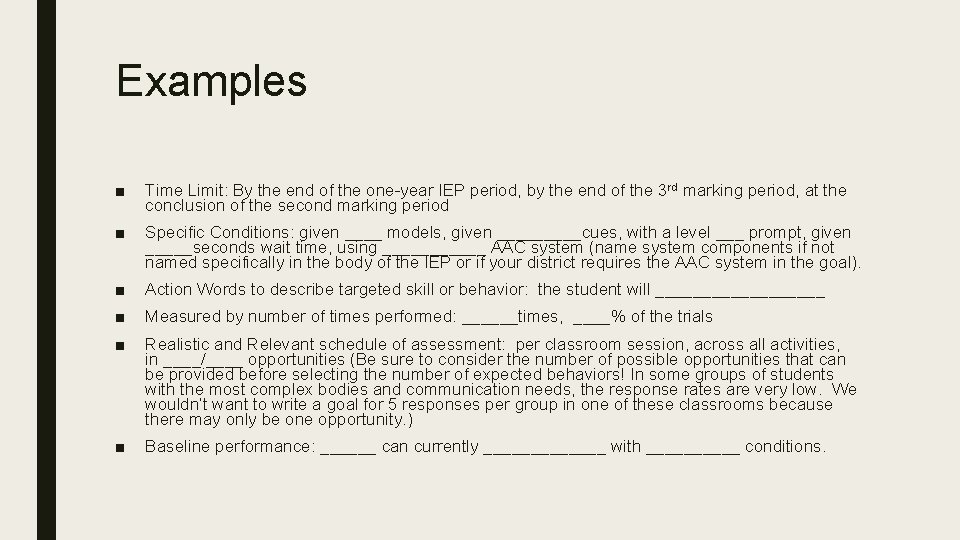
Examples ■ Time Limit: By the end of the one-year IEP period, by the end of the 3 rd marking period, at the conclusion of the second marking period ■ Specific Conditions: given ____ models, given _____cues, with a level ___ prompt, given _____seconds wait time, using ______ AAC system (name system components if not named specifically in the body of the IEP or if your district requires the AAC system in the goal). ■ Action Words to describe targeted skill or behavior: the student will _________ ■ Measured by number of times performed: ______times, ____% of the trials ■ Realistic and Relevant schedule of assessment: per classroom session, across all activities, in ____/____ opportunities (Be sure to consider the number of possible opportunities that can be provided before selecting the number of expected behaviors! In some groups of students with the most complex bodies and communication needs, the response rates are very low. We wouldn’t want to write a goal for 5 responses per group in one of these classrooms because there may only be one opportunity. ) ■ Baseline performance: ______ can currently _______ with _____ conditions.
■ By the end of the one-year IEP period, following 2 models and a level 2 prompt and 10 seconds of wait time, Gina will use her AAC system to request recurrence of an activity with the word “more” in a 30 -minute classroom activity with 4/5 opportunities.
■ Linguistic Competence 1. Student will use his/her core word communication board to express sentences of at least 3 words to participate in classroom activities. 3. Given a field of at least 5 options, student will use his AAC system to choose the preferred over the non-preferred at least twice per activity. Social Competence 1. Student will use her AAC system to ask partner-focused questions (e. g. , What do you think? How about you? What’s new? ) to one adult and one peer. 2. Student will use his AAC system to invite a peer to play. 3. Given her AAC system, student will interact with a peer and take 3 -4 conversational turns that relate to the topic at hand. 4. Student will use his AAC system to greet peers when they enter/leave at least 10 times/day. – Strategic Competence 3. Student will use a single message device to ask partners to wait while a full message is constructed. 4. Student will set the topic prior to shifting to a new subject of conversation. – Operational Competence 1. Student will adjust the volume to accommodate the noise level of the environment. 2. Given a dynamic screen AAC device or app, the student will navigate from the core language screen to at least 4 other screens. 3. Student will type 3 letters, check prediction window, and select the desired word or continue typing.
Goals That Matter • Goals That Matter DO address skills that make the communicator happier or more independent. • Goals That Matter DO teach things that enable the communicator to be a more efficient learner. • Goals That Matter DO provide a strong foundation for further language development. • Goals That Matter DO positively influence how other people treat the communicator. • Goals That Matter DON’T address a skill just because the communicator missed it on a test/ evaluation instrument. • Goals That Matter DON’T teach something just because it is part of a goal sequence that someone developed for a generic program. • Goals That Matter DON’T assume that because someone hasn’t mastered ‘early skills’ that ‘later skills’ are out of the question
■ http: //praacticalaac. org/praactical-aac-goals/ ■ https: //docs. google. com/file/d/0 By. EK 0 Raj. LVWz. QXY 2 Qn. Jnbj. ZZc. Fk/edit
Let us now, share our Individual experiences with each client in the clinic ■ How you collect data ■ Goals ■ Any concerns ■ Difficulties faced