Culture What do people mean when they say
- Slides: 17
Culture What do people mean when they say: “You are cultured”?
Culture w Material Culture: the w All the shared physical objects that products of a people create. human group. w Includes physical w Nonmaterial Culture: abstract objects, beliefs, human creations. values, and w Society: group of behaviors. mutually w Methods by interdependent which collections people who have of people deal organized in a way with their to share a common environment. culture.
Components of Culture w Culture is learned and shared. w Specific components vary among societies and changes occur over time. w Culture Lag: when nonmaterial culture can’t keep up with material culture. w Symbols: stands for something else - shared meaning attached to it. w Language: organization of written or spoken symbols into a standardized system.
Components continued… w Values: shared beliefs about what is good or bad, right or wrong, desirable or undesirable, beautiful or ugly. w Norms: the shared rules of conduct that tell people how to act in specific situations (expectations) based on a community’s shared values. w Based on who and where the individual is.
American Value System w Certain values are shared by the majority of Americans. w Value systems change due to various social factors, which leads to value conflicts as some values change over time. Value Cluster: values that fit together to form a larger whole. Value Contradiction: to follow one, means you must given up another
Some American Values w Certain values are shared by the majority of Americans: w w w w Personal Achievement/Success Work Morality Humanitarianism Efficiency Practicality Material Comfort Equity w w w Democracy Freedom Self-Fulfillment Leisure Physical Fitness Youthfulness Environmental Concerns Individualism Science/Technology Education Religiosity Romantic Love
Norms more in depth… w One who breaks the norms = deviant. w Some people are expected to behave in certain ways based on their specific role. w Folkways: norms that do not have great moral significance attached to them (the etiquette and customs of a people that are not of critical importance to the society). • Mores: have great moral significance attached to them (violation of them endangers the well-being and stability of society). • Taboo: a norm so strong that it often brings revulsion if violated.
What makes people in society conform to norms? w Social Control: means by which social norms are upheld and enforced. w Internalization: belief that the norm is good, useful or appropriate - becomes part of an individual’s personality. w Sanctions: rewards or punishments that a society sets up to enforce the norms.
Sanctions continued… w Positive: reward or positive reaction w Negative: expression of disapproval for breaking a norm w Physical or Psychological w Formal vs. Informal w Psychological: address the feelings and emotions of a person. w Informal: unwritten and based on personal relations and public opinion. Moral Holiday: specified times when people are allowed to break a norm Moral Holiday Place: locations where norms are expected to be broken
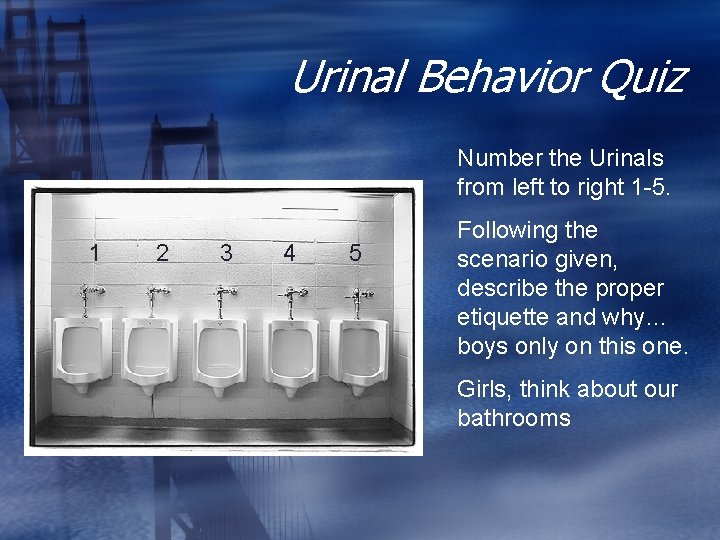
Urinal Behavior Quiz Number the Urinals from left to right 1 -5. 1 2 3 4 5 Following the scenario given, describe the proper etiquette and why… boys only on this one. Girls, think about our bathrooms
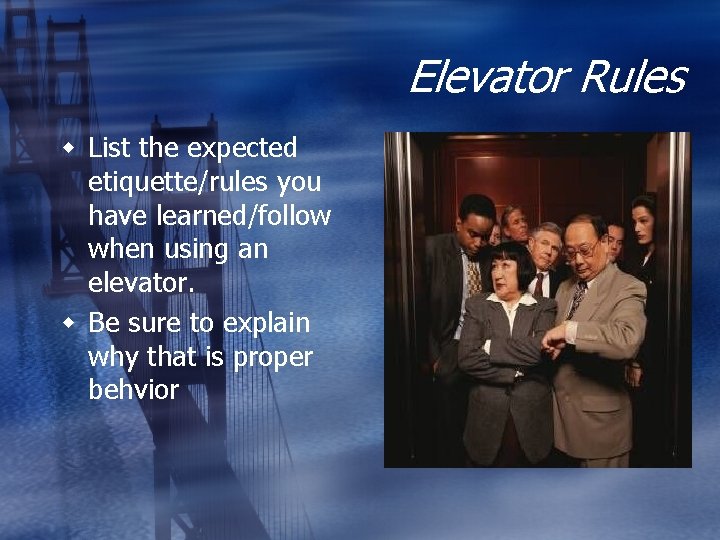
Elevator Rules w List the expected etiquette/rules you have learned/follow when using an elevator. w Be sure to explain why that is proper behvior
Variation among and within Society w Culture Shock: disorientation experienced when we cannot make sense of the world when our nonmaterial culture “fails” us. w Ethnocentrism: the tendency to view one’s own culture and group as superior to others. w Cultural Relativism: cultures should be judged by their own standards of their own culture - viewed from the point of view of the members of that society. w Is there such thing as “normal” and “abnormal” when looking at differences in culture? w Subculture: a group in society that shares values, norms, and behaviors that are not shared by the entire population. w Contra culture: subcultures whose values (outlaw motorcyclists) or activities and goals (terrorists) conflict with mainstream culture. w Counterculture: a group that rejects the values, norms, and practices of the larger society and replaces them with a new set of cultural patterns/practices.
Cultural Diversity and Universals Cultural Diversity w If humans all have the same basic needs, how can cultures be so different? w Cultural Diffusion: the spread of cultural characteristics from one group to another. w Cultural Leveling: process by which cultures become similar to one another. Cultural Universals w Some needs are so basic that all societies must develop ways to ensure their fulfillment. w However human beings have the ability to meet these needs in a vast number of ways. w Example - survival => need to care for young => families. w But are all families the same?
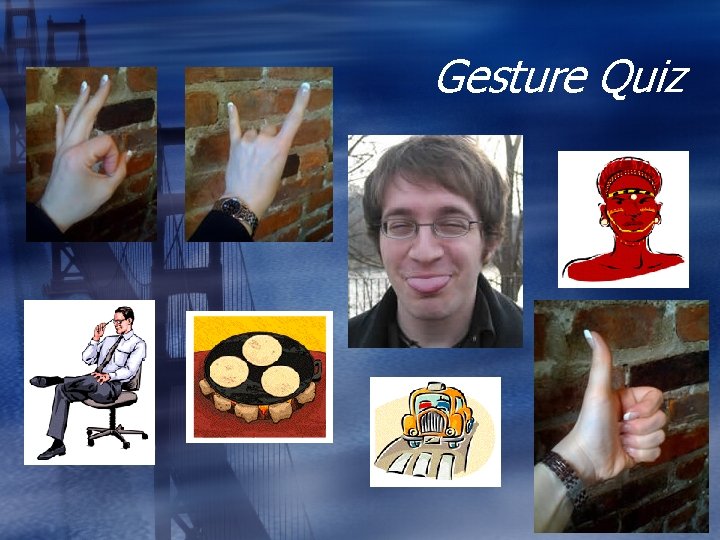
Symbolic Culture w Things people attach meaning to (usually nonmaterial) that they use to communicate. w Gestures: using one’s body to communicate (meanings might change from one culture to the other) w Some gestures are biological. w. Language: organization of written or spoken symbols into a standardized system. w. Provide deeper understanding of what we are communicating w. Represents objects and abstract thought. w. Emoticons: “written gestures” for expressing yourself online whttp: //pc. net/emoticon s/
Language Continued w Allows culture to develop – move beyond immediate experiences. w Provides a social or shared past and future – understand past events (times, dates, places). w Allows for shared perspectives – form a shared understanding that forms the basis of social life w Not sharing a language while living alongside one another, invites miscommunication and suspicion. w Allows complex, shared, and goal-directed behaviors – establish purpose.
Sapir-Whorf Hypothesis w Language creates ways of thinking and perceiving (rather than objects) w In the United States we have learned to classify people (with given titles) – jocks, goths, stoners, skaters, preps, etc. w Because of that we will perceive people in an entirely different way from someone who does not know these classifications.
Gesture Quiz