CSE 408 Fundamentals of Data Structure Lecture 2


- Slides: 15
CSE 408 Fundamentals of Data Structure Lecture #2 Copyright © 2007 Pearson Addison-Wesley. All rights reserved. A. Levitin “Introduction to the Design & Analysis of Algorithms, ” 2 nd ed. , Ch. 1
Fundamental data structures b list b graph • array b tree and binary tree • linked list b set and dictionary • string b stack b queue b priority queue/heap Copyright © 2007 Pearson Addison-Wesley. All rights reserved. A. Levitin “Introduction to the Design & Analysis of Algorithms, ” 2 nd ed. , Ch. 1
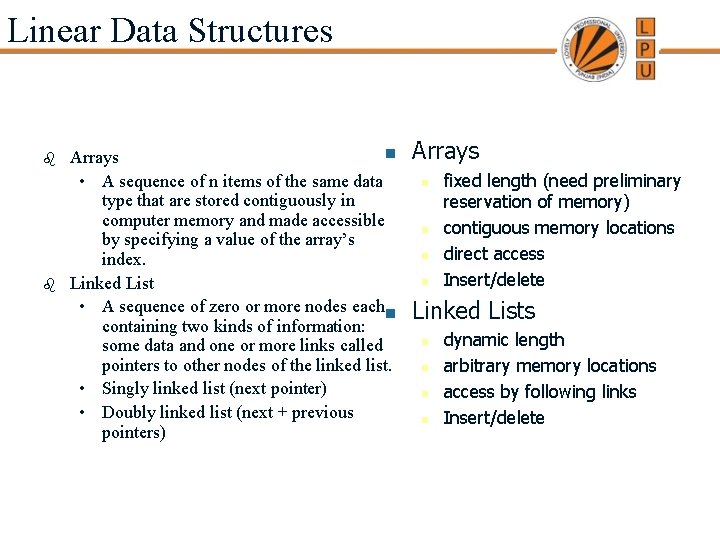
Linear Data Structures b b n Arrays • A sequence of n items of the same data type that are stored contiguously in computer memory and made accessible by specifying a value of the array’s index. Linked List • A sequence of zero or more nodes eachn containing two kinds of information: some data and one or more links called pointers to other nodes of the linked list. • Singly linked list (next pointer) • Doubly linked list (next + previous pointers) a 1 Copyright © 2007 Pearson Addison-Wesley. All rights reserved. a 2 … Arrays fixed length (need preliminary reservation of memory) contiguous memory locations direct access Insert/delete n n Linked Lists dynamic length arbitrary memory locations access by following links Insert/delete n n an . A. Levitin “Introduction to the Design & Analysis of Algorithms, ” 2 nd ed. , Ch. 1
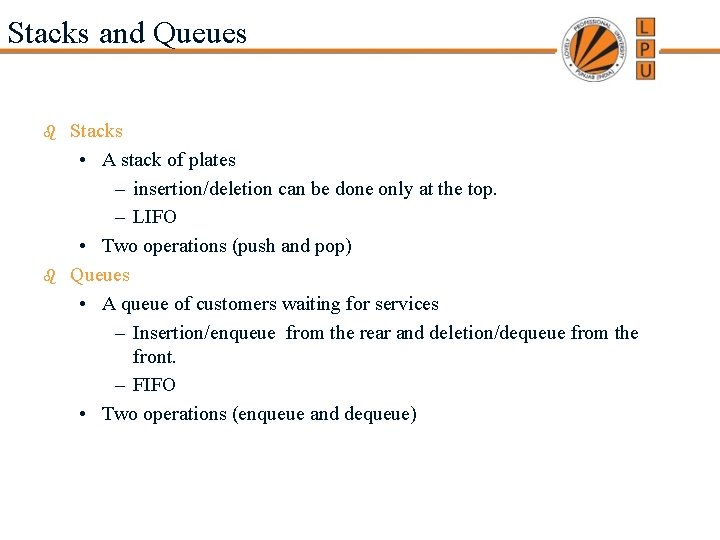
Stacks and Queues b b Stacks • A stack of plates – insertion/deletion can be done only at the top. – LIFO • Two operations (push and pop) Queues • A queue of customers waiting for services – Insertion/enqueue from the rear and deletion/dequeue from the front. – FIFO • Two operations (enqueue and dequeue) Copyright © 2007 Pearson Addison-Wesley. All rights reserved. A. Levitin “Introduction to the Design & Analysis of Algorithms, ” 2 nd ed. , Ch. 1
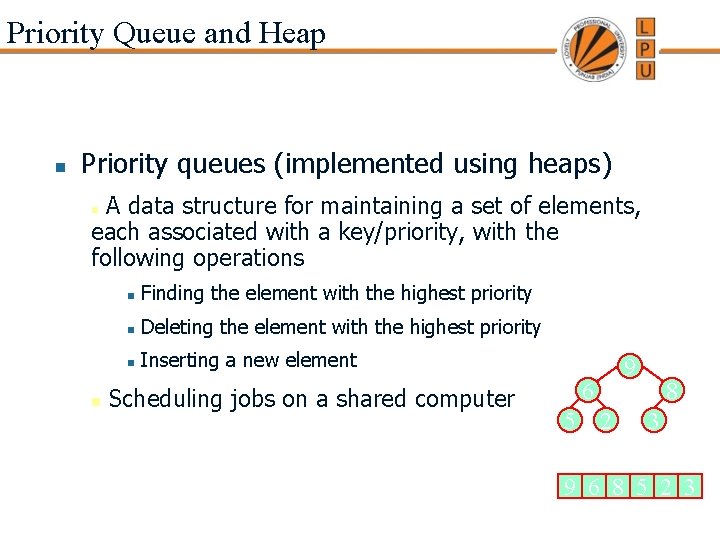
Priority Queue and Heap n Priority queues (implemented using heaps) A data structure for maintaining a set of elements, each associated with a key/priority, with the following operations n n n Finding the element with the highest priority n Deleting the element with the highest priority n Inserting a new element Scheduling jobs on a shared computer 9 6 5 2 8 3 9 6 8 5 2 3 Copyright © 2007 Pearson Addison-Wesley. All rights reserved. A. Levitin “Introduction to the Design & Analysis of Algorithms, ” 2 nd ed. , Ch. 1
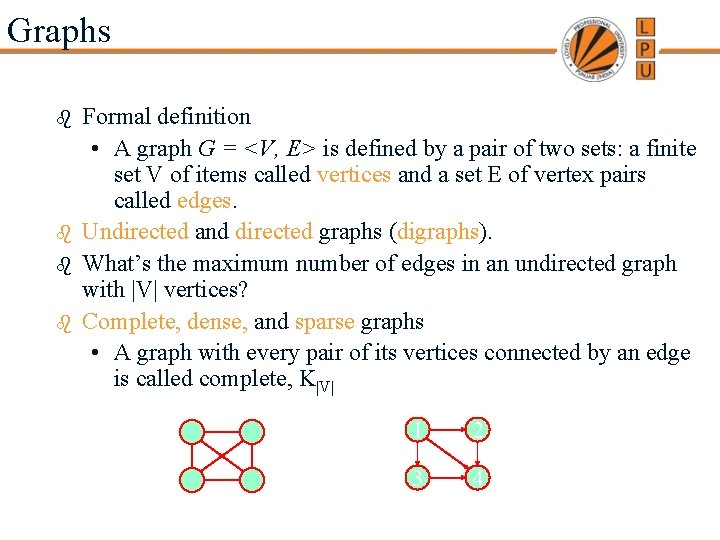
Graphs b b Formal definition • A graph G = <V, E> is defined by a pair of two sets: a finite set V of items called vertices and a set E of vertex pairs called edges. Undirected and directed graphs (digraphs). What’s the maximum number of edges in an undirected graph with |V| vertices? Complete, dense, and sparse graphs • A graph with every pair of its vertices connected by an edge is called complete, K|V| Copyright © 2007 Pearson Addison-Wesley. All rights reserved. 1 2 3 4 A. Levitin “Introduction to the Design & Analysis of Algorithms, ” 2 nd ed. , Ch. 1
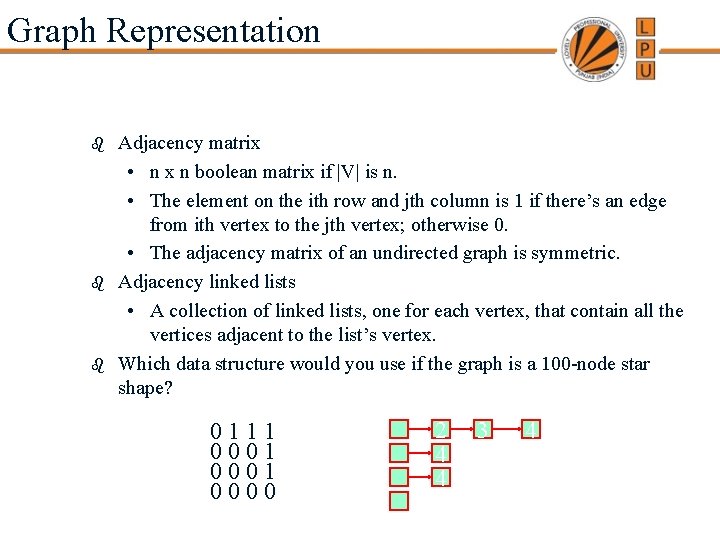
Graph Representation b b b Adjacency matrix • n x n boolean matrix if |V| is n. • The element on the ith row and jth column is 1 if there’s an edge from ith vertex to the jth vertex; otherwise 0. • The adjacency matrix of an undirected graph is symmetric. Adjacency linked lists • A collection of linked lists, one for each vertex, that contain all the vertices adjacent to the list’s vertex. Which data structure would you use if the graph is a 100 -node star shape? 0111 0001 0000 Copyright © 2007 Pearson Addison-Wesley. All rights reserved. 2 4 4 3 4 A. Levitin “Introduction to the Design & Analysis of Algorithms, ” 2 nd ed. , Ch. 1
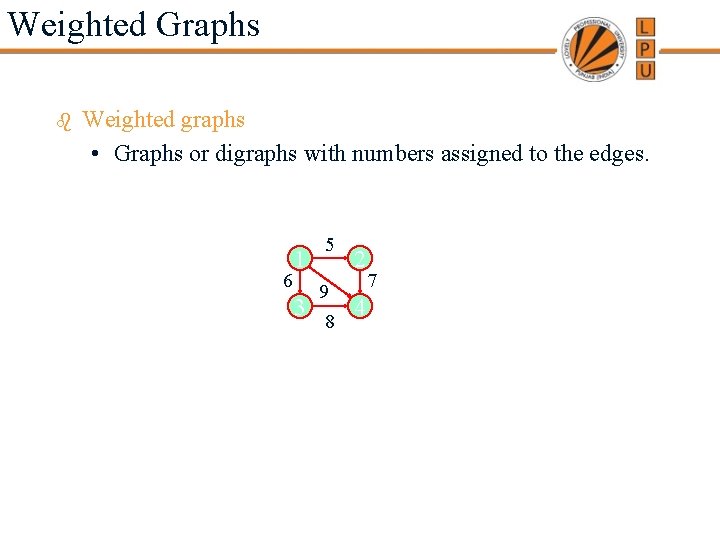
Weighted Graphs b Weighted graphs • Graphs or digraphs with numbers assigned to the edges. 6 1 3 Copyright © 2007 Pearson Addison-Wesley. All rights reserved. 5 9 8 2 7 4 A. Levitin “Introduction to the Design & Analysis of Algorithms, ” 2 nd ed. , Ch. 1
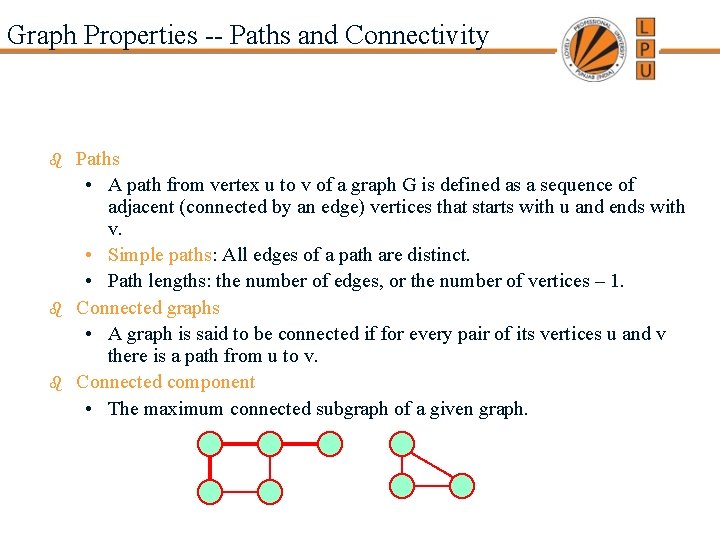
Graph Properties -- Paths and Connectivity b b b Paths • A path from vertex u to v of a graph G is defined as a sequence of adjacent (connected by an edge) vertices that starts with u and ends with v. • Simple paths: All edges of a path are distinct. • Path lengths: the number of edges, or the number of vertices – 1. Connected graphs • A graph is said to be connected if for every pair of its vertices u and v there is a path from u to v. Connected component • The maximum connected subgraph of a given graph. Copyright © 2007 Pearson Addison-Wesley. All rights reserved. A. Levitin “Introduction to the Design & Analysis of Algorithms, ” 2 nd ed. , Ch. 1
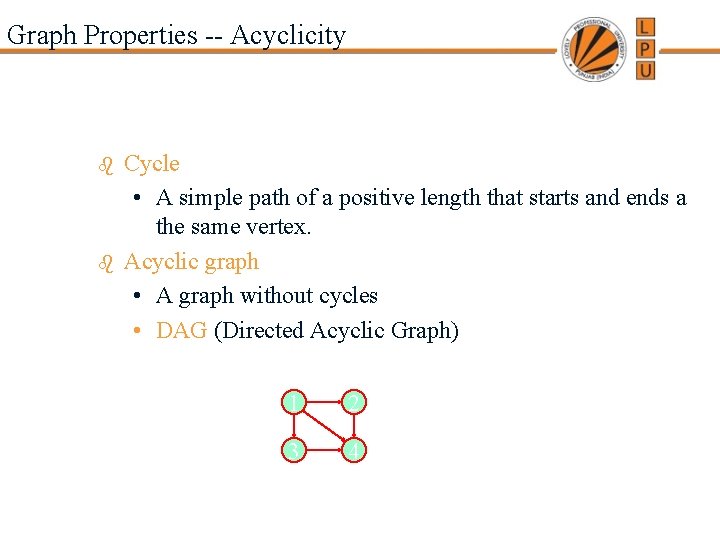
Graph Properties -- Acyclicity b b Cycle • A simple path of a positive length that starts and ends a the same vertex. Acyclic graph • A graph without cycles • DAG (Directed Acyclic Graph) Copyright © 2007 Pearson Addison-Wesley. All rights reserved. 1 2 3 4 A. Levitin “Introduction to the Design & Analysis of Algorithms, ” 2 nd ed. , Ch. 1
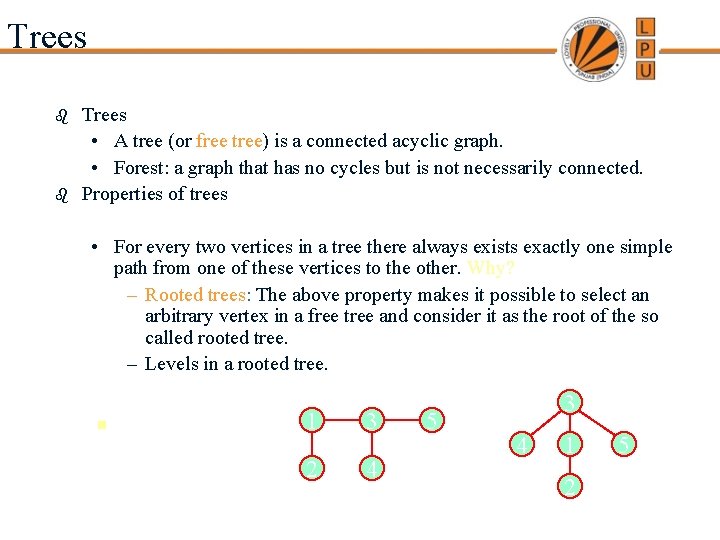
Trees b b Trees • A tree (or free tree) is a connected acyclic graph. • Forest: a graph that has no cycles but is not necessarily connected. Properties of trees • For every two vertices in a tree there always exists exactly one simple path from one of these vertices to the other. Why? – Rooted trees: The above property makes it possible to select an arbitrary vertex in a free tree and consider it as the root of the so called rooted tree. – Levels in a rooted tree. n |E| = |V| - 1 Copyright © 2007 Pearson Addison-Wesley. All rights reserved. 1 3 2 4 5 rooted 3 4 1 5 2 A. Levitin “Introduction to the Design & Analysis of Algorithms, ” 2 nd ed. , Ch. 1
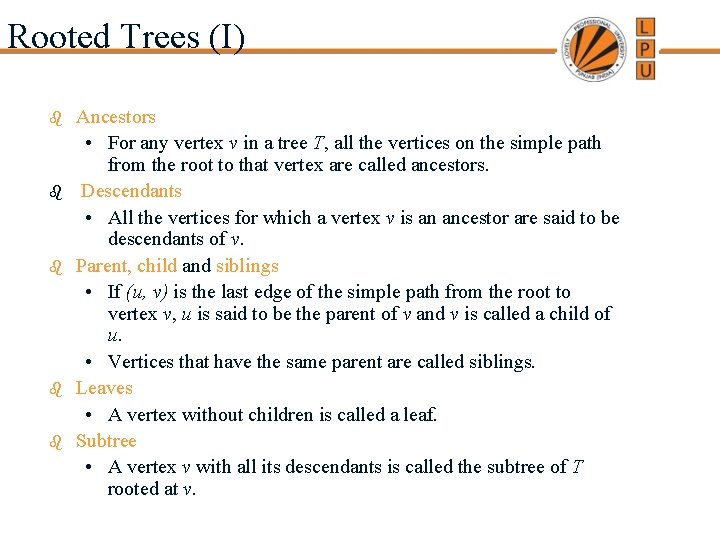
Rooted Trees (I) b b b Ancestors • For any vertex v in a tree T, all the vertices on the simple path from the root to that vertex are called ancestors. Descendants • All the vertices for which a vertex v is an ancestor are said to be descendants of v. Parent, child and siblings • If (u, v) is the last edge of the simple path from the root to vertex v, u is said to be the parent of v and v is called a child of u. • Vertices that have the same parent are called siblings. Leaves • A vertex without children is called a leaf. Subtree • A vertex v with all its descendants is called the subtree of T rooted at v. Copyright © 2007 Pearson Addison-Wesley. All rights reserved. A. Levitin “Introduction to the Design & Analysis of Algorithms, ” 2 nd ed. , Ch. 1
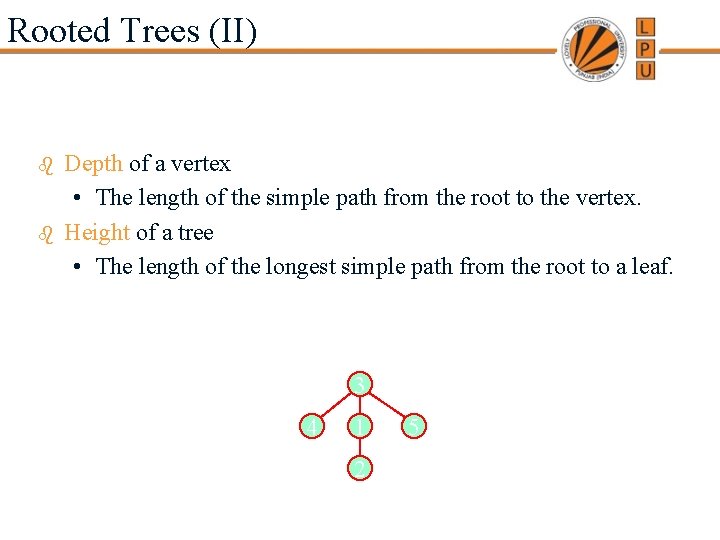
Rooted Trees (II) b b Depth of a vertex • The length of the simple path from the root to the vertex. Height of a tree • The length of the longest simple path from the root to a leaf. h=2 3 4 1 5 2 Copyright © 2007 Pearson Addison-Wesley. All rights reserved. A. Levitin “Introduction to the Design & Analysis of Algorithms, ” 2 nd ed. , Ch. 1
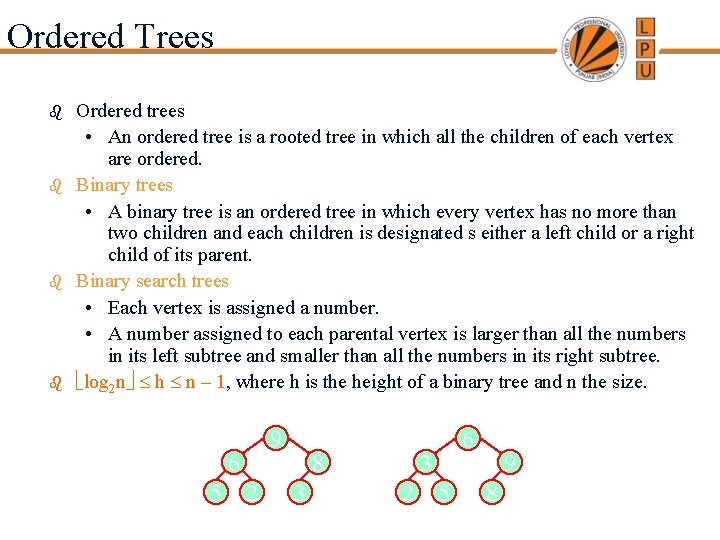
Ordered Trees b b Ordered trees • An ordered tree is a rooted tree in which all the children of each vertex are ordered. Binary trees • A binary tree is an ordered tree in which every vertex has no more than two children and each children is designated s either a left child or a right child of its parent. Binary search trees • Each vertex is assigned a number. • A number assigned to each parental vertex is larger than all the numbers in its left subtree and smaller than all the numbers in its right subtree. log 2 n h n – 1, where h is the height of a binary tree and n the size. 6 9 5 2 Copyright © 2007 Pearson Addison-Wesley. All rights reserved. 8 3 3 2 5 6 9 8 A. Levitin “Introduction to the Design & Analysis of Algorithms, ” 2 nd ed. , Ch. 1
k n a Th Copyright © 2007 Pearson Addison-Wesley. All rights reserved. ! ! ! u o Y A. Levitin “Introduction to the Design & Analysis of Algorithms, ” 2 nd ed. , Ch. 1