CS 149 Operating Systems March 5 Class Meeting
- Slides: 31
CS 149: Operating Systems March 5 Class Meeting Department of Computer Science San Jose State University Spring 2015 Instructor: Ron Mak www. cs. sjsu. edu/~mak
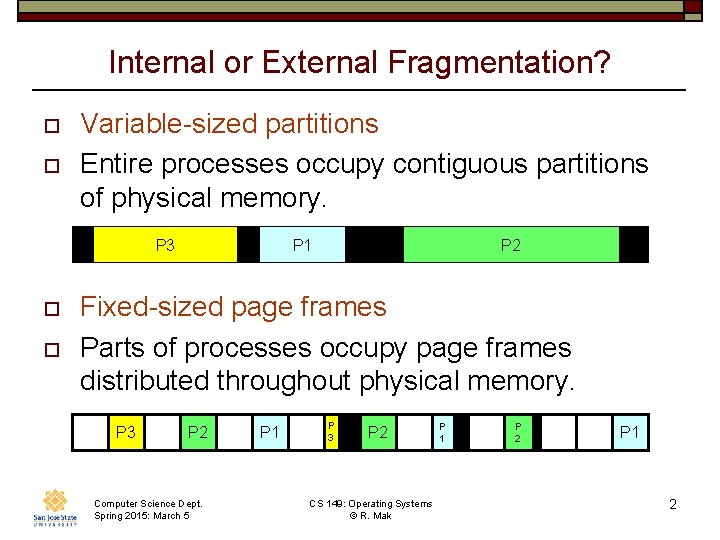
Internal or External Fragmentation? o o Variable-sized partitions Entire processes occupy contiguous partitions of physical memory. P 3 o o P 1 P 2 Fixed-sized page frames Parts of processes occupy page frames distributed throughout physical memory. P 3 P 2 Computer Science Dept. Spring 2015: March 5 P 1 P 3 P 2 CS 149: Operating Systems © R. Mak P 1 P 2 P 1 2
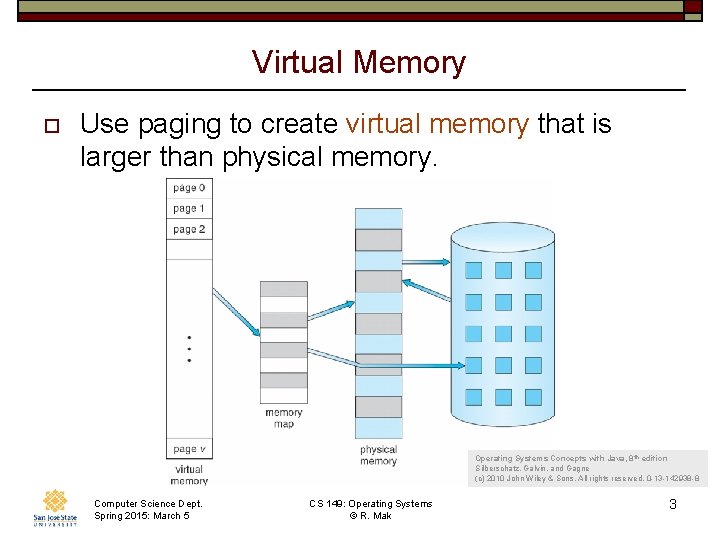
Virtual Memory o Use paging to create virtual memory that is larger than physical memory. Operating Systems Concepts with Java, 8 th edition Silberschatz, Galvin, and Gagne (c) 2010 John Wiley & Sons. All rights reserved. 0 -13 -142938 -8 Computer Science Dept. Spring 2015: March 5 CS 149: Operating Systems © R. Mak 3
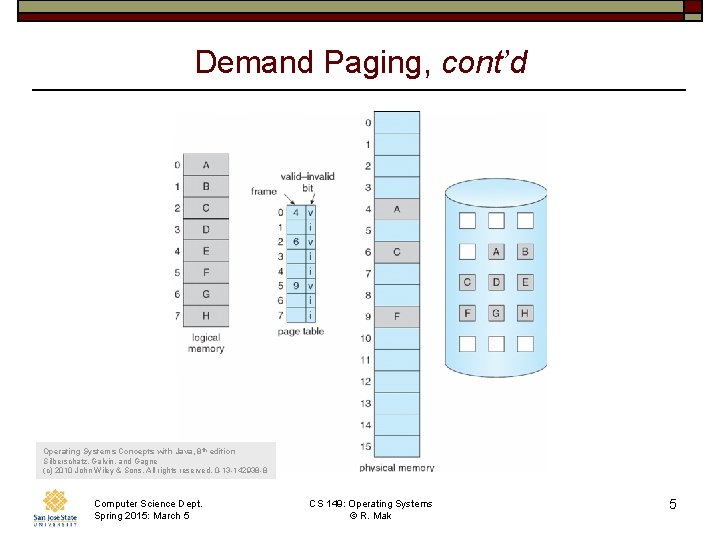
Demand Paging o Unlike swapping, not all of a program needs to be loaded into memory at once. o Only load program pages when needed. o Pages that are never accessed are never loaded. Computer Science Dept. Spring 2015: March 5 CS 149: Operating Systems © R. Mak 4
Demand Paging, cont’d Operating Systems Concepts with Java, 8 th edition Silberschatz, Galvin, and Gagne (c) 2010 John Wiley & Sons. All rights reserved. 0 -13 -142938 -8 Computer Science Dept. Spring 2015: March 5 CS 149: Operating Systems © R. Mak 5
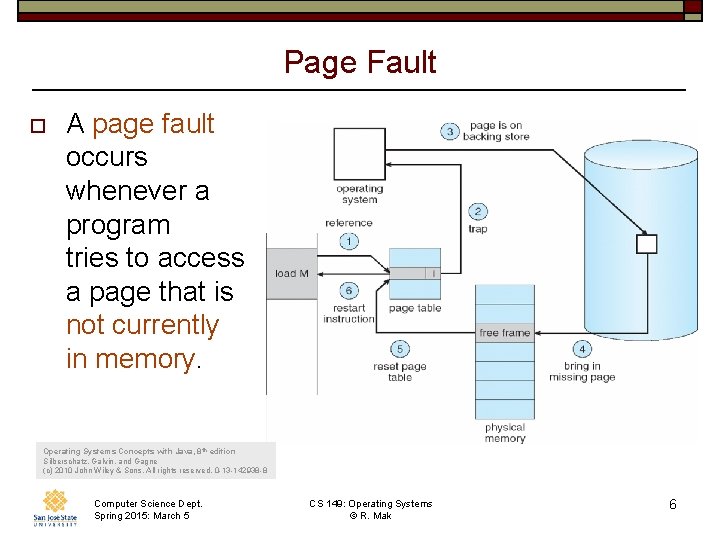
Page Fault o A page fault occurs whenever a program tries to access a page that is not currently in memory. Operating Systems Concepts with Java, 8 th edition Silberschatz, Galvin, and Gagne (c) 2010 John Wiley & Sons. All rights reserved. 0 -13 -142938 -8 Computer Science Dept. Spring 2015: March 5 CS 149: Operating Systems © R. Mak 6
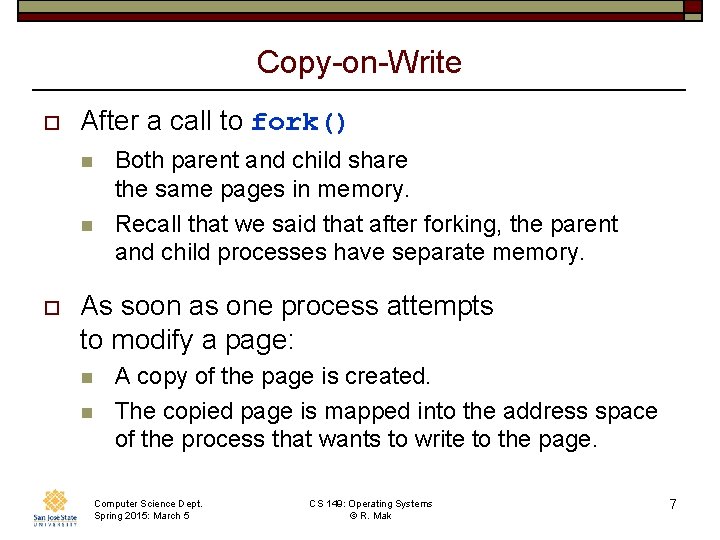
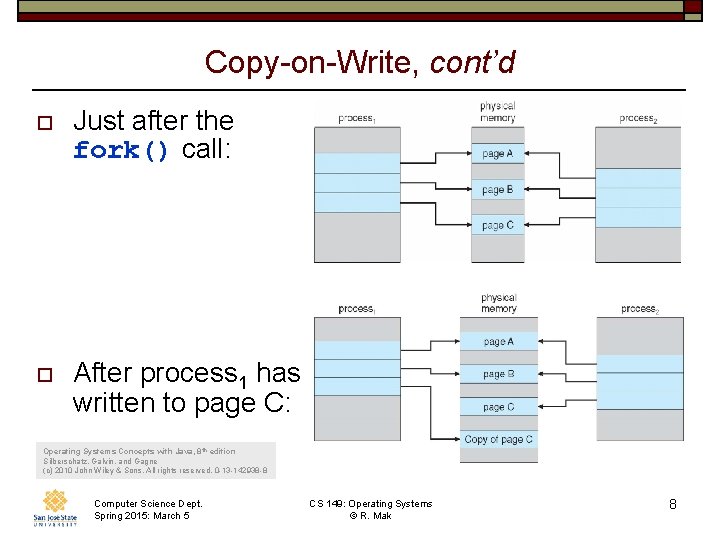
Copy-on-Write o After a call to fork() n n o Both parent and child share the same pages in memory. Recall that we said that after forking, the parent and child processes have separate memory. As soon as one process attempts to modify a page: n n A copy of the page is created. The copied page is mapped into the address space of the process that wants to write to the page. Computer Science Dept. Spring 2015: March 5 CS 149: Operating Systems © R. Mak 7
Copy-on-Write, cont’d o Just after the fork() call: o After process 1 has written to page C: Operating Systems Concepts with Java, 8 th edition Silberschatz, Galvin, and Gagne (c) 2010 John Wiley & Sons. All rights reserved. 0 -13 -142938 -8 Computer Science Dept. Spring 2015: March 5 CS 149: Operating Systems © R. Mak 8
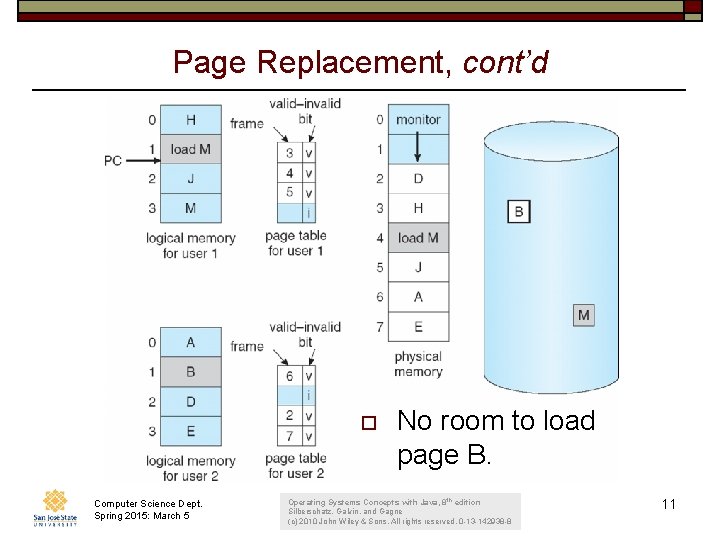
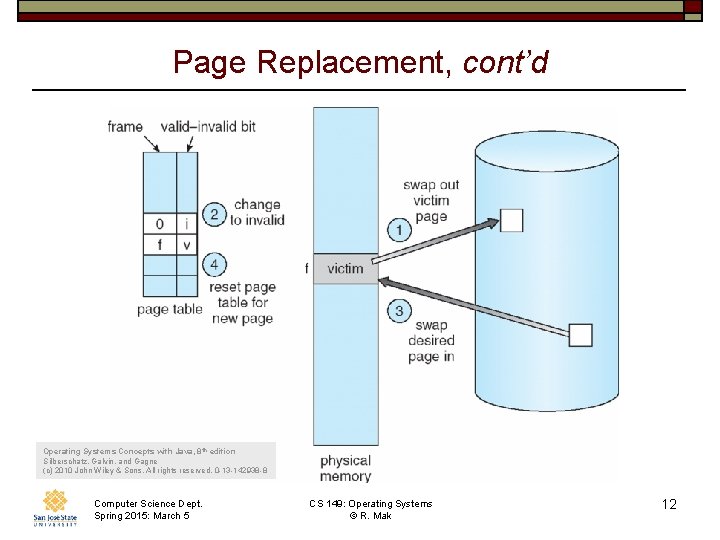
Page Replacement o When a page fault occurs, the operating system must choose a “victim” page to evict from memory to make room for the page to be loaded from disk. o If the victim page has not been modified, then its copy on disk is up-to-date. Computer Science Dept. Spring 2015: March 5 CS 149: Operating Systems © R. Mak 9
Page Replacement o If the victim page has been modified, then the page must be written to disk. n o Overwrite the old page. Which page should be evicted from memory? n Several algorithms to decide. Computer Science Dept. Spring 2015: March 5 CS 149: Operating Systems © R. Mak 10
Page Replacement, cont’d o Computer Science Dept. Spring 2015: March 5 No room to load page B. Operating Systems Concepts with Java, 8 th edition CS 149: Operating Systems Silberschatz, Galvin, and Gagne © R. Mak (c) 2010 John Wiley & Sons. All rights reserved. 0 -13 -142938 -8 11
Page Replacement, cont’d Operating Systems Concepts with Java, 8 th edition Silberschatz, Galvin, and Gagne (c) 2010 John Wiley & Sons. All rights reserved. 0 -13 -142938 -8 Computer Science Dept. Spring 2015: March 5 CS 149: Operating Systems © R. Mak 12
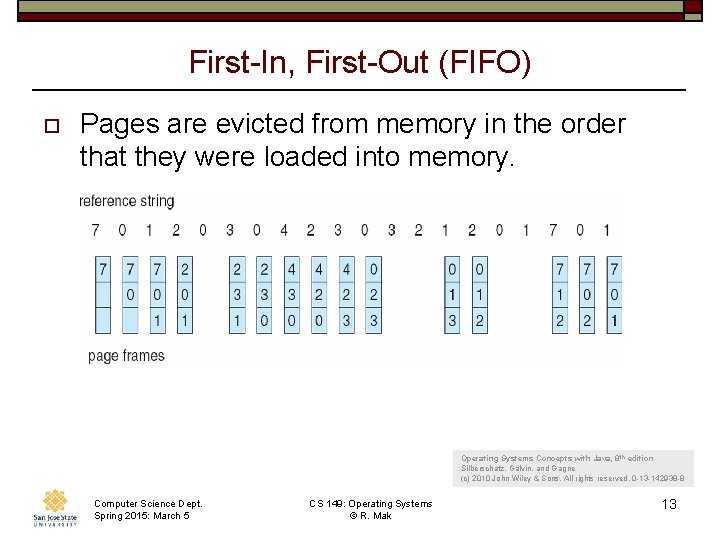
First-In, First-Out (FIFO) o Pages are evicted from memory in the order that they were loaded into memory. Operating Systems Concepts with Java, 8 th edition Silberschatz, Galvin, and Gagne (c) 2010 John Wiley & Sons. All rights reserved. 0 -13 -142938 -8 Computer Science Dept. Spring 2015: March 5 CS 149: Operating Systems © R. Mak 13
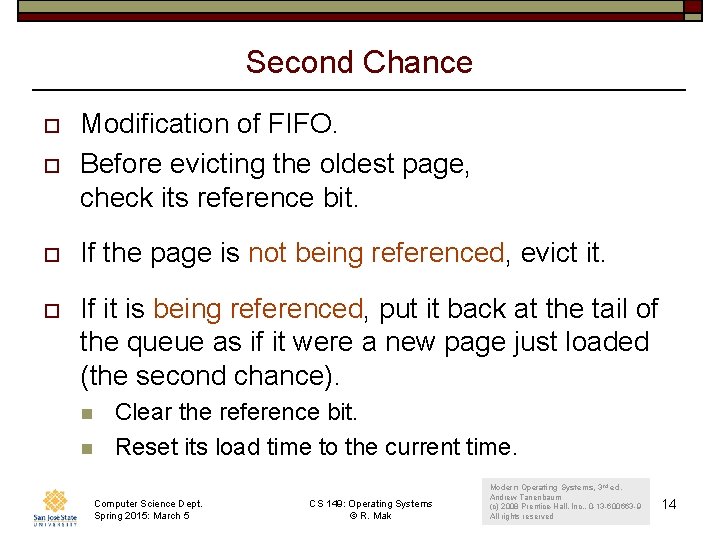
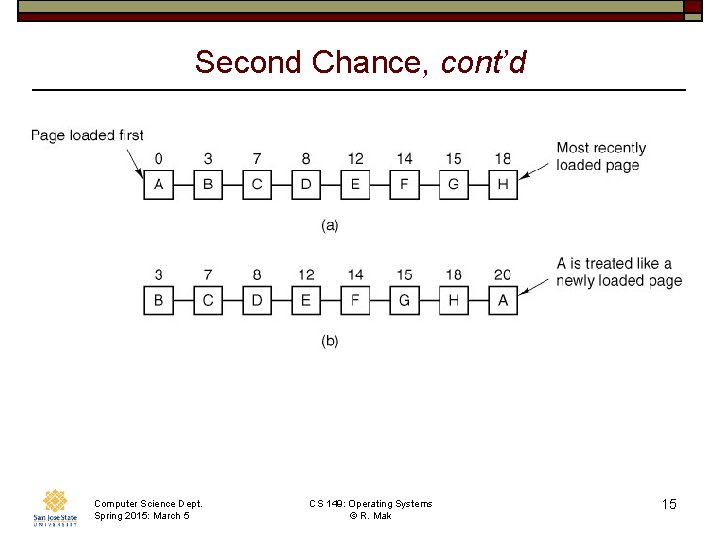
Second Chance o Modification of FIFO. Before evicting the oldest page, check its reference bit. o If the page is not being referenced, evict it. o If it is being referenced, put it back at the tail of the queue as if it were a new page just loaded (the second chance). o n n Clear the reference bit. Reset its load time to the current time. Computer Science Dept. Spring 2015: March 5 CS 149: Operating Systems © R. Mak Modern Operating Systems, 3 rd ed. Andrew Tanenbaum (c) 2008 Prentice-Hall, Inc. . 0 -13 -600663 -9 All rights reserved 14
Second Chance, cont’d Computer Science Dept. Spring 2015: March 5 CS 149: Operating Systems © R. Mak 15
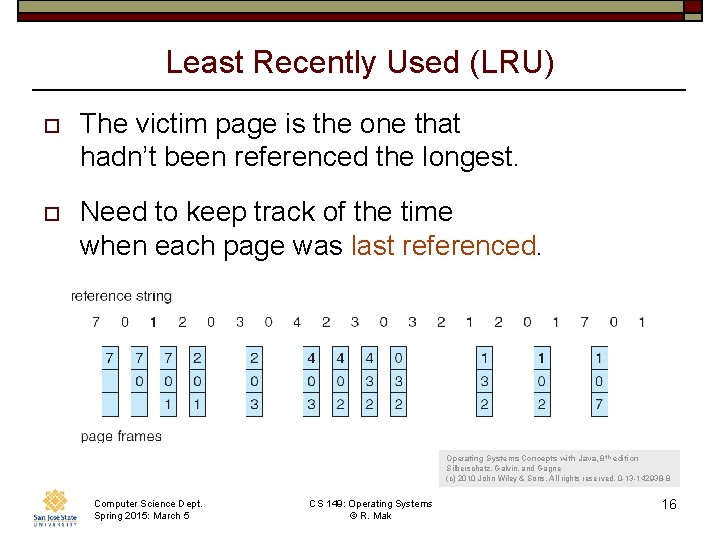
Least Recently Used (LRU) o The victim page is the one that hadn’t been referenced the longest. o Need to keep track of the time when each page was last referenced. Operating Systems Concepts with Java, 8 th edition Silberschatz, Galvin, and Gagne (c) 2010 John Wiley & Sons. All rights reserved. 0 -13 -142938 -8 Computer Science Dept. Spring 2015: March 5 CS 149: Operating Systems © R. Mak 16
Least Frequently Used (LFU) o Evict the page that has the lowest use count. o Problems: n If a page was heavily used at the beginning of a program’s execution, it may stay in memory even if it’s never referenced again. n A page that was just loaded may be the least frequently used page. Reference locality says it will be used again soon. Computer Science Dept. Spring 2015: March 5 CS 149: Operating Systems © R. Mak 17
Most Frequently Used (MFU) o Evict the page that has the highest use count. o Pages with the smallest use count probably just got loaded, and they will be used again soon. Computer Science Dept. Spring 2015: March 5 CS 149: Operating Systems © R. Mak 18
Random Pick o Randomly pick a page to evict. o This can have surprisingly good results. Computer Science Dept. Spring 2015: March 5 CS 149: Operating Systems © R. Mak 19
Working Set o The set of pages a process is currently using. o If a process’s working set can fit in memory, there will be few page faults. Computer Science Dept. Spring 2015: March 5 Operating Concepts with Java, 8 th edition CSSystems 149: Operating Systems Silberschatz, Galvin, and Gagne © R. Mak (c) 2010 John Wiley & Sons. All rights reserved. 0 -13 -142938 -8 20
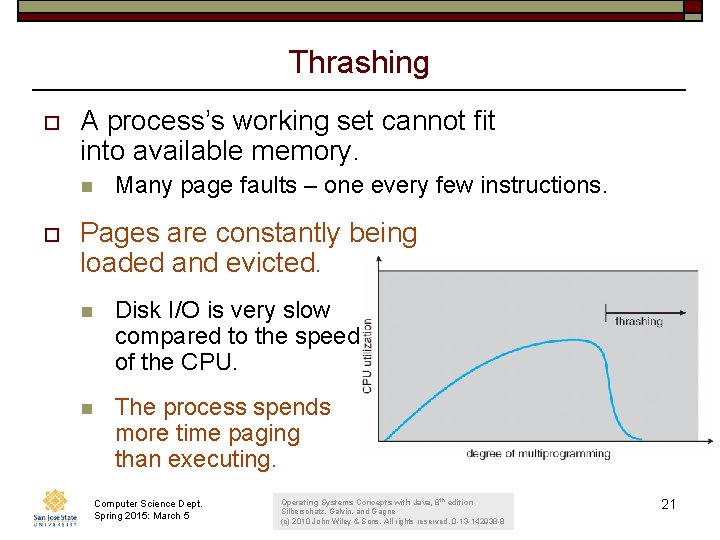
Thrashing o A process’s working set cannot fit into available memory. n o Many page faults – one every few instructions. Pages are constantly being loaded and evicted. n Disk I/O is very slow compared to the speed of the CPU. n The process spends more time paging than executing. Computer Science Dept. Spring 2015: March 5 Operating Concepts with Java, 8 th edition CSSystems 149: Operating Systems Silberschatz, Galvin, and Gagne © R. Mak (c) 2010 John Wiley & Sons. All rights reserved. 0 -13 -142938 -8 21
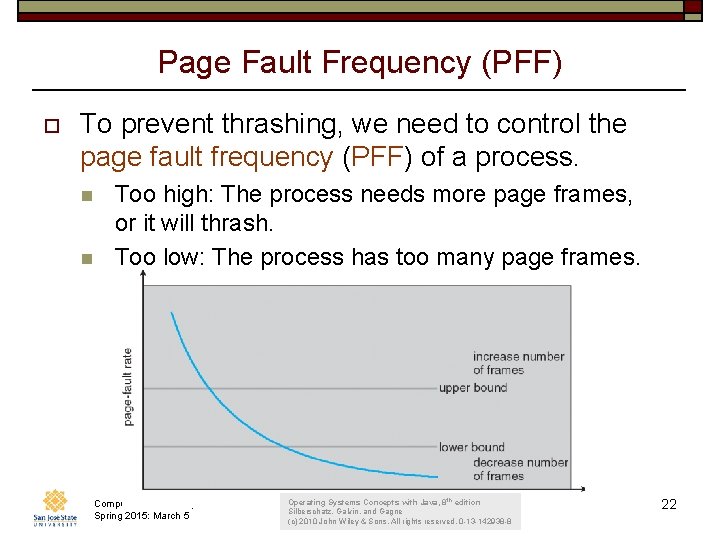
Page Fault Frequency (PFF) o To prevent thrashing, we need to control the page fault frequency (PFF) of a process. n n Too high: The process needs more page frames, or it will thrash. Too low: The process has too many page frames. Computer Science Dept. Spring 2015: March 5 Operating Systems Concepts with Java, 8 th edition CS 149: Operating Systems Silberschatz, Galvin, and Gagne © R. Mak (c) 2010 John Wiley & Sons. All rights reserved. 0 -13 -142938 -8 22
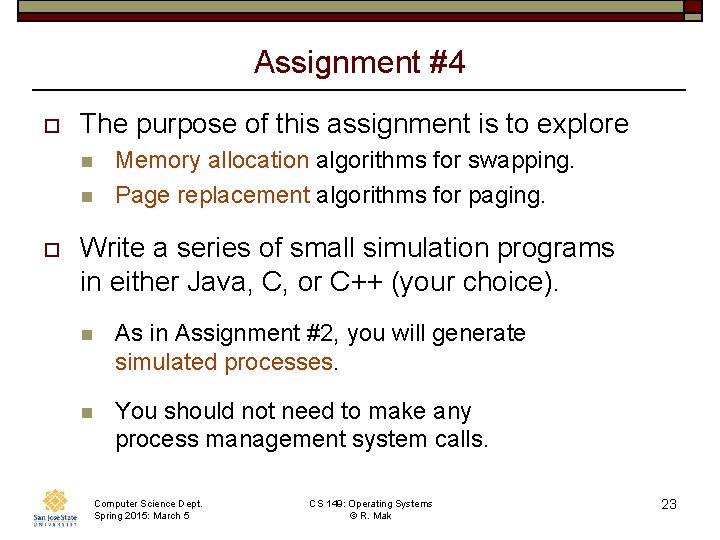
Assignment #4 o The purpose of this assignment is to explore n n o Memory allocation algorithms for swapping. Page replacement algorithms for paging. Write a series of small simulation programs in either Java, C, or C++ (your choice). n As in Assignment #2, you will generate simulated processes. n You should not need to make any process management system calls. Computer Science Dept. Spring 2015: March 5 CS 149: Operating Systems © R. Mak 23
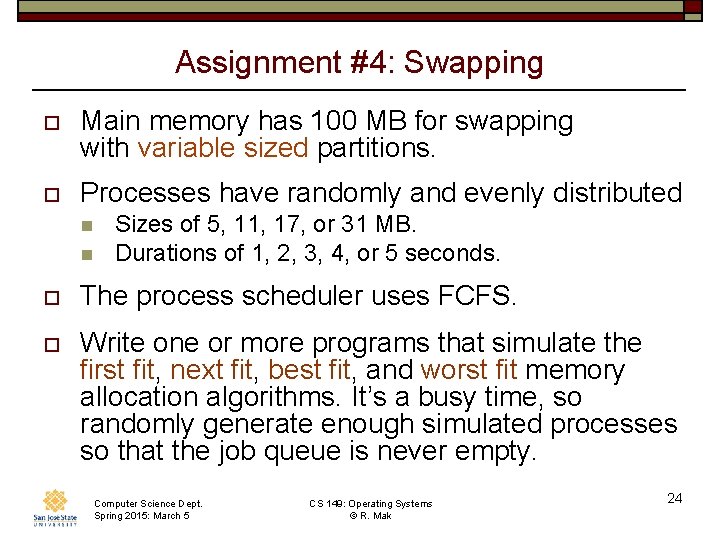
Assignment #4: Swapping o Main memory has 100 MB for swapping with variable sized partitions. o Processes have randomly and evenly distributed n n Sizes of 5, 11, 17, or 31 MB. Durations of 1, 2, 3, 4, or 5 seconds. o The process scheduler uses FCFS. o Write one or more programs that simulate the first fit, next fit, best fit, and worst fit memory allocation algorithms. It’s a busy time, so randomly generate enough simulated processes so that the job queue is never empty. Computer Science Dept. Spring 2015: March 5 CS 149: Operating Systems © R. Mak 24
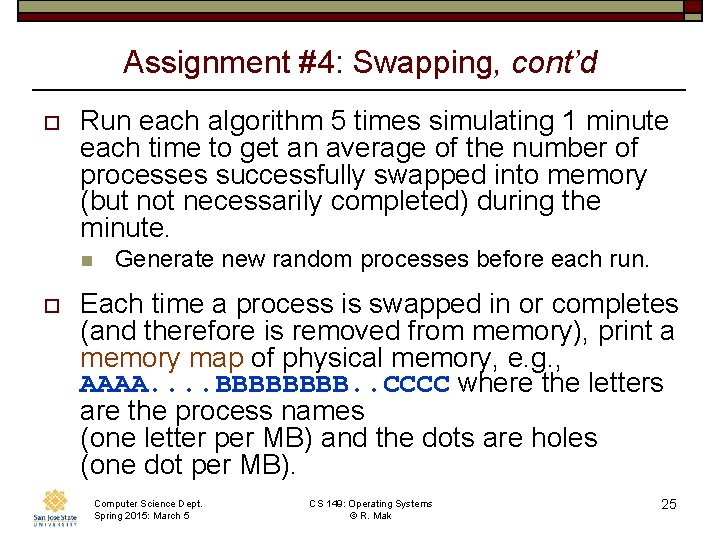
Assignment #4: Swapping, cont’d o Run each algorithm 5 times simulating 1 minute each time to get an average of the number of processes successfully swapped into memory (but not necessarily completed) during the minute. n o Generate new random processes before each run. Each time a process is swapped in or completes (and therefore is removed from memory), print a memory map of physical memory, e. g. , AAAA. . BBBB. . CCCC where the letters are the process names (one letter per MB) and the dots are holes (one dot per MB). Computer Science Dept. Spring 2015: March 5 CS 149: Operating Systems © R. Mak 25
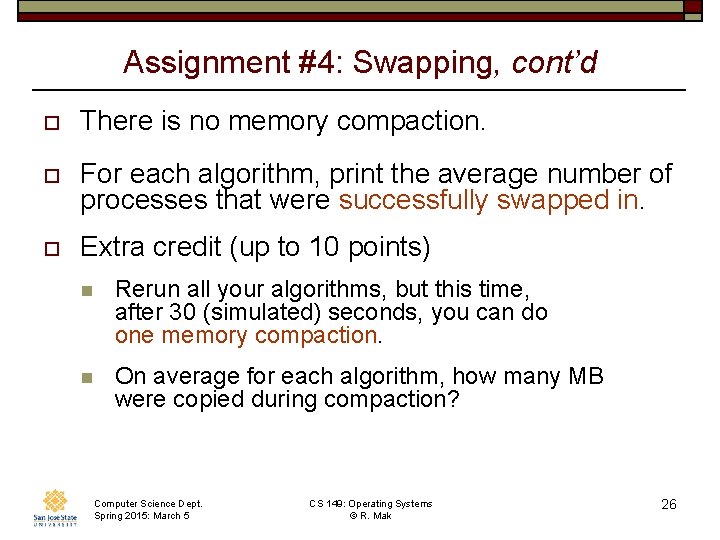
Assignment #4: Swapping, cont’d o There is no memory compaction. o For each algorithm, print the average number of processes that were successfully swapped in. o Extra credit (up to 10 points) n Rerun all your algorithms, but this time, after 30 (simulated) seconds, you can do one memory compaction. n On average for each algorithm, how many MB were copied during compaction? Computer Science Dept. Spring 2015: March 5 CS 149: Operating Systems © R. Mak 26
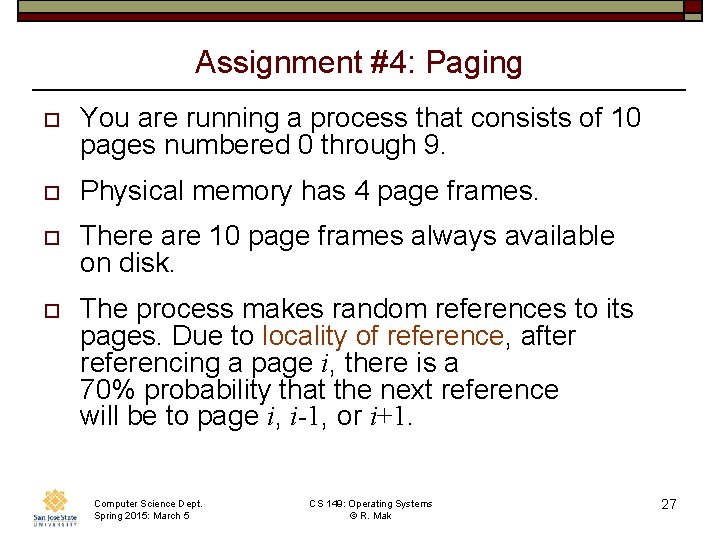
Assignment #4: Paging o You are running a process that consists of 10 pages numbered 0 through 9. o Physical memory has 4 page frames. o There are 10 page frames always available on disk. o The process makes random references to its pages. Due to locality of reference, after referencing a page i, there is a 70% probability that the next reference will be to page i, i-1, or i+1. Computer Science Dept. Spring 2015: March 5 CS 149: Operating Systems © R. Mak 27
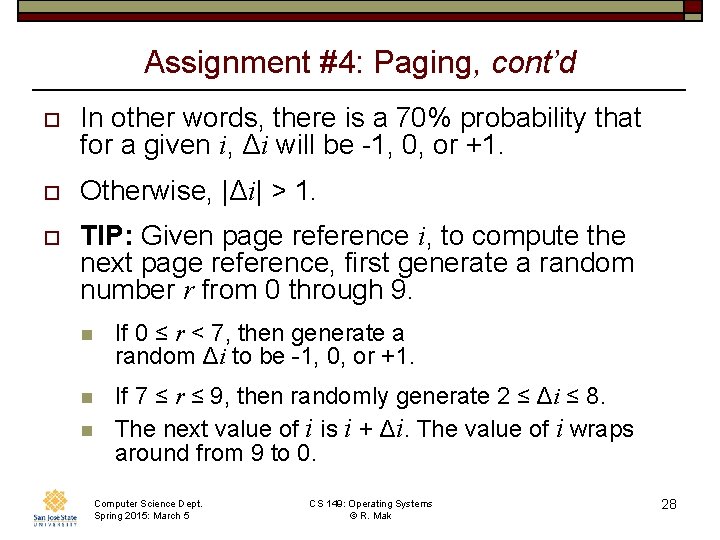
Assignment #4: Paging, cont’d o In other words, there is a 70% probability that for a given i, Δi will be -1, 0, or +1. o Otherwise, |Δi| > 1. o TIP: Given page reference i, to compute the next page reference, first generate a random number r from 0 through 9. n If 0 ≤ r < 7, then generate a random Δi to be -1, 0, or +1. n If 7 ≤ r ≤ 9, then randomly generate 2 ≤ Δi ≤ 8. The next value of i is i + Δi. The value of i wraps around from 9 to 0. n Computer Science Dept. Spring 2015: March 5 CS 149: Operating Systems © R. Mak 28
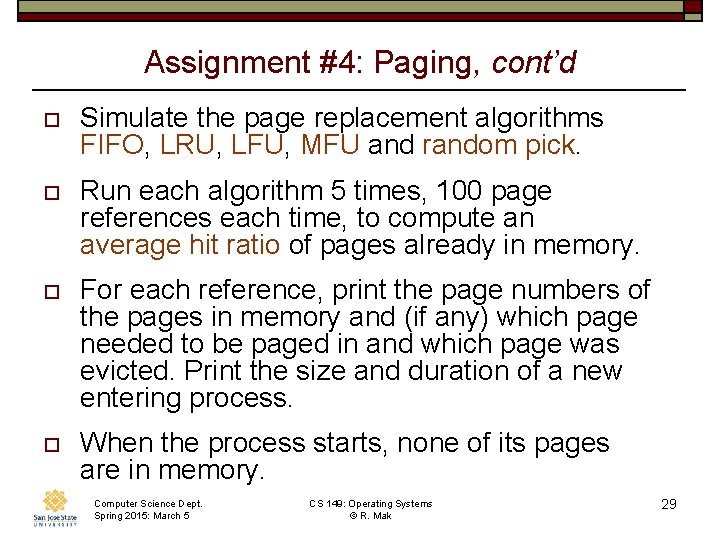
Assignment #4: Paging, cont’d o Simulate the page replacement algorithms FIFO, LRU, LFU, MFU and random pick. o Run each algorithm 5 times, 100 page references each time, to compute an average hit ratio of pages already in memory. o For each reference, print the page numbers of the pages in memory and (if any) which page needed to be paged in and which page was evicted. Print the size and duration of a new entering process. o When the process starts, none of its pages are in memory. Computer Science Dept. Spring 2015: March 5 CS 149: Operating Systems © R. Mak 29
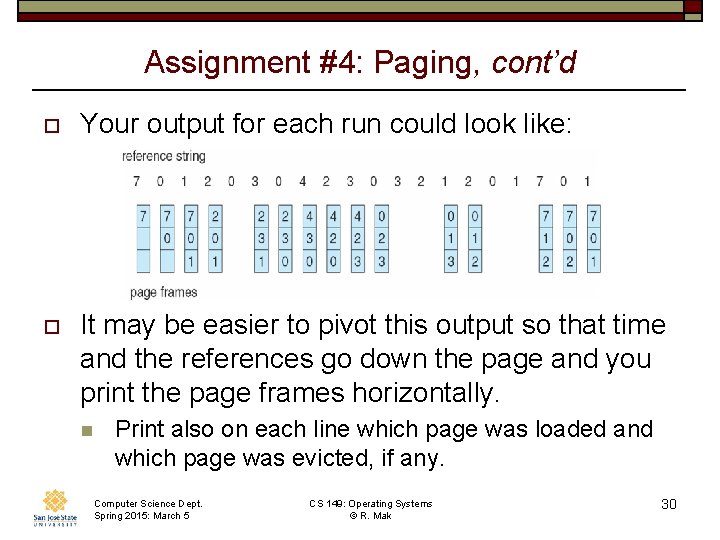
Assignment #4: Paging, cont’d o Your output for each run could look like: o It may be easier to pivot this output so that time and the references go down the page and you print the page frames horizontally. n Print also on each line which page was loaded and which page was evicted, if any. Computer Science Dept. Spring 2015: March 5 CS 149: Operating Systems © R. Mak 30
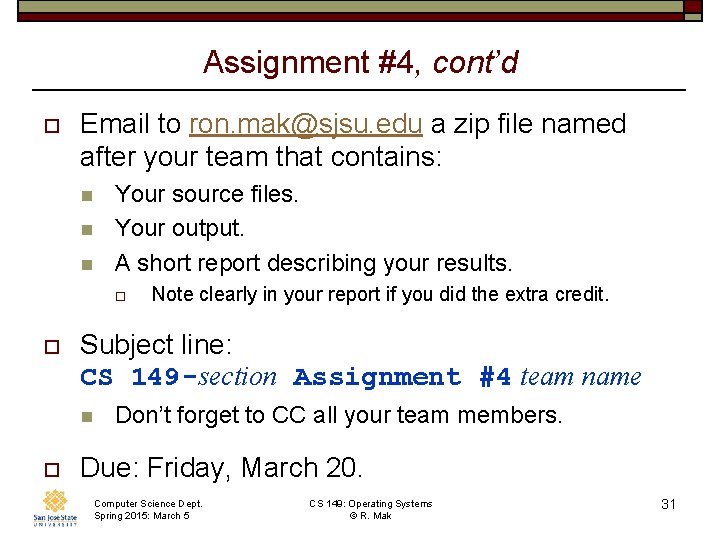
Assignment #4, cont’d o Email to ron. mak@sjsu. edu a zip file named after your team that contains: n n n Your source files. Your output. A short report describing your results. o o Subject line: CS 149 -section Assignment #4 team name n o Note clearly in your report if you did the extra credit. Don’t forget to CC all your team members. Due: Friday, March 20. Computer Science Dept. Spring 2015: March 5 CS 149: Operating Systems © R. Mak 31