CS 149 Operating Systems April 30 Class Meeting

- Slides: 35
CS 149: Operating Systems April 30 Class Meeting Department of Computer Science San Jose State University Spring 2015 Instructor: Ron Mak www. cs. sjsu. edu/~mak Department of Computer Science Spring 2015: April 30 CS 149: Operating Systems © R. Mak 1
Security o Protection mechanisms protect against internal problems. o Security measures protect against external threats. Department of Computer Science Spring 2015: April 30 CS 149: Operating Systems © R. Mak 2
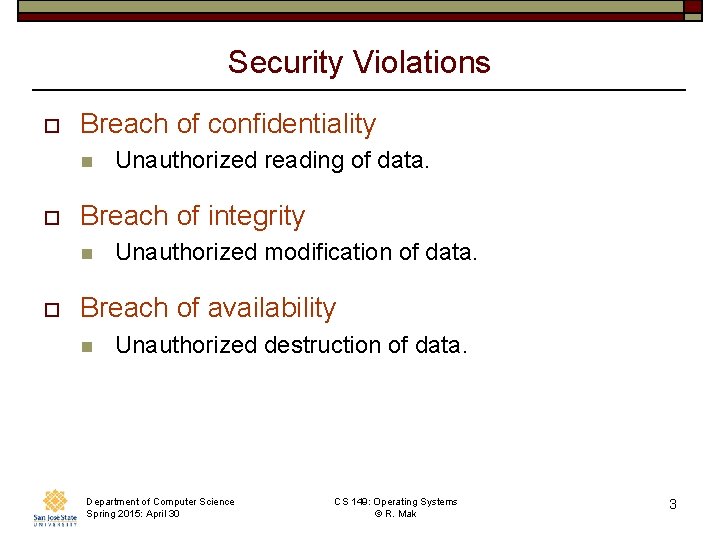
Security Violations o Breach of confidentiality n o Breach of integrity n o Unauthorized reading of data. Unauthorized modification of data. Breach of availability n Unauthorized destruction of data. Department of Computer Science Spring 2015: April 30 CS 149: Operating Systems © R. Mak 3
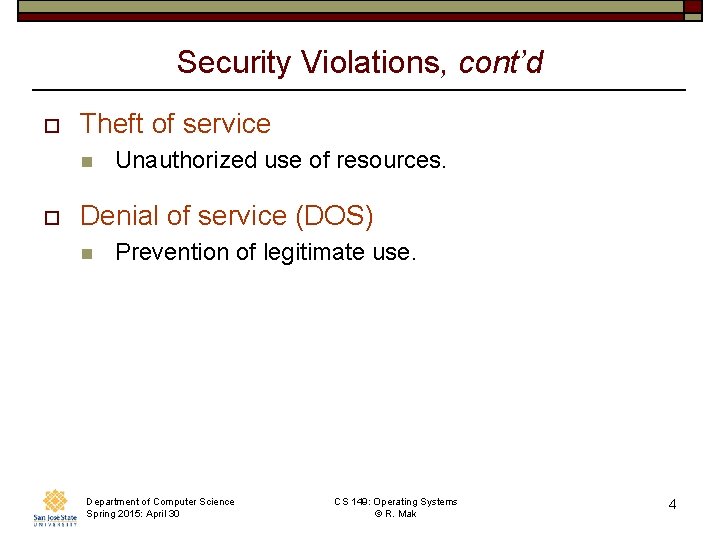
Security Violations, cont’d o Theft of service n o Unauthorized use of resources. Denial of service (DOS) n Prevention of legitimate use. Department of Computer Science Spring 2015: April 30 CS 149: Operating Systems © R. Mak 4
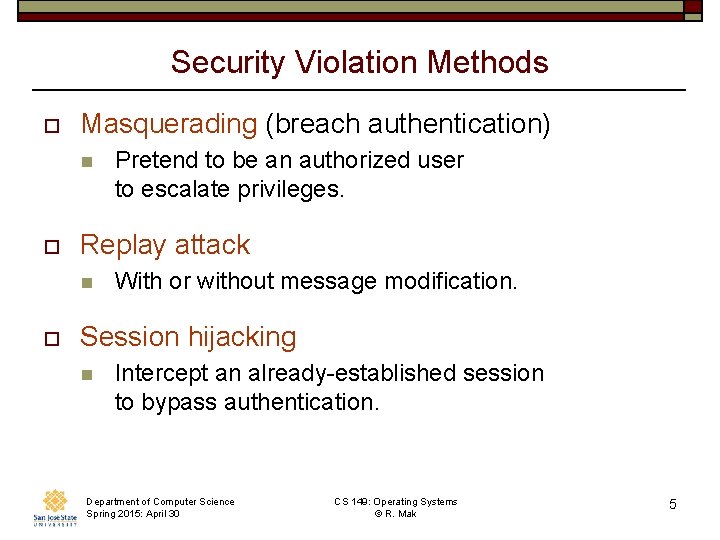
Security Violation Methods o Masquerading (breach authentication) n o Replay attack n o Pretend to be an authorized user to escalate privileges. With or without message modification. Session hijacking n Intercept an already-established session to bypass authentication. Department of Computer Science Spring 2015: April 30 CS 149: Operating Systems © R. Mak 5
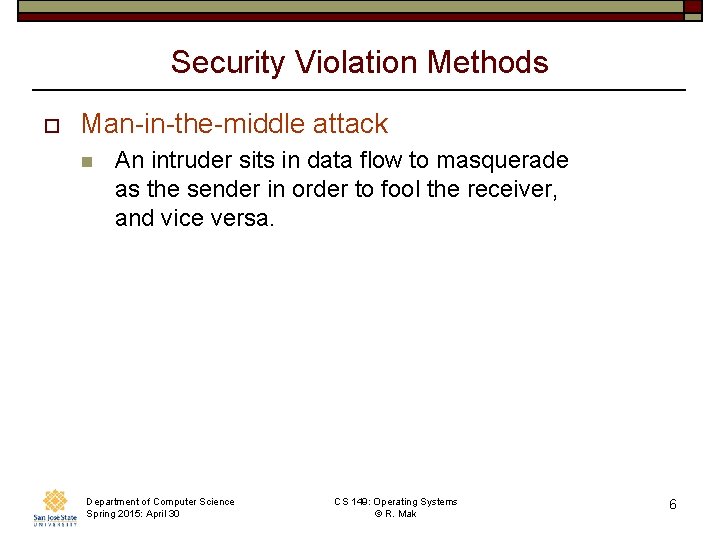
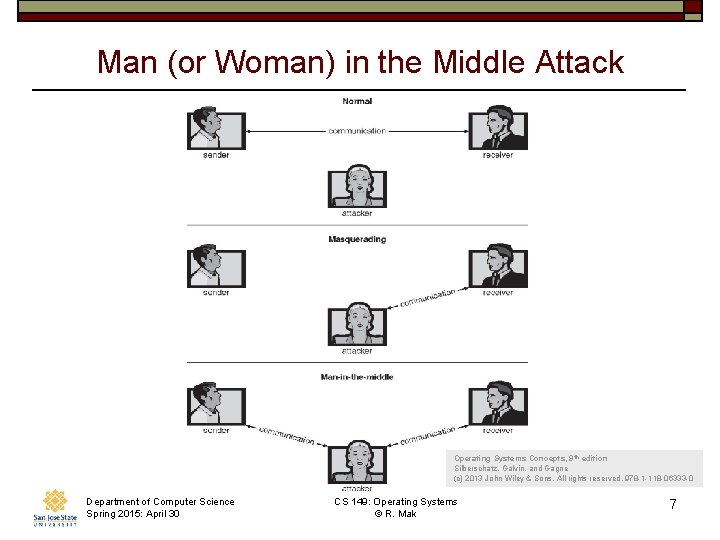
Security Violation Methods o Man-in-the-middle attack n An intruder sits in data flow to masquerade as the sender in order to fool the receiver, and vice versa. Department of Computer Science Spring 2015: April 30 CS 149: Operating Systems © R. Mak 6
Man (or Woman) in the Middle Attack Operating Systems Concepts, 9 th edition Silberschatz, Galvin, and Gagne (c) 2013 John Wiley & Sons. All rights reserved. 978 -1 -118 -06333 -0 Department of Computer Science Spring 2015: April 30 CS 149: Operating Systems © R. Mak 7
Levels of Security o It is impossible to have absolute security. o Make the cost to the perpetrator sufficiently high to deter most intruders. o Security is as strong as the weakest link in the chain. o But can too much security be a problem? Department of Computer Science Spring 2015: April 30 CS 149: Operating Systems © R. Mak 8
Levels of Security, cont’d o Security must occur at four levels to be effective: n Physical o n Human o n Avoid social engineering, phishing, dumpster diving. Operating system o n Data centers, servers, connected terminals. Protection mechanisms, debugging. Network o Intercepted communications, interruption, DOS. Department of Computer Science Spring 2015: April 30 CS 149: Operating Systems © R. Mak 9
Trojan Horse Attack o A program written by one user can execute in another user’s environment. n n The program gains the other user’s access rights. The program misuses those rights. o A long UNIX path names exposes each directory on the path. o A path that includes “. ” when used in another user’s directory can give a program access to the other user’s home directory. Department of Computer Science Spring 2015: April 30 CS 149: Operating Systems © R. Mak 10
Trojan Horse Attack, cont’d o Examples: n n o spyware pop-up browser windows browser plug-ins covert channels Up to 80% of spam is delivered by spyware-infected systems. Department of Computer Science Spring 2015: April 30 CS 149: Operating Systems © R. Mak 11
Trap Door Attack o Specific user identifier or password that circumvents normal security procedures. o The trap door could be included in a compiler. n How can you inspect every compiled program? Department of Computer Science Spring 2015: April 30 CS 149: Operating Systems © R. Mak 12
Logic Bomb o A program initiates a security incident under certain circumstances. o Developed by a disgruntled programmer. n Must enter a password daily to prevent the bomb from going off. o If the programmer is fired, the bomb explodes. o Must hire the programmer back as an expensive consultant to “solve” the problem. Department of Computer Science Spring 2015: April 30 CS 149: Operating Systems © R. Mak 13
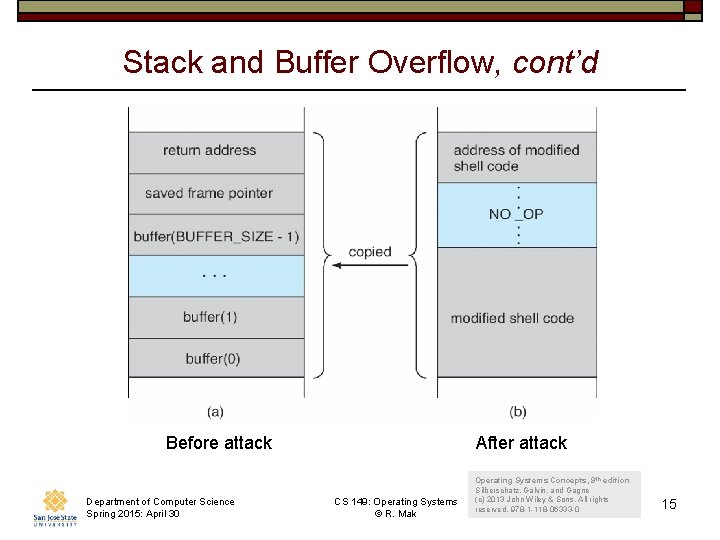
Stack and Buffer Overflow o Exploit a bug in a program to gain unauthorized user or privilege escalation. n n Overflow either the stack or memory buffers. Fail to check bounds on inputs or arguments. o Write past the arguments on the stack into the return address on stack. o When routine returns from a function call, it returns to a hacked address. n Load code onto stack that executes malicious instructions. Department of Computer Science Spring 2015: April 30 CS 149: Operating Systems © R. Mak 14
Stack and Buffer Overflow, cont’d Before attack Department of Computer Science Spring 2015: April 30 After attack CS 149: Operating Systems © R. Mak Operating Systems Concepts, 9 th edition Silberschatz, Galvin, and Gagne (c) 2013 John Wiley & Sons. All rights reserved. 978 -1 -118 -06333 -0 15
Viruses o A malicious code fragment embedded in a legitimate program. o Self-replicating, designed to infect other computers. o Very specific to CPU architecture, operating system, applications. o Usually borne via email or as a macro. Department of Computer Science Spring 2015: April 30 CS 149: Operating Systems © R. Mak 16
Categories of Viruses o Parasitic file Boot Macro Source code o Polymorphic o o o n o Avoids having a virus signature Encrypted n n Encrypted to avoid detection. Decrypts to execute. Department of Computer Science Spring 2015: April 30 CS 149: Operating Systems © R. Mak 17
Categories of Viruses, cont’d o Stealth n o Tunneling n o Installs in the interrupt-handler chain or in device drivers. Multipartite n o Modifies parts of the system that can be used to detect it. Infect multiple parts of a system. Armored n Hard for antivirus researchers to detect. Department of Computer Science Spring 2015: April 30 CS 149: Operating Systems © R. Mak 18
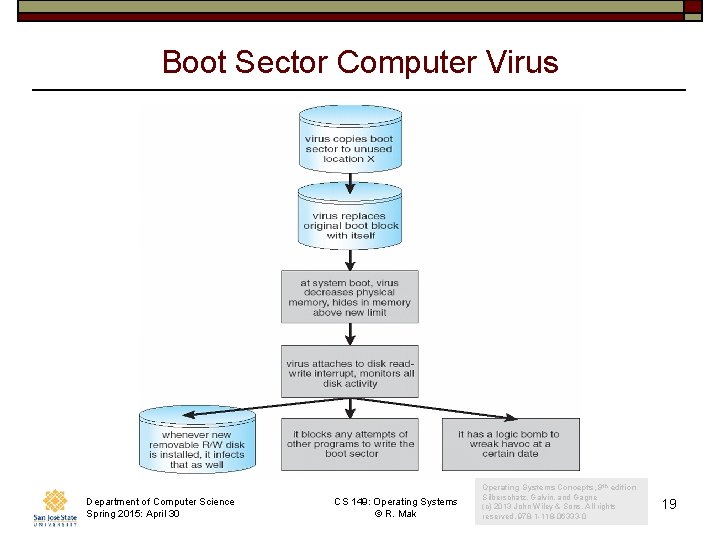
Boot Sector Computer Virus Department of Computer Science Spring 2015: April 30 CS 149: Operating Systems © R. Mak Operating Systems Concepts, 9 th edition Silberschatz, Galvin, and Gagne (c) 2013 John Wiley & Sons. All rights reserved. 978 -1 -118 -06333 -0 19
Keystroke Logger Virus o A virus that intercepts keystrokes. o Records passwords, etc. o Sends confidential information to a malicious recipient. Department of Computer Science Spring 2015: April 30 CS 149: Operating Systems © R. Mak 20
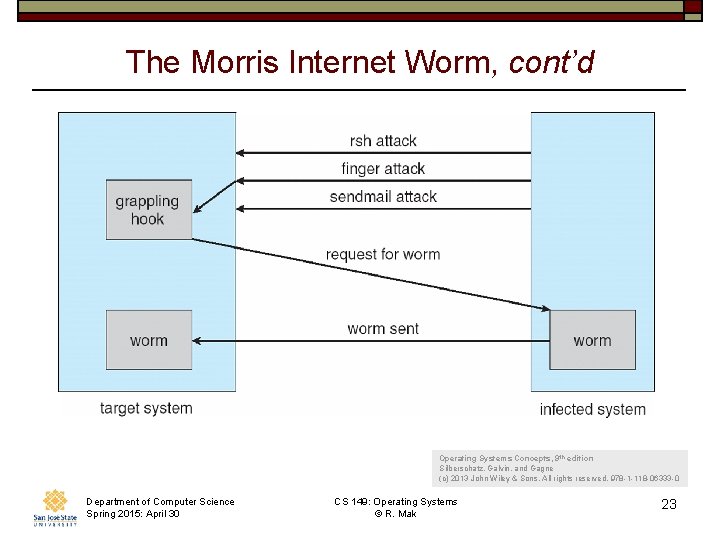
The Morris Internet Worm o A worm uses a spawn mechanism to duplicate itself. o The Morris Internet worm n Launched November 2, 1988 by Robert Morris, a first-year Cornell grad student. n Exploited UNIX networking features and bugs in the finger and sendmail programs. n Exploited trust-relationship mechanism used by rsh to access friendly systems without the use of a password. Department of Computer Science Spring 2015: April 30 CS 149: Operating Systems © R. Mak 21
The Morris Internet Worm, cont’d o The Morris Internet worm, cont’d n The grappling hook program uploaded the main worm program. o n o o 99 lines of C code Hooked systems then uploaded main code and attacked connected systems. Morris was convicted in federal court. Now a computer science professor at MIT. Department of Computer Science Spring 2015: April 30 CS 149: Operating Systems © R. Mak 22
The Morris Internet Worm, cont’d Operating Systems Concepts, 9 th edition Silberschatz, Galvin, and Gagne (c) 2013 John Wiley & Sons. All rights reserved. 978 -1 -118 -06333 -0 Department of Computer Science Spring 2015: April 30 CS 149: Operating Systems © R. Mak 23
Port Scanning o Automated attempt to connect to a range of ports on one IP address or on a range of IP addresses. o Detect answering service protocol. o Detect OS and version running on system. Department of Computer Science Spring 2015: April 30 CS 149: Operating Systems © R. Mak 24
Port Scanning, cont’d o nmap scans all ports in a given IP range or a response n o http: //www. insecure. org/nmap Frequently launched from zombie systems. n To decrease traceability. Department of Computer Science Spring 2015: April 30 CS 149: Operating Systems © R. Mak 25
Denial of Service o Overload the targeted computer to prevent it from doing any useful work. o A distributed denial-of-service (DDOS) comes from multiple sites at once. n o “Ping” of death. Consider traffic to a web site. n How can you tell the difference between being a target and being really popular? Department of Computer Science Spring 2015: April 30 CS 149: Operating Systems © R. Mak 26
Denial of Service, cont’d o Accidental n o CS students writing bad fork() code. Purposeful n Extortion, punishment Department of Computer Science Spring 2015: April 30 CS 149: Operating Systems © R. Mak 27
Design Principles for Security q The system design should be public. q The default should be no access. q Check for current authority. q Give each process the least authority possible. Department of Computer Science Spring 2015: April 30 CS 149: Operating Systems © R. Mak 28
Design Principles for Security, cont’d q The protection mechanism should be simple, uniform, and built into the lowest layers of the system. q The scheme chosen must be psychologically acceptable. Department of Computer Science Spring 2015: April 30 CS 149: Operating Systems © R. Mak 29
User Authentication: Passwords o Easy to defeat. o Passwords are often easy to guess. Department of Computer Science Spring 2015: April 30 CS 149: Operating Systems © R. Mak 30
User Authentication: Passwords, cont’d o A classic research study in 1979 compiled a list of likely passwords. n n n o first and last names street and city names words from a moderate-sized dictionary license plate numbers short strings of random numbers Discovered that over 86% of passwords then in use were in their list. Department of Computer Science Spring 2015: April 30 CS 149: Operating Systems © R. Mak 31
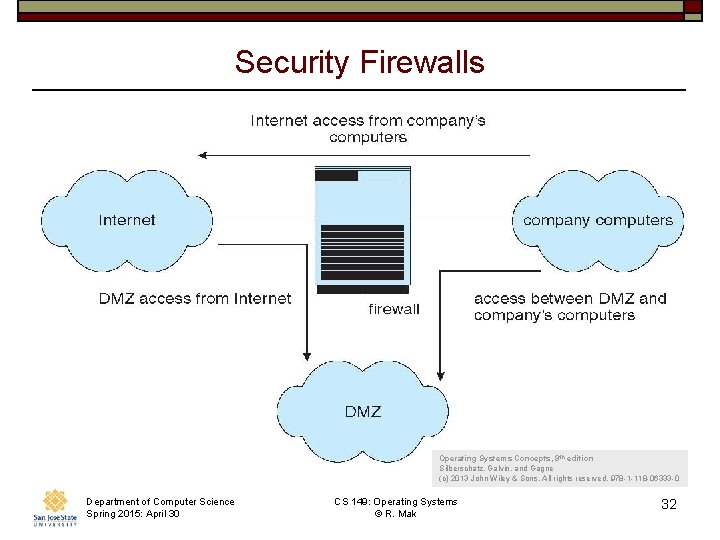
Security Firewalls Operating Systems Concepts, 9 th edition Silberschatz, Galvin, and Gagne (c) 2013 John Wiley & Sons. All rights reserved. 978 -1 -118 -06333 -0 Department of Computer Science Spring 2015: April 30 CS 149: Operating Systems © R. Mak 32
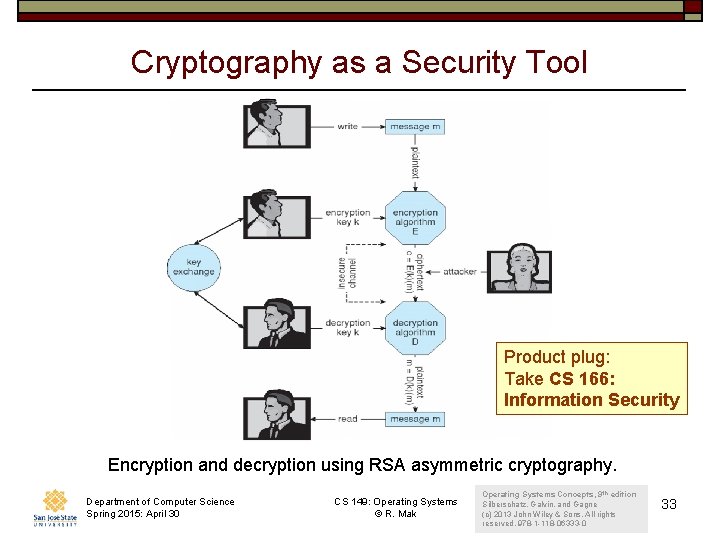
Cryptography as a Security Tool Product plug: Take CS 166: Information Security Encryption and decryption using RSA asymmetric cryptography. Department of Computer Science Spring 2015: April 30 CS 149: Operating Systems © R. Mak Operating Systems Concepts, 9 th edition Silberschatz, Galvin, and Gagne (c) 2013 John Wiley & Sons. All rights reserved. 978 -1 -118 -06333 -0 33
The Bad Guys o “Script kiddies” n n n Young “hackers” who run malicious scripts that are shared among the hacker communities. Break-ins and stolen data are trophies for bragging. Can be thwarted by “honey pots” o o Corporate thieves n o Fake data at a site designed to lure hackers. Steal confidential data from competitors. Hostile (or friendly) governments n n Snooping and monitoring Spying Department of Computer Science Spring 2015: April 30 CS 149: Operating Systems © R. Mak 34
Computer Security as a Career o Cybersecurity is a hot field. n n n o Computers are used everywhere. Big data. Privacy issues. Operate in a dark, shadowy world. n SRI anecdote. Department of Computer Science Spring 2015: April 30 CS 149: Operating Systems © R. Mak 35