CPS 590 4 Some practice questions Vincent Conitzer
- Slides: 8
CPS 590. 4 Some practice questions Vincent Conitzer conitzer@cs. duke. edu
Matching pennies to decide who is player 1 • In the poker game discussed in class, it matters who is player 1. • Suppose two players first play a round of “matching pennies” to determine who gets to be player 1, and then play the game. • Model the whole game as an extensiveform game and solve for subgameperfect equilibrium.
Many equilibria • Can you create an n x n game that has 2 n-1 Nash equilibria?
Correlated beats unique pure Nash • Can you create a game that has • a unique Nash equilibrium, which is a pure-strategy equilibrium, and • another correlated equilibrium that is better for both players
Confusing profiles of votes • For an arbitrary number n of alternatives, can you come up with a profile of votes such that… • The Borda ranking is the opposite of the plurality ranking? • The Copeland ranking is the opposite of the plurality ranking? • Etc.
Generous Groves • For a combinatorial auction, can you create a Groves mechanism so that every bidder always receives a nonnegative payment?
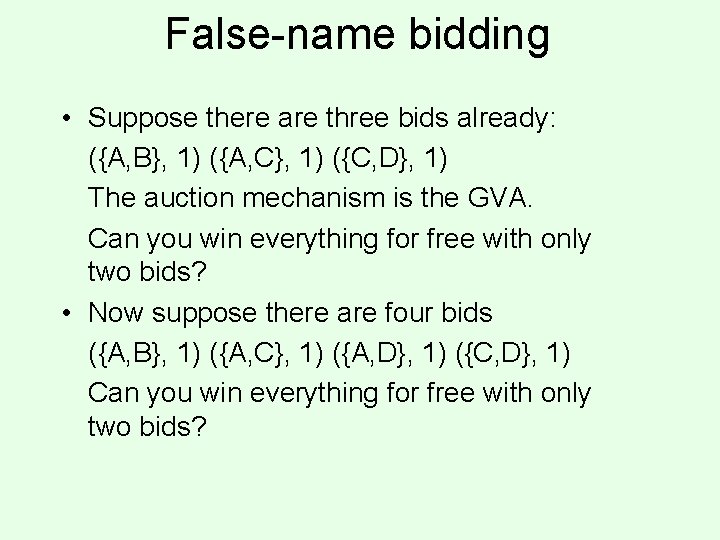
False-name bidding • Suppose there are three bids already: ({A, B}, 1) ({A, C}, 1) ({C, D}, 1) The auction mechanism is the GVA. Can you win everything for free with only two bids? • Now suppose there are four bids ({A, B}, 1) ({A, C}, 1) ({A, D}, 1) ({C, D}, 1) Can you win everything for free with only two bids?
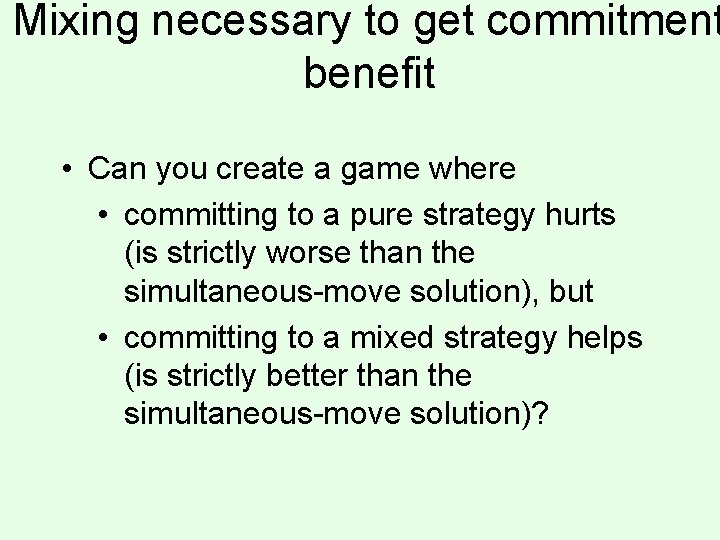
Mixing necessary to get commitment benefit • Can you create a game where • committing to a pure strategy hurts (is strictly worse than the simultaneous-move solution), but • committing to a mixed strategy helps (is strictly better than the simultaneous-move solution)?