CONFLICT COOPERATION Cooperation Organizations International Conflicts Genocide COOPERATION

- Slides: 24
CONFLICT & COOPERATION Cooperation Organizations International Conflicts Genocide
COOPERATION ORGANIZATION
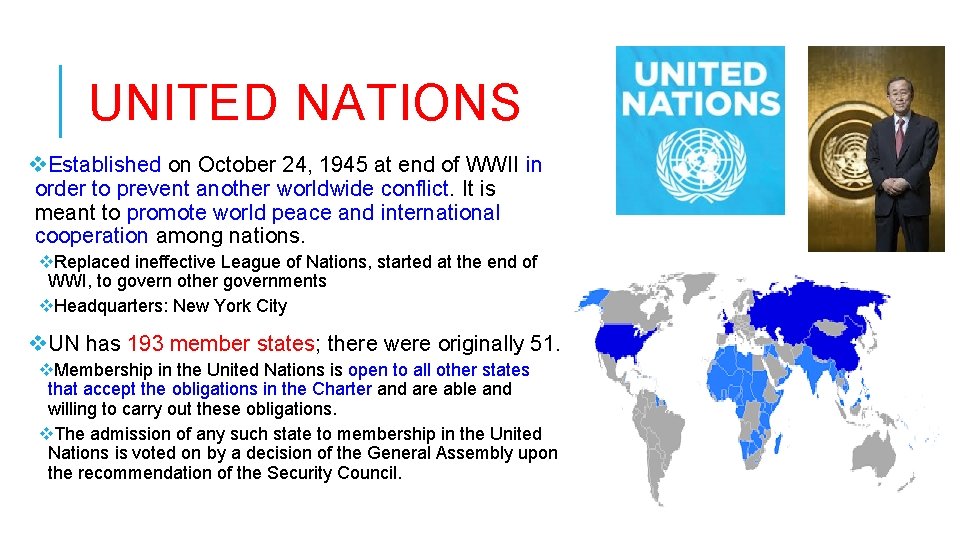
UNITED NATIONS v. Established on October 24, 1945 at end of WWII in order to prevent another worldwide conflict. It is meant to promote world peace and international cooperation among nations. v. Replaced ineffective League of Nations, started at the end of WWI, to govern other governments v. Headquarters: New York City v. UN has 193 member states; there were originally 51. v. Membership in the United Nations is open to all other states that accept the obligations in the Charter and are able and willing to carry out these obligations. v. The admission of any such state to membership in the United Nations is voted on by a decision of the General Assembly upon the recommendation of the Security Council.
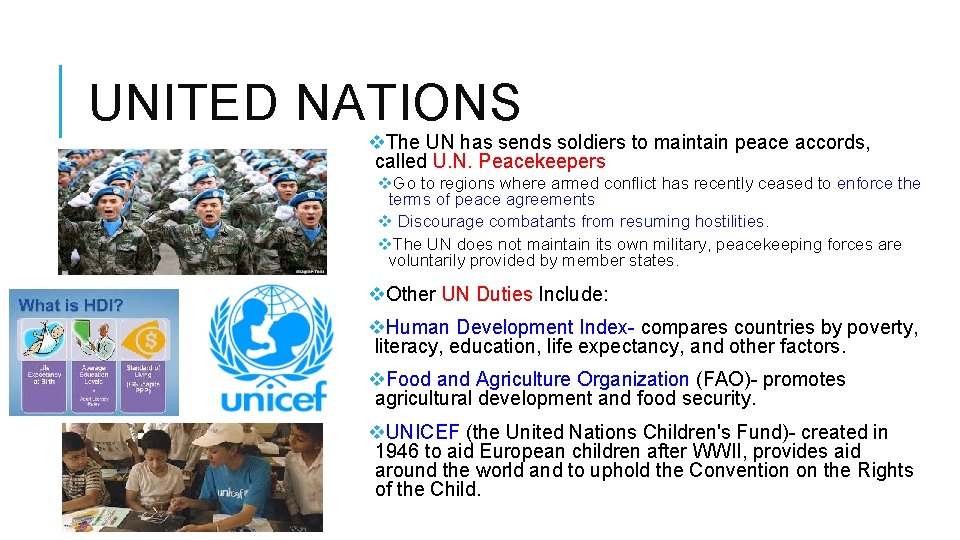
UNITED NATIONS v. The UN has sends soldiers to maintain peace accords, called U. N. Peacekeepers v. Go to regions where armed conflict has recently ceased to enforce the terms of peace agreements v Discourage combatants from resuming hostilities. v. The UN does not maintain its own military, peacekeeping forces are voluntarily provided by member states. v. Other UN Duties Include: v. Human Development Index- compares countries by poverty, literacy, education, life expectancy, and other factors. v. Food and Agriculture Organization (FAO)- promotes agricultural development and food security. v. UNICEF (the United Nations Children's Fund)- created in 1946 to aid European children after WWII, provides aid around the world and to uphold the Convention on the Rights of the Child.
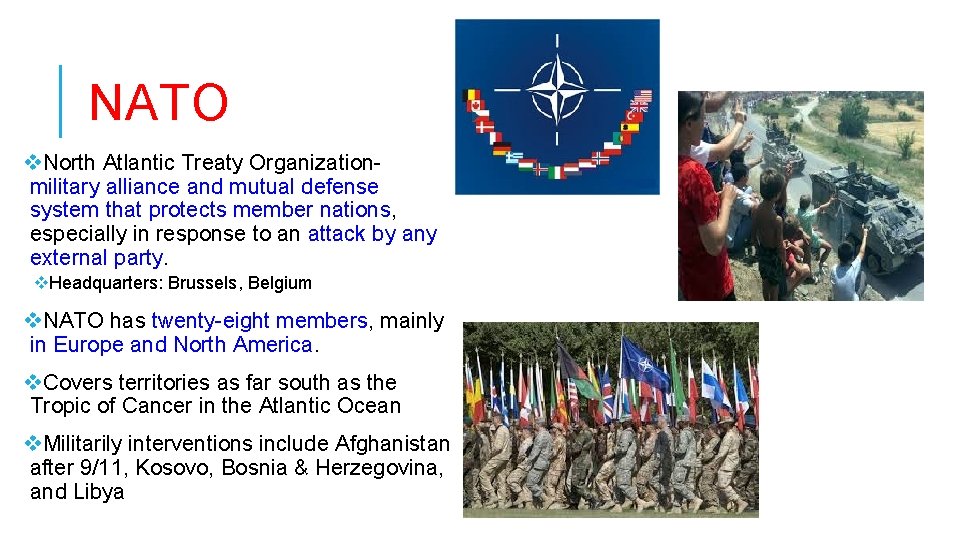
NATO v. North Atlantic Treaty Organization- military alliance and mutual defense system that protects member nations, especially in response to an attack by any external party. v. Headquarters: Brussels, Belgium v. NATO has twenty-eight members, mainly in Europe and North America. v. Covers territories as far south as the Tropic of Cancer in the Atlantic Ocean v. Militarily interventions include Afghanistan after 9/11, Kosovo, Bosnia & Herzegovina, and Libya
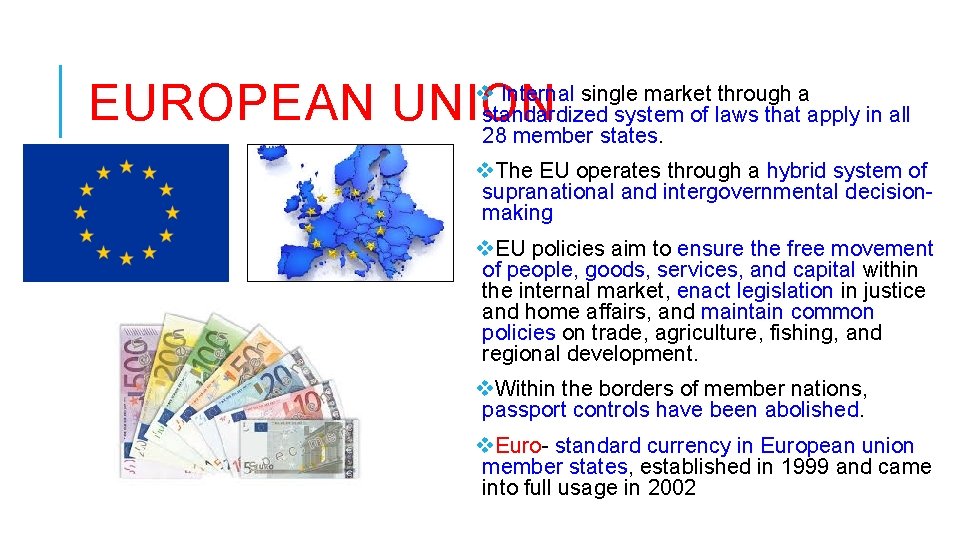
EUROPEAN UNION v Internal single market through a standardized system of laws that apply in all 28 member states. v. The EU operates through a hybrid system of supranational and intergovernmental decisionmaking v. EU policies aim to ensure the free movement of people, goods, services, and capital within the internal market, enact legislation in justice and home affairs, and maintain common policies on trade, agriculture, fishing, and regional development. v. Within the borders of member nations, passport controls have been abolished. v. Euro- standard currency in European union member states, established in 1999 and came into full usage in 2002
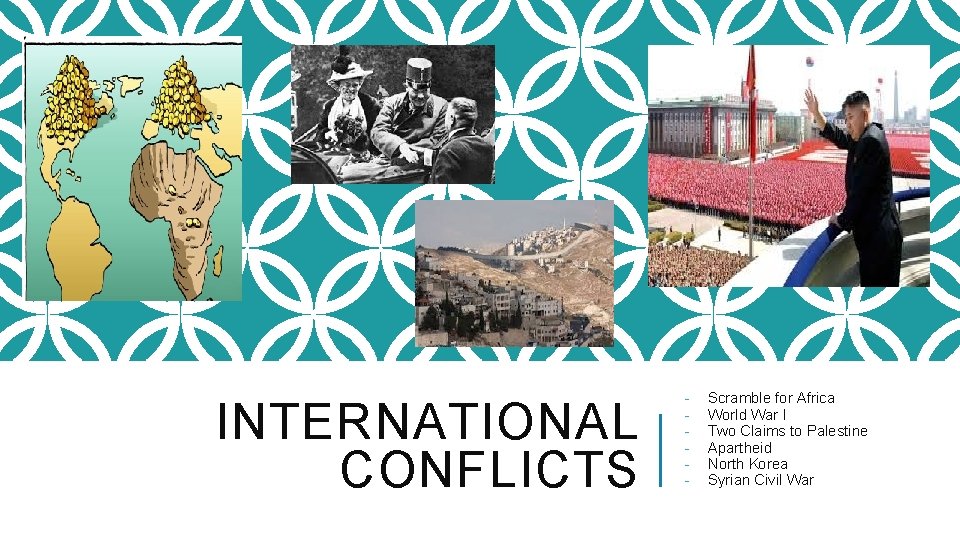
INTERNATIONAL CONFLICTS - Scramble for Africa World War I Two Claims to Palestine Apartheid North Korea Syrian Civil War
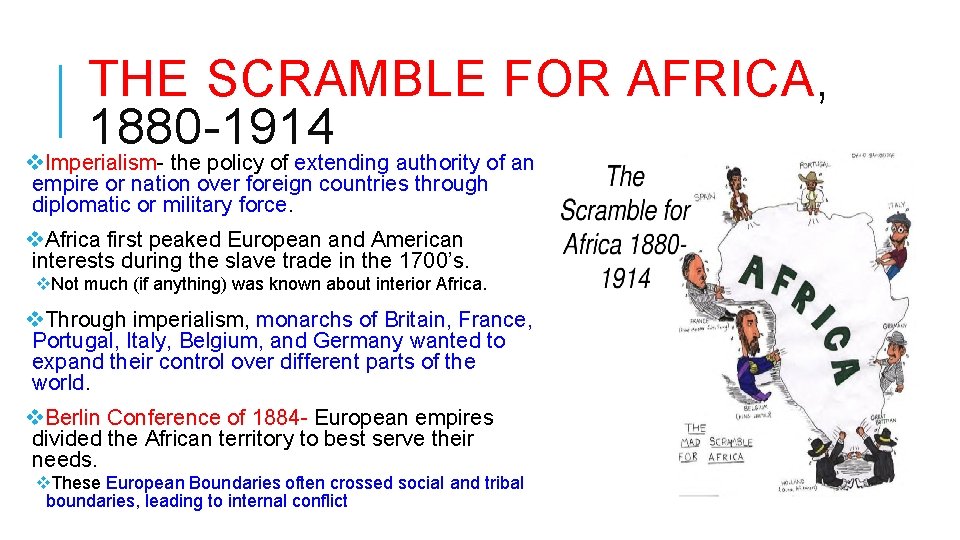
THE SCRAMBLE FOR AFRICA, 1880 -1914 v. Imperialism- the policy of extending authority of an empire or nation over foreign countries through diplomatic or military force. v. Africa first peaked European and American interests during the slave trade in the 1700’s. v. Not much (if anything) was known about interior Africa. v. Through imperialism, monarchs of Britain, France, Portugal, Italy, Belgium, and Germany wanted to expand their control over different parts of the world. v. Berlin Conference of 1884 - European empires divided the African territory to best serve their needs. v. These European Boundaries often crossed social and tribal boundaries, leading to internal conflict
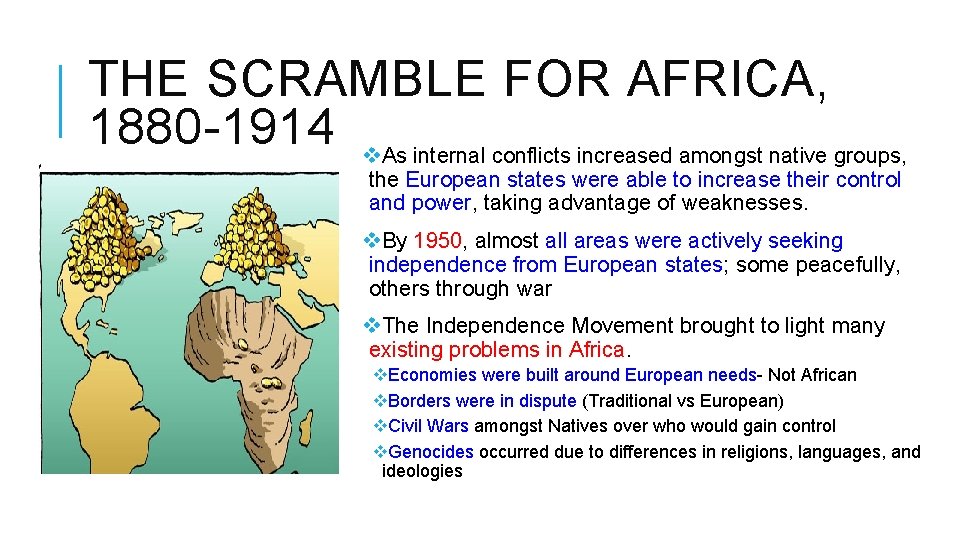
THE SCRAMBLE FOR AFRICA, 1880 -1914 v. As internal conflicts increased amongst native groups, the European states were able to increase their control and power, taking advantage of weaknesses. v. By 1950, almost all areas were actively seeking independence from European states; some peacefully, others through war v. The Independence Movement brought to light many existing problems in Africa. v. Economies were built around European needs- Not African v. Borders were in dispute (Traditional vs European) v. Civil Wars amongst Natives over who would gain control v. Genocides occurred due to differences in religions, languages, and ideologies
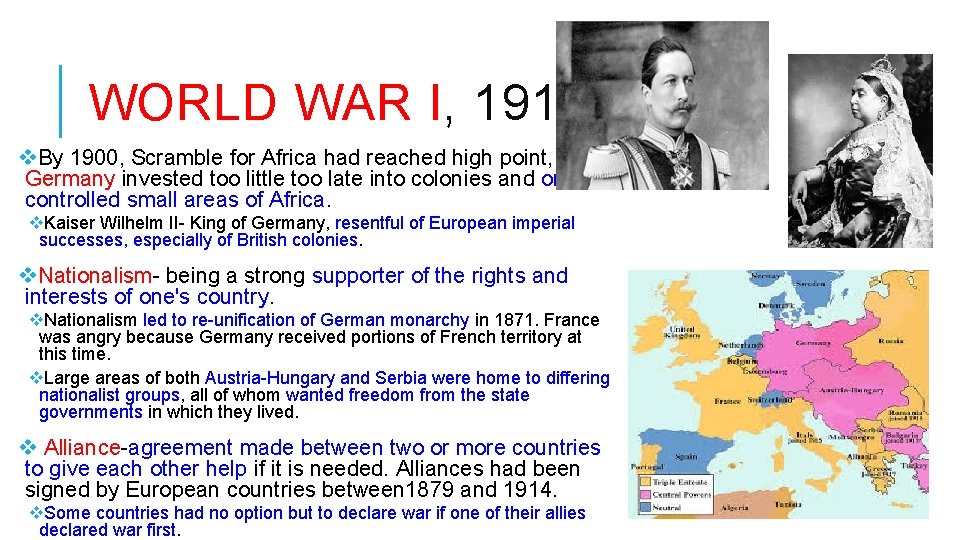
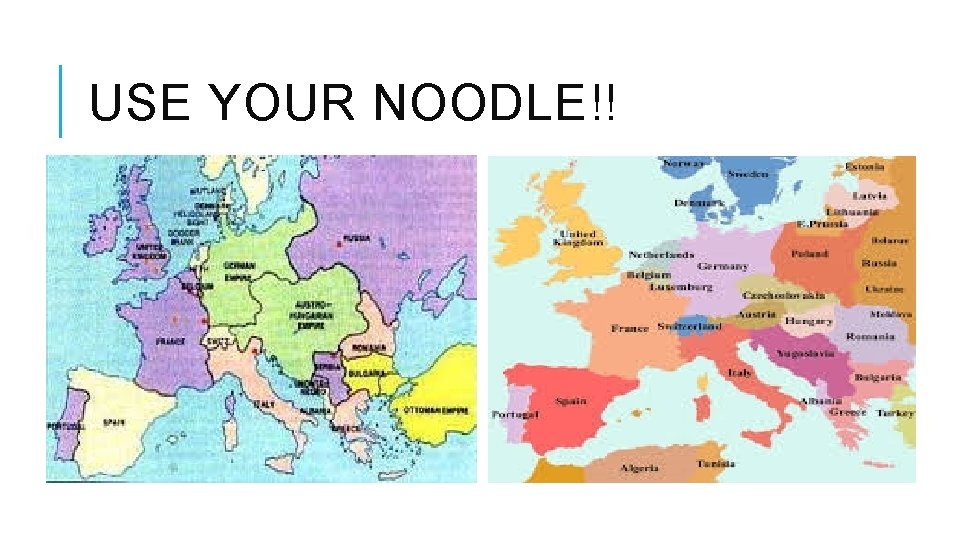
WORLD WAR I, 1914 -1918 v. By 1900, Scramble for Africa had reached high point, but Germany invested too little too late into colonies and only controlled small areas of Africa. v. Kaiser Wilhelm II- King of Germany, resentful of European imperial successes, especially of British colonies. v. Nationalism- being a strong supporter of the rights and interests of one's country. v. Nationalism led to re-unification of German monarchy in 1871. France was angry because Germany received portions of French territory at this time. v. Large areas of both Austria-Hungary and Serbia were home to differing nationalist groups, all of whom wanted freedom from the state governments in which they lived. v Alliance-agreement made between two or more countries to give each other help if it is needed. Alliances had been signed by European countries between 1879 and 1914. v. Some countries had no option but to declare war if one of their allies declared war first.
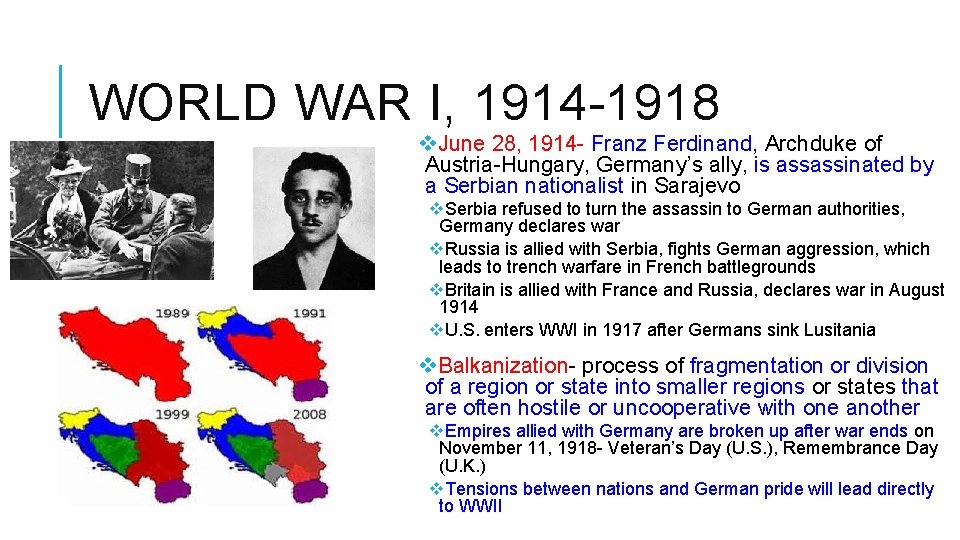
WORLD WAR I, 1914 -1918 v. June 28, 1914 - Franz Ferdinand, Archduke of Austria-Hungary, Germany’s ally, is assassinated by a Serbian nationalist in Sarajevo v. Serbia refused to turn the assassin to German authorities, Germany declares war v. Russia is allied with Serbia, fights German aggression, which leads to trench warfare in French battlegrounds v. Britain is allied with France and Russia, declares war in August 1914 v. U. S. enters WWI in 1917 after Germans sink Lusitania v. Balkanization- process of fragmentation or division of a region or state into smaller regions or states that are often hostile or uncooperative with one another v. Empires allied with Germany are broken up after war ends on November 11, 1918 - Veteran’s Day (U. S. ), Remembrance Day (U. K. ) v. Tensions between nations and German pride will lead directly to WWII
USE YOUR NOODLE!!
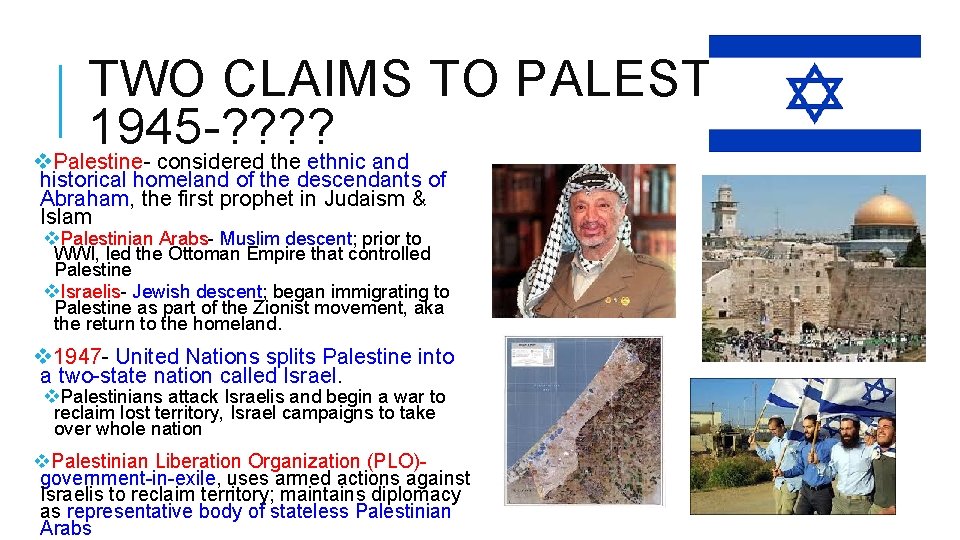
TWO CLAIMS TO PALESTINE, 1945 -? ? v. Palestine- considered the ethnic and historical homeland of the descendants of Abraham, the first prophet in Judaism & Islam v. Palestinian Arabs- Muslim descent; prior to WWI, led the Ottoman Empire that controlled Palestine v. Israelis- Jewish descent; began immigrating to Palestine as part of the Zionist movement, aka the return to the homeland. v 1947 - United Nations splits Palestine into a two-state nation called Israel. v. Palestinians attack Israelis and begin a war to reclaim lost territory, Israel campaigns to take over whole nation v. Palestinian Liberation Organization (PLO)- government-in-exile, uses armed actions against Israelis to reclaim territory; maintains diplomacy as representative body of stateless Palestinian Arabs
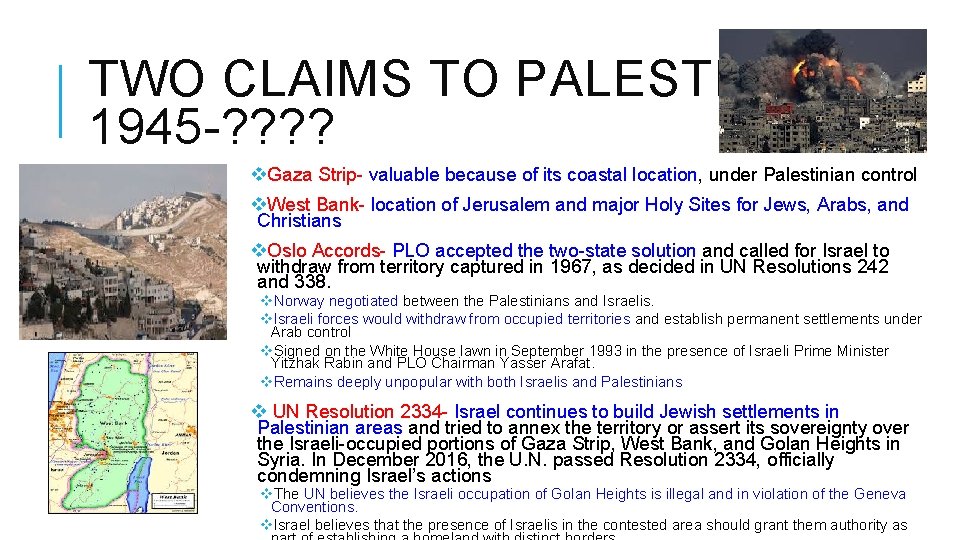
TWO CLAIMS TO PALESTINE, 1945 -? ? v. Gaza Strip- valuable because of its coastal location, under Palestinian control v. West Bank- location of Jerusalem and major Holy Sites for Jews, Arabs, and Christians v. Oslo Accords- PLO accepted the two-state solution and called for Israel to withdraw from territory captured in 1967, as decided in UN Resolutions 242 and 338. v. Norway negotiated between the Palestinians and Israelis. v. Israeli forces would withdraw from occupied territories and establish permanent settlements under Arab control v. Signed on the White House lawn in September 1993 in the presence of Israeli Prime Minister Yitzhak Rabin and PLO Chairman Yasser Arafat. v. Remains deeply unpopular with both Israelis and Palestinians v UN Resolution 2334 - Israel continues to build Jewish settlements in Palestinian areas and tried to annex the territory or assert its sovereignty over the Israeli-occupied portions of Gaza Strip, West Bank, and Golan Heights in Syria. In December 2016, the U. N. passed Resolution 2334, officially condemning Israel’s actions v. The UN believes the Israeli occupation of Golan Heights is illegal and in violation of the Geneva Conventions. v. Israel believes that the presence of Israelis in the contested area should grant them authority as
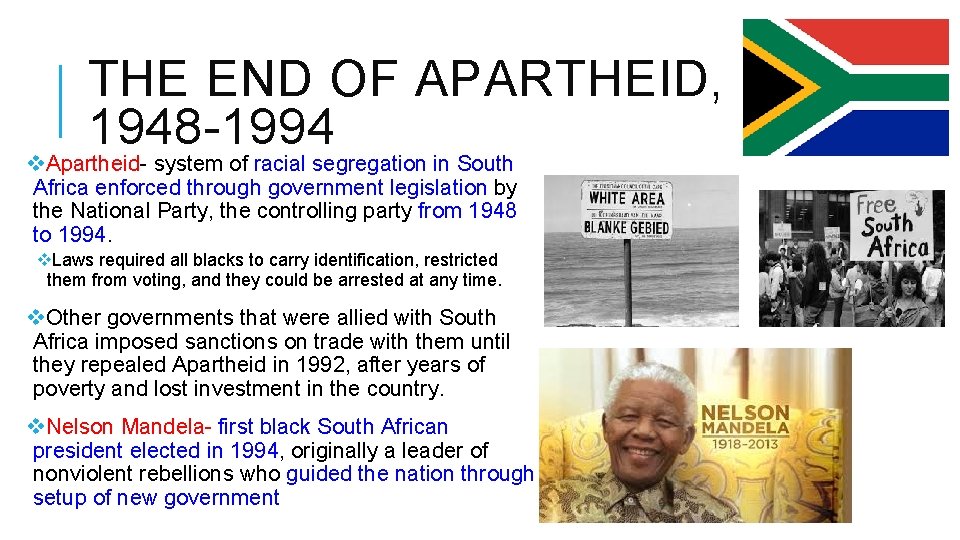
THE END OF APARTHEID, 1948 -1994 v. Apartheid- system of racial segregation in South Africa enforced through government legislation by the National Party, the controlling party from 1948 to 1994. v. Laws required all blacks to carry identification, restricted them from voting, and they could be arrested at any time. v. Other governments that were allied with South Africa imposed sanctions on trade with them until they repealed Apartheid in 1992, after years of poverty and lost investment in the country. v. Nelson Mandela- first black South African president elected in 1994, originally a leader of nonviolent rebellions who guided the nation through setup of new government
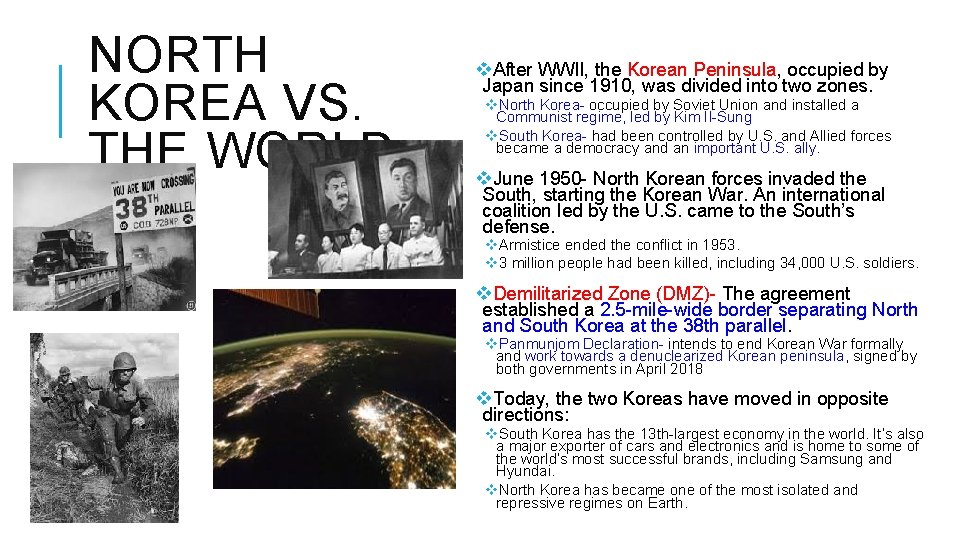
NORTH KOREA VS. THE WORLD v. After WWII, the Korean Peninsula, occupied by Japan since 1910, was divided into two zones. v. North Korea- occupied by Soviet Union and installed a Communist regime, led by Kim Il-Sung v. South Korea- had been controlled by U. S. and Allied forces became a democracy and an important U. S. ally. v. June 1950 - North Korean forces invaded the South, starting the Korean War. An international coalition led by the U. S. came to the South’s defense. v. Armistice ended the conflict in 1953. v 3 million people had been killed, including 34, 000 U. S. soldiers. v. Demilitarized Zone (DMZ)- The agreement established a 2. 5 -mile-wide border separating North and South Korea at the 38 th parallel. v. Panmunjom Declaration- intends to end Korean War formally and work towards a denuclearized Korean peninsula, signed by both governments in April 2018 v. Today, the two Koreas have moved in opposite directions: v. South Korea has the 13 th-largest economy in the world. It’s also a major exporter of cars and electronics and is home to some of the world’s most successful brands, including Samsung and Hyundai. v. North Korea has became one of the most isolated and repressive regimes on Earth.
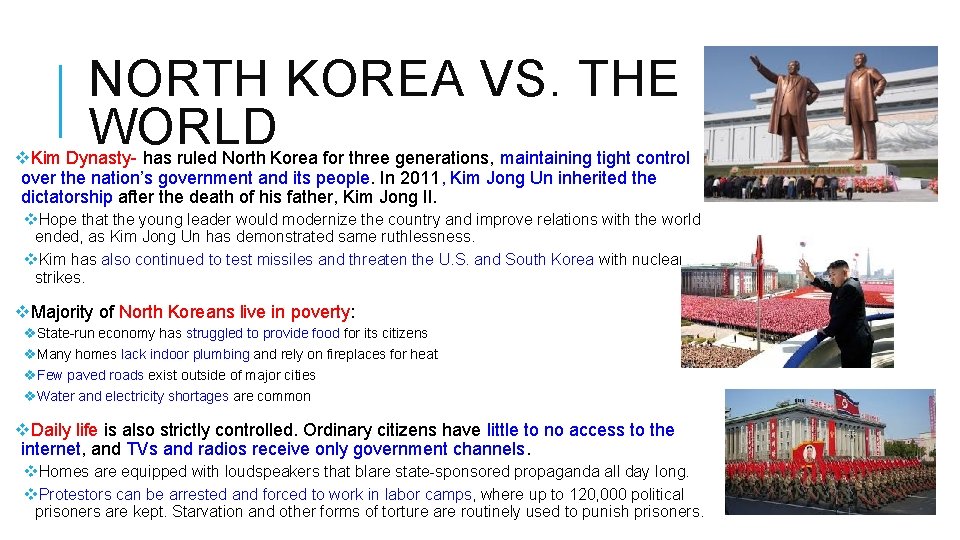
NORTH KOREA VS. THE WORLD v. Kim Dynasty- has ruled North Korea for three generations, maintaining tight control over the nation’s government and its people. In 2011, Kim Jong Un inherited the dictatorship after the death of his father, Kim Jong Il. v. Hope that the young leader would modernize the country and improve relations with the world ended, as Kim Jong Un has demonstrated same ruthlessness. v. Kim has also continued to test missiles and threaten the U. S. and South Korea with nuclear strikes. v. Majority of North Koreans live in poverty: v. State-run economy has struggled to provide food for its citizens v. Many homes lack indoor plumbing and rely on fireplaces for heat v. Few paved roads exist outside of major cities v. Water and electricity shortages are common v. Daily life is also strictly controlled. Ordinary citizens have little to no access to the internet, and TVs and radios receive only government channels. v. Homes are equipped with loudspeakers that blare state-sponsored propaganda all day long. v. Protestors can be arrested and forced to work in labor camps, where up to 120, 000 political prisoners are kept. Starvation and other forms of torture are routinely used to punish prisoners.
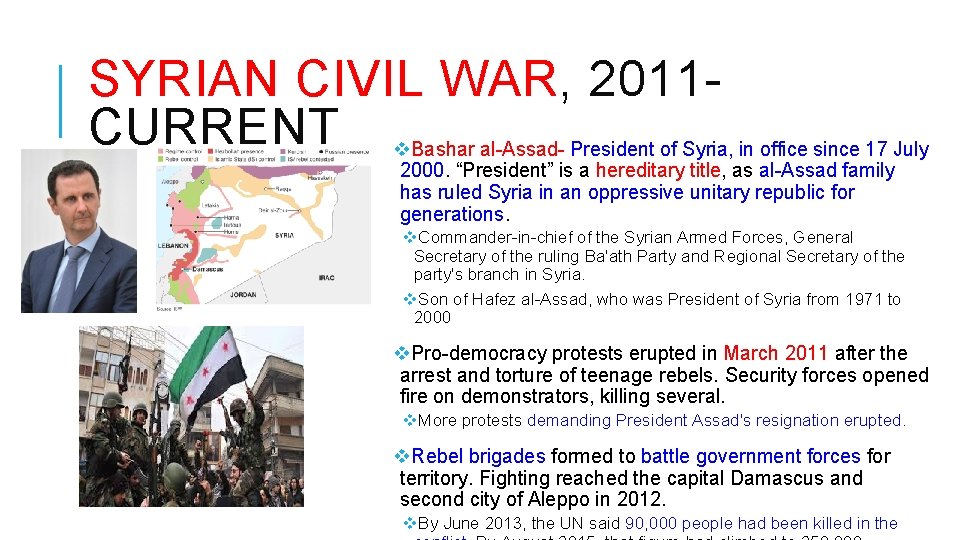
SYRIAN CIVIL WAR, 2011 CURRENT v Bashar al-Assad- President of Syria, in office since 17 July 2000. “President” is a hereditary title, as al-Assad family has ruled Syria in an oppressive unitary republic for generations. v. Commander-in-chief of the Syrian Armed Forces, General Secretary of the ruling Ba'ath Party and Regional Secretary of the party's branch in Syria. v. Son of Hafez al-Assad, who was President of Syria from 1971 to 2000 v. Pro-democracy protests erupted in March 2011 after the arrest and torture of teenage rebels. Security forces opened fire on demonstrators, killing several. v. More protests demanding President Assad's resignation erupted. v. Rebel brigades formed to battle government forces for territory. Fighting reached the capital Damascus and second city of Aleppo in 2012. v. By June 2013, the UN said 90, 000 people had been killed in the
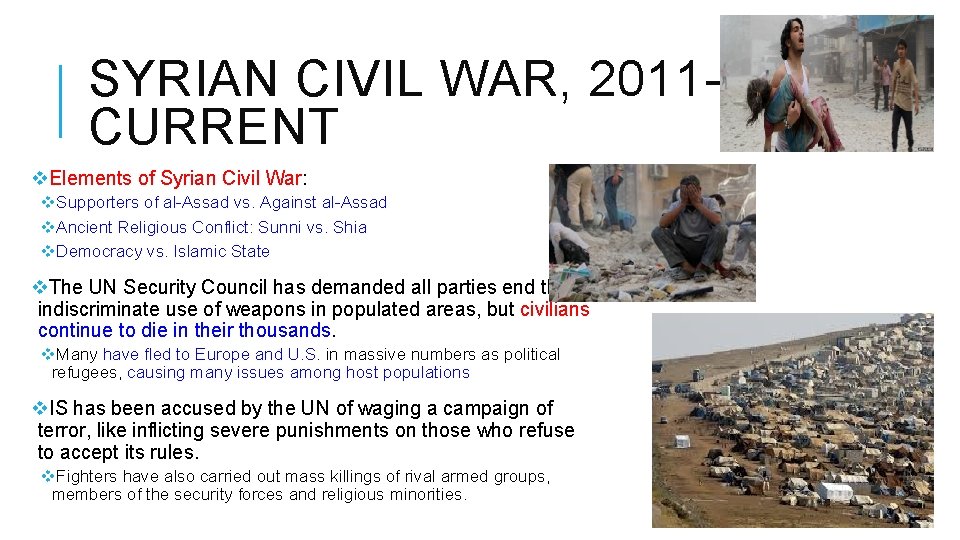
SYRIAN CIVIL WAR, 2011 - CURRENT v. Elements of Syrian Civil War: v. Supporters of al-Assad vs. Against al-Assad v. Ancient Religious Conflict: Sunni vs. Shia v. Democracy vs. Islamic State v. The UN Security Council has demanded all parties end the indiscriminate use of weapons in populated areas, but civilians continue to die in their thousands. v. Many have fled to Europe and U. S. in massive numbers as political refugees, causing many issues among host populations v. IS has been accused by the UN of waging a campaign of terror, like inflicting severe punishments on those who refuse to accept its rules. v. Fighters have also carried out mass killings of rival armed groups, members of the security forces and religious minorities.
GENOCIDE
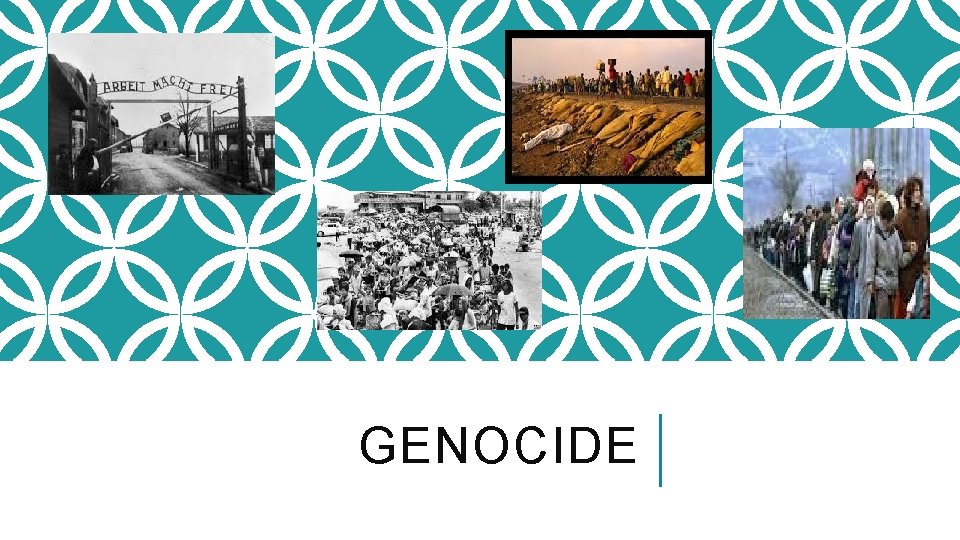
GENOCIDE v. Genocide- the deliberate mass murder of a large group of people, especially those of a particular race or ethnic group v. When a dominant group (political, ethnic, or religious) engages in a systematic expulsion or elimination of another group. v. The Holocaust- From 1933 -1945, Nazi Germany and its leader, Adolf Hitler, developed a plan to eliminate Jews and other undesirables from Europe. v. They were taken to concentration camps, where they were used for hard labor or killed v 6 Million Jews, 1. 5 Million Romani (Gypsies), 270, 000 disabled or mentally ill, and 10 million of various Slav ethnic groups from Europe were killed
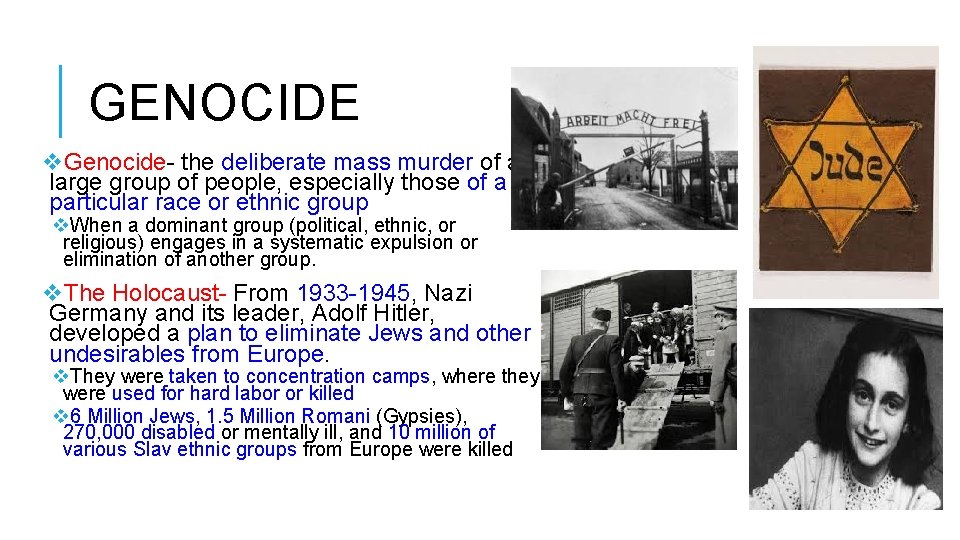
v. Khmer Rouge- armed wing of the Communist Party of Kampuchea (Cambodia); after a right-wing military coup toppled head of state in 1970, began to attract increasing support. CAMBODIAN GENOCIDE v. During civil war that lasted for nearly five years, it gradually increased its control in the countryside. Khmer Rouge forces finally took over the capital, Phnom Penh, in 1975. v. Pol Pot- influenced by the hill tribes in rural NE, who were self-sufficient in their communal living, had no use for money and were "untainted" by Buddhism. Goals when he came to power included transforming Cambodia into agrarian utopia. v"Year Zero“- Pol Pot’s isolation policy from the rest of the world included emptying cities, abolishing money, private property and religion, and setting up rural communes. v. Hundreds of thousands of the educated middleclasses and intellectuals like professors and teachers were tortured and executed in special centers v. Others died from disease, starvation or exhaustion as members of the Khmer Rouge forced people to do back-breaking work. v“Killing Fields”- locations of mass graves from 19751979, 3 Million Cambodian Minorities (Chinese, Korean, Vietnamese) were executed
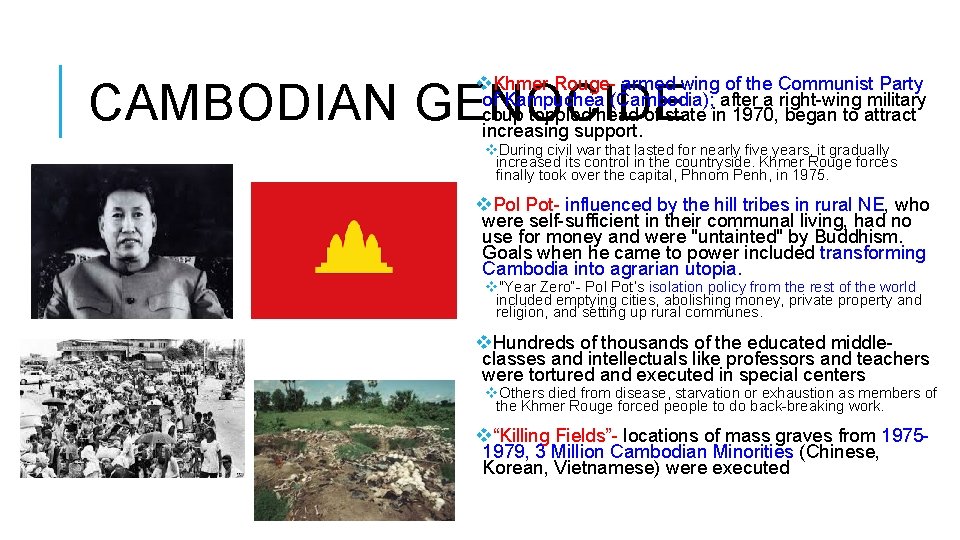
RWANDAN GENOCIDE v. Rwandan Genocide- April to July 1994; Hutu ethnic majority in Rwanda murdered as many as 800, 000 people, mostly of the Tutsi ethnic minority. v 85% of Rwandans are Hutu, but the Tutsi minority long dominated the country. v. Begun by extreme Hutu nationalists in the capital of Kigali in 1994, ordinary citizens were encouraged by local officials and the government to take up arms against their neighbors. v. Tutsi-led Rwandese Patriotic Front gained control of the country through a military offensive in early July 1994, ending the conflict v 1 million Tutsi killed v. Hundreds of thousands of Rwandans displaced from their homes.
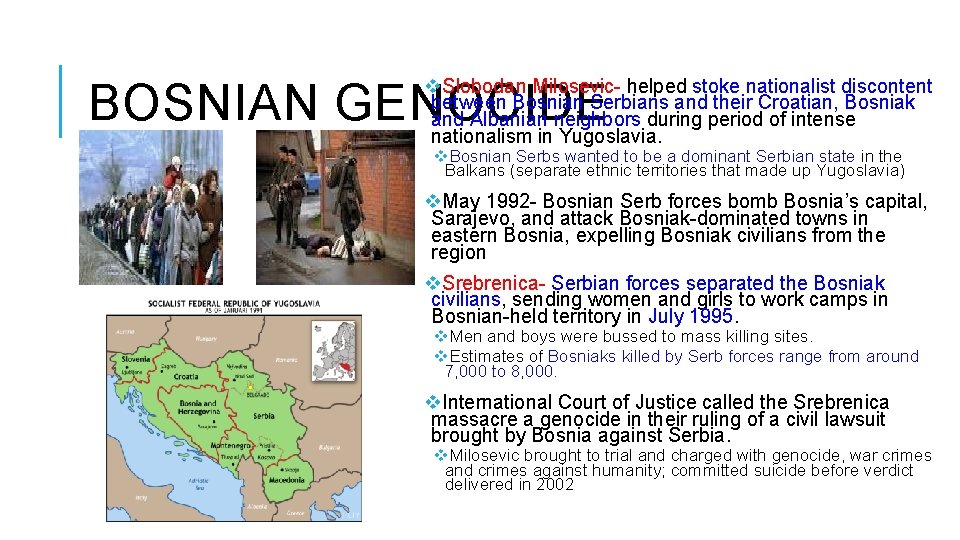
v. Slobodan Milosevic- helped stoke nationalist discontent between Bosnian Serbians and their Croatian, Bosniak and Albanian neighbors during period of intense nationalism in Yugoslavia. BOSNIAN GENOCIDE v. Bosnian Serbs wanted to be a dominant Serbian state in the Balkans (separate ethnic territories that made up Yugoslavia) v. May 1992 - Bosnian Serb forces bomb Bosnia’s capital, Sarajevo, and attack Bosniak-dominated towns in eastern Bosnia, expelling Bosniak civilians from the region v. Srebrenica- Serbian forces separated the Bosniak civilians, sending women and girls to work camps in Bosnian-held territory in July 1995. v. Men and boys were bussed to mass killing sites. v. Estimates of Bosniaks killed by Serb forces range from around 7, 000 to 8, 000. v. International Court of Justice called the Srebrenica massacre a genocide in their ruling of a civil lawsuit brought by Bosnia against Serbia. v. Milosevic brought to trial and charged with genocide, war crimes and crimes against humanity; committed suicide before verdict delivered in 2002