
A Human Rights Approach to Labor Policy Democracy
“A Human Rights Approach to Labor Policy" Democracy and the Workplace UNLV 2012 Robert Hebdon, Mc. Gill University
Introduction n n A negative effect of globalization and trade liberalization has been the growing inequality in many developed and developing societies To deal with this inequality the International Labor Organization (ILO) has recently passed a “Declaration on Social Justice for a Fair Globalization” 2008
Introduction The declaration requires that nation states adhere to the core labour standards of the ILO: • freedom of association and the effective recognition of the right to collective bargaining, • the elimination of all forms of forced or compulsory labour, • the effective abolition of child labour, and • the elimination of discrimination in respect of employment and occupation.
A Human Rights Approach n n n In the past labour law (employee and union rights) has been subject to the whims of the political process. This shifting labour policy has often been justified in terms of achieving a balance of power between capital and labour. Historically, U. S. & Canadian labour law has not been fashioned by using a human rights standard.
A Human Rights Approach n n Human rights are moral rights stemming from the fact of our human existence, not dependent on statute or the strength of the collective bargaining agreement (Gross, 1999). Thus we need a new labour policy fashioned around human rights
An International Consensus n n During the 1990 s in the context of globalization a strong international consensus emerged around core labour rights (Adams 2002). The accord was politically diverse including the Organization of Economic Cooperation, the World Trade Organization, the International Labour Organization, and the United Nations.
An International Consensus n n Also signing on were such employer organizations as the International Chamber of Commerce, the International Organization of Employers, at least fifty major multinationals, and the U. S. Council for International Business. It held that all human rights are universal, indivisible, interdependent, and interrelated.

An International Consensus n The consensus centred on the ILO’s Declaration of Fund Principles and Rights at Work in 1998. It had 2 purposes: • to encourage members to endorse and legislate the core labour standards
An International Consensus n also to “respect, promote, and to realize in good faith” five core rights deemed to be fund human rights: • Freedom of association; • Effective recognition of the right to collective bargaining; • Elimination of compulsory labour; • Effective abolition of child labour; • Elimination of employment discrimination.
The Project n n A key question that this paper will attempt to answer is whether the fundamental human right of freedom of association has and continues to be respected for public sector employees in the U. S and Canada We use internationally accepted Conventions and decisions of the ILO as benchmarks for judging U. S. and Canadian federal and state public sector labour laws.
What is collective bargaining? n n n Freedom of association includes collective bargaining (ILO and Supreme Court of Canada) No universal definition A broad definition would include 4 elements: • • • a neutral procedure to freely choose a union a duty to bargain and a good faith a right to strike except in the case of essential services • the right to negotiate all working conditions and terms of employment
The Government Accounting Office Study n The GAO definition included 2 elements: • a neutral procedure to freely choose a union • a duty to bargain and a good faith n And excluded • a right to strike except in the case of essential services • the right to negotiate all working conditions and terms of employment
The Government Accounting Office Study - Findings n the GAO found that 32 million workers lacked access to collective bargaining, • 6. 9 million of which were in the federal, state, and local public sectors. • about 8. 5 million independent contractors, • 5. 5 million employees of certain small businesses and • 10. 2 million supervisory/managerial employees (including 8. 6 million first-line supervisors).
The GAO Study – an expanded analysis n The GAO definition included 2 elements: • a neutral procedure to freely choose a union • a duty to bargain and a good faith n And excluded • a right to strike except in the case of essential services • the right to negotiate all working conditions and terms of employment
The GAO Study – an expanded analysis n We add in the right to strike to the GAO definition: • a neutral procedure to freely choose a union • a duty to bargain and a good faith • a right to strike except in the case of essential services • the right to negotiate all working conditions and terms of employment
The GAO Study – an expanded analysis n n Seven states provide for a right to strike, seven have arbitration and the vast majority of 36 states are in the ‘no finality’ category. These latter states are in violation of the human right to freedom of association insofar as there is no procedure available to a union to effectively bargain with employers.
The GAO Study – an expanded analysis n n In Canada, all of the provinces and federal government provide for collective bargaining with either a right to strike or arbitration as a final dispute procedure. Canadian violations of freedom of association fall into four categories: • removal of right to strike for non-essential workers, • frequent use of back-to-work legislation to end strikes, • the exclusion of police groups from collective bargaining, and • restrictions on the scope of negotiable issues
Conclusion n n It is clear that we are in a new era of globalization that involves free trade in goods and services, greater mobility and security of capital, and constraints on government action. Labour market regulation has been slow to respond to these developments. We assert that there is a growing international consensus around core labour rights as set out by the ILO and various international bodies.
Conclusion n We have found North American governments to be in violation of the fundamental right to freedom of association for a significant number of their own employees. This question needs a much more thorough investigation than is offered here. For example there should be a full enquiry into legislative restrictions on the scope of negotiable issues. It seems clear, however, based on their own evidence that governments have been playing ‘fast and loose’ with employee rights including freedom of association – a human right.
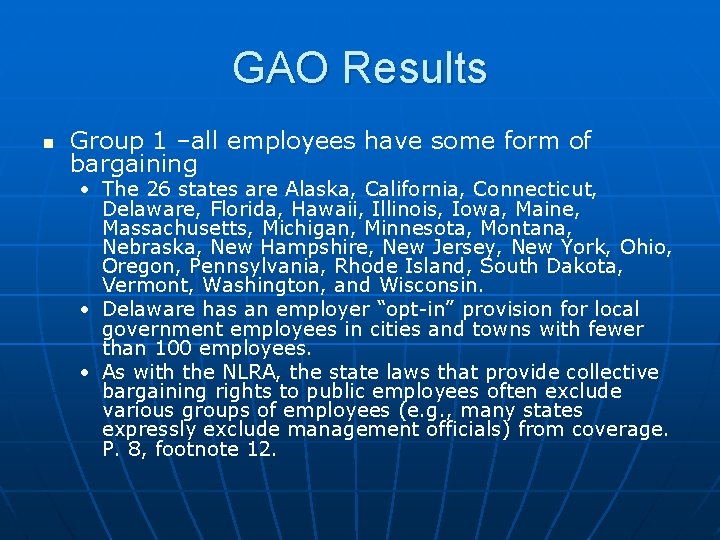
GAO Results n Group 1 –all employees have some form of bargaining • The 26 states are Alaska, California, Connecticut, Delaware, Florida, Hawaii, Illinois, Iowa, Maine, Massachusetts, Michigan, Minnesota, Montana, Nebraska, New Hampshire, New Jersey, New York, Ohio, Oregon, Pennsylvania, Rhode Island, South Dakota, Vermont, Washington, and Wisconsin. • Delaware has an employer “opt-in” provision for local government employees in cities and towns with fewer than 100 employees. • As with the NLRA, the state laws that provide collective bargaining rights to public employees often exclude various groups of employees (e. g. , many states expressly exclude management officials) from coverage. P. 8, footnote 12.
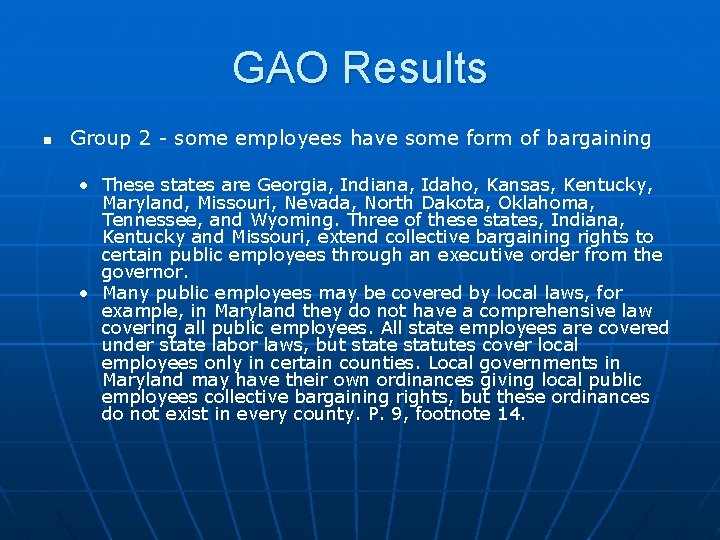
GAO Results n Group 2 - some employees have some form of bargaining • These states are Georgia, Indiana, Idaho, Kansas, Kentucky, Maryland, Missouri, Nevada, North Dakota, Oklahoma, Tennessee, and Wyoming. Three of these states, Indiana, Kentucky and Missouri, extend collective bargaining rights to certain public employees through an executive order from the governor. • Many public employees may be covered by local laws, for example, in Maryland they do not have a comprehensive law covering all public employees. All state employees are covered under state labor laws, but state statutes cover local employees only in certain counties. Local governments in Maryland may have their own ordinances giving local public employees collective bargaining rights, but these ordinances do not exist in every county. P. 9, footnote 14.
GAO Results n Group 3 - no public employee groups have bargaining rights • Twelve states do not have collective bargaining laws for public employees. They are Alabama, Arizona, Arkansas, Colorado, Louisiana, Mississippi, New Mexico, North Carolina, South Carolina, Texas, Virginia, and West Virginia. • In addition, Texas prohibits collective bargaining for most groups of public employees. However, firefighters and police may bargain in jurisdictions with approval from a majority of voters. P. 9, footnote 13. n Source GAO Report, 2002
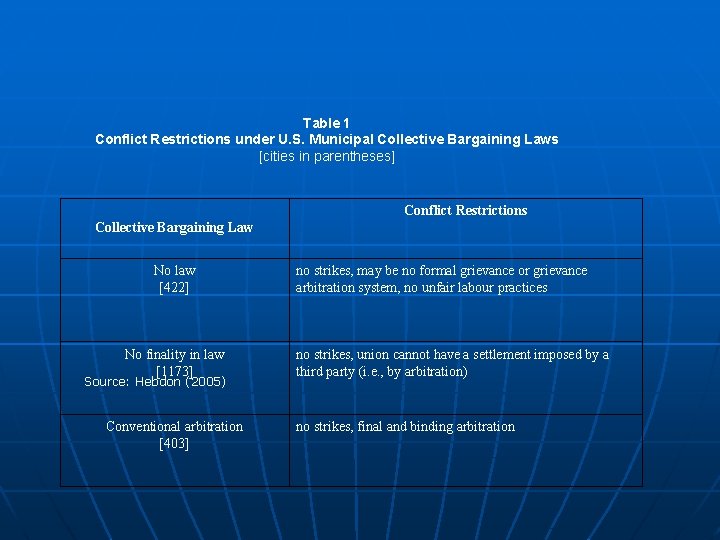
Table 1 Conflict Restrictions under U. S. Municipal Collective Bargaining Laws [cities in parentheses] Conflict Restrictions Collective Bargaining Law No law [422] No finality in law [1173] Source: Hebdon (2005) Conventional arbitration [403] no strikes, may be no formal grievance or grievance arbitration system, no unfair labour practices no strikes, union cannot have a settlement imposed by a third party (i. e. , by arbitration) no strikes, final and binding arbitration
Extended Analaysis n n In table 2, states are identified by the dominant collective bargaining law for municipal employees. Seven states provide for a right to strike, seven have arbitration and the vast majority of 36 states are in the ‘no finality’ category. These latter states are in violation of the human right to freedom of association insofar as there is no procedure available to a union to effectively bargain with employers.
- Slides: 24