Computer Systems Synchronizing Threads with Semaphores Recap MultiThreaded
- Slides: 25
Computer Systems Synchronizing Threads with Semaphores
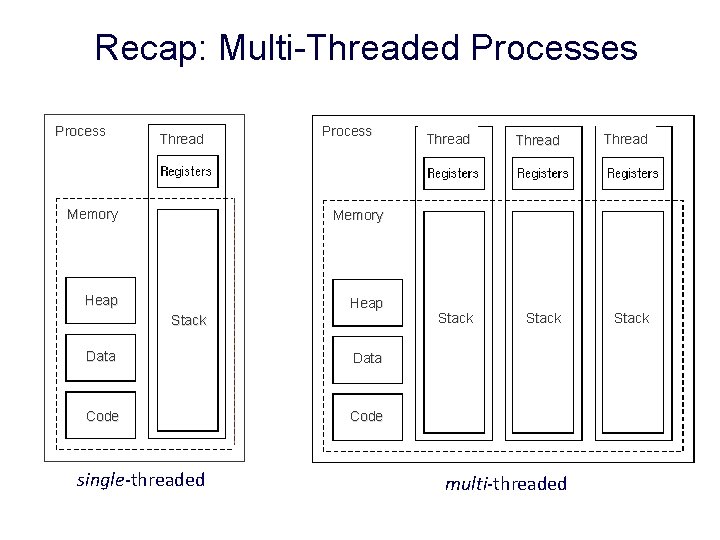
Recap: Multi-Threaded Processes Process Thread Process Memory Heap Stack Data Code single-threaded Thread Stack multi-threaded
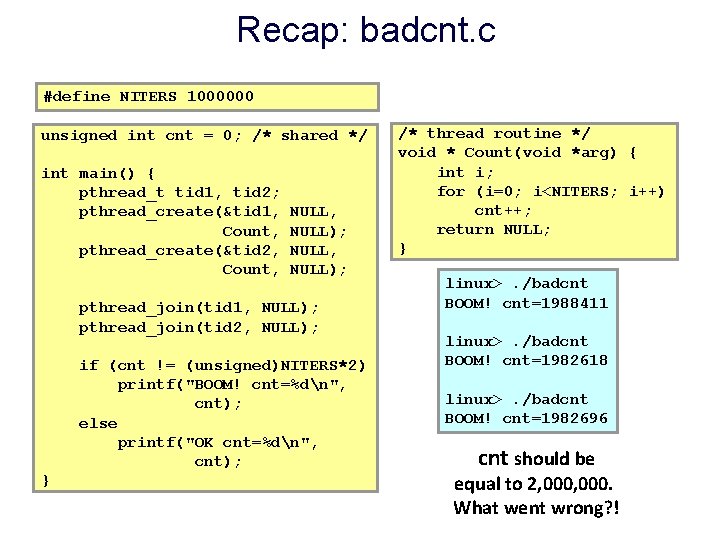
Recap: badcnt. c #define NITERS 1000000 unsigned int cnt = 0; /* shared */ int main() { pthread_t tid 1, tid 2; pthread_create(&tid 1, Count, pthread_create(&tid 2, Count, NULL, NULL); pthread_join(tid 1, NULL); pthread_join(tid 2, NULL); if (cnt != (unsigned)NITERS*2) printf("BOOM! cnt=%dn", cnt); else printf("OK cnt=%dn", cnt); } /* thread routine */ void * Count(void *arg) { int i; for (i=0; i<NITERS; i++) cnt++; return NULL; } linux>. /badcnt BOOM! cnt=1988411 linux>. /badcnt BOOM! cnt=1982618 linux>. /badcnt BOOM! cnt=1982696 cnt should be equal to 2, 000. What went wrong? !
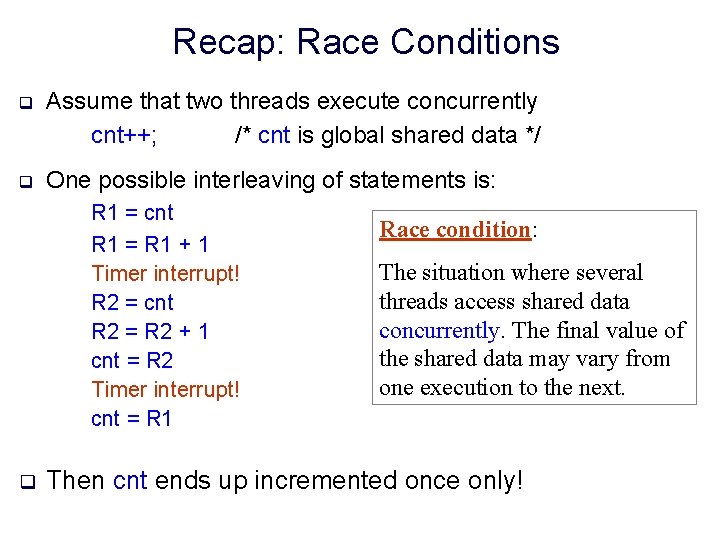
Recap: Race Conditions q Assume that two threads execute concurrently cnt++; /* cnt is global shared data */ q One possible interleaving of statements is: R 1 = cnt R 1 = R 1 + 1 Timer interrupt! R 2 = cnt R 2 = R 2 + 1 cnt = R 2 Timer interrupt! cnt = R 1 q Race condition: The situation where several threads access shared data concurrently. The final value of the shared data may vary from one execution to the next. Then cnt ends up incremented once only!
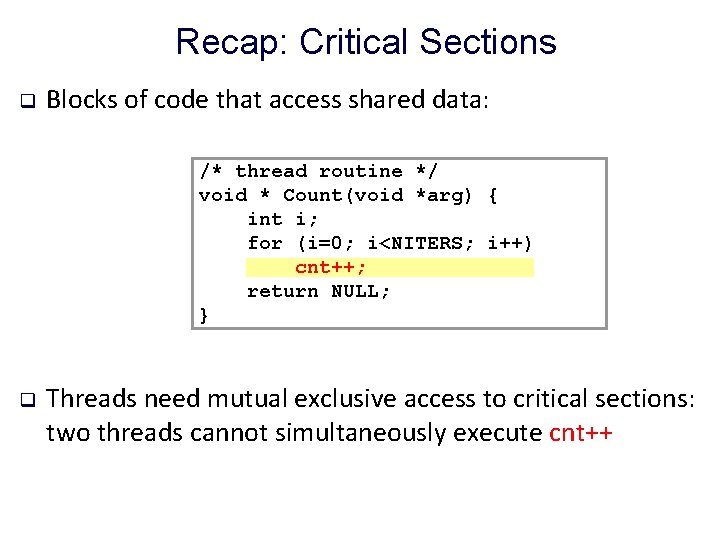
Recap: Critical Sections q Blocks of code that access shared data: /* thread routine */ void * Count(void *arg) { int i; for (i=0; i<NITERS; i++) cnt++; return NULL; } q Threads need mutual exclusive access to critical sections: two threads cannot simultaneously execute cnt++
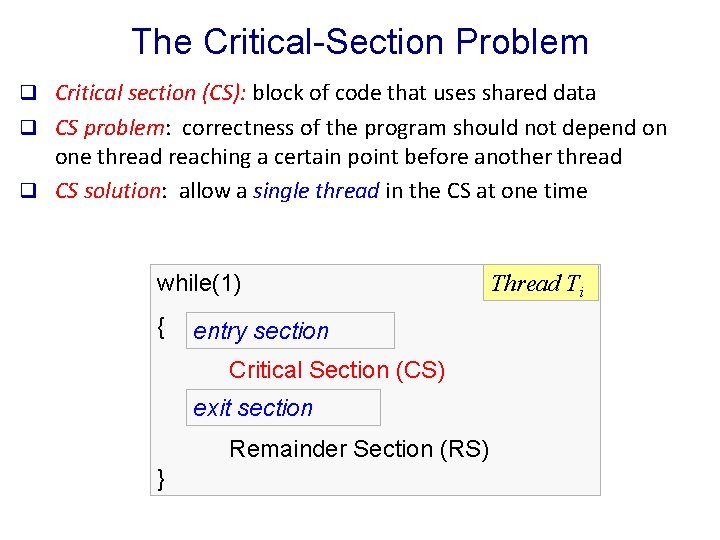
The Critical-Section Problem q Critical section (CS): block of code that uses shared data q CS problem: correctness of the program should not depend on one thread reaching a certain point before another thread q CS solution: allow a single thread in the CS at one time while(1) { entry section Critical Section (CS) exit section Remainder Section (RS) } Thread Ti
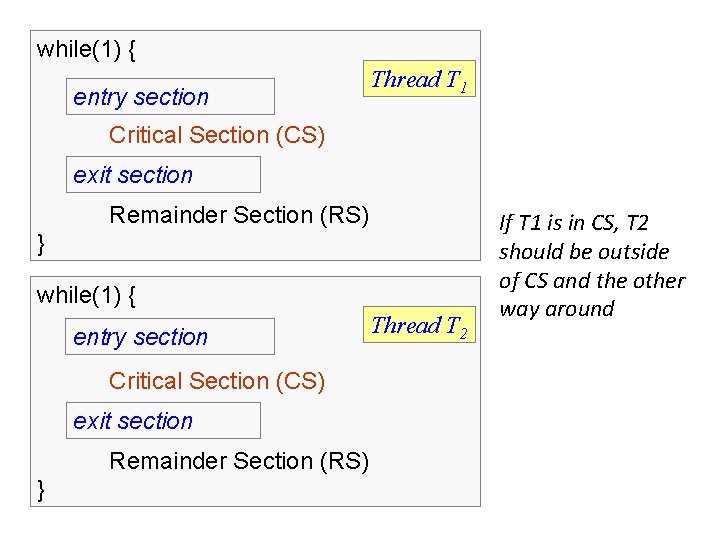
while(1) { entry section Thread T 1 Critical Section (CS) exit section Remainder Section (RS) } while(1) { entry section Critical Section (CS) exit section Remainder Section (RS) } Thread T 2 If T 1 is in CS, T 2 should be outside of CS and the other way around
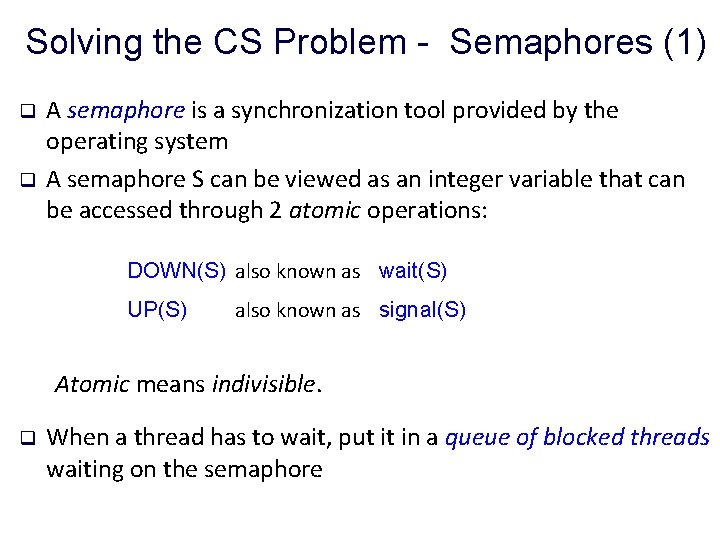
Solving the CS Problem - Semaphores (1) q q A semaphore is a synchronization tool provided by the operating system A semaphore S can be viewed as an integer variable that can be accessed through 2 atomic operations: DOWN(S) also known as wait(S) UP(S) also known as signal(S) Atomic means indivisible. q When a thread has to wait, put it in a queue of blocked threads waiting on the semaphore
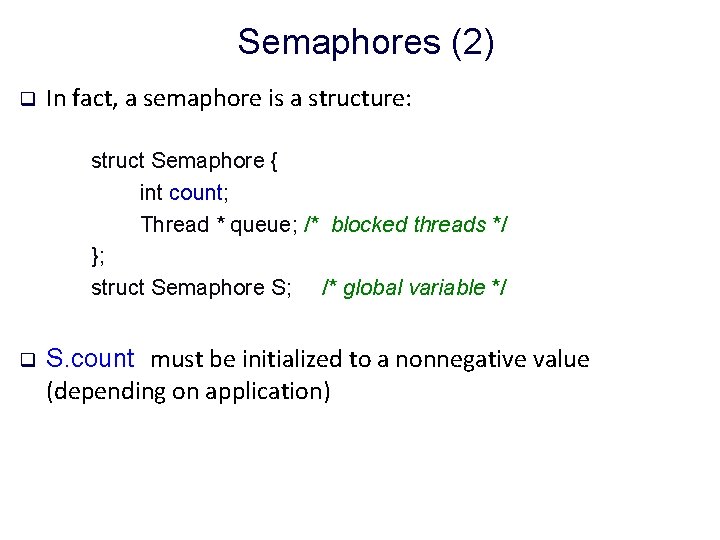
Semaphores (2) q In fact, a semaphore is a structure: struct Semaphore { int count; Thread * queue; /* blocked threads */ }; struct Semaphore S; /* global variable */ q S. count must be initialized to a nonnegative value (depending on application)
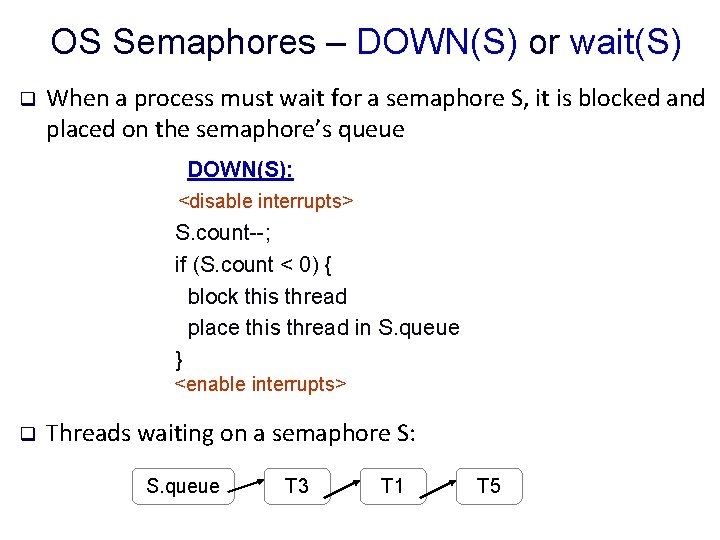
OS Semaphores – DOWN(S) or wait(S) q When a process must wait for a semaphore S, it is blocked and placed on the semaphore’s queue DOWN(S): <disable interrupts> S. count--; if (S. count < 0) { block this thread place this thread in S. queue } <enable interrupts> q Threads waiting on a semaphore S: S. queue T 3 T 1 T 5
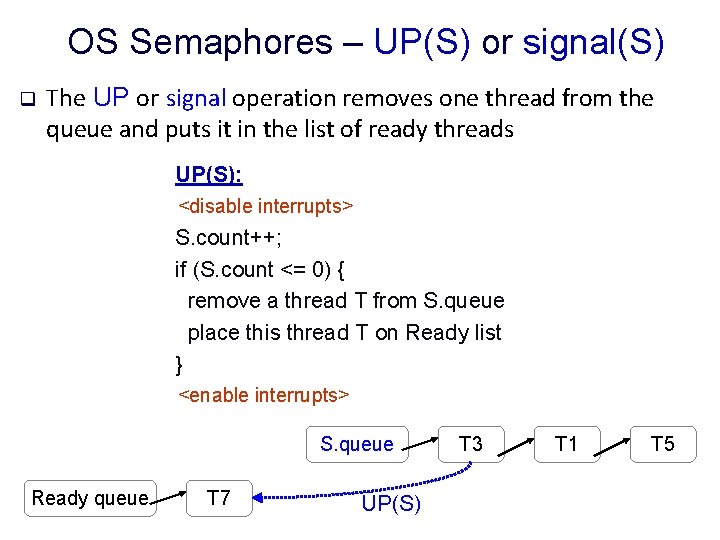
OS Semaphores – UP(S) or signal(S) q The UP or signal operation removes one thread from the queue and puts it in the list of ready threads UP(S): <disable interrupts> S. count++; if (S. count <= 0) { remove a thread T from S. queue place this thread T on Ready list } <enable interrupts> S. queue Ready queue T 7 UP(S) T 3 T 1 T 5
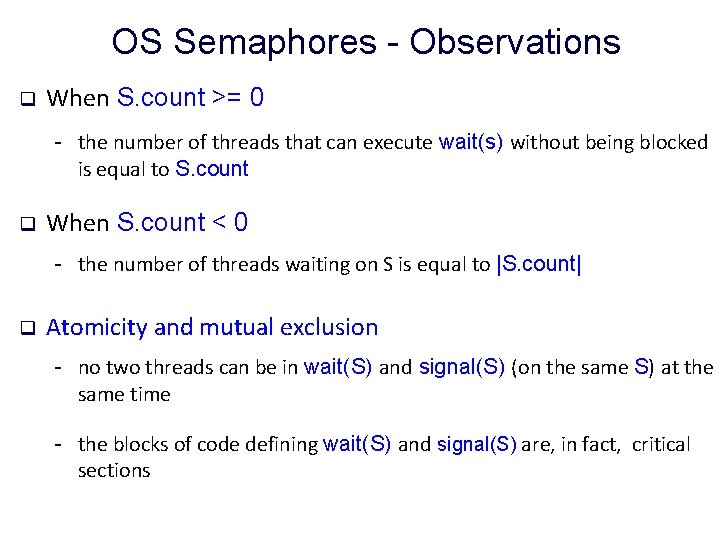
OS Semaphores - Observations q When S. count >= 0 - the number of threads that can execute wait(s) without being blocked is equal to S. count q When S. count < 0 - the number of threads waiting on S is equal to |S. count| q Atomicity and mutual exclusion - no two threads can be in wait(S) and signal(S) (on the same S) at the same time - the blocks of code defining wait(S) and signal(S) are, in fact, critical sections
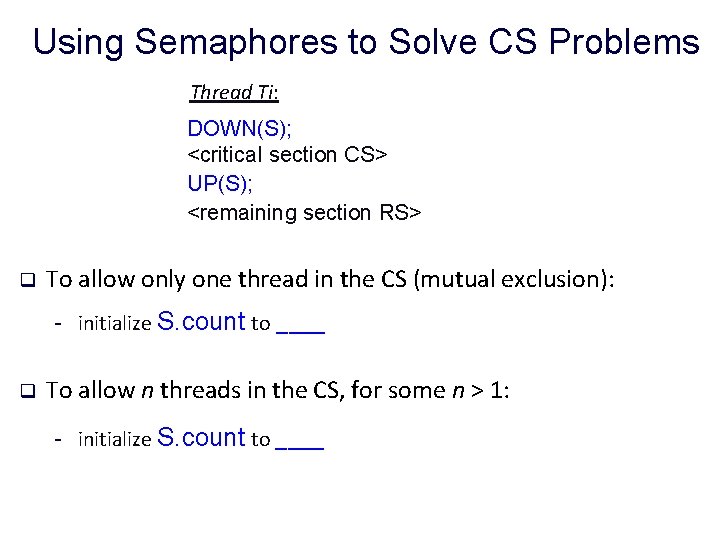
Using Semaphores to Solve CS Problems Thread Ti: DOWN(S); <critical section CS> UP(S); <remaining section RS> q To allow only one thread in the CS (mutual exclusion): - initialize S. count to ____ q To allow n threads in the CS, for some n > 1: - initialize S. count to ____
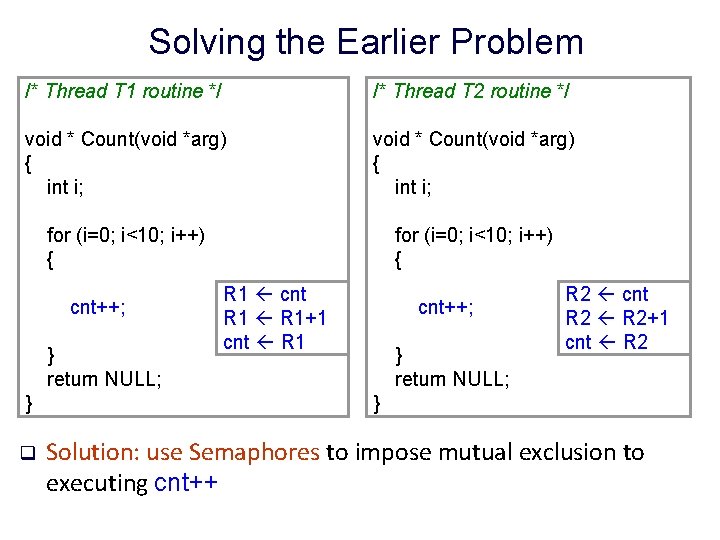
Solving the Earlier Problem /* Thread T 1 routine */ /* Thread T 2 routine */ void * Count(void *arg) { int i; for (i=0; i<10; i++) { cnt++; } return NULL; } q R 1 cnt R 1+1 cnt R 1 cnt++; } return NULL; R 2 cnt R 2+1 cnt R 2 } Solution: use Semaphores to impose mutual exclusion to executing cnt++
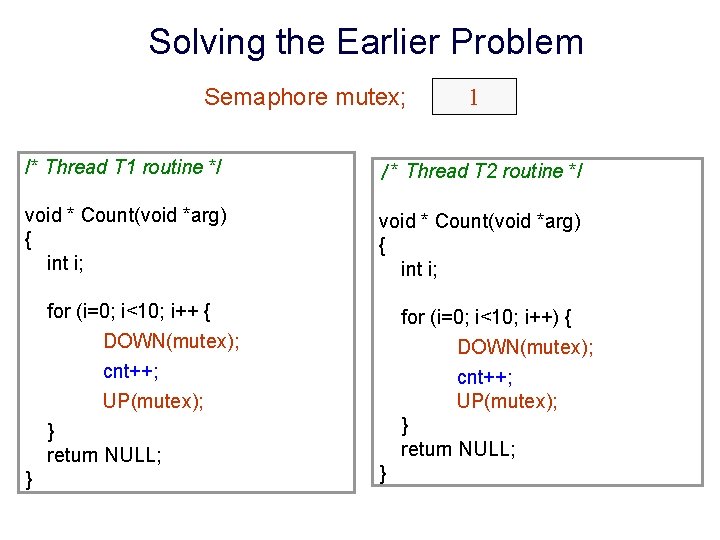
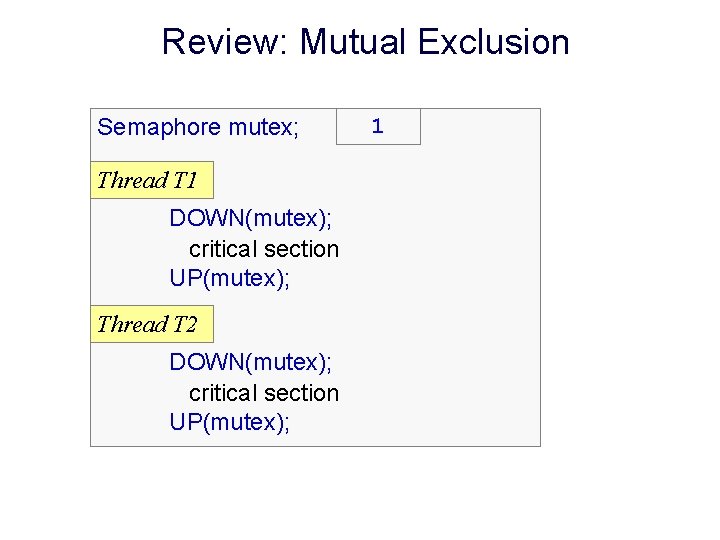
Solving the Earlier Problem Semaphore mutex; 1 /* Thread T 1 routine */ /* Thread T 2 routine */ void * Count(void *arg) { int i; for (i=0; i<10; i++ { DOWN(mutex); cnt++; UP(mutex); } return NULL; } for (i=0; i<10; i++) { DOWN(mutex); cnt++; UP(mutex); } return NULL; }
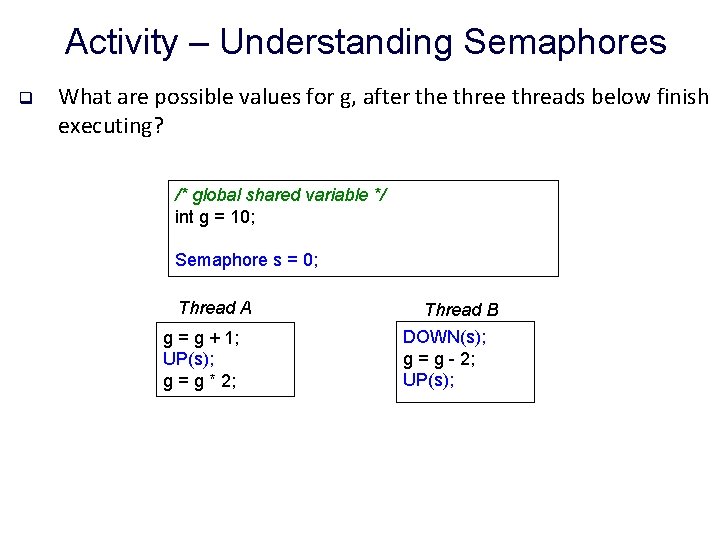
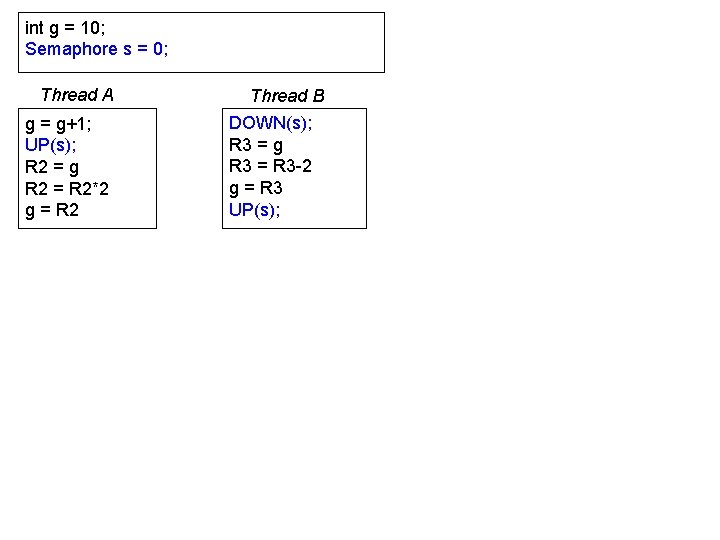
Activity – Understanding Semaphores q What are possible values for g, after the threads below finish executing? /* global shared variable */ int g = 10; Semaphore s = 0; Thread A g = g + 1; UP(s); g = g * 2; Thread B DOWN(s); g = g - 2; UP(s);
int g = 10; Semaphore s = 0; Thread A g = g+1; UP(s); R 2 = g R 2 = R 2*2 g = R 2 Thread B DOWN(s); R 3 = g R 3 = R 3 -2 g = R 3 UP(s);
Using OS Semaphores q Semaphores have two uses: - Mutual exclusion: making sure that only one thread is in a critical section at one time - Synchronization: making sure that T 1 completes execution before T 2 starts?
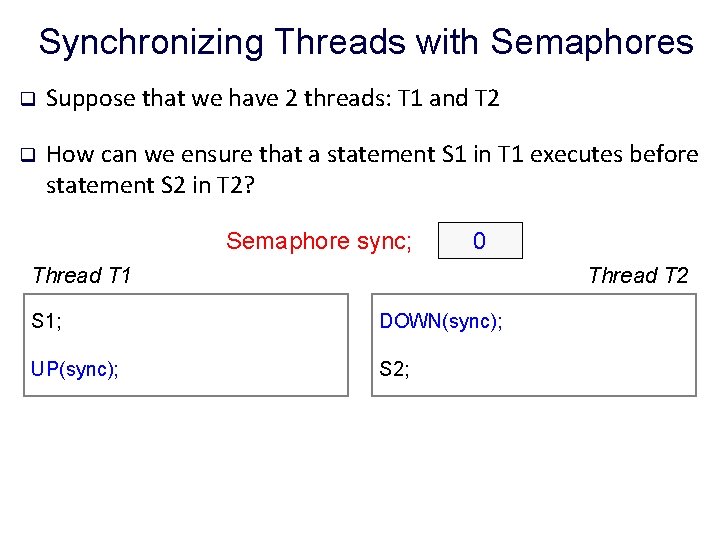
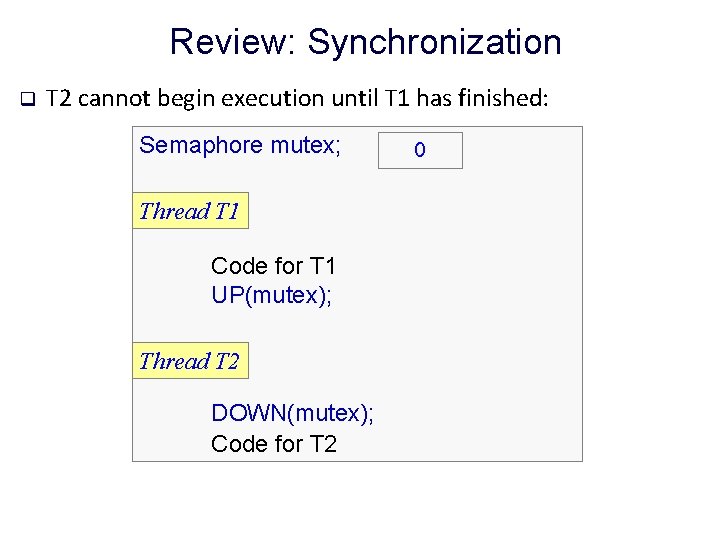
Synchronizing Threads with Semaphores q Suppose that we have 2 threads: T 1 and T 2 q How can we ensure that a statement S 1 in T 1 executes before statement S 2 in T 2? Semaphore sync; 0 Thread T 1 Thread T 2 S 1; DOWN(sync); UP(sync); S 2;
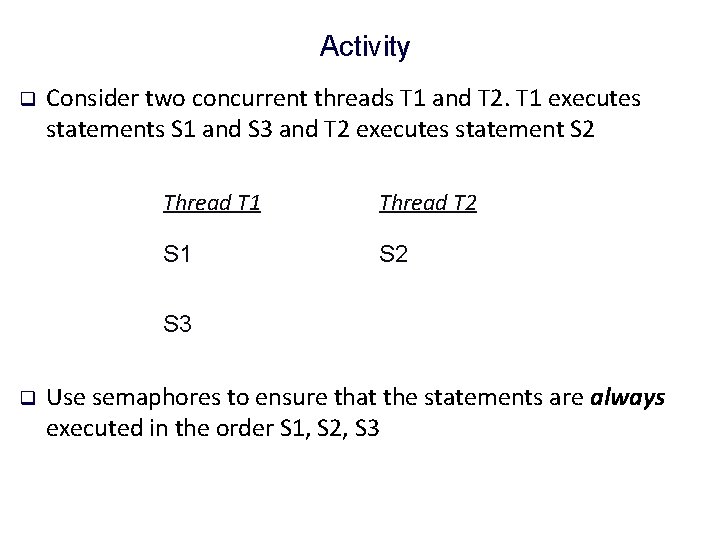
Activity q Consider two concurrent threads T 1 and T 2. T 1 executes statements S 1 and S 3 and T 2 executes statement S 2 Thread T 1 Thread T 2 S 1 S 2 S 3 q Use semaphores to ensure that the statements are always executed in the order S 1, S 2, S 3
Review: Mutual Exclusion Semaphore mutex; Thread T 1 DOWN(mutex); critical section UP(mutex); Thread T 2 DOWN(mutex); critical section UP(mutex); 1
Review: Synchronization q T 2 cannot begin execution until T 1 has finished: Semaphore mutex; Thread T 1 Code for T 1 UP(mutex); Thread T 2 DOWN(mutex); Code for T 2 0
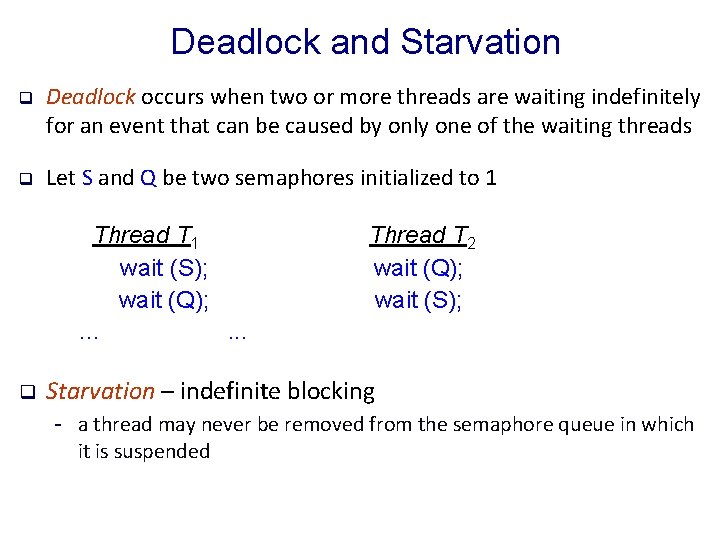
Deadlock and Starvation q Deadlock occurs when two or more threads are waiting indefinitely for an event that can be caused by only one of the waiting threads q Let S and Q be two semaphores initialized to 1 Thread T 1 wait (S); wait (Q); . . . q Thread T 2 wait (Q); wait (S); Starvation – indefinite blocking - a thread may never be removed from the semaphore queue in which it is suspended
Hands-on Session q POSIX semaphores - q sem_init sem_wait sem_post sem_getvalue sem_destroy Fix the badcnt. c program to produce correct result
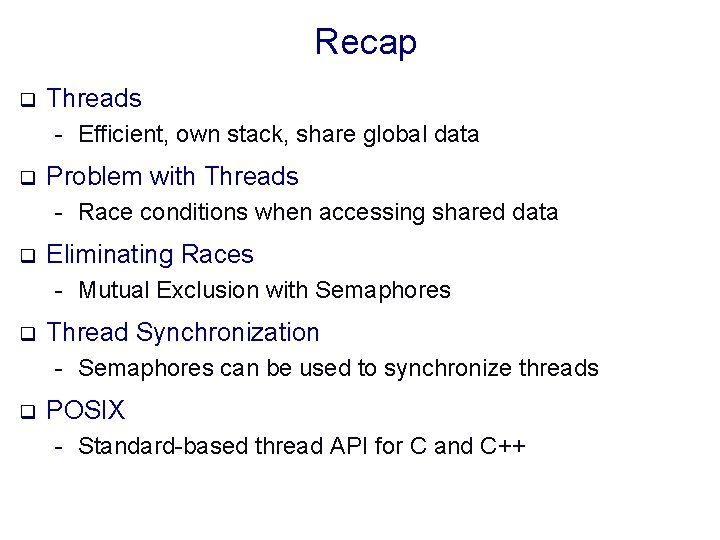
Recap q Threads - Efficient, own stack, share global data q Problem with Threads - Race conditions when accessing shared data q Eliminating Races - Mutual Exclusion with Semaphores q Thread Synchronization - Semaphores can be used to synchronize threads q POSIX - Standard-based thread API for C and C++