Computer Networking A TopDown Approach Featuring the Internet

- Slides: 18
Computer Networking A Top-Down Approach Featuring the Internet Introduction
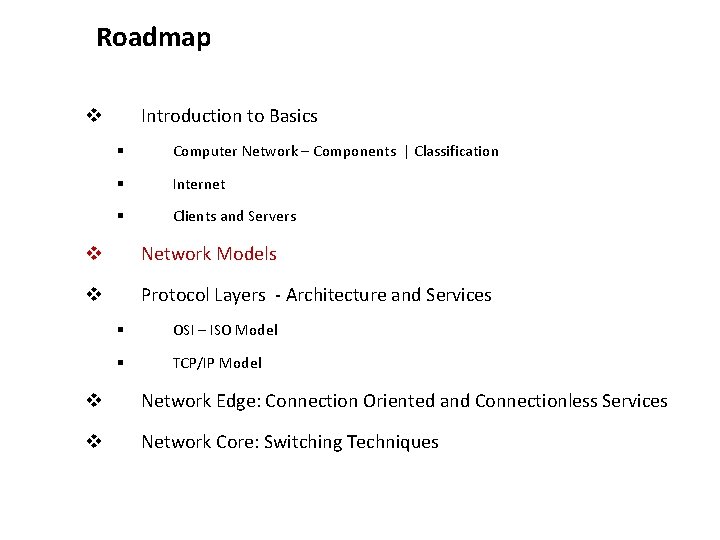
Roadmap Introduction to Basics v § Computer Network – Components | Classification § Internet § Clients and Servers v Network Models v Protocol Layers - Architecture and Services § OSI – ISO Model § TCP/IP Model v Network Edge: Connection Oriented and Connectionless Services v Network Core: Switching Techniques
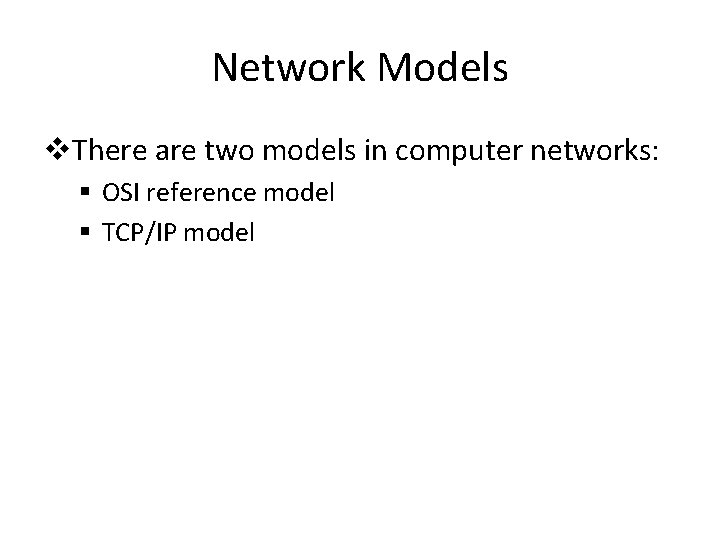
Network Models v. There are two models in computer networks: § OSI reference model § TCP/IP model
Roadmap Introduction to Basics v § Computer Network – Components | Classification § Internet § Clients and Servers v Network Models v Protocol Layers - Architecture and Services § OSI – ISO Model § TCP/IP Model v Network Edge: Connection Oriented and Connectionless Services v Network Core: Switching Techniques
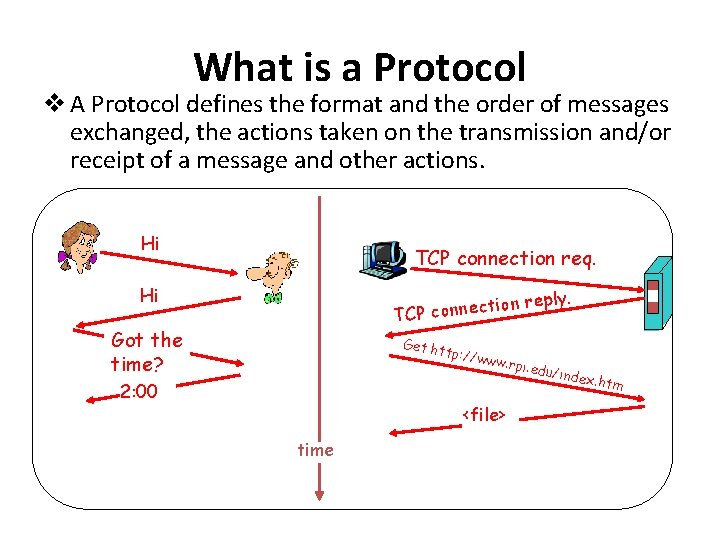
What is a Protocol v A Protocol defines the format and the order of messages exchanged, the actions taken on the transmission and/or receipt of a message and other actions. Hi TCP connection req. Hi ly. ion rep t c e n n o c P TC Got the time? Get ht 2: 00 tp: //w ww. rp <file> time i. edu/ index. htm
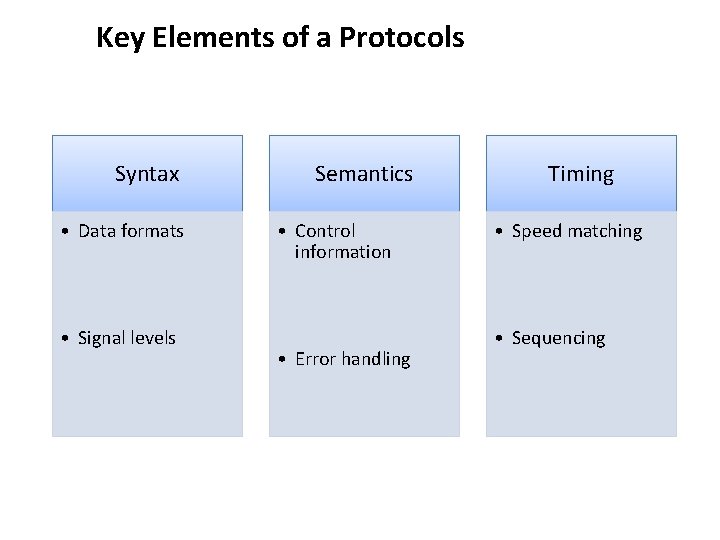
Key Elements of a Protocols Syntax • Data formats • Signal levels Semantics • Control information • Error handling Timing • Speed matching • Sequencing
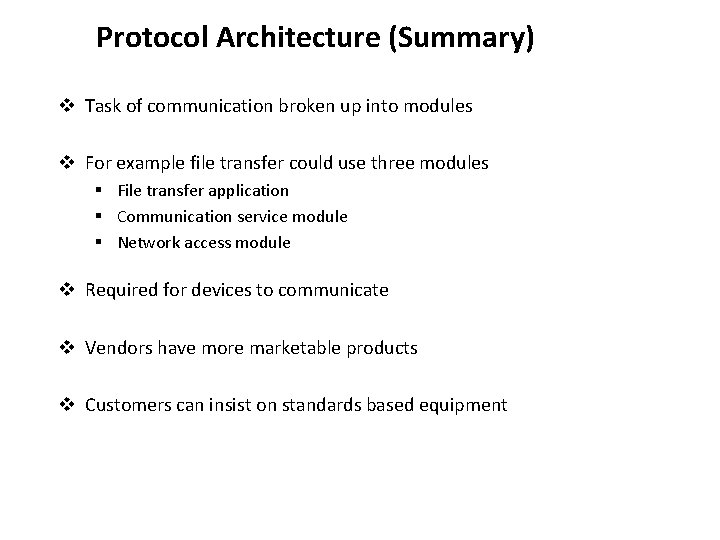
Protocol Architecture (Summary) v Task of communication broken up into modules v For example file transfer could use three modules § File transfer application § Communication service module § Network access module v Required for devices to communicate v Vendors have more marketable products v Customers can insist on standards based equipment
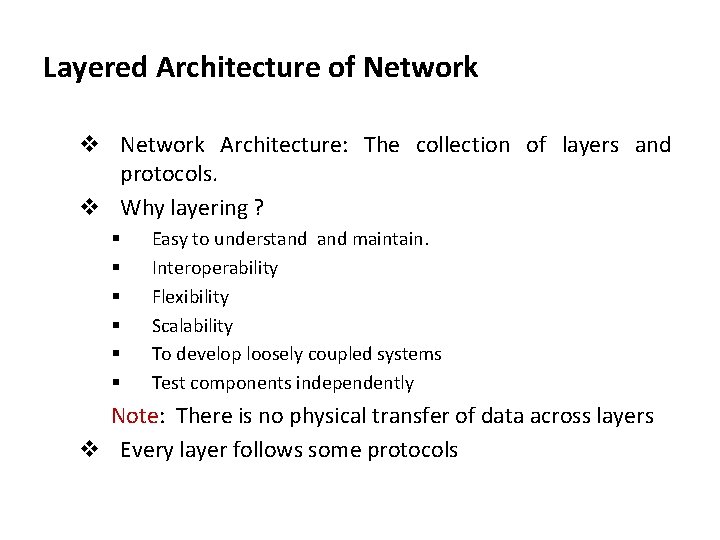
Layered Architecture of Network v Network Architecture: The collection of layers and protocols. v Why layering ? § § § Easy to understand maintain. Interoperability Flexibility Scalability To develop loosely coupled systems Test components independently Note: There is no physical transfer of data across layers v Every layer follows some protocols
Layered Architecture v Networks organized as a stack of layers: § To offer services to the layer above it using an interface (libraries hide details while providing a service) § Reduces design complexity v Protocols: peer-to-peer layer-n conversations v Data Transfer: each layer passes data & control information to the layer below; eventually physical medium is reached.
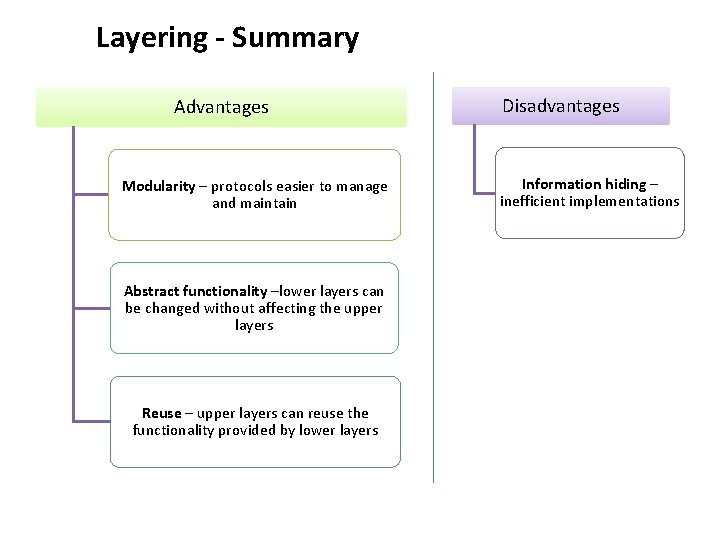
Layering - Summary Advantages Modularity – protocols easier to manage and maintain Abstract functionality –lower layers can be changed without affecting the upper layers Reuse – upper layers can reuse the functionality provided by lower layers Disadvantages Information hiding – inefficient implementations
Roadmap Introduction to Basics v § Computer Network – Components | Classification § Internet § Clients and Servers v Network Models v Protocol Layers - Architecture and Services § OSI – ISO Model § TCP/IP Model v Network Edge: Connection Oriented and Connectionless Services v Network Core: Switching Techniques
OSI v. Open Systems Interconnection v. Developed by the International Organization for Standardization (ISO) v. Seven layers v. A theoretical system delivered too late!
OSI - The Model v. A layered model v. Each layer performs a subset of the required communication functions v. Each layer relies on the next lower layer to perform more primitive functions v. Each layer provides services to the next higher layer v. Changes in one layer should not require changes in other layers
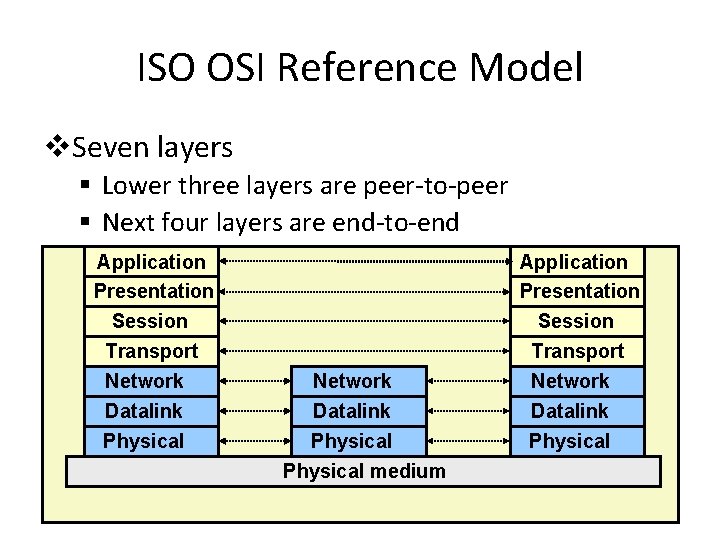
ISO OSI Reference Model v. Seven layers § Lower three layers are peer-to-peer § Next four layers are end-to-end Application Presentation Session Transport Network Datalink Physical medium Application Presentation Session Transport Network Datalink Physical
OSI Layer 1 -Physical Layer v. Physical Layer § Physical interface between devices • • Mechanical (joins 1 or more signal conductor, circuits) Electrical (Representation of bits and bit rate) Functional ( function performed by individual circuits ) Procedural (sequence of events) § Modulation and Demodulation § Raw bit stream § Modem: broadly used to refer to any module that performs the function above
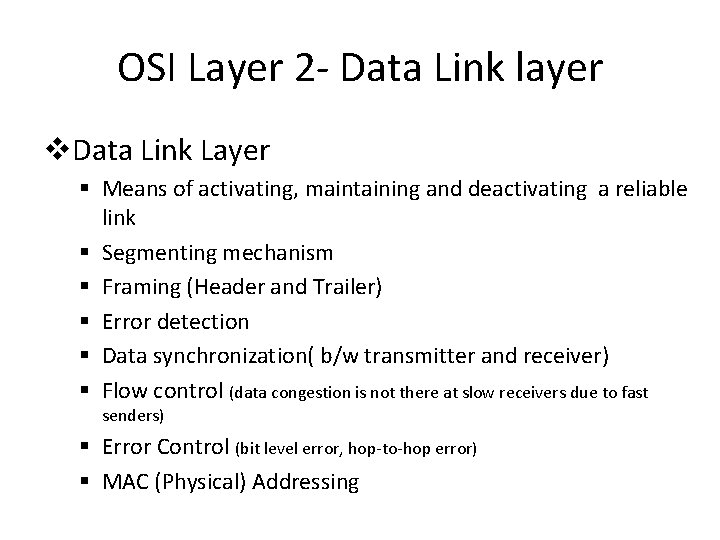
OSI Layer 2 - Data Link layer v. Data Link Layer § Means of activating, maintaining and deactivating a reliable link § Segmenting mechanism § Framing (Header and Trailer) § Error detection § Data synchronization( b/w transmitter and receiver) § Flow control (data congestion is not there at slow receivers due to fast senders) § Error Control (bit level error, hop-to-hop error) § MAC (Physical) Addressing
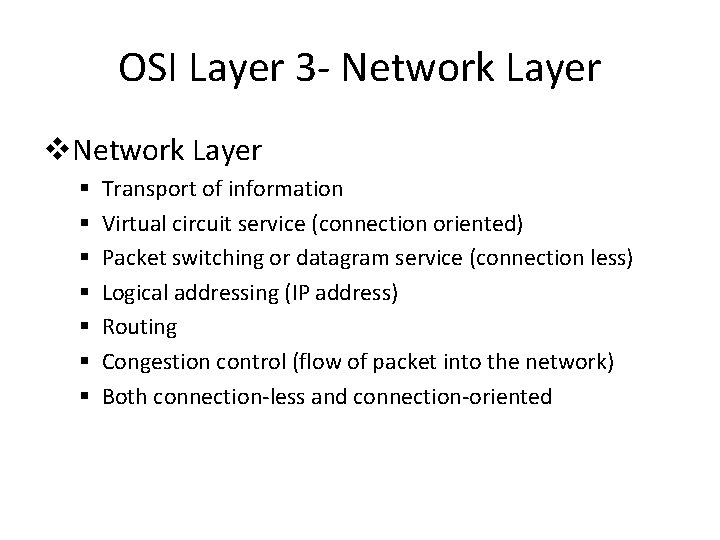
OSI Layer 3 - Network Layer v. Network Layer § § § § Transport of information Virtual circuit service (connection oriented) Packet switching or datagram service (connection less) Logical addressing (IP address) Routing Congestion control (flow of packet into the network) Both connection-less and connection-oriented
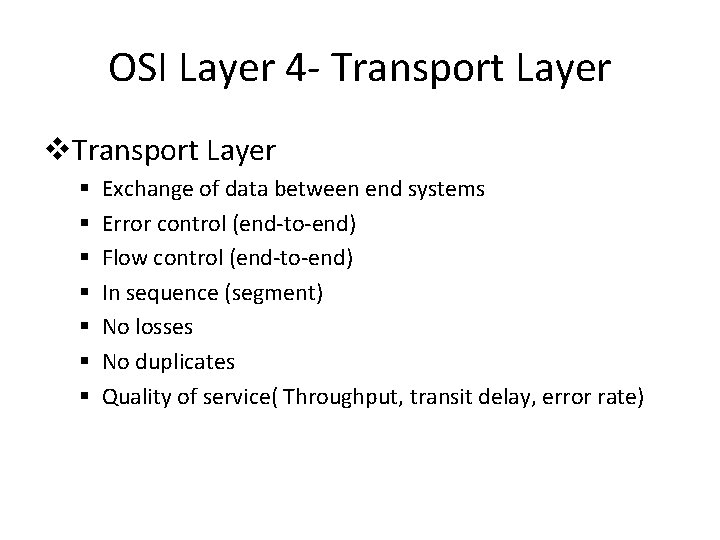
OSI Layer 4 - Transport Layer v. Transport Layer § § § § Exchange of data between end systems Error control (end-to-end) Flow control (end-to-end) In sequence (segment) No losses No duplicates Quality of service( Throughput, transit delay, error rate)