COMP 3500 Introduction to Operating Systems Project 3



- Slides: 8
COMP 3500 Introduction to Operating Systems Project 3 – Synchronization Cats and Mice Implemenation using Locks and Condition Variables (cont. ) Dr. Xiao Qin 1 Auburn University http: //www. eng. auburn. edu/~xqin@auburn. edu
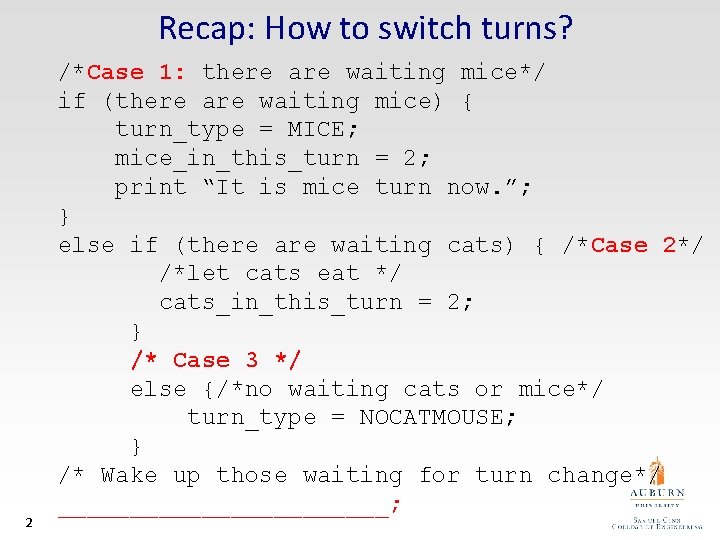
Recap: How to switch turns? /*Case 1: there are waiting mice*/ if (there are waiting mice) { turn_type = MICE; mice_in_this_turn = 2; print “It is mice turn now. ”; } else if (there are waiting cats) { /*Case 2*/ /*let cats eat */ cats_in_this_turn = 2; } /* Case 3 */ else {/*no waiting cats or mice*/ turn_type = NOCATMOUSE; } /* Wake up those waiting for turn change*/ ____________; 2
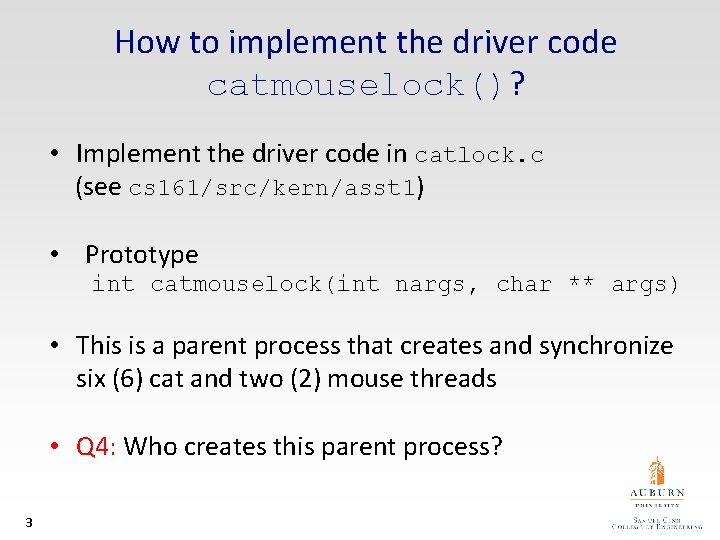
How to implement the driver code catmouselock()? • Implement the driver code in catlock. c (see cs 161/src/kern/asst 1) • Prototype int catmouselock(int nargs, char ** args) • This is a parent process that creates and synchronize six (6) cat and two (2) mouse threads • Q 4: Who creates this parent process? 3
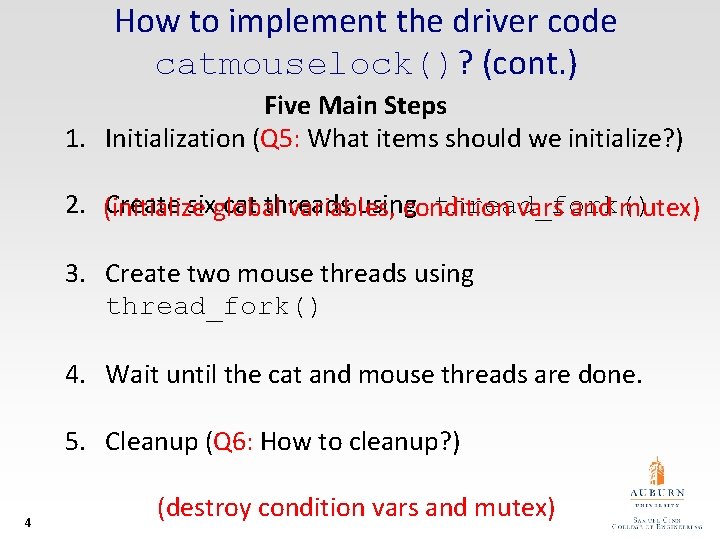
How to implement the driver code catmouselock()? (cont. ) Five Main Steps 1. Initialization (Q 5: What items should we initialize? ) 2. (initialize Create sixglobal cat threads using thread_fork() variables, condition vars and mutex) 3. Create two mouse threads using thread_fork() 4. Wait until the cat and mouse threads are done. 5. Cleanup (Q 6: How to cleanup? ) 4 (destroy condition vars and mutex)
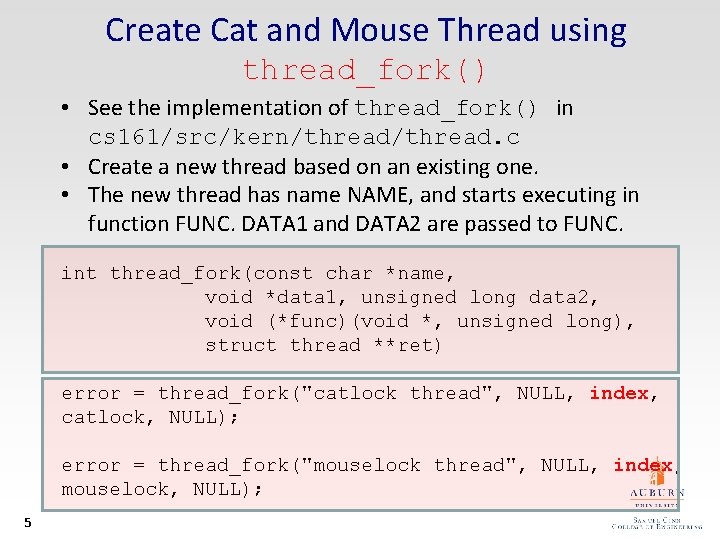
Create Cat and Mouse Thread using thread_fork() • See the implementation of thread_fork() in cs 161/src/kern/thread. c • Create a new thread based on an existing one. • The new thread has name NAME, and starts executing in function FUNC. DATA 1 and DATA 2 are passed to FUNC. int thread_fork(const char *name, void *data 1, unsigned long data 2, void (*func)(void *, unsigned long), struct thread **ret) error = thread_fork("catlock thread", NULL, index, catlock, NULL); error = thread_fork("mouselock thread", NULL, index, mouselock, NULL); 5
Create Cat and Mouse Thread using thread_fork() error = thread_fork("catlock thread", NULL, index, catlock, NULL); error = thread_fork("mouselock thread", NULL, index, mouselock, NULL); static void catlock(void * unusedpointer, unsigned long catnumber); static void mouselock(void * unusedpointer, unsigned long mousenumber) Input Parameters: void * unusedpointer: currently unused. unsigned long catnumber: holds the cat ID unsigned long mousenumber: holds the mouse ID 6
How to wait until the cat and mouse threads are done? • Q 7: What is the condition under which this parent process (i. e. , catmouselock()) has to wait for the cat and mouse threads? Number of cats that finish eating < 6 OR Number of mice that finish eating < 2 Should we use AND or OR here? • Q 8: Can you let the parent process wait using cv_wait()? Q 6: Did I miss anything? lock_acquire(mutex); while (num_cats_done < 6 || num_mice_done < 2) cv_wait(donecv, mutex); lock_release(mutex); Q 9: Who wake up the parent? 7
No 1 a option in the test menu • Must rebuild kernel for project 3. %cd ~/cs 161/src %. /configure %cd ~/cs 161/src/kern/conf %. /config ASST 1 % cd. . /compile/ASST 1 % make depend % make 8